“People are looking for new.” How to succeed in Italian food and wine sales in the COVID-19 era.

On Tuesday of this week, nearly 200 people attended the Italy-America Chamber of Commerce South Central webinar, “Open for Business: The Italian Food and Wine Supply Chain.” It was the first of series of live events presented by the IACC entitled “Challenges and Opportunities in the Post-Pandemic Era.”

For Italian food and wine producers who are either currently working in the U.S. or looking to break into the market here, I highly recommend that you check out what veteran importer Cecilia Ercolino (above) has to say.

“People are looking for new,” she noted, drawing from her own experience as the owner of an “essential” business.

Because of disruptions in the supply chain, she explained, consumers are willing to abandon their loyalty to one particular brand or another. As a result, there is immense opportunity for Italian food producers to break into the market.

She also spoke at length about how companies that are willing to do “whatever it takes” are the ones that are making gains in the market. It’s a new era in sales and marketing for Italian food and wine, she said. Wine and food producers need to look to their importers and distributors for guidance on what the support they need to move their products. And they need to listen.

The other speakers also offer compelling insights into creative and innovative ways to reach buyers and consumers in the COVID-19 era.

A lot of viewers will be surprised at how many opportunities the crisis has created for open-minded food and wine producers.

I highly recommend it to you and I was proud to be one of the moderators. As soon as we have the details for the next event, I’ll share them here. Thanks for watching. Please feel free to share. There is some solid info in there.

A kismet story: my Italian brother by another mother Sandro Angelini and me on Instagram live today at 11 a.m. CST.

There were a lot of people I already knew at Ethica Wines before I started working with the company as a media consultant in late 2019. After all, the owner and founder is a friend I met 30 years ago when I was touring in a cover band in Belluno province (no shit!). He’s been a wonderful friend to me over the years. And a handful of the sales and marketing folks have been my students at the Slow Food University of Gastronomic Sciences.

But before this January, I had never met the inimitable Alessandro “Sandro” Angelini, one of Ethica’s sales managers, whom I soon discovered was my Italian brother by another mother. That’s Sandro, above, donning his Cappello Alpino, the classic Alpine soldier hat (from his days during mandatory military service), a photo I poached this morning from his Facebook.

It only took one dinner (and a few bottles of Barolo) on a chilly night in Novello before he and I realized that we used to go to the same clubs and used to hang in the same bars back in the day, when I was a student and musician in Italy.

We weren’t surprised to learn that we also share a profound appreciation of great wine and food. He’s a true gourmet, in the genuine sense of the word. And he’s also a true mensch, a person of great humanity.

AND the dude can also tell a great joke in Veneto dialect (unprintable here, of course).

I’m super stoked that he and I will be meeting again in a live story today at 11 a.m. CST (12 p.m. EST) on the @EthicaWines Instagram.

We’ll be discussing and tasting wines from the La-Vis cooperative (that’s a photo of the mural that appears outside the winery, below, taken when I visited and first met Sandro in January).

I hope you can join us! Thanks for your support.

How sommeliers are keeping guests (and themselves) safe as dine-in service resumes in Houston.

Please check out my post today for the Houston Press on how sommeliers are keeping guests and themselves safe as dine-in service resumes in our city.

It’s a challenging time to be a restaurant worker, even if you are a wine director overseeing a world-class cellar.

Texas is one of the first states to allow restaurants to reopen. As all of the wine professionals I spoke to noted, there is no model for how to execute wine service safely. And neither the state or federal government have provided adequate guidance.

A mere 11 days have passed since our state’s governor superseded local orders to isolate, wear masks, and keep restaurants and other businesses closed. There are anecdotal reports of numerous restaurateurs not following social distancing protocols. But everyone I talked to for this piece is taking it extremely seriously. I was surprised by what some of them told me (including those who didn’t end up in the post).

Thanks for checking it out and please stay safe.

Master Sommelier Brett Zimmerman shows how to produce a virtual tasting video — by example.

Master Sommelier Brett Zimmerman at home in Boulder, Colorado.

Master Sommelier Brett Zimmerman, owner of the Boulder Wine Merchant, may be best known among wine lovers across the country for his Boulder Burgundy Festival. The gathering would have celebrated its 10th anniversary this year.

But some in the wine trade will remember that the early years of his career as a master were spent focused on his passion for the wines of Italy.

Knowing that he’s a big fan of its wines, a few weeks ago my client Antica Casa Scarpa reached out to Brett asking him to contribute a few educational videos to its ongoing “Scarpa Cellar Dive” social media campaign (you can view the first one below or follow along on the Scarpa US blog here).

As he does in all things, he produced a clip that serves as an instruction manual for how to produce high-quality wine education videos. From the lighting, framing, and backdrop to the length and confident tone of his presentation, this is how it’s done.

As stay home/work safe orders remain in place around the country, the wine industry is sprinting toward a new virtual presence and new ways to interact with trade and consumers. But teaching and sales skills don’t always translate into high-quality video production.

Note how Brett’s face is well lit. This is so important for making the a video compelling and engaging.

Note the even pacing of his presentation. He speaks with an even-keeled conversational tone but he keeps it moving along — another important element in keeping the viewer engaged.

Note the quality of the image. I believe he shot this with his phone: it’s an example of how lighting and setting can give the production polish to footage shot with a personal smart device.

Note the backdrop. It’s Brett’s living room at home. It gives the clip warmth and most importantly in my view, it imparts authenticity and intimacy. You feel like you’re “at home” with the presenter.

Lastly, note how well prepared he is. He’s done his homework. And he provides information that’s genuinely useful. What good is the production quality if the substance is lacking?

Can you tell how much I love this vlog post? I wanted to share it here because I think it’s a great model for all of us amateur videographer wine professionals.

Brett and and I first met in New York in 2007 when he was working as the in-house educator for a major importer of Italian wines. We reconnected later in Texas when he was leading seminars and tastings for TexSom (in its early years). A few years later, he asked to me to join the Boulder Wine Merchant team as the blogger for the Boulder Burgundy Festival (one of the most rewarding experiences of my career in wine).

In my view, he is the apotheosis of the Master Sommelier. He’s worked in nearly every field of the industry: as a floor sommelier, restaurateur, educator, and retailer. He is the embodiment of collegiality, hospitality, and professionalism. He’s also a professional chef (dinner at the Zimmermans’ is an extraordinary experience, I can say from personal experience). And he’s also one of the nicest and kindest people I know in the business.

Cheers to you, Brett! Thanks for being part of the Scarpa campaign and thank you for everything you’ve done to support me over the years.

Check out his video below. We’ll be posting another one later this week. And if you’d like to be part of the Scarpa Cellar Dive program, just send me a note and we’ll see if we can’t get you a sample bottle or replace a bottle you already have in your cellar.

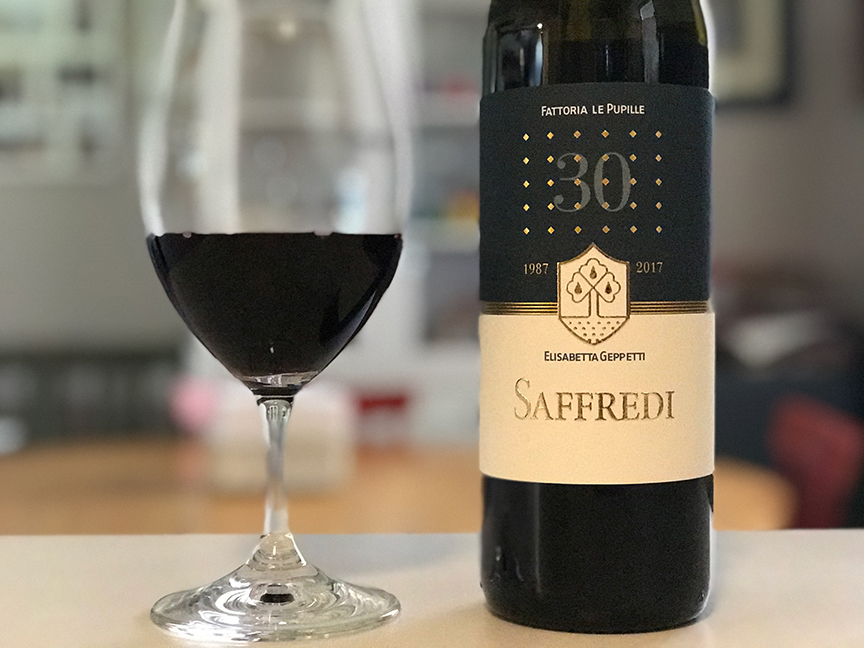
Rethinking the OG Super Tuscans with Clara Gentili of Le Pupille live today at 11 a.m. CST on the @EthicaWines Instagram

Over my years of working in Italian wine, it’s become apparent that there are two questions posed more frequently than any other.

The first is what’s your favorite wine? My standard answer is shared by most of my fellow wine educators: it depends on what I’m eating, where I’m eating it and whom I’m eating it with.

The second is what’s a Super Tuscan? When asked to reflect on this now decades-old conundrum, my ready reply is I can’t tell you what a Super Tuscan is but I know one when I taste it.

Looking back to the early years of the Italian wine renaissance, it’s now clear (at least to me) that when we keepers of the faith railed against the Super Tuscan trend, our issue wasn’t as much with the “aia” wines as it was with the media who championed them.

Part of the problem was that many of us didn’t have the financial means to spend proper time with the wines. For many, the only opportunity to taste them was at walk-around events where we were served just a few ounces. Who could afford to go out to dinner and order a bottle of 1988 Sassicaia back then (or now)? But it was also exacerbated by said writers’ arrogance and, in many cases, their ignorance of a broader picture of Italian wine. Just because you read Italo Calvino in college doesn’t mean that Cesare Pavese wasn’t one of the greatest writers of the 20th century.

One of the things that I’m eager to discuss today on my live Instagram story with Clara Gentili of Fattoria Le Pupille (@EthicaWines today at 11 a.m. CST/12 p.m. EST) is the legacy of the OG Super Tuscans. The ones, like her family’s, that have been around since before the “aia” era. The ones, like her family’s, grown on hillsides. The ones, like her family’s, that aim for elegance and balance, with acidity that will help the wine to age gracefully and make it food friendly at the dinner table. The ones, like her family’s, that taste of the Tuscan garigue even though they are made with international grape varieties.

I hope you can join us.

Webinar May 12: “Open for Business: The Italian Food and Wine Supply Chain.”

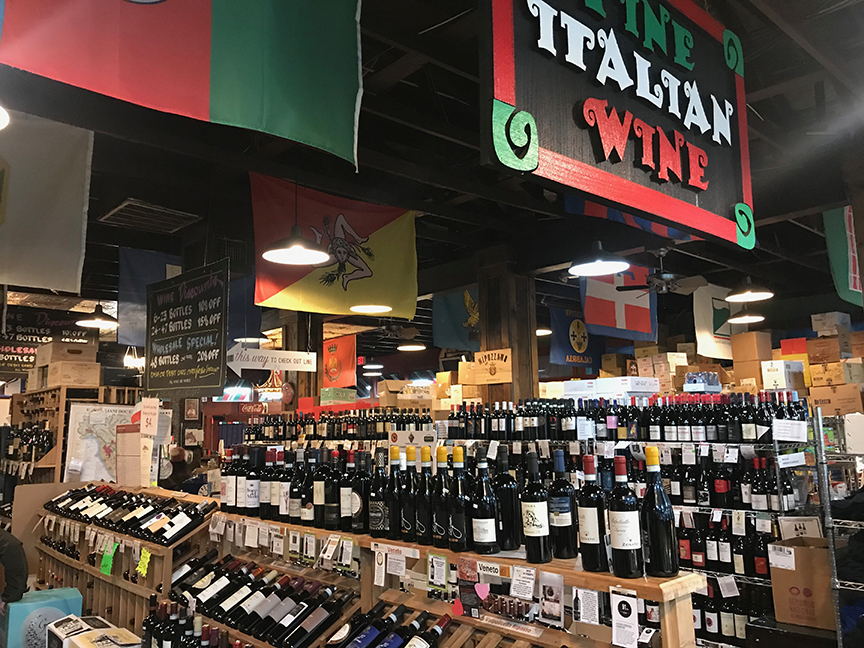
Above: Jimmy’s Food Store in Dallas, an Italian specialty shop. Photo taken in late February.

As businesses in Italy begin to reopen this week, Italian food and wine professionals are looking for new ways to connect with buyers across the U.S. With travel restrictions still in place and consumer confidence low, the challenges of doing business here are greater than ever.

In keeping with its mission to foster business ties between the two countries, the Italy-America Chamber of Commerce has asked me to moderate a series of webinars with leading importers, distributors, and buyers from across the nation.

The first one is scheduled for Tuesday of next week at 10 a.m. EST and it’s open to all (you don’t have to be a chamber member to participate).

I’ll be talking to two east coast importers and a business development specialist from the south (see their bios below).

I’m particularly excited to hear what my good friend Niccolo Lorimer has to say. He’s a top logistics expert and is specialized in clearing wine for trade events, a really interesting (and sweet) guy who always has compelling insights to share.

Please use the link below to register. And please feel free to share. All are welcome.

NEW WEBINAR SERIES: Challenges and Opportunities in the Post-Pandemic Era

A webinar series on how to navigate the challenges and opportunities of the After COVID-19 Era, featuring top food and wine importers, distributors, and buyers from across the U.S.

CLICK HERE TO REGISTER.

EPISODE 1: “Open for Business: The Italian Food and Wine Supply Chain.”

Tuesday, May 12
10 a.m. EST / 4 p.m. CET

With veteran Italian food importer Cecilia Ercolino, global strategist and business development expert Denise Henderson Thomas, and logistics, customs, and importing expert Niccolo Lorimer.
Continue reading

Texas restaurants reopen today and it scares me to hell.

Image via Adobe Stock.

“Let me just say that it is my hope that with the measures that are being put in place that our numbers will not spike… That is my hope.”

Those are the words of our city’s mayor, Sylvester Turner, speaking at a news conference Monday, April 27 following Texas governor Greg Abbott’s announcement that the state would “reopen” today, May 1.

Mayor Turner and Harris County Judge Lina Hidalgo (our city manager) had planned to keep Houston’s “Stay Home/Work Safe” order in place and they had just announced that masks would be mandatory when Abbott decided to supersede all local measures to combat the spread of the deadly virus.

It was the latest volley in Abbott’s ongoing war on local authority in our state. Since coming into office, he has lobbied assiduously to punish cities like Houston and Austin for their status as sanctuary cities and for their progressive policies on reproductive rights.

This week, he took it a step further: now he’s playing with life and death.

In just a few hours, scores of restaurants across Houston will begin opening their doors for “dine-in” service. Abbott has ordered that they can only operate at 25 percent capacity. But beyond that, he’s given no guidance on how restaurateurs can keep their staff and customers safe and how they can curb COVID-19’s spread.

Some in our city are looking to Georgia’s example. The state’s governor, Brian Kemp, issued these guidelines for reopening restaurants last week (Georgia’s restaurants were allowed to reopen on Monday).

But with no official norms or regulations in place, Houston’s restaurant managers are on their own in terms of how they operate and what safety measures they adopt.*

In other words, it’s the wild west when it comes to culinary hygiene. Concerned (however courageous) restaurant-goers have no way of knowing with confidence what safety protocols restaurants owners have put into place, if any.

I understand the economic logic behind reopening. And I recognize that Texas has “flattened the curve.” But on the same day that “Texas reports most deaths in a day from COVID-19” (a story that appears on the landing page of the Houston Chronicle this morning), wouldn’t it be prudent to provide businesses like restaurants — where proper hygiene is always essential for safety — with more robust guidance?

Just like the families of countless wine professionals across our state, ours is struggling to make ends meet in the time of the pandemic. It’s my hope that we’ll all be able to get back to work as soon as possible. But without the proper guidance, Abbot’s order is a genuine gastronomic “go to Hell” to Houston and Austin where local authorities have fought to keep restrictions in place.

Texas reopens today and I am scared as hell for dishwashers, prep cooks, line cooks, waitstaff, sommeliers, and the customers they will serve.

This isn’t political. It’s just common sense.

I encourage you to watch Mayor Turner’s news conference. His remarks moved me to tears when I watched them in real time. He and Judge Hidalgo are true American heroes.

*”‘Reopened services’ shall consist of the following,” wrote Abbott in his decree, listing which businesses could reopen today, including dining establishments: “Dine-in restaurant services, for restaurants that operate at up to 25 percent of the total listed occupancy of the restaurant…”

He specifies that the order only applies to restaurants “that have less than 51 percent of their gross receipts from the sale of alcoholic beverages” and he also prohibits valet parking except for “except for vehicles with placards or plates for disabled parking.”

But there is no mention of masks, gloves, hand-washing, or testing, for example.

In all fairness to our heartless governor, he does offer an overarching recommendation that reopened businesses “should implement social distancing… and practice good hygiene, environmental cleanliness, and sanitation.” But it’s just advice, not an order. “Individuals are encouraged to wear appropriate face coverings,” he writes, “but no jurisdiction can impose a civil or criminal penalty for failure to wear a face covering.”

My first virtual wine dinner was a disaster (and a lot of fun).

Yesterday evening, a Houston-based wine professional and his wife attended their first-ever virtual wine dinner.

Registered guests were asked to pick up their food and bottles curbside between 5-7 p.m. And the event was to begin at 7:30. So far so good.

After plastic bags were discarded and the to-go boxes and bottles were wiped down with sanitizer, hands were washed, the food was plated, and the bottles were opened and poured.

A mix-up with the Zoom link triggered frantic scrambling to get all the participants the correct credentials. By the time it was all sorted out and nearly everyone was online, many — including said wife — had already begun to eat the food because it was just too tempting with all the victuals laid out before them.

The hosts of the event were clearly flustered by the technical snafu and spent the first 10 minutes apologizing as the guests continued to trickle in. And just as one of the couples logged on, their chihuahuas had an outright conniption and erupted into a burst of barking, huffing, and snarling. They — the humans, not the chihuahuas — had neglected to mute their microphone.

But when the first masterfully Berkel-cut slice of Prosciutto di Parma was wrapped around an oozing chunk of burrata and a glasses of Malvasia Puntinata were first drawn to the participants’ lips, the frustrations and craving appetites all melted away like the thin layer of snow that occasionally falls across tropical southeast Texas in winter.

The foibles of Zoom users and the drawbacks of virtual events like these have been widely parsed in the mainstream media. We’re all learning, warts and all, how to connect in the new world where social distancing is the byword to live by. And although Tracie and I have already taken part in countless Zoom sessions for work and private socializing, we’d never been participants in an end-user-focused event like this — with couples we’d never met before.

And we had a blast.

Tracie wore lipstick at dinner (something that doesn’t happen regularly these days). I shaved and donned a nice shirt (as opposed to my regular two-day stubble and ratty around-the-house t-shirt). We got out some of our better dishes and stemware and set our table properly. Even our daughters, ages 6 and 8, seemed to get a sense that last night’s dinner was special (and highly unusual for them, they went to bed straight away after their own dinner without protest — a miracle!). Our chihuahuas were another story all together.

All in all and despite the mishaps, it was a breath of fresh air that disrupted the monotony and monochromy of self-isolation dining. We laughed, we pigged out, we drank a little too much, and we even made some new friends. In the era before the health crisis, I used to attend dinners like this — in person — at least twice a month. It was great to get a taste of what life used to be like. And the experience reminded me of the important role that food and wine play in creating community.

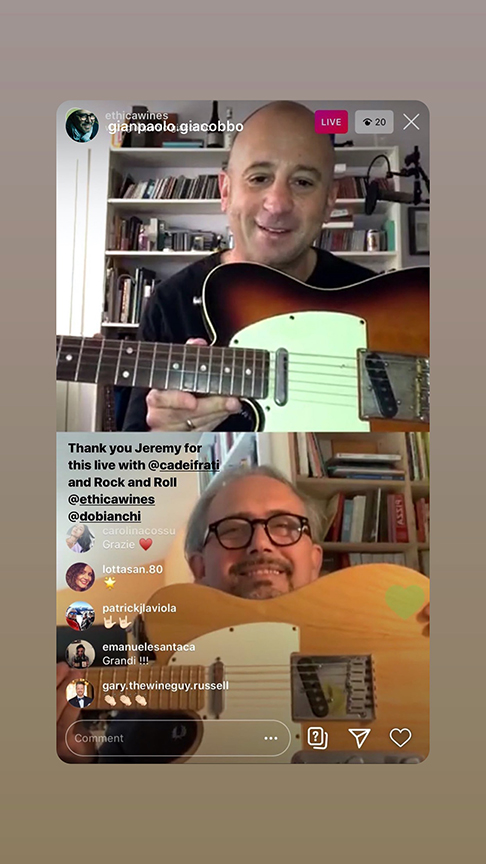
Last night’s dinner was the second virtual wine tasting event I took part in yesterday. Earlier in the day, I tasted some great Lugana with my buddy Gianpaolo Giacobbo via Instagram live stories — I was here in Houston and he in Montebelluna (Treviso province, Veneto). At the end of our chat, we even busted out our dueling telecasters and played an eight-bar blues (below).

It will take years before life in food and wine finds its footing in the new ordinary. I’m looking forward to that day. But in the meantime, I’m reminded of the great line by George Harrison:

The farther one travels
The less one knows
The less one really knows

Arrive without traveling! Stay safe and thanks for being here and supporting Italian wine.

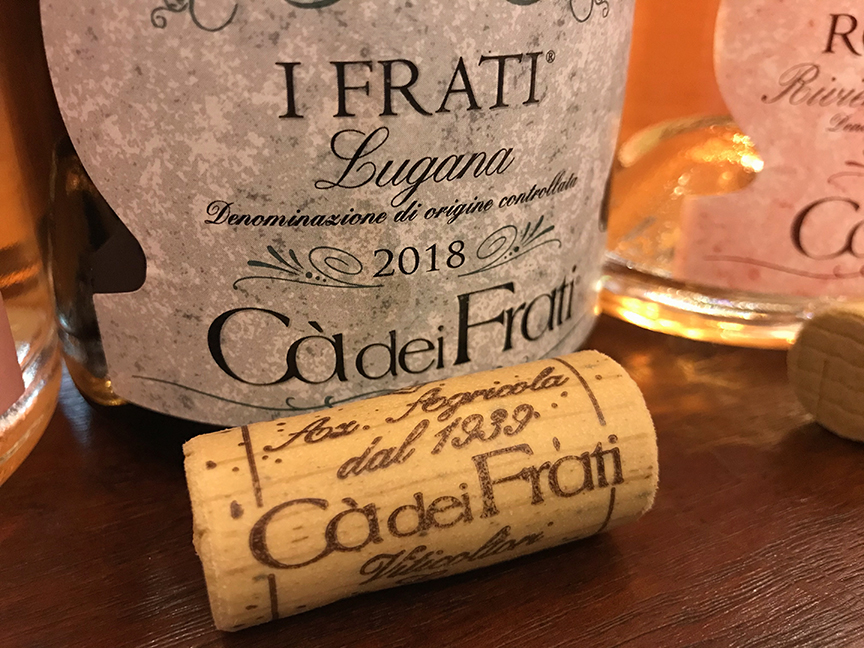
Taste Ca’ dei Frati Lugana with me and Giampi on Instagram live @EthicaWines today at 11 a.m. CST/12 p.m. EST. Please join us!

Above: I visited and tasted at the Ca’ dei Frati winery in January on my last trip to Italy.

Today at 11 a.m. CST/12 p.m. EST I’ll be chatting live with my good friend Gianpaolo Giacobbo on the @EthicaWines Instagram about one of my favorite Veneto winery, Ca’ dei Frati, producer of Lugana.

I’ve been drinking the wines for years with my friends in Franciacorta (one of my buddies is a consulting enologist there) and they’re great.

I’m stoked that they’ll be coming to a town near you soon thanks to the folks at Ethica.

And I’m super geeked to chat with Gianpaolo. We even have big surprise in store for you! I know people are going to like it. Ready, Giampi? Psyched to connect! 

Hope you can join us… Thanks for being here and there.

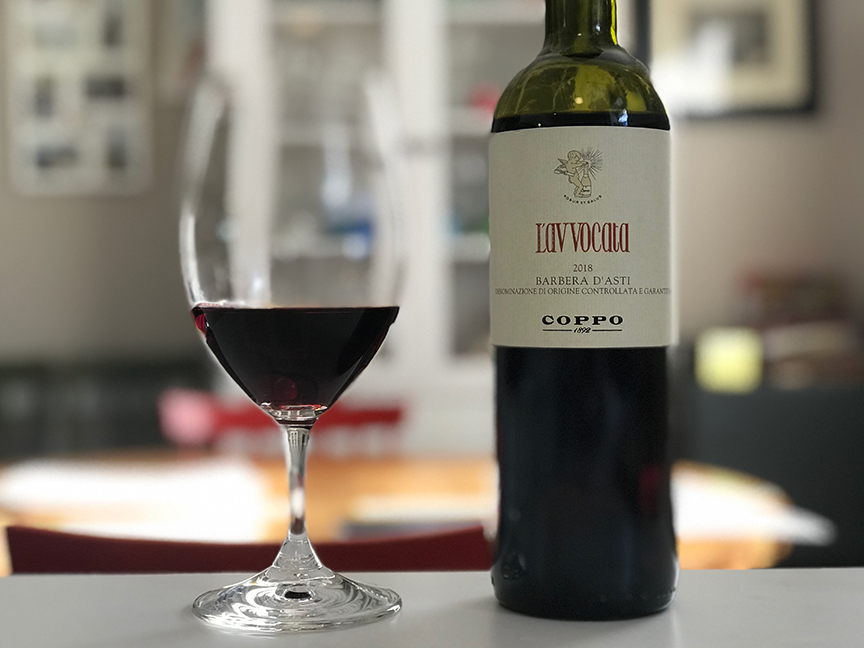
A red wine for my wife thanks to Luigi Coppo’s L’Avvocata.

Like a lot of American wine professionals, we drink mostly white wine at home. Unless we are having meat for a main course or aged cheeses for dessert, its fresh-style white wine we crave.

In recent years, my wife Tracie has stopped drinking red wine altogether, unless it’s something really special or something with some “age on it” as we say in the trade. That’s partly owed to the fact that red wine doesn’t always agree with her. At our house, wine is an essential part of our dinner and the wines we choose are always those that align with our metabolic rhythms. (I believe that one of the most important things we overlook in wine tasting and writing is how does the wine make you feel, during and after the meal? That’s another story for another post.)

But the other night when I opened a bottle of my friend Luigi Coppo’s Barbera d’Asti L’Avvocata (shared with me by the generous folks at Folio Fine Wine Partners), Tracie asked me to pour her a second and even a third glass.

We were both surprised: wines made from Barbera are known for their high acidity and excessive acidity can often be a turn-off for Tracie. Of all the red wines we have in our home cellar, a Barbera d’Asti was the least likely candidate for a wine she would enjoy, we thought.

Although this classic fresh-style, bright, slightly underripe red fruit-driven expression of Barbera d’Asti delivered the acidity that we expected, its balance was so beautiful that it seemed to sing in the glass. I’ve tasted so much Barbera d’Asti over the last couple of years (because I’ve spent so much time teaching in Piedmont for the last four years), including some great ones.

But this one just seemed to have a marcia in più, as the Italians say, an extra gear in the motor. What a wonderful wine! And what a great pairing for the chicken breasts we sautéed and deglazed with white wine that night for ourselves and the girls. The apotheosis of what Barbera can and should be in my view.

I knew and tasted with Luigi’s father Paolo back in the day when I was living and working in the wine trade in New York. And over the last few years, thanks to my Piedmontese sojourns, Luigi (above in his family’s historic cave) has become a good friend.

It seems like a lifetime ago that he and I were sharing dinner in Manhattan, drinking the same wine, back in late February. We even talked about writing some songs together and possibly doing an event in Houston this year.

Man, we miss those times before the pandemic. But Luigi’s wine brought a lot of joy into our lives the other night. The next best thing besides having him here with us and getting to taste it together.

I highly recommend the man and the wine to you.

Check out this recent post by friend Michael Godel, one of the best tasters I know, on a visit to the Coppo winery in late 2019, including Michael’s always spot-on tastings notes.

And thanks again to Folio for hooking us up!

Grande Luigi! Salutami tanto tuo padre. Un abbraccione.