City of Houston declares June 2 “Italian National Day.”

Above from left, Italian Consul General Federico Ciattaglia, Italian MP for North and Central America Fuscia Nissoli, and Houston Councilwoman Mary Nan Huffman.

At yesterday’s celebration of Italian Republic Day (June 2), the City of Houston proclaimed the day “Italian National Day” in the city. The proclamation was delivered on behalf of Mayor Sylvester Turner by Houston Councilwoman Mary Nan Huffman.

Hosted at the beautiful Cohen House on the campus of Rice University, the event included addresses by Ciattaglia, Nissoli, and Huffman, as well as a performance of “Fratelli d’Italia” (“Brothers of Italy”), the Italian national anthem, followed by the “Star Spangled Banner.”

Members of the Italian Air Force, stationed at Sheppard Air Force Base in Wichita Falls, were also in attendance.

In one bittersweet note during the festivities, Italian Consul General Federico Ciattaglia shared the news that his mandate will end this fall and that he will be leaving Houston.

Please consider giving to Unicef’s Ukraine child refugee fund. This link takes you straight to the donation page.

Eating well in Langa/Roero: old school is better than new. My Bra has some cool options.

Today’s post is the second in a series on my favorite places to eat in Bra (Cuneo province, Piedmont) during my seminars at the Slow Food University of Gastronomic Sciences in (my) Bra. The toponym Bra comes from the late Latin braida, meaning a suburban field for farming.

Early in my career in wine, trips to Piedmont revolved around press junkets and visits to high-profile wineries that my clients, generally importers, hired me to write about for their websites and promotional materials. Those visits and tastings were often followed by meals at marquee restaurants.

But my gig teaching at Slow Food U has given me the opportunity to break out on my own and with my friends to discover some of Piedmont’s lower profile but equally delicious dining destinations.

One of those restaurants is the SUPER old school Trattoria Gallinaccia in Bra.

I ate there alone on my first full day and night in town in May when I was there to for my food communications grad seminars.

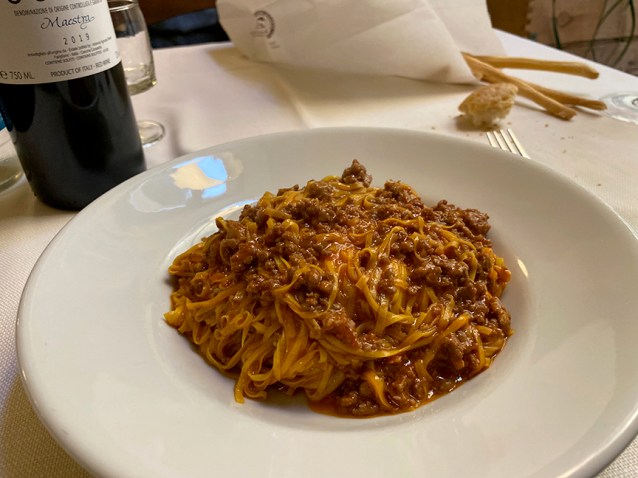
In Piedmont, restaurants like these generally have the same traditional menu, from appetizer to dessert. You won’t find any creative cuisine or colorful interpretations of classic dishes. Gallinaccia is so traditional that they don’t even recommend adding grated Parmigiano Reggiano to their tajarin al ragù (below).

Although not my favorite, Gallinaccia is solid. The staff is friendly. And the interior evokes a between-the-wars ambiance.

I liked it a lot.

One of the coolest things is that the wine prices at places like this are ridiculously low for Americans. I ordered a bottle of Dolcetto because I always start my Piedmont stay with the region’s de rigueur gastronomic wine (a personal tradition of mine).

It wasn’t a night to go “big.” But had it been, I would have gone with the Giacomo Fenocchio 2015 Barolo Bussia for €52. Yes, just €52! Can you imagine what that bottle costs at a restaurant, let alone retail, in California or New York? You can’t even find Fenocchio, one of my all-time favorite Nebbiolo growers, in Texas.

The next night I went to a similarly old school place and did go big… and it was worth every penny. Stay tuned.

Please consider giving to Unicef’s Ukraine child refugee fund. This link takes you straight to the donation page.

What’s so sexy about Moscato d’Asti? Come find out with me in Dallas on June 16.

Image via the Marenco winery Facebook. Marenco will be pouring its single-vineyard Moscato d’Asti for the guided tasting I’ll be leading on June 16 in Dallas. Their Albarossa will be served at the lunch following the seminar.

A few years ago, the Moscato d’Asti Consortium asked me to lead a seminar and tasting of top wines from the appellation here in Houston.

The resulting talk — “What’s so sexy about Moscato d’Asti?” — was so well received that they asked me to give the same presentation earlier this year for another group of Houston wine professionals.

On Thursday, June 16, I’ll be giving the same talk at the legendary Hotel ZaZa in Dallas.

Click here to register for the 11 a.m. event.

Did you know that Moscato d’Asti is one of the world’s few wines made to sparkle using only the grape’s natural sugar?

Did you know that Moscato d’Asti, despite how many perceive the wines, is grown entirely on small, family-owned and run farms?

Did you know that Moscato d’Asti, despite its undeserved reputation, is one of Italy’s most terroir-driven wines?

Every time we put on this seminar, it’s amazing to watch even seasoned tasters be blown away by the diversity and personality of these wines.

The other thing that I love about this seminar is that we talk about how Moscato d’Asti is the one and only Italian wine that has become part of the extra-Italian culinary canon in the southeastern U.S. There is a whole swath of people who drink Moscato d’Asti regularly but remain ignored by the wine trade. We’re going to talk about that, too.

Our tasting will be followed by a lunch where Coppo will be pouring its Nizza Barbera, Marenco will be pouring its Albarossa (attention wine geeks!), and there will even be a Barbaresco among many other top Piedmont wines.

I hope you can join us. And word has it that the Bubbleista might join us. Tracie and the girls will be with me that day as well.

Here’s a Texas Tribune post on how to give to victims’ families in Uvalde. Please consider also giving to Unicef’s Ukraine child refugee fund. This link takes you straight to the donation page.

The unimaginable: prayers for our sisters and brothers in Uvalde.

The Parzen family wishes to offer its heartfelt condolences to all the families of Uvalde who have been affected by yesterday’s unfathomable act of violence.

This morning when I walked our girls to their school, the parents who were dropping off — me included — waited until every one of their kids crossed the building’s threshold. There was a lot of extra hugging and I-love-yous as we all wished our children a good day.

It’s unimaginable to think that there are nineteen families who won’t be picking their kids up today at school… in a community not that far nor not too different from our own.

G-d bless them. We are praying for them and we share their pain, however unimaginable for us.

In future, there will be time to address the insanity of our state’s gun laws.

But today, we pray and we hold our children as tight as we can.

*****

There are moments that the words don’t reach
There is suffering too terrible to name
You hold your child as tight as you can
Then push away the unimaginable

From the song “It’s Quiet Uptown” from the musical “Hamilton.”

All about (my) Bra: were I eat and drink in Slow Food City.

Please consider giving to Unicef’s Ukraine child refugee fund. This link takes you straight to the donation page.

My recent trip to Italy to teach at Slow Food U was a whirlwind. My itinerary and schedule had me on the ground for literally four days. Because the timing was so tight (including a day with two back-to-back three-hour seminars), wine country visits and trips to Piedmont’s many great dining destinations were not possible.

So it was that the small city of Bra, where the Slow Food Movement was founded in 1986, was radius of my culinary exploration.

Because of its association with Slow Food, Bra has some really interesting restaurants (including many chain pilot programs; more on that later). My next series of posts will be devoted to my favorite spots to eat and drink (including destinations from previous visits).

The first question that comes up when you mention the name Bra to an English speaker is does Bra, the toponym, have a relation to bra, the intimate apparel?

No, it does not (obviously).

Bra comes from the late Latin braida meaning a field in a suburban area. It’s relatively common across northern Italy. Some will remember the famous Piazza del Bra in Verona.

Bra in Cuneo province (Piedmont) got its name because it was an agricultural hub in Roman times (as was Verona, for that matter).

Over the seven years of my teaching gig there, one of my favorite first stops has always been Local, the university’s food shop and casual restaurant. It’s expensive, as the students always complain. But the food products there are phenomenally good.

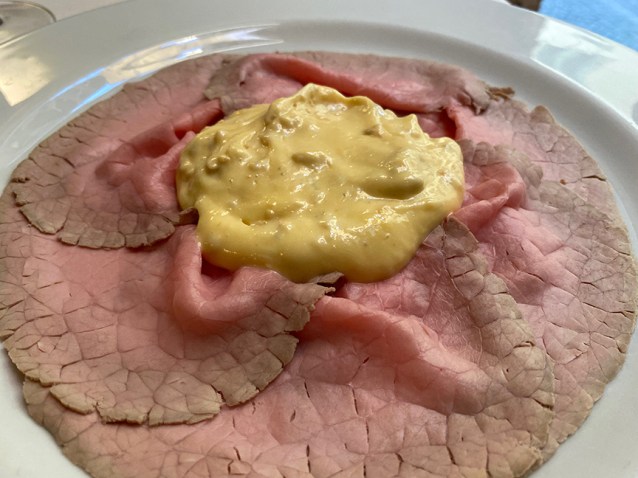
Even though it’s not a regional dish, their porchetta sandwiches are inanely delicious (not always available) and their vitello tonnato is as traditional as it comes. They also do modern and classic interpretations of Bra’s famous veal sausage (more on that later). Our girls loved the cooked salsiccia the year they came with me.

But on this occasion, the classic Piedmontese salt-cured anchovies with salsa verde spoke to me.

Dissertations could be scribed on this mainstay of Piedmontese gastronomy. In many ways, it represents the basic building blocks of the Roero-Langhe-Monferrato culinary cannon. Vitello tonnato couldn’t exist without those anchovies. Nor could bagna cauda.

It was a thrill for this wine blogger to discover that they were serving a new wine from a favorite Dogliani farm, a Riesling from Cascina Corte, an ante litteram naturalist producer.

The bright acidity and intense fruit of the wine was such a fantastic match for the richly salty fishes and the garlic-heavy flat leaf parsley dressing.

And it all really hit the spot for lunch after a long day of travel from Houston.

Stay tuned for more notes on where to eat and drink in Bra…

G-d bless our sisters and brothers in Buffalo. When are we going to stop teaching our children hate?

G-d bless our sisters and brothers in Buffalo.

When are we going to stop teaching our children to hate?

When are we going to realize that racism is so deeply engrained in our society that it leads a young person to shoot people who look different than them?

When are we going to come to terms with the fact that barely veiled racism is all around us, no matter where we live?

Only when we do are we going to break the expanding cycle of racist terror in our country.

G-d bless our sisters and brothers in Buffalo. G-d bless our sisters and brothers in El Paso. G-d bless our sisters and brothers in Pittsburgh.

*****

No one is born hating another person because of the colour of his skin, or his background, or his religion. People must learn to hate, and if they can learn to hate, they can be taught to love, for love comes more naturally to the human heart than its opposite.

Nelson Mandela
Long Walk to Freedom (1994)

Did you see Stanley Tucci at Slow Food U where I teach in Italy? I’m heading back there next week.

Stanley Tucci is one of the few issues that brings division to the Parzen family household.

Tracie loves — LOVES — his show.

I still haven’t forgiven him for mispronouncing timpano in his 1999 breakout hit “Big Night” (ouch).

Scherzi a parte… Joking aside…

Tracie did eventually convince me to watch a few episodes of his “Searching for Italy” show and I genuinely thought it was great.

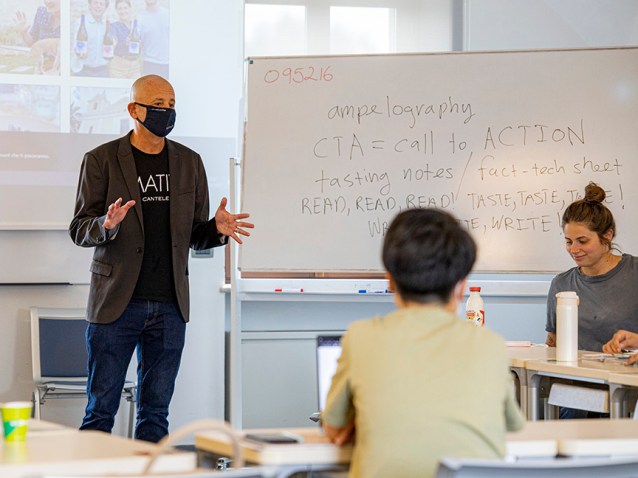
We still haven’t seen the episode where he goes to Piedmont. But we’ve been told that he makes a stop at Slow Food University where I have been teaching in the grad program for the last seven years (above).

I’m so proud of the work I do there (I teach food and wine communications). It meant the world to me that so many people called to say they had seen Pollenzo, the village and campus, on Tucci’s show.

I’ll be there on Monday and will be teaching for the better part of the week. Because Tracie is working full-time now, we need to limit the time I’m away from home. So this is going to be a very short trip. But if you happen to be in the Roero-Langhe area, ping me for sure and we’ll taste something great together (there’s a wonderful natural wine bar and a mostly great old-school Piedmontese in the town where I stay).

In other news…

My editor gave my pitch the green light and if all things go as planned, my Pietro Crescenzi translation and critical apparatus are going to be published by a University of Toronto imprint later this year.

I’m so stoked about this. My heartfelt thanks to all the folks who shared good vibes, encouragement, and wishes. We did it! THANK YOU.

I fly out tomorrow night. Wish me luck, wish me speed. Hit me up if you’re around. See you on the other side…

The Italian wine list has evolved in America. But is Italian wine in danger?

Above: the list and food at Felix Trattoria in Venice, California blew one Italian wine blogger completely away. Wine director Matthew Rogel has created what is possibly the best Italian list in the country right now. Its depth and thoughtfulness are going to be hard to match.

Today it seems hard to believe. But it’s been more than 20 years since Joe Bastianich launched his game-changing all-Italian, high end-heavy wine list at Babbo in the West Village, opened in 1998.

New York-focused Italian wine insiders from that era will also remember that it was right around that same time that Nicola Marzovilla debuted his similarly ambitious list at I Trulli on E. 27th with a southern-centric program.

Of course, the ultimate cognoscenti will also recall the extraordinary cellar put together by Vincenzo Cerbone, and later by his son Anthony (one of the loveliest people in our industry), at Manducatis in Long Island City — “opened on Christmas Day in 1977.” But that was ante litteram and antediluvial.

All three of these lists were a foreshadowing of what was to become a bona fide renaissance of Italian wine throughout the world.

I’m not quite old enough to remember the good old days of the holy tretalogy — Bolla (Soave and Valpolicella), Ricasoli, and Fazi-Battaglia — that once populated the italophile wine lists of America.

But memories of Santa Margherita Pinot Grigio, with its artsy-fartsy label and clear-glass bottle, are yet unhazed in my mind.

It’s incredible to think how refreshingly unsurprising it is today to find a sub-section for “Alto Piemonte-Valle d’Aosta” in the superb program conceived by Matthew Rogel at Felix Trattoria in Venice, California (above). It’s followed by “Roero-Langhe” and not by “Barolo-Barbaresco-Brunello-Super Tuscans” et alia, as one would have unwittingly expected even just a decade ago.

But is Italian wine in America “in danger” as one colleague (a leading player no less) put it to me earlier this month?

Above: a friend treated me to a super bottle last night at the wonderful Ferraro’s Kitchen Restaurant and Wine Bar in North Miami. In terms of its drinking window, that wine was as perfect as it could possibly be. What a bottle! And great menu by chef/owner Igor Ferraro. Even a decade ago, you wouldn’t have expected to find such a gem and such excellent wine service in the U.S. outside of New York.

The presence and marketshare of Italian wine in the U.S. has expanded over the last 20 years, they said, thanks to Italian restaurants here.

But now that the once supremely unencroachable Italian restaurant scene here is now being gently however consistently elbowed by the growing tide of internationally focused concepts, Italian wine is not growing in tandem.

The plain-sight evidence of this? Italian restaurants, for the most part, have Italian-focused programs, they pointed out. But as soon as you stray to something like, say, a high-end and high-concept Korean steakhouse, you’ll be hard pressed to find much beyond France and California. Similarly, casual and formal-dining French concepts hardly even consider Italian wine. Progressive American cuisine? Only the initiated will ever know how much Italian wine appears on the list at the French Laundry.

For Italian wine to meet the challenges of the future, they noted, it needs to find a way to connect with an increasingly fusion-focused international dining crowd. And it needs to reconnect with francophiles who now seem more open to getting oustide their box (perhaps because of prohibitive pricing of the French stuff).

Is natural wine the key? Is sustainable? Is organic? Will it be through programs subsidized by the EU? Will it be thanks to a new generation of new wave of Italian wine lovers? Will it be launched by a new generation of Italian wine professionals? Do we need to mount an intervention with the WSET to inform them that Italian wine isn’t just an afterthought?

My colleague doesn’t have the answer yet. But they’re working on it.

After more than two decades of unparalleled growth for Italian wine, it seems we are at a crossroads. Who’s with me?

Please consider giving to Unicef’s Ukraine child refugee fund. This link takes you straight to the donation page.

Sex in the vineyard: polyculture is the key to the future, says Aleš Kristančič of Movia.

Anyone who’s ever spent a significant time around the legendary grape grower and winemaker Aleš Cristančič (above) knows that he loves to talk about sex and sexuality. (I’ll never forget the time my band played a crazy wild gig at his winery, Movia, below. But that’s another story for another time.)

To some who know him only peripherally, it may seem like a cliché, not uncommon among European and American men of a certain age. But over the years of our interactions, it’s become clear to me that his obsession with sexuality is not just an expression of attenuated or hyperactive masculinity. No, Aleš has plenty of manliness and sexual confidence to go around, even beyond his sensual discourse.

When we spoke a few weeks ago, we discussed his reflections on polyculture vs. monoculture and how he is working to bolster and foster polyculture on his family’s estate in innovative and immensely thoughtful ways.

On my last trip to Italy before the lockdowns in January 2020, my visit and tasting at Movia prompted a powerfully compelling discussion of how the rise in monoculture has begun to homogenize winemaking, even at the highest levels of production.

It’s a conversation that was presaged not so many years ago in an article by Slow Food founder and essayist Carlo Petrini where he bemoaned Piedmontese growers who are grubbing up less lucrative, lesser known grape varieties and replanting their vineyards entirely to more bankable Nebbiolo.

Although they haven’t yet published on the topic, Melissa Muller, a chef turned winemaker, and her husband Fabio Sireci, a legacy grower at Feudo Montoni in Sicily, shared with me a study on their successful experimentations with polyculture, conducted over many years. It’s a work in fieri they explained. But gauging from their preliminary survey, it’s not hard to imagine that many winemakers will read it eagerly.

I recently caught up with Aleš by phone and asked him to expand on some of the observations he shared with me in 2020. That call resulted in a wonderful, if somewhat chaotic, interview published last week by my client Ethica Wines, his U.S. importer.

In our chat, he makes a really profound point about clonal selections. Nurseries may provide you with a genetically perfect clone. But where, he asks, did that clone come from originally? It’s not the result of massal selection in his vineyards, he explains. And so it’s lacking some of the local genetic information that vines acquire through massal selection and decades of growing in the same place. This means that grape farmers around the world are increasingly using the same clones and as a result they are promoting homogeneity and monoculture with adverse effects on the wines’ quality.

He also talks at length about what he calls “passion” in the vineyards. He’s referring to pollination and how the vines and other plants compete for sexual fulfillment. That tension, he believes, especially when well managed through polyculture, is key to creating wines that speak of place, of terroir to borrow a cliché. When stronger clones are introduced to a vineyard with old vines, they tend to hoard the pollen and as a result pollination isn’t equally distributed, as it were. That results in uneven ripening and diminished quality, he contends.

There are some real gems in this wild and crazy piece and I highly recommend it to you. Thanks for checking it out.

Please consider giving to Unicef’s Ukraine child refugee fund. This link takes you straight to the donation page.