Gambero Rosso in San Diego (or What Would Happen if All Tuscans Became Super Tuscans?)

Above: Giovanni Folonari pours his new Super Tuscan, Campo al Mare (Bolgheri) at the Gambero Rosso Tour in San Diego, California.

Does the world really need another Super Tuscan? This question plagued me as I tasted through the wines on display at the Gambero Rosso “Top Italian Wine Roadshow” at the San Diego Wine and Culinary Center in downtown San Diego.

Otherwise useful as a directory of Italian wineries, the Gambero Rosso Guide to the Wines of Italy favors the big “lip-smacking,” luscious wines that seem do sell well in the United States. The three-glass scoring system used in the guide is yet another – however poetically veiled – points-based system, and while the same big-name wines seem to score well year after year in the guide, few small producers and even fewer lower-end wines make it up the ladder.

When I asked how the guide has grown in the 20+ years he’s served as editor-in-chief, Marco Sabellico told me, “the guide hasn’t grown because Italians are making more wines. The guide has grown because Italians are making more higher-end wines.”

It’s not really clear to me how the wines are chosen for the Gambero Rosso “Top Italian Wine Roadshow” (held this year in San Francisco, Los Angeles, and for the first time San Diego). Its “Three Glass” tasting features only those wines that have won the guide’s top award. For the roadshow, it seems that Marina Thompson PR might have something to do with the selection. Marina happens to be Gambero Rosso president Daniele Cernilli’s wife.

What lured me to the event this year was the fact that it was held for the first-time in San Diego, California.

Above: Tim Grace of Il Mulino di Grace, a Chianti Classico producer in the township of Panzano.

I was asked by many presenters to taste this or that “new” Super Tuscan.

Giovanni Folonari had me taste his Campo al Mare, made from Merlot, Cabernet, and Petit Verdot (no Sangiovese). The estate, he told me, lies between Sassicaia and Ornellaia. The wine was well made, not overly woody, and not too high in alcohol. But does the world need yet another Super Tuscan? Maybe it does and since I’m not a fan of Merlot and/or Cabernet Sauvignon in the first place, maybe I should just keep my mouth shut. Giovanni told me it will retail for about $35 and that’s good news, I guess. Maybe the world does need a new reasonably priced Super Tuscan.

I also tasted a Super Tuscan (Gratius) by Mulino di Grace (Panzano, Chianti Classico). The Grace family’s Chianti Classico is a blend of Sangiovese with smaller amounts of Merlot and Cabernet. I kinda liked its Chianti Classico, where the addition of small amounts of international grapes give the wine more color and forward fruit, thus making it more modern in style. But I really liked the Gratius, 100% Sangiovese, a wine that showed the balance of fruit, acidity, and gentler tannin, and the lightness in the mouth that you get with Tuscany’s Sangiovese. To my palate, the Gratius tasted the most like Chianti Classico of all the wines he was pouring (in fact, owner Tim Grace told me, the wine could have been classified as Chianti Classico DOCG).

Some believe that the term Super Tuscan was coined by Nicolas Belfrage and was first used in print in Life Beyond Lambrusco (1985), co-authored by Nicolas and Jancis Robinson. The early Super Tuscans were generally made with international grape varieties and the wines generally saw some time in new wood. Because the wines — most famously, Sassicaia and Tignanello — did not meet standards for any existing appellations at the time they were first released, they were officially classified as vini da tavola or table wines, even though they were marketed as high-end wines.

According to usage, a Super Tuscan is a Tuscan-made wine that 1) does not meet requirements set forth by local appellation laws (in many cases, this is due merely to the fact that a given wine uses grape varieties not allowed by the appellation); or 2) has been intentionally declassified by the producer (as in the case of Tim Grace’ wine). While barrique aging is often used for Super Tuscans, barrique is not a sine qua non.

One of the reasons why the term Super Tuscan helps winemakers to sell wines in the United States is the moniker itself: it just sounds good and it implies that the wines are somehow better, that they surpass the rest of the field. I certainly can’t blame Tim for declassifying his wine. Chianti is a confusing appellation for Americans and if declassification helps him to promote awareness of his wines, more power to him (and his wines are good and deserve attention).

But because the term Super Tuscan is now applied to wines made in Bolgheri (on the Tuscan coast), Chianti Classico, Chianti Rufina, Chianti Colli Fiorentini (and other subzones), Montalcino, Montecucco, Montepulciano… and the list goes on… it has became a de facto über-classification that eclipses the personality of those places and the character of the persons who make those wines.

Tuscans are a highly diverse group of people and their language, their food, their traditions, and their wines change from city to city, town to town, from village to village (and from principality to principality, we would have said in another age). Just ask a Florentine what s/he thinks of the Pisans and you’ll see what I mean (and I won’t repeat the colloquial adage nor the often quoted line from Dante here). I’ve traveled extensively in Tuscany and have spent many hours in its libraries, its trattorie, and wineries. I would certainly be disappointed if the Tuscans, like their wines, all became Super Tuscans.

NOUS NON PLUS SLOVENIA DATES ANNOUNCED

Above: do you think Slovenia can handle Céline Dijon and Nous Non Plus?
(click the image to see the full-sized flyer)

Please excuse the shameless self-promotion…

Allo Allo –

A quick update on upcoming Nous Non Plus shows…

The NYC show on Sat March 22 has been changed to 11pm from midnight.
This means more time for drinking and french kissing afterwards.

Slovenia public shows will be April 9 and 10 in “secret locations” to be announced shortly. For all of you traveling to Slovenia in April, please stay tuned. We hear one show may involve playing on a stage that covers two countries.

In sum:

MARCH 22
NYC
CLUB MIDWAY

25 Avenue B, New York, NY
(Between 2nd and 3rd st.)
NNP @ 11pm
$6

APRIL 9 & 10
SLOVENIA!

Venues to be announced

Impossible n’est pas français.

I’m Drinking What He’s Pouring (or This Ain’t Circe’s Wine)

Above: despite his modesty, wine writer David Lynch is no second-string sommelier (center, with enologist Antigoni Karamvali and marketing director Valerie Tsakiris of Boutari).

It seems that Greek wines are in the air: Eric included a wine from Santorini in a post and column this week and I recently learned that the 2008 Food & Wine Classic in Aspen will include a seminar on Greek wine led by David Lynch — wine writer, top-flight sommelier, and all-around good guy.

Week before last, David and I attended a tasting of wines by Boutari (whose website is written entirely in Greek). Besides Boutari’s winemaker and marketing director, we were also joined by Mitch Frank of The Wine Spectator, a former political writer (whose insights into the current campaign were fascinating).

David likes to joke that he’s a “J[unior] V[arsity]” member among NYC’s top sommeliers but, let me tell you, this guy really knows his stuff: few can rival his knowledge of Italian wine and he’s tasted and poured with the best of them.

“95% of the value of a wine in a restaurant,” he said, “is the serving temperature and the stemware. Serve a $35 bottle of wine at the right temperature and in the right glass, and it’s worth twice that much.”

Above: of the whites, I really liked the Moscofilero (left) but the Santorini (center) blew me away.

While the higher-end blends of native Greek varieties and Bordeaux grapes were international in style and heavy on the wood, the lower-end bottlings were fresh, clean, and delightful. The Moschofilero (white) was distinctive, slightly musky, and delicious with grilled octopus and I really liked the Santorini, made from Assyrtiko grapes, a white with balanced mineral and fruit flavors.

As Eric mentions in his post, the vineyards on the volcanic island of Santorini are a sight to behold (I’ve never been but have seen photographs): the vines are trained in “bushes” (or baskets, as enologist Antigoni Karamvali called them). Bush training helps to protect the vines from strong winds (the same training methods are used in Sicily and Apulia). The bush training also allows the vine to “migrate”: Antigoni showed me images of vineyards originally planted in perfectly straight rows, where the vines had crept — at slightly different rates — to more humid parts of the vineyard. Drinking this wine, you really get that sense of place, that sensation that this wine could have been made no were else in the world.

The wine that surprised me the most, however, was the Nemea (a place name), made from 100% Aghiorghitiko (also known as Agiorgitiko) grapes: the wine was light in color and in the mouth, with wonderful red berry flavor, a perfect wine to serve slightly chilled on a summer’s eve with filleted branzino (otherwise known as Mediterranean sea bass). From what I understood, the price-point for this wine should weigh in under $20.

This was no wine of Circe.* And, hey, if David is pouring, I’m drinking.

In other news…

Thanks to everyone for the messages and positive vibes for VinoWire, which launched this week with a scoop about the changing of the guard at the Bruno Giacosa winery. I am proud to report that VinoWire was the first publication — Italian or English — to to break the story and to reveal the name of the new winemaker. Stay tuned to VinoWire for more…

* For [the painting] “The Wine of Circe” by Edward Burne Jones.

Dusk-haired and gold-robed o’er the golden wine
She stoops, wherein, distilled of death and shame,
Sink the black drops; while, lit with fragrant flame,
Round her spread board the golden sunflowers shine.

Doth Helio here with Hecatè combine
(O Circe, thou their votaress!) to proclaim
For these thy guests all rapture in Love’s name,
Till pitiless Night give Day the countersign?

Lords of their hour, they come. And by her knee
Those cowering beasts, their equals heretofore,
Wait; who with them in new equality
To-night shall echo back the sea’s dull roar
With a vain wail from passion’s tide-strown shore

Where the disheveled seaweed hates the sea.

— Dante Gabriel Rossetti

VinoWire, news from the world of Italian wine

It took a little bit longer than we had expected but Franco Ziliani and I have finally launched our new project, VinoWire.com, a “news wire” devoted to the world of Italian wine (click on the image above to view).

Franco (left) is one of Italy’s leading wine writers and one of its most respected wine critics. Those of you who read my blog know I consider his blog, Vino al Vino, the best source for cutting-edge Italian wine news (in Italian) undiluted by the Italian wine industry’s PR machine.

Vino al Vino takes its name from the Italian proverb, vino al vino, pane al pane, call wine wine, call bread bread. Franco is not afraid to call a spade a spade and his blog is at once informative, enlightening, and entertaining — and often controversial (as Italophones can gather from reading his comment threads).

Call it another one of my Quixotic adventures: Franco and I hope to fill a gap that we perceived in the English-speaking world by creating an unmitigated transatlantic news source (see our press release below).

Please have a look, send it to your friends, and add it to your blogrolls… Thanks!

For Immediate Release

Tuesday, March 4, 2008

VinoWire.com goes live.

Esteemed Italian journalist and wine critic Franco Ziliani and American writer, blogger, and translator Jeremy Parzen, Ph.D., announced the launch of VinoWire (www.VinoWire.com) today, a news wire devoted to Italian wine. VinoWire, conceived by Ziliani and Parzen, provides a “wire service” feed of current news and events from the world of Italian wine.

“Italian wine is now the number one imported category to America,” said Parzen, “and while North American and British editors do devote attention to Italian wine and food, relatively little news coverage reaches the English-speaking world directly from Italy. VinoWire’s primary goal is to offer English-speaking wine lovers an unbiased, direct, timely, and journalistic source of information on Italian wine, the people who produce it, and the places where it is made.”

What began as a trans-Atlantic virtual conversation between Italian wine writer and pundit Ziliani and food and wine historian and Italian translator Parzen has evolved into an online editorial collaboration, providing unfiltered, balanced news direct from Italy’s base of media and wine professionals.

“The goal is that of creating something different, a confluence of news, ideas, comments, recommendations, tasting notes, opinions, and much more – a site that helps wine enthusiasts around the world to come into contact with Italian wine, to understand it better and appreciate it even more,” said Ziliani. “We hope to open the eyes of American readers who wish to reach beyond the official vulgate of popular magazines with their glossy photographs.”

“Regrettably,” noted the VinoWire creators on their site, “much of the news that makes the crossing to North American loses something in translation: As a twentieth-century Italian poet once said, there is no greater misunderstanding than the Atlantic Ocean.”

In addition to VinoWire’s weekly coverage of Italian wine-related breaking news and events, it will include feature-length editorial addressing a broad range of issues, points-free tasting notes and guest opinion editorial by additional journalists.

VinoWire is hosted by Simplicissimus Blog Farm and was designed by Lorenzo Giuggiolini.

For more information about Franco Ziliani, click here.

For more information about Jeremy Parzen, Ph.D.: click here.

www.VinoWire.com

You’ve come a long way, baby.

“Americans have had a long-standing love affair with the cuisine of Italy,” write Nina and Tim Zagat in the preface to Zagat’s America’s 1,000 Top Italian Restaurants. “Americans say that they prefer Italian food to any other type of food — even American food — in survey after survey.”

Leafing through the new guide, I was impressed by the radical transformation of Americans’ perceptions of Italian food and how they have changed over the last ten years. When I finished my doctorate in Italian in 1997 in Los Angeles and moved to NYC, people still thought of Italian cuisine as “northern” or “southern” (the former being preferable at the time) and few Americans could tell you the difference between gnocchi and cavatelli.

The appearance of the Zagat’s national Italian restaurant directory comes ten years after The New York Times published two articles that — in my opinion — marked the dawn of a new era in Americans’ perceptions of Italian cuisine.

One was Ruth Reichl’s 3-star review of Babbo, “A Radical Departure With Sure Footing” (August 26, 1998), where she anointed Mario Batali as the new prince of Italian cuisine in the U.S. (Just two months earlier, on June 26, she had written of Mario’s previous effort: “I should probably start by telling you that I am not a big fan of Po. So when I heard that Mario Batali, its chef and owner, had taken over the old Coach House on Waverly Place in Greenwich Village…, I was not particularly impressed.”) At the time, 3 stars from The Times for an Italian restaurant were practically inconceivable.

The other was Amanda Hesser’s “A Southern Italian Renaissance; After red sauce, America is discovering the real thing” (October 21, 1998). Albeit not the first but certainly one of the earliest fans of genuine southern Italian food, Amanda wrote convincingly that southern Italian cuisine deserved the epicure’s attention. Her interest in Salvatore Anzalone’s Sicilian restaurant, Caffè Bondi, and Nicola Marzovilla’s Apulian, I Trulli, showed readers that serious food writers (and restaurateurs) were taking southern Italy seriously. Regional Italian cuisine had arrived.

“In the past,” write Nina and Tim, “Italian restaurants in America described themselves as either Northern or Southern, but in recent years more and more Italian chefs have proudly emphasized their regional roots. Thus, Americans are coming to understand the distinct tastes of the many regions of Italy.” [There are 20 regions of Italy, btw.]

The Zagats were among the pioneers of “user-generated content” and the success of their guides is testament to their vision. The downside is that the user-generated reviews are not always reliable. The 2008 Zagat NYC restaurant guide named Babbo — surprise, surprise — the city’s top Italian restaurant. Number 2 was Il Mulino, one of the city’s worst tourist traps and most disappointing landmark restaurants: last year, I had what was possibly the worst and most expensive (adding insult to injury) meals of my life there.

America’s 1,000 Top Italian Restaurants wisely omits a top-5 listing and it includes a useful (however poorly translated) primer to Italian food and wine and regional Italian cuisine.

Whatever your favorite Italian restaurant or regional cuisine, one thing’s for certain: North America’s taste for Italian food has come a long way.

Analog Wine in a Digital Age

Above: a vintage Neve “mic pre,” one of the microphone pre-amps developed in the 1960s that shaped the sounds of the recordings made then. I guarantee you that some of your favorite recordings were made using this technology (click on the image to read more about Neve consoles and mic-pres).

I really liked this post by Dave Buchanan, author of Wine Opener, where he writes about European winemakers who are pushing the envelope “in terms of getting their grapes ripe enough and using questionable winemaking techniques to produce wines that will mimic and sell as well as the full-throttle big reds first made popular in California”:

    That’s bad news to those of us who still seek those analog wines somehow surviving in a continually more digital world. We want wines that speak of their vineyards and their traditions, not of technological innovations designed to make them not simply drinkable but (more importantly to the winemaker) commercially successful.

The digital/analog analogy resonates with me: it reminds me of my experience in the recording studio with my high-school friend, über-producer and vintage-gear nut Mike Andrews, who taught me how to “record digitally” using “analog ears” when he produced a record I co-wrote and played on a few years ago (with a band I am a “former member of”). In the mid-1990s, producers and recording engineers began using digital technology in new ways to capture analog sounds. Mike was one of the trailblazers and he and the new generation of “analog ear” recording artists rallied around TapeOp magazine, published by my friend and gourmet John Bacigaluppi.

The post also made me think of something Jean-Georges’ wine director Bernard Sun said to me the other day when he had me taste a wine that he is making in California, III Somms, a Cabernet Franc-based blend that surprised with great balance, low alcohol, nice acidity, and even-handed fruit (Bernie, who is one of the nicest people you’ll meet in the wine trade, created the wine with two other sommeliers, hence the name, and he pours this food-friendly wine by the glass in the Jean-Georges group restaurants). “With all the wine trickery out there today,” Bernie said, “there’s no excuse to make an imbalanced wine.” He’s right: while so many are using “questionable wineamaking techniques,” as Dave points out, to make “full-throttle big reds,” they could be harnessing technology to make more balanced wine.

The records made during the golden age of recording — 1950s, 1960s, and 1970s — continue to shape the way music is recorded today. Recording and mixing music is a lot like making wine: it’s all about taste, texture, and balance. A glass of 1961 Giacomo Conterno Monfortino as we listen to that last take, anyone?

The Squires Paradox

Unfortunately your registration at Mark Squires’ Bulletin Board on eRobertParker.com did not meet our membership requirements. Therefore your registration was deleted. Sorry, Mark Squires’ Bulletin Board on eRobertParker.com team.

The above message was sent to me the other day, about four hours after I tried to register for the Mark Squires’ Bulletin Board. I didn’t really want to join the Mark Squires’ Bulletin Board. After all, Squires doesn’t seem to like the natural-wine-loving kind. He already booted two of my favorite wine bloggers, Alice and Lyle. I only wanted to read a post by Mark Fornatale, who works for Skurnik (an importer). He had written about recent managerial changes at one of my favorite wineries, Borgogno: the prince of modern-style Barbaresco, Giorgio Rivetti of La Spinetta, he reported, would be revising vinification practices at the winery. I had been alerted to the post by Franco, who, upon reading Mark’s report, promptly contacted Borgogno’s new owner, Oscar Farinetti, and asked him point-blank if he would allow Giorgio to modify the style. Oscar answered via SMS (entrepreneur Farinetti is the creator of Eataly in Turin):

    Borgogno has no need for any changes in the cellar. As far as Rivetti is concerned, he will play no internal role. He will give us a hand with exports. The following is Borgogno’s corporate strategy: no change in the cellar or in winemaking [and] elimination of wines not internally produce… Borgogno will continue to produce [its wines] using the classic method. (translation mine, see the Franco’s post in Italian with quote from Squires BB in English).

Thank goodness Franco was able to clear things up: to lose Borgogno to the realm of homogeneous modern-style wine would be a tragedy.

Groucho Marx
(above, left) once said famously, “I refuse to join any club that would have me as a member.” Squires would not have me as a member so I guess I can’t refuse membership. But why did Squires refuse me membership? On paper I met all the “requirements.” Did he see Alice and Lyle on my blog roll? did he visit DoBianchi.com and browse disapprovingly through my blog? (You can’t register with a gmail account so I used my dobianchi.com email.)

I wonder what the great logician Bertrand Russell (left), discoverer of “Russell’s paradox”, would have said about Groucho’s paradox. Russell recognized that self-reference “lies at the heart of paradox.” Groucho’s self-referential line is a not-so classic but very funny example of Russell’s paradox: “I refuse to join the set that would have me as a member of that set,” Russell might have joked. I would have liked to join the club of bloggers who had joined Squires BB and then were booted. But Squires wouldn’t even let me on in the first place. I guess I’ll never know what I’m missing. But who can see the logic in that? Sorry, Mark Squires.
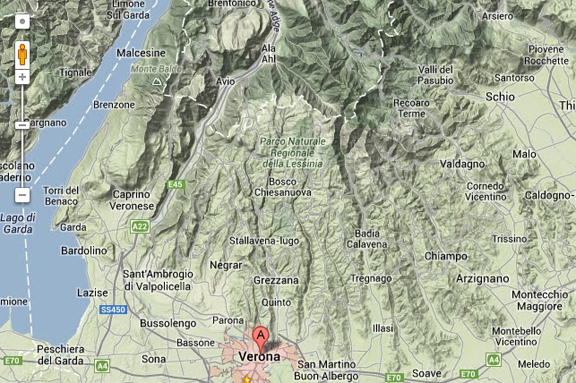
There may be many wine cellars in Valpolicella but…

valpolicella map vineyards crus

Above: Google’s “terrain” map shows the “wrinkles” of Valpolicella. The topography of the Valpolicella or “valley of alluvial deposits” is defined by a series of small rivers.

From the Greek topos or place and onoma or name, toponymy is the study of place names.

As is the case with many wine-related place names, the names themselves reflect the vine-growing practices of the place. One of my favorites is the Côte-Rôtie or the roasted slope, so-called because the slopes are “roasted” by the sun and there are countless others.

While many erroneously claim that the toponym Valpolicella comes from a hitherto undocumented Greek term for valley of many cellars, it is widely accepted that the name first appeared in the twelfth century (in a decree by Frederic I of Swabia, aka Barbarossa or Red Beard) and by the sixteenth century was widely found in Latin inscriptions as Vallis pulicellae, literally the valley of sand deposits, from the Latin pulla, a term used in classical Latin to denote to dark soil and then later to denote alluvial deposits.

In fact, Valpolicella is not a valley but rather a series of “wrinkles” defined by the Marano, Negrar, Fumane, and Nòvare torrents (streams).

If you’ve ever traveled through that part of Italy, you’ve seen how the hills roll gently across the landscape. There are other Veronese place names that reflect this tradition, like the towns Pol, Pol di Sopra, and Santa Lucia di Pol where pol denotes the presence of a stream or torrent and the pebbly, sandy deposits it forms.

There are some who point to the lass or pulzella portrayed in the device (emblem) of the town of San Pietro in Cariano as the origin of the name. But this theory seems as unlikely to me as the oft-repeated valley of many cellars (another facile faux ami or false cognate).

Valpolicella’s wines were praised highly by Latin authors, notably Virgil and Cassiodorus. Etruscan and proto-Roman winemakers recognized early on that Valpolicella’s undulating landscape was ideal for growing wine grapes.

As Virgil wrote famously, Bacchus amat colles, Bacchus loves hills.

An Auspicious Year for Amarone

Above: the Masi tasting last week featured Campolongo di Torbe 1988 and 1983, top vintages for Amarone.

Dr. Sandro Boscaini (left, owner of Masi) paid a visit to New York City last week to celebrate the 50th Anniversary of his winery’s single-vineyard Amarone, Campolongo di Torbe, a bottling believed by many to be the first Amarone cru.

Amarone della Valpolicella and Recioto della Valpolicella are unique appellations in the panorama of Italian enology and they arguably represent its most misunderstood. They are made from blends of dried Corvina, Rondinella, and Molinara grapes grown in Valpolicella in the province of Verona (Corvina is the primary grape and other grapes, including international varieties, are allowed by the appellation). Although vinification practices vary significantly, fermentation is stopped sooner in the case of Recioto, resulting in a sweeter flavor profile; longer fermentation creates a drier flavor profile for Amarone. Sometimes winemakers use a process called ripasso, literally “second passage,” whereby the wine is aged with the skins and lees (dead yeast cells) leftover from previously vinified wine.

Masi’s wines are made in a modern style (as Dr. Boscaini is proud to point out) and the oaky flavors of the younger wines are a big turn off for me (we tasted a horizontal of the winery’s four 2001 crus and a vertical of the Campolongo di Torbe). The 1983 and 1988 — outstanding vintages for Amarone — were however fantastic and the 1988 in particular was stellar. Boscaini noted that 2007 will be a great vintage for these wines and will rival 97, 88, and 83.

But the 2001 Vaio Armarone was a pleasant surprise: this wine, made in collaboration with the Serego Alighieri winery, is aged in cherry-wood casks, and even at a young age, showed beautiful natural fruit. It stood out against the other young wines and weighed in at a slightly lower price point ($75 retail). Serego Alighieri — pronounced seh-REH-goh AH-lee-GHEE’eh-ree — was purportedly founded by Dante’s son Pietro Alighieri in the mid-fourteenth century: following his exile from Florence, Dante Alighieri (left) found his “first refuge” in Verona and his son ultimately settled there. (See Purgatorio, XVII, 70. Check out the awesome Princeton Dante Project to read the line in context — in Italian and translation — and commentary.)

Dr. Boscaini — “Mr. Amarone,” as he likes to call himself — spoke at length about his family’s decision to “modernize” the winery in 1983 (the same year that Veronelli implored Italian winemakers to revisit their growing and vinification practices; see my post on Veronelli). He sought to eliminate “oxidation” and “unpleasant aromas” in his family’s wines, Boscaini told the group of journalists who had gathered to taste the wines. In doing so, he claimed, he single-handedly created a market for Amarone in the U.S. (an assertion we should take cum grano salis since it was a combination of modernization, more aggressive marketing, and renewed interest in Italian wine that opened a new market for Amarone in the U.S.).

I found his lecture fascinating and he made a number of points I found interesting and topical to understanding Amarone in a historical perspective:

  • Recioto, Recioto Amarone, and Amarone are names for a wine that has always been made, he believes, in a dry and sweet style (many believe that Amarone was vinified as a dry wine for the first time in the twentieth century);
  • botrytis or noble rot, he claimed, is a key element in Amarone and gives it an “illusion of sweetness” (many would counter this claim; he showed data to support it but it wasn’t clear how the information was gathered);
  • only Corvina, Rondinella, and Molinara should be used to make Amarone, he said (others would say that true Amarone is made from “field blends,” i.e., where Corvina, Rondinella, and Molinara are the primary grapes but others are used — sometimes even unspecified and/or grapes growing spontaneously in the vineyard);
  • the term Recioto probably comes from the Latin name for wine produced in Valpolicella, reticum, rather than the commonly accepted recia, Veronese dialect for “ear” or “top bunch” of grapes (I believe he’s right: recioto could very well be a metathesis of reticum);
  • the term Amarone could come from Armaron, a toponym, name of one of the appellation’s oldest growing sites (if this were true, it would indeed bolster his thesis that the wines were always made in a dry style since it would weaken the theory that the wine is called amarone — a linguistic combination of amaro or “bitter” and the augmentative suffix -one — due to the fact that it is dry as opposed to sweet);
  • one of the earliest appearances of the term Amarone on a label was on Masi’s 1948 Recioto Amarone (although he acknowledged that the term appeared as early as the 1930s on bottles produced by the Cantina Sociale Valpolicella).
  • I certainly couldn’t drink Masi’s wines every day: they’re too modern in style for my palate. No matter what the price point (and these wines are expensive), I want to drink something more food friendly (he claimed exactly the opposite: because they are made in a “contemporary style,” he said, his wines are more food friendly). But the wines are very elegant and I can see they can appeal to the modern-style lover while retaining a sense of place.

    If you’ve read this far, then you, too, would have enjoyed Mr. Amarone’s prolixity. I’ll taste his wines with him — however modern they may be — anytime.

    Have you ever been? A glass (or two) in the West Village.

    A friend and I met for a few glasses of wine the other night at The 8th St Wine Cellar, in the heart of the West Village, right down the street from Electric Lady Studio, conceived and created in 1970 by Jimi Hendrix (left), perhaps the first major recording artist to own a studio in the modern era of rock ‘n’ roll. Every time I walk down 8th st., I can’t help but think of the countless classic recordings that were made on this historic block, now lined with head shops and tattoo and piercing parlors (check out the clients page on the studio’s website).

    Even after all these years, the West Village has retained its free spirit and the sense of openness that began to form here in the late 1950s and early 60s. The easy-going bartenders at The 8th St. Wine Cellar were friendly and generous with their pours and when I ordered a glass of Antichi Vigneti di Cantalupo 2006 Agamium, our waiter said he didn’t mind at all opening a new bottle for me.

    Above: bacon-wrapped figs with mascarpone with a glass of Agamium.

    Antichi Vigneti di Cantalupo (Ancient Vines of Cantalupo) is one of my favorite producers of Nebbiolo and it makes a fairly wide range of traditional-style wines, from their single-vineyard Collis Carellae and Collis Breclemae to the Agamium, their entry-level label. One of the things I love about Cantalupo is the winery’s interest in local ancient history, which expresses itself in the names of their wines: Agamium is the Latin name of Ghemme (a township in the province of Novara) where the grapes are grown and the wines are produced. Ghemme is one of the great, to borrow a Manhattan-centric phrase, “outer-borough” expressions of Nebbiolo (i.e., Nebbiolo grown outside the more noted Barolo and Barbaresco appellations; look for an upcoming post on the historical role of “outer-borough” Nebbiolo).

    The 2006 Agamium was fresh and light in style and I believe that the winery limits maceration time in order to rein in the grape’s tannin, thus making it more approachable at such a young age. Check out the winery’s website. Although the English translations are sometimes awkward, the otherwise excellent site is easy to navigate and highly informative.

    Above: 1480 – 1819 were the start and end dates of the Inquisition, one of the waiters told me. I inferred that his t-shirt’s message was meant to remind us that the Inquisition is indeed over. (For the record, I’m not really sure what information those dates are based on because it’s generally accepted that the official dates of the Spanish Inquisition were 1478 – 1834. A quick Google search revealed that the t-shirts was created by Humanitarians Not Heroes.)

    I really liked the vibe at The 8th St. Wine Cellar and I guess I shouldn’t have been surprised to find a handful of wines that I liked on their relatively small list, including a half bottle of NV Taittinger La Française and Teodobaldo Cappellano Barolo. Honestly, I didn’t expect to find a cool little wine bar on 8th St. between Gray’s Papaya and the bong and tattoo shops. I guess it’s time for me to “cast all my hang-ups over the seaside,” as Jimi once sang (in a song he recorded right down the street).

    The 8th St Wine Cellar
    28 W 8th St
    (btwn 5th and 6th ave)
    New York, NY 10011
    (212) 260-9463

    *****

    Have you ever been (have you ever been) to Electric Ladyland?
    The magic carpet waits for you so don’t you be late
    Oh, (I wanna show you) the different emotions
    (I wanna run to) the sounds and motions
    Electric woman waits for you and me
    So it’s time we take a ride, we can cast all of your hang-ups over
    the seaside
    While we fly right over the love filled sea
    Look up ahead, I see the loveland, soon you’ll understand.

    Make love, make love, make love, make love.

    The angels will spread their wings, spread their wings
    Good and evil lay side by side while electric love penetrates the sky
    Lord, Lord I wanna show you
    Hmm, hmmm, hmmm
    Show you

    — Jimi Hendrix