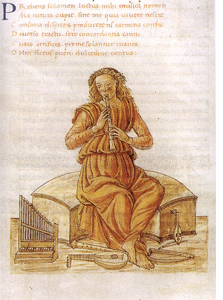
 Yesterday on the Twitter, Alfonso asked me about the origins of the enonym Sangiovese. (I bet you’re wondering about the significance of the “allegory of music” from an illuminated Renaissance manuscript to the left but more on that below.)
First off, in all of my readings, I have found no one and nowhere that point to sangue di Giove (blood of Jupiter [Zeus]) as a philologically tenable origin of the grape name. This is what philologists call a folkloric etymology, most likely due to the quasi-homonymic (and Romantic) rapport between the enonym and purported etymon (the literal sense of a word according to its origin). While divine blood plays a central role in Christian myth and liturgy (another element that most likely contributes to the folkloric etymology), it is not found in the Roman or Italian cults that honored Jupiter during the vinaliae (wine festivals) of late antiquity. (For the record, blood does play a role in the myth of Zeus, when the “blood from the birth of Zeus begins to boil up” in a “sacred cave of bees… said to be found on Crete.” See this profile of Rhea, who gave birth to the deity.)
Most scholars believe the most plausible etymon to be sangiovannina, a term which denotes an early ripening grape in the dialect of Sarzana, a township that lies on the border of Liguria and Tuscany in northwestern Tuscany. (Hohnerleien-Buchinger, 1996, cited in Vitigni d’Italia, eds. A. Scienza et alia).
 It’s also possible that Sangiovese comes from sangiovannese, an ethnonym denoting an inhabitant of San Giovanni Valdarno, a town in the province of Arezzo. (I actually think this is the most likely answer to the conundrum; here’s a link to the Sangiovannese soccer team website.)
Others yet point to the etymon jugalis (Latin yoke), giogo in Italian, possibly derived from a vine training system. (There is a precedent in the enonym Schiava but I believe this an unlikely linguistic kinship.)
In my research last night (conducted in the golden hour, when the day’s toil is through, and Tracie P and I relax before dinner), I came across a wonderful journal devoted to Romagnolo (the dialect of Romagna). It’s called Ludla (click to download the edition I found), or spark in Romagnolo. In it, I found an article on the origin of Sanzves, the Romagnolo inflection of Sangiovese. Here’s where it gets really interesting…
It’s important to remember that the enonym appears for the first time in Tuscany in the 16th century as Sangiogheto (Soderini, 1590) and today, most ampelographers concur that Sangiovgheto or Sangioveto are geographically aligned with Tuscany while Sangiovese is more closely related to Romagna (on the other side of the Apennines).
The author of the Ludla article proposes that Sanzves might be derived (however remotely) from Mons Jovis, a site near the town of Savignano (where the Romagnoli believe the grape to have originated, another possible linguistic kinship), today known as Giovedìa, where Jupiter (Giove, in Italian) was worshiped in late antiquity.
The bottom line? It’s very likely that we will never know the true origin of the enonym. But that’s not important.
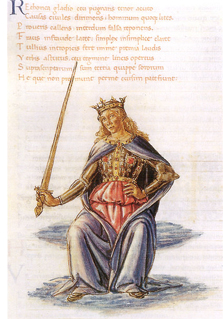
The images that adorn this post (allegories of musica and rehtorica) are culled from a Renaissance codex of De Nuptiis Philologiae et Mercurii (On the Marriage of Philology and Mercury) by Martianus Capella, a pagan writer of late antiquity whose work formed the basis for the study of the liberal arts in western civilization. Philology is literally the love of words and Mercury is the mythical embodiment of commerce or intelligent pursuit.
While we may never know the etymon of the enonym, the journey of discovery by the way offers rewards all the more satisfying to our intellectual curiosity, emboldening our knowledge and awareness of the world around us.
When we marry the love of words and intelligent pursuit, only good things are bound to happen. The same thing happens when we pair a great bottle of Brunello with a bistecca alla fiorentina (something I hope to do later this week).
Thanks for reading…