
Some shots of our band Nous Non Plus playing a few weeks ago in LA by Mila Reynaud.
Category Archives: de vino
A star is born in Chianti in Porta di Vertine (and a Super Tuscan that I loved)
These days, we can’t even figure out how so many unsolicited samples make it to our doorstep. Before my days writing for the Houston Press, we’d receive the occasional Italian sample and my winemaker friends would often send me new vintages of their wines for me to taste. But now media relations companies just send wine without letting us know (not a good move in hotter than July Texas!) and without taking a moment to reflect on what kind of wine I’ll review for my “column” for Houston’s weekly rag.
But when Walter Speller, who writes for Jancis Robinson on Italy, sends an email saying, “I think you’d really like these wines… would you like me to send you samples?”, well, how could I refuse?
On the surface, the Porta di Vertine estate in Gaiole might seem like the same old paradigm: retired, rich couple from the east coast buys vacation/tax-shelter property in Chianti; hires top-notch Italian viticulturist and winemaker; replants vineyards with Cabernet and Merlot and Sangiovese (the latter for good measure); vinifies wine as trophy for friends and dinner parties.
But, man, when Tracie P and I tasted these wines over the last few evenings, we were blown away by how good they are and how much we enjoyed them.
I even liked the obligatory “Super Tuscan” (what an irrelevant term, no?), made predominantly from Merlot with a balance of Cabernet Sauvignon. It was bright and deliciously fresh, with zinging acidity holding the earthiness and red fruit in check. And when I retasted the wine a week after I opened it, it was still delicious.
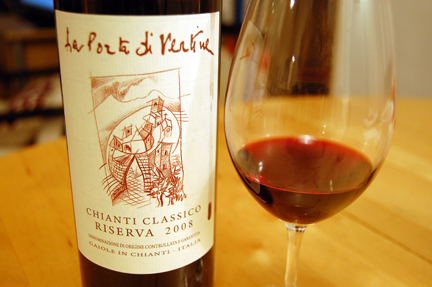
But the wine that really won me over was the Chianti Classico Riserva, 100% Sangiovese.
There are so few Chianti Classico producers making traditional-style wine today with a historical perspective on what came before. The unmitigated success of the Chianti brand in the 1970s, the fall from grace with the sale of some of the big domains to American corporations, and the subsequent refashioning in the image of California… Chianti Classico — in my view – is a “brand” that lost its way and lacks the stalwart models for excellence and tradition that Montalcino has.
Just look at the color in the photo above (taken by Tracie P)… the translucent beauty of real Sangiovese… This wine had it all: the freshness, the bright acidity, the red stone fruit flavor, and just a touch kiss of horse sweat. Very elegant yet earthy, muscular in its tannic structure but with delicate floral notes in the nose and in the mouth.
The classic Chianti Classico (as opposed to the Riserva, above) was meatier thanks to a blend of the classic indigenous grapes, including Pugnitello (I learn from reading the winery’s website). But the Sangiovese remained the wine’s alpha grape and I’m hoping the price on this wine, once it reaches US shores, will be below $30 so that I can drink one bottle per week. It’s that good…
Of all the wines that make their way to our tasting table these days (and I taste EVERYTHING that arrives no matter how unpromising), it was so refreshing to find a project that breaks from the predictable paradigm of contemporary Chianti. We loved all the wines (all of them 2008).
Tracie P’s new blog, heading @SottoLA, and Give Greece a Chance

In case you hadn’t already seen it, Tracie P has a new blog called Sugarpie where “mommy maximus” reflects on what it’s like to be a first-time mother and our experiences as new parents. I’m so glad that she’s blogging again and that she’s been applying her irresistible humor to the ups and downs of parenting… I love her and Georgia P so much and her humor, spirit, and beauty are an antidote to the often overwhelming challenges of being a first-time parent.
In other news…
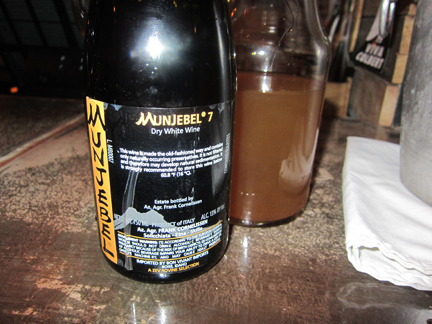
On Friday and Saturday nights, I’ll be working the floor at Sotto in Los Angeles where we’ll be launching our new wine list for 2012. There are a lot of the old favorites on the new carta dei vini but there are also a bunch of new lots as well, like the Cornelissen Munjebel Bianco.
In today’s New York Times, Eric the Red wrote that Cornelissen’s wines are “unlike almost any others on earth, which people tend to love or hate…” Bring it on!
If you happen to be in LA this weekend, please come and see me and I’ll pour you something great!
And on a more solemn note…
With everything that’s been going on “on the ground” in Greece, it’s been really difficult to find inspiration to write about Greek wine for the Boutari Wines Project this year.
Evidently, my blogging colleague Markus Stolz — author of Elloinos, the world’s top Greek wine blog — has been suffering from the same aporia and he, like me, posted today about the Give Greece a Chance project: it’s a print media PR campaign spearheaded by Greek business leaders who are trying to raise awareness of the human suffering that’s happening there.
I highly recommend this page: it provides some background and some basic information on the grave situation there.
See also what Markus has to say.
Markus lives with his family in Greece and is watching this tragedy unfold firsthand.
“A lot of real human suffering,” he wrote to me today in a tweet. “I like initiatives like the one we both posted about, builds community and leads to change.”
Let’s hope so… And let’s not forget our sisters and brothers in Greece. Una faccia, una razza…
Heading to Friuli (it’s official)
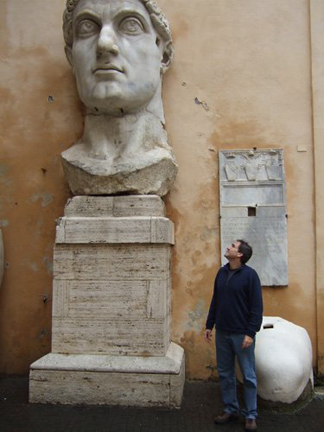
It’s official: I’ll be leading a group of bloggers (again) to Friuli, including my good friend Chris, above, who writes a wonderful food column for the Houston Chronicle.
The trip starts April 2 and I’ve already started posting over at the COF2012 aggregate blog.
This morning I posted the list of bloggers who will be joining us…
Thanks for following along! It’s going to be a blast…
From Defender of Wily Politicians, Serial Killers and Drug Dealers to Texas Winemaker
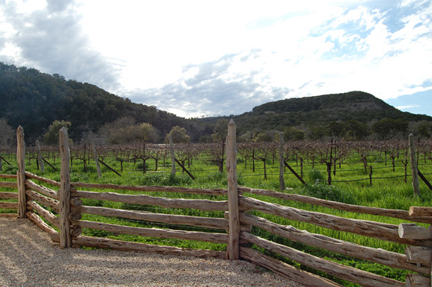
On Friday afternoon, I snapped the above photo in the gorgeous Texas Hill Country where I was among the first guests at my friend Lewis Dickson’s new tasting room (on his La Cruz de Comal estate, where he grows Blanc du Bois and Black Spanish).
Here’s my profile of Lewis — criminal defense attorney turned Natural winemaker — over at the Houston Press today.
Colli Orientali del Friuli 2012: Mission Impossible
From the department of “coming to a blog near you soon“…
Pizza and Champagne (Socialists)

My treatise on Champagne and the 99 percenters today over at the Houston Press.
After all, one man’s pizza doesn’t have to be another’s poison…
Arianna Occhipinti & Giorgio Grai walk into a winebar…
From the department of “public service announcements”…
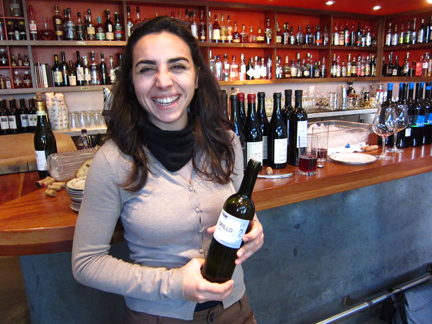
How’s this for a premise? [hipster Sicilian Natural wine producer] Arianna Occhipinti (above) and [legendary winemaker, master blender, and race car driver] Giorgio Grai walk into a winebar in Siena… The two winemakers represent the antipodes of Italian winemaking in nearly every way (including geographically!). And they are two of the nicest and most intelligent people in Italian wine today.
I probably won’t be getting up at 3 a.m. (10 a.m. Italian time) on March 16 to watch the streaming of a conversation between Arianna, Giorgio, the original Italian celebrity chef Gualtiero Marchesi, Giuseppe Vajra (one of our favorite winemakers), and a few other Italian food and wine luminaries. But I’m hoping that someone will have the good sense to post a YouTube somewhere. The icing on the cake: one of my favorite Italian food bloggers, Stefano Caffarri, curator of Appunti di Gola, will be moderating.
My good friend Francesco Bonfio, president of Vinarius (the association of Italian wine shops) is the organizer.
In other news…
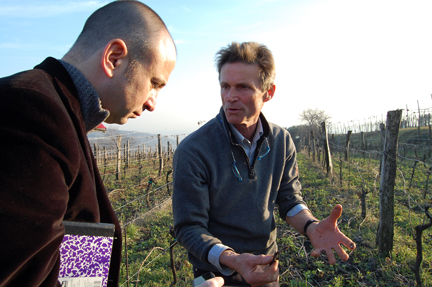
One of the winemakers I admire the most (for the superb wines he makes and for his honesty and soulfulness), Angiolino Maule has announced the dates of the VinNatur conference and tasting at the Villa Favorita, March 24-26.
Of all the Natural and biodynamic wine fairs in Italy, VinNatur is perhaps the one that thrills me the most and its selection process is the most rigorous. Not only are producers required to practice chemical-free farming, but they are also required to submit soil samples to ascertain whether or not “residual” chemicals are present in their vineyards (resulting from runoff from their neighbors’s vineyards).
In past years, my very close friend and jazz guitar virtuoso Ruggero Robin has performed at the event (he and Angiolino — an accomplished musician in his previous life — are good friends, as well). I don’t know yet if Ruggero will be there but I hope so!
El mejor Tempranillo (one of the best bottlings of Tempranillo I’ve ever tasted)
Some of the great U.S. wine impresarios “fly over” Texas each year, ignoring a large state and lucrative market where the big distributors’s chokehold on the flow of wine makes it difficult for the smaller guys to get a word in edgewise.
Some of them come every year, cultivating relationships and building brand recognition for European wines that our countrymen hardly know or know how to pronounce.
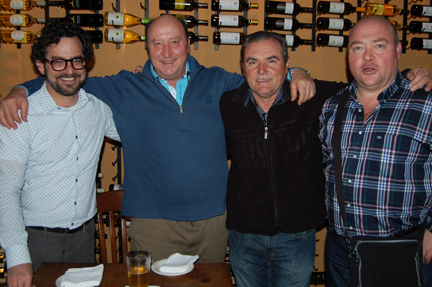
It was fascinating to sit down the other day at Vino Vino in Austin with the dynamic André Tamers (above, left), who has built one of the best Spanish portfolios in the U.S.
He was “working the market” (as we say in the biz) with three of his core producers, winemakers whose products have shaped his career over the last fifteen years as one of the leading importers of European wines in the U.S.: from André’s left, Florentino Monje (Luberri), Gerardo Méndez (Do Ferreiro), and Jesús Gómez (Viña Sastre).
What a thrill to taste their wines and chat (in my passable Spanish) with these men — all of them growers.
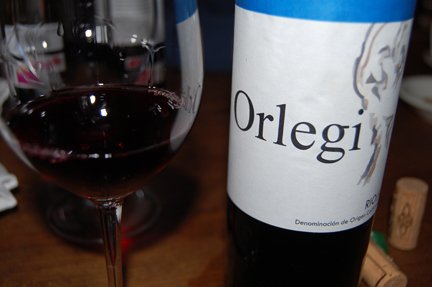
I liked the wines across the board but I couldn’t resist telling Florentino that his Orlegi Tempranillo was one of the best I’ve ever tasted: partial-whole-cluster-fermented Tempranillo vinified in a light, fresh youthful style (a “return to the traditional,” writes André on his site). Lip-smackingly delicious, low-alcohol, food friendly and inexpensive wine.
There’s a lot of great old-school Tempranillo out there and available in our country (and you don’t need to tell you the producers if you follow along here). But this wine really surprised me. I love, love, loved it…
Chapeau bas, André. See you this time next year back in Texas.
Los Pilares: Not so Natural but delicious in San Diego (it’s a small world after all)
it’s a world of laughter, a world or tears
it’s a world of hopes, it’s a world of fear
there’s so much that we share
that it’s time we’re aware
it’s a small world after all
I used to love that song as a kid (and still do) and I would sing it over and over and over again… my favorite ride at that twentieth-century experiment in social engineering otherwise known as Disneyland…
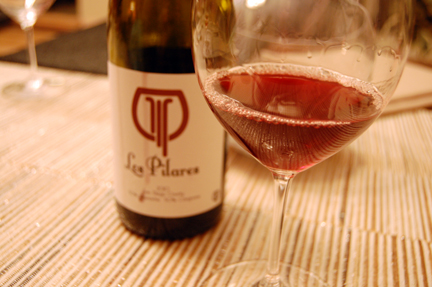
It was only natural (small n) that I would get a call asking if I’d like to taste the first bottling by Los Pilares in San Diego after our friend Alice Feiring wrote about the wine glowingly on her blog the same week that Tracie P, Georgia P, and I were visiting my hometown (La Jolla High School Class of ’85).
When the call (and connection) came, our friend — cancer survivor, author, local radio personality, and vibrant life force — Chrissa Chase informed me that she wanted to set up a tasting and a meeting with one of the winemakers, a nice gent named Michael Christian, a retired lawyer who, like many in his generation, grew tired of drinking concentrated, overly oaked, and excessively alcoholic Californian wines.
In the wake of the excitement that followed Alice’s post (and calls expressing interest in representation from the Garagiste and from one of the top distributors of Natural wine in California, said Michael), the San Diego folks began calling the wine a “Natural” wine.
But when I sat down with Michael — a super nice guy — I discovered that, in fact, the grapes had been sourced from local growers whose “Natural” credentials would surely be questioned by the Natural wine elite (had they been consulted). And of course, the wine had been inoculated for malolactic fermentation — a red flag among the self-appointed Natural wine auditors.
After a thirty-minute discussion on the Natural wine dialectic, the Natural wine elite in our country (a club I don’t belong to because as Groucho Marx once noted, “I don’t care to belong to any club that will have me as a member”), and what makes a wine Natural (as per Eric the Red’s recent op-ed in the Times), I turned to my host and her guest Michael and said, “who the hell cares if it’s a Natural wine or not? Let’s just taste it!”
I thought the wine — a blend of San Diego-grown Grenache and Carignane — was delicious: bright and fresh, with a lot of cinnamon and spice in the initial impression, giving way to ripe berry and red fruit flavors. And like Alice (I hadn’t yet read her review when I tasted it), I loved the low alcohol content (12.5%). Michael noted that the cool 2010 harvest in California allowed him and his partners to achieve the ripeness they wanted without the high alcohol. I liked the wine so much that I convinced Michael to sell me a bottle ($24) to taste with Tracie P at dinner the next night.
Maybe the folks in San Diego have come to the Natural wine discussion a few years late… Maybe the word itself Natural is just too sexy to resist. Ultimately, whether a wine is Natural or not is now irrelevant, especially considering the vitriol that the discussion has generated (the exact opposite of what Natural wine should mean, in my view).
In the end, the important thing to remember is…
There is just one moon and one golden sun
And a smile means friendship to everyone.
Though the mountains divide
And the oceans are wide
It’s a small small world…
 Do Bianchi