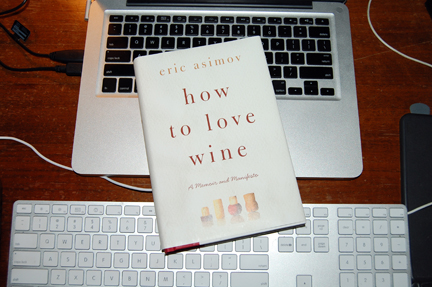
@EricAsimov teaches our generation “how to love wine”

best wine book 2012

“Instead of a joy,” writes Eric the Red (Eric Asimov) in his newly released “memoir and manifesto,” How to Love Wine, “for many people wine has become a burden.”

“The United States,” he observes, “has become the largest single consumer of wine on the planet, yet what’s missing in many people’s experience of wine is a simple sense of ease. Instead, choosing a wine becomes an exercise in anxiety. Many people have come to believe that they cannot enjoy wine unless they are already knowledgeable, and so deny themselves the pleasurable experiences that would allow them to gain confidence.”

(His column last week for The New York Times, also addresses this phenomenon and the misunderstood role of the sommelier.)

As I read Eric’s new book over the weekend, I couldn’t stop thinking about how our generation (he’s my eldest brother’s age) is the first American generation to approach wine in demotic terms.

Like him, I grew up in a Jewish household where wine was considered a luxury (if it was considered at all). He notes his (our) parents were among the first American generation who could afford to travel to Europe. They went made a first trip in 1971: “Perhaps most interesting of all to them, they ate in French restaurants and drank wine.” (Around the same time, my parents went to Russia and drank vodka.)

He talks about drinking “bland and boring” beer and smoking weed in high school and college, not “turn[ing] up my nose at the sort of things that typically found their way to dormitory parties back then.”

And then, in 1982, while a grad student in Austin, Texas, an epiphany is delivered by an $8 bottle of Giacomo Conterno Barbera d’Alba (my epiphany bottle was a literally homegrown Sangiovese in Montalcino in 1989).

The parallels in our lives are uncanny as they are common among our generation. (For our mutual friend Alice Feiring, another one of my favorite wine writers, it was a bottle of Nebbiolo in 1980; the fact that we’re all Slavic Jews and the role that Italian wine has played are also unheimlich.)

As Georgia P played with her toys on the floor and I devoured Eric’s book, I realized that she will grow up in an America that is aware (and self-aware) of its application of wine. And I also thought deeply about how our generation’s “anxiety” in approaching wine is probably what has fueled the enoblogosphere’s explosion, the vitriol that often sullies the discusion of wine, and the joy that so many of us find in the wine blogging community.

I plan to write a proper review of the book for the Houston Press.

In the meantime, I highly recommend it to you.

O, and why is Eric called “Eric the Red” here on my blog, you ask?

He took the name himself inspired by my brush with Dany Le Rouge.

Support New York City restaurants (lunch at SD26)

Above: The signature dish at SD26, a large raviolo stuffed with cheese and a gently poached egg yolk. Prix fixe lunch at SD26 is just $28.

As my friends and I ate our way through Manhattan last week, I heard a lot of people say that the restaurant scene there has begun to “pick up” again in the wake of the financial crisis “reset.”

I left the city on Friday: on Monday, Manhattan saw its worst flooding in a generation, a catastrophe that has already impacted New York’s struggling restaurateurs.

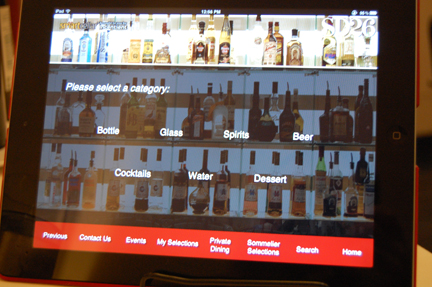
Above: The wine list at SD26 is presented on an iPad. I was thrilled to discover that the restaurant has an open network and that I could get online at the bar as I waited for my good friends Michele and Charles Scicolone who treated me to lunch.

Gastronomic culture in Manhattan and Brooklyn plays such an important role in our country: many of our nation’s best chefs and top sommeliers pay their dues and make their names there. When restaurants in New York thrive, restaurateurship throughout our country prospers as well.

Now, more than ever, the New York restaurant scene needs our support.

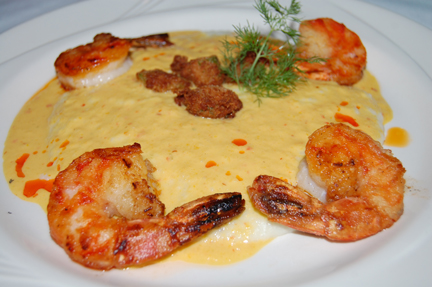
the best shrimp and grits I’ve ever had

Today at Charivari in Houston, lunch with the inimitable Bear Dalton (who told me they’re his favorite shrimp and grits “in town”).

The grits weren’t overly buttered and their mouthfeel was even and substantive without seeming heavy.

Just enough spice on the shrimp and fried okra in the middle took it over the top.

Thanks again, Bear!

Terroir, Soldera, Barthes, Derrida, and St. Augustine

deconstruction derrida barthes eco

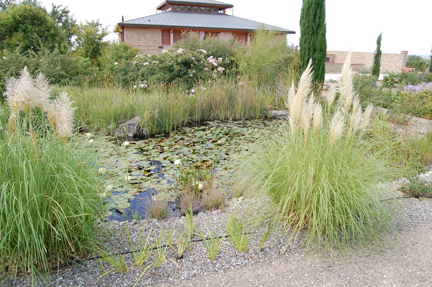
Above: In the late 1970s, Gianfranco Soldera created a “terroir” by building a series of botanical gardens in Montalcino, including this mini swamp.

My entry today for the Houston Press is an intro to the concept of terroir.

As I was writing it, it occurred to me that many wine writers omit bacteria as one of the defining elements of terroir. In the light of the dialectic over native yeast in recent years, I was surprised not to find bacteria or yeast mentioned in the online edition of the Oxford Companion to Wine.

I wasn’t surprised to discover that few wine authorities discuss the human contribution to terroir through culture, history, and tradition. Would we have a notion of terroir, I asked myself, if the friars of Burgundy hadn’t manicured and monitored their cloistered vineyards with maniacal care?

terroir montalcino brunello

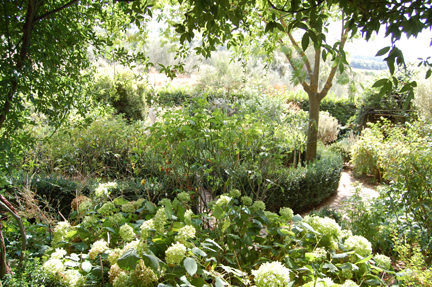
Above: Soldera’s white garden is his biggest source of pride.

My thoughts led me to a memory of walking through Gianfranco Soldera’s botanical garden for the first time in 2008. Anyone who’s ever visited the estate knows that his biggest point of pride is the garden and in particular the white-flower garden and the mini swamp (above). In the 1970s, he created his own terroir on barren land, including the yeast colony that rose from his earthly handiwork.

If humankind can create terroir by reinterpreting landscape, I wondered, does humankind’s perception of terroir influence terroir itself?

At first, Barthes, Derrida, and deconstruction came to mind. Could Eco’s notion of the “open work” be applied to wine connoisseurship? Is the winemaker dead (to quote Barthes)? Every bottle of wine is an expression of a moment and a fabric — a text — of elements that converge between harvest and vinification. And each bottle of wine tells a different story depending on how and when it is handled and opened and by whom.

Yes! I thought: a bottle of wine is an “open text” whose meaning is interpreted and ultimately defined by the reader/drinker.

But can terroir — the quasi-mythical concept of site and vintage specificity — be influenced by the reader/drinker?

Surely it can. To apply Kantian absolutism to terroir would be to negate the very ethos of terroir.

Ultimately, my thoughts led my back to my beloved St. Augustine and his reflections on the nature of memory.

Our concept and conception of terroir could not exist unless we remembered our previous perception of terroir.

In other words, if you only tasted Bonnes Mares or Monprivato once in your lifetime and tasted no other expressions of Pinot Noir or Nebbiolo, you’d have no sense of their uniqueness.

I arrived at the conclusion that terroir could not exist if we were not there to perceive it (in many ways St. Augustine was a precursor of the proverbial tree that falls in the forest but doesn’t make a sound).

If terroir cannot exist without humankind, then humankind does, indeed, wield influence over it. And if perception of terroir cannot exist without humankind’s memory of terroir, then it follows that even the end user of a bottle of wine play a role in terroir.

Whether you taste a bottle of Soldera on his estate (where he built a terroir ex novo), whether you taste it on the hilltop where he regularly dines, or whether you taste it in New York City or Houston, Texas, you play a role in the terroir by perceiving it.

Wine for thought…

Carbonara, a new theory for its origins and name

origin name carbonara

Above: Tracie P adds onion to her Carbonara, just another idiosyncratic — and delicious — interpretation of this recipe (the above was one of the dishes in last night’s dinner at our house).

Premise

Perhaps more than any other recipe in the Italian gastronomic canon, spaghetti alla carbonara and its origins have perplexed and eluded gastronomers for more than five decades.

Most food historians group the currently and popularly accepted theories of the etymon into three groups: the origin of the dish can be ascribed to 1) coal miners; 2) American soldiers who mixed “bacon and eggs” and pasta after occupying Italy in the post-war era; and 3) Ippolito Cavalcanti, the highly influential nineteenth-century Neapolitan cookery book author, whose landmark 1839 Cucina Teorico-Pratica included a recipe for pasta with eggs and cheese.

There is also a fourth theory that points to the restaurant La Carbonara, opened in 1912 in Rome. According to its website, it was launched by “coal seller” Federico Salomone. But the authors of site do not lay claim to the invention of carbonara nor do they address the linguistic affinity (even though they mention that their carbonara was included in a top-ten classification by the Gambero Rosso).

Origins and historical meaning of the word carbonara

The “coal miner” hypothesis is highly unlikely in my view. Carbonari are not coal miners but rather makers of [wood] charcoal (colliers in archaic English). If we agree that carbonara (the dish) began to appear in industrialized Italy (see below), we also have to take into account that the word carbonaro/a also had a different and more prevalent meaning for Italians at that time. The carbonari were members of a Neapolitan secret revolutionary society (similar to the Free Masons) called the Carboneria. The nineteenth-century group took their name from a fifteenth-century Scottish group of rebels who masked their subversive activities by pretending to be colliers.

Continue reading

Trulli yours, New York: 97 Barolo Massara and Ben’s new movie

best apulian pugliese restaurant

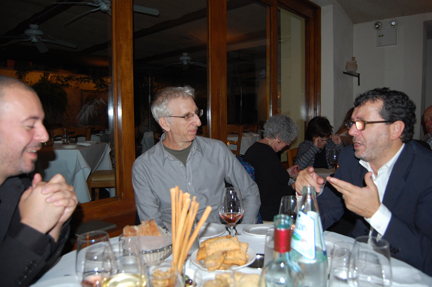
Last night found Alice, Paolo (in the photo above, left), and me at the table of New York restaurant maven Nicola Marzovilla (above, right), whose landmark I Trulli Enoteca e Ristorante has been one of the city’s culinary standbys since the late 1990s (when I first moved to New York).

We were joined by my good friend Ben (above, center) whose new movie, Gregory Crewdson: Brief Encounters, will be shown at the great cinema d’essai, Film Forum, starting October 31.

(Click here for the trailer and click here for screening info and see the synopsis of the film below.)

Nicola’s been returning to his roots, he said, as we enjoyed his mother’s cavatelli with broccoli raab and orecchiette with rabbit and tomato. He’s running the kitchen these days and the menu has returned to its original mandate of classic Apulian (Pugliese) cuisine with flourishes of Sicilian and Sardinian.

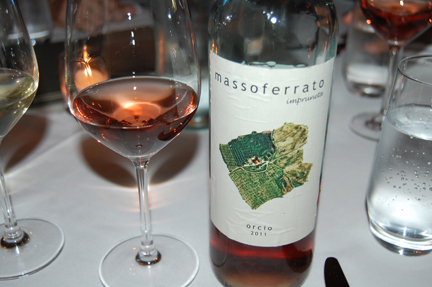
We also got to taste Nicola’s new wines, including the amphora-aged rosé from Sangiovese grown on Nicola’s small property in Impruneta (not far from Florence). I loved this wine, bright and fresh and very food-friendly.

But the show-stopper was this 1997 Castello di Verduno Barolo Massara. Surprisingly tight and ungenerous with its fruit, it showed beautifully as it opened up, with notes of spearmint on the nose and dark earth in the mouth (it reminded me in style of the great wines of Giuseppe Mascarello).

Congrats, Ben, on the new film (I saw it in Austin at SXSW, where it was one of the most talked about films in the festival) and congrats, Nicola, on the new wines…

Now it’s time to get my butt back to Texas… There’ll be more New York stories coming just as soon as I get my feet back on the ground and wrap my arms around my girls… thanks for following along…

*****

Gregory Crewdson’s riveting photographs are elaborately staged, elegant narratives compressed into a single, albeit large-scale image, many of them taken at twilight, set in small towns of Western Massachusetts or meticulously recreated interior spaces, built on the kind of sound stages associated with big-budget movies. Ben Shapiro’s fascinating profile of the acclaimed Berkshire-based artist includes stories of his Park Slope childhood (in which he tried to overhear patients of his psychologist father), his summers in the bucolic countryside (which he now imbues with a sense of dread and foreboding), and his encounter with Diane Arbus’s work in 1972 at age 10. Novelists Rick Moody and Russell Banks, and fellow photographer Laurie Simmons, comment on the motivation behind their friend’s haunting images. But Crewdson remains his own best critic: “Every artist has one central story to tell. The struggle is to tell and retell that story over again – and to challenge that story. It’s the defining story of who you are.”

So sexy at L’Apicio, Manhattan’s newest über cool restaurant

Maybe because it’s the hottest new restaurant in Manhattan… Maybe because its wine list is organized by white, red, and orange… Maybe it’s because everybody who’s anybody in the NYC scene was there last night… or maybe because owner Joe Campanale is just so damned good looking…

You just can’t help but feel sexy at L’Apicio, named after L’Apicio Moderno, the landmark eighteenth-century cookery book.

The restaurant just opened last week and Alice, Paolo, and I were lucky enough to snag a table.

How can you not love a restaurant that has Donati Malvasia frizzante on the list?

Everyone in Manhattan is talking about the Arpepe Rosso di Valtellina, recently landed on the island.

Friggin’ brilliant… just friggin’ brilliant… I loved it.

I’ve known owners Joe, August, and Katherine since 2005 when we all worked together during some heady times in the New York wine world. It’s so great to see their immense success as they build a new Italophile, enogastronomic empire. They’re among the nicest people in the wine and food biz and I love them and what they do. And I learned last night that Katherine’s husband, chef Gabe Thompson, is from Texas! We’re looking forward to seeing them in Austin…

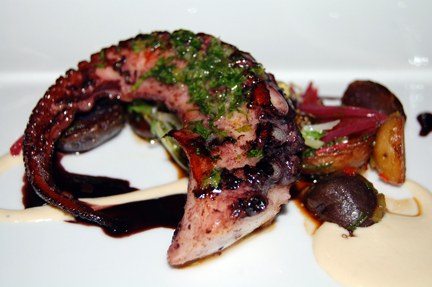
Oxidative Clairette and octopus at Marea

From the department of “life could be worse”…

What a thrill to dine last night at Marea with Alice Feiring and Paolo Cantele, two of my favorite people in the world.

The food was spectacular and I was surprised to see that they’ve expanded their list greatly to include an impressive French selection (the first time I visited the focus and concentration was purely Italian).

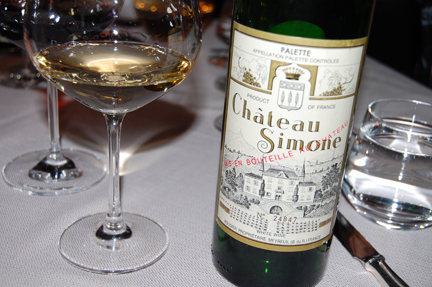
Alice’ choice was 2007 Château Simone white, my first taste of this extraordinary expression of Clairette. It took a while to open up and I reserved a glass to drink at the end of the meal, when its fruit really began to show brilliantly.

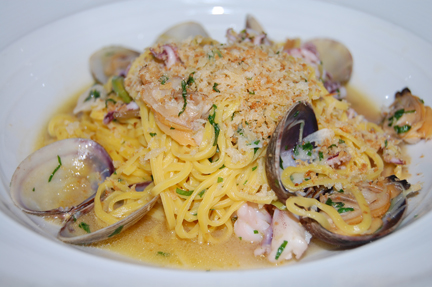
The pasta at Marea has been consistently superb in my experience there. The long noodles with shellfish and calamari was great.

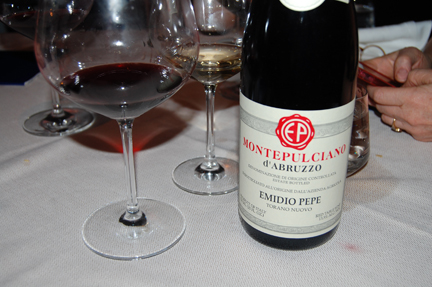
My selection was the 2001 Pepe, still very tannic and dark but utterly delicious, with that rich mouthfeel unique to Pepe’s wines.  I’ve tasted a lot of Pepe lately because we currently offer a vertical at Sotto in LA (where I curate the wine list) and these wines always inspire me.

Tonight we’re heading to Joe Campanale’s new restaurant L’Apicio and then to visit one of my best friends in the NYC wine and food scene… Stay tuned…