Frank Cornelissen & the “zoo of Natural wine” @SottoLA

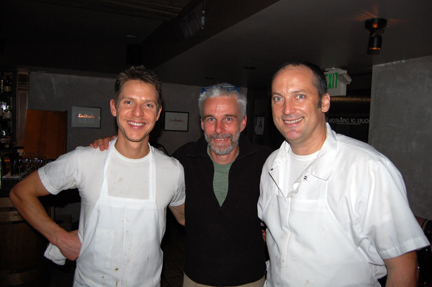
We had a truly epic dinner at Sotto last night with Frank Cornelissen (above with chef Zach Pollack, left, and chef Steve Samson, right).
Even though I’ve followed the wines for years, I’d never met Frank, who was visiting the U.S. for the first time with his wines (he had visited before he started making wine many years ago).

With all the mystery and aura that seems to surround him, I wasn’t sure what to expect. But I discovered that he’s a super cool dude, very approachable and just fun to talk to.
We spoke at length about what he calls the “zoo of Natural wine.”

“Natural wine hasn’t been defined and so we really can’t call wine Natural,” he said, noting that he doesn’t care for the term.
I was thoroughly impressed by his concept of “high definition” wines and I admired the respectful tone with which he spoke of his neighbors on Etna.

He speaks impeccable Italian, btw.

Levi always gets mad at me for doing this but I’m so slammed today (while on the road in southern California) that I’ll have to post my complete notes, including Lou’s thoughts, when I have a moment to catch my breath…

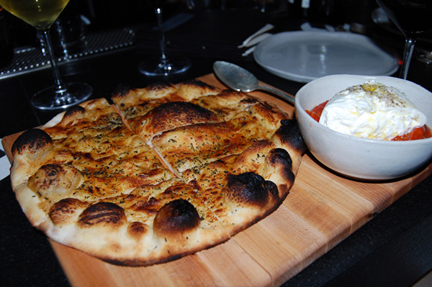
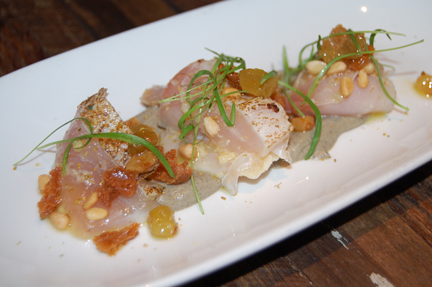
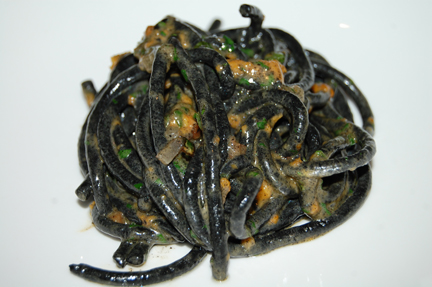
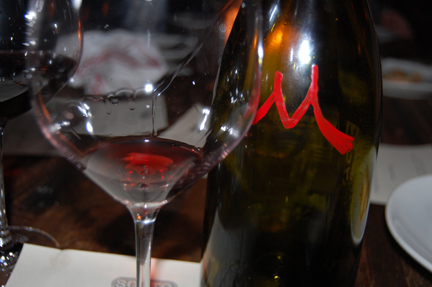
In the meantime, the seared tuna with raisins, pinenuts, and bread crumbs was INSANE (first food photo). And the squid ink spaghetti with uni was possible my top dish for 2012… amazing… And wow, what a thrill to finally get to taste the (declassified) Magma.

Levi, I promise to post all my notes asap!

Stay tuned…
Scavino vs. Produttori del Barbaresco: a political allegory

One of the cool things about what I do for a living is that wine (sales) reps will often offer to “taste me on” their wines.

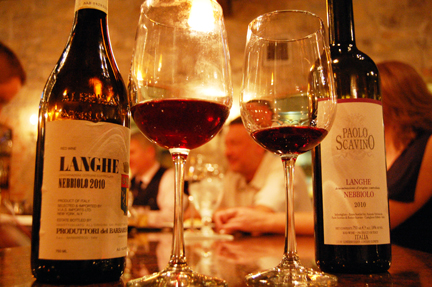
Last night, I was catching up with one of my clients here in Austin and a rep asked me if I’d like to taste the 2010 Langhe Nebbiolo by the “father” of modern Langa, Paolo Scavino.

It just so happened that I was drinking the 2010 Langhe Nebbiolo by Produttori del Barbaresco, one of the stalwarts and standard-bearers of traditional Nebbiolo.

Even though I can’t say I’m a fan of the Scavino style, I thought that both wines were showing great.

The Scavino had that trademark cherry cough syrup note (easy to identify even when tasting this wine blind) and I was surprised by how tannic it was (citing second-hand sources, the rep told me that Scavino is declassifying some of its best fruit, otherwise destined for its Barolo, and using it for this wine; after tasting the wine, I believed him). It was elegant and focused and it had good acidity. While I just can’t get around that cough syrup flavor, I can see why people like this wine and why it does so well in restaurants.

The Produttori del Barbaresco was all classic, all the way. Bright and light on the palate, this wine leaned more toward berry fruit with a balance of earth and the cooperative winery’s signature acidity keeping all the other elements in check. Tasting it side-by-side with the Scavino, I couldn’t help but note that the Produttori del Barbaresco has very little tannin in it. This softness, combined with the acidity and clarity of fruit, is one of the reasons why this wine does so well among restaurant-goers (not to mention the affordability).

I’m not sure how it happened but the conversation shifted to politics. The rep is a Romney supporter and a diehard republican.

As they sat there on the bar, the wines became — in my mind — an allegory of our deeply divided country.

It’s a facile analogy, I know, but it just leapt out at me: on the one side, a nineteenth-century cooperative of farmers united by a priest in a hilltop village, a bottle of earth and berry fruit, ever true to its original mission; on the other side, an old Langarola family who had led the charge of modernism in the 1990s, abandoning the traditions of a bygone era and delivering a hearty, tannic wine that tasted of cough syrup, slick, polished, and refined, well intentioned and honest no doubt, but detached from the place whence it came.

“I guess you don’t like cherries,” said the rep when he noted that I preferred the Produttori del Barbaresco with my meal.

“Cherries are fine,” I said, “but the wine’s just not my speed.”

“Fair enough,” he said.

As far as I know, he made a “placement” last night.

I guess that in Austin — the little blue town in the big red state — there’s room for both.

A couple of wine dinners I’ve got coming up…

From the department of “it’s a tough job but someone’s got to keep the world safe for Italian wine”…

gaja brunello houston

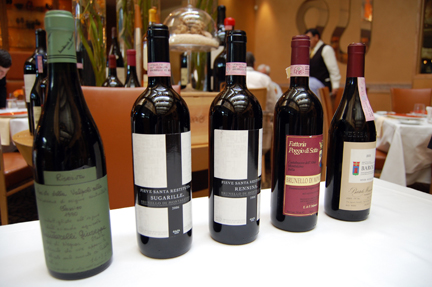
That’s the flight of wine (above) I’ll be talking about when I speak at Tony’s in Houston on Wednesday, November 28. Tony and I have so much fun working together and I’m thrilled that he asks me to do these dinners. 1990 Recioto by Quinatrelli? The answer is yes.

And this Sunday, November 11, I’ll be presenting Frank Cornelissen at Sotto in Los Angeles. The most valuable nose in this business, Lou Amdur, will also be on hand to speak.

Alice Feiring was going to join us on Sunday but “nature conspired” against her trip, as she put it: Sandy made it impossible for her to get here from NYC.

I’ll also be pouring Sicilian and Sardinian wine on Wednesday, November 14, with Piero Selvaggio and Darrell Corti at Piero’s Valentino in Los Angeles. Chef Steve Samson will also be cooking for the event. I can’t wait to see Darrell!

Groovy Xinomavro in Houston @PassProvisions in @EatingOurWords

I had fun handicapping the colorful, idiolectally beautiful, and farraginously befuddling wine list at Houston’s new mustachioed hipster hippodrome, The Pass and Provisions (where I loved the Kir-Yanni Naoussa last night).

Click here for my post today over at the Houston Press.

It can be a fine line between style and affectation, but the young dudes at this joint cut it.

@EricAsimov teaches our generation “how to love wine”

best wine book 2012

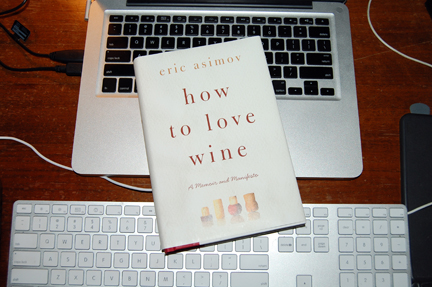
“Instead of a joy,” writes Eric the Red (Eric Asimov) in his newly released “memoir and manifesto,” How to Love Wine, “for many people wine has become a burden.”

“The United States,” he observes, “has become the largest single consumer of wine on the planet, yet what’s missing in many people’s experience of wine is a simple sense of ease. Instead, choosing a wine becomes an exercise in anxiety. Many people have come to believe that they cannot enjoy wine unless they are already knowledgeable, and so deny themselves the pleasurable experiences that would allow them to gain confidence.”

(His column last week for The New York Times, also addresses this phenomenon and the misunderstood role of the sommelier.)

As I read Eric’s new book over the weekend, I couldn’t stop thinking about how our generation (he’s my eldest brother’s age) is the first American generation to approach wine in demotic terms.

Like him, I grew up in a Jewish household where wine was considered a luxury (if it was considered at all). He notes his (our) parents were among the first American generation who could afford to travel to Europe. They went made a first trip in 1971: “Perhaps most interesting of all to them, they ate in French restaurants and drank wine.” (Around the same time, my parents went to Russia and drank vodka.)

He talks about drinking “bland and boring” beer and smoking weed in high school and college, not “turn[ing] up my nose at the sort of things that typically found their way to dormitory parties back then.”

And then, in 1982, while a grad student in Austin, Texas, an epiphany is delivered by an $8 bottle of Giacomo Conterno Barbera d’Alba (my epiphany bottle was a literally homegrown Sangiovese in Montalcino in 1989).

The parallels in our lives are uncanny as they are common among our generation. (For our mutual friend Alice Feiring, another one of my favorite wine writers, it was a bottle of Nebbiolo in 1980; the fact that we’re all Slavic Jews and the role that Italian wine has played are also unheimlich.)

As Georgia P played with her toys on the floor and I devoured Eric’s book, I realized that she will grow up in an America that is aware (and self-aware) of its application of wine. And I also thought deeply about how our generation’s “anxiety” in approaching wine is probably what has fueled the enoblogosphere’s explosion, the vitriol that often sullies the discusion of wine, and the joy that so many of us find in the wine blogging community.

I plan to write a proper review of the book for the Houston Press.

In the meantime, I highly recommend it to you.

O, and why is Eric called “Eric the Red” here on my blog, you ask?

He took the name himself inspired by my brush with Dany Le Rouge.

Support New York City restaurants (lunch at SD26)

Above: The signature dish at SD26, a large raviolo stuffed with cheese and a gently poached egg yolk. Prix fixe lunch at SD26 is just $28.

As my friends and I ate our way through Manhattan last week, I heard a lot of people say that the restaurant scene there has begun to “pick up” again in the wake of the financial crisis “reset.”

I left the city on Friday: on Monday, Manhattan saw its worst flooding in a generation, a catastrophe that has already impacted New York’s struggling restaurateurs.

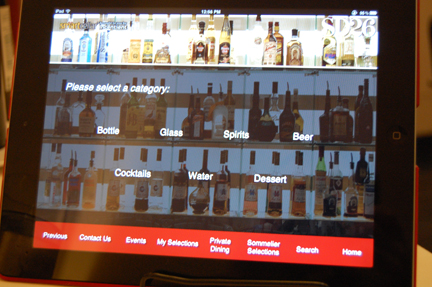
Above: The wine list at SD26 is presented on an iPad. I was thrilled to discover that the restaurant has an open network and that I could get online at the bar as I waited for my good friends Michele and Charles Scicolone who treated me to lunch.

Gastronomic culture in Manhattan and Brooklyn plays such an important role in our country: many of our nation’s best chefs and top sommeliers pay their dues and make their names there. When restaurants in New York thrive, restaurateurship throughout our country prospers as well.

Now, more than ever, the New York restaurant scene needs our support.

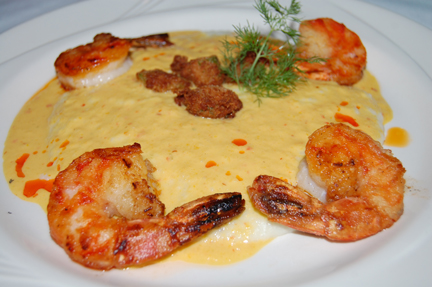
the best shrimp and grits I’ve ever had

Today at Charivari in Houston, lunch with the inimitable Bear Dalton (who told me they’re his favorite shrimp and grits “in town”).

The grits weren’t overly buttered and their mouthfeel was even and substantive without seeming heavy.

Just enough spice on the shrimp and fried okra in the middle took it over the top.

Thanks again, Bear!