Lake fish & Franciacorta at the “dispensary”

best fish restaurant italy

Marinated coregone (Coregonus lavaretus, European white fish) served with an “ice cream marinade.”

When you really get down to the thick and thin of it, “there’s really nothing unique about the terroir of Franciacorta,” as one prominent producer told me when I was visiting there over the Thanksgiving weekend.

With its marittime influence (thanks to Lake Iseo) and its alternance of morainic (glacial-era) and calcareous subsoils, it is indeed an ideal place to grow acidity- and minearl-driven Pinot Nero and Chardonnay. But in fact, those conditions can be found in many spots of the pre-Alps.

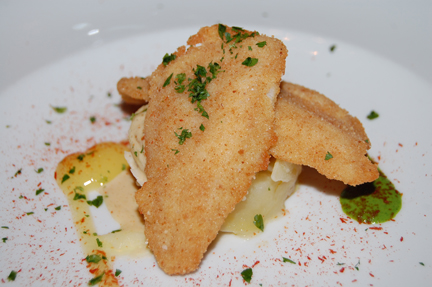
italian perch

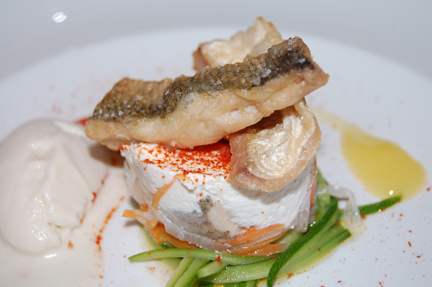
Gently fried perch (Perca fluviatilis) served over a potato “millefoglie.”

The tradition of sparkling wine there is owed to a small group of wealthy, industrialist landowners who began making classic-method wines in the 1960s (Franco Ziliani of the Guido Berlucchi winery was the first).

In my view, the thing that really sets Franciacorta apart as a producer of fine bubbles is the local, fresh-water cuisine there.

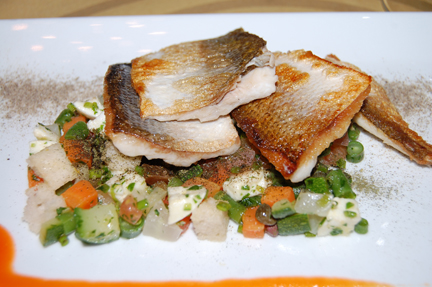
European white fish

Vittorio called this superb however simple dish “bread and salt” coregone fillets.

And there is no one who can rival the fresh-water fish mastery of chef Vittorio Fusari at his amazing Dispensa Pani e Vini (“Bread and Wine Dispensary”) in the village of Torbiato di Adro (in the province of Brescia).

The restaurant is a temple to locally sourced lake fish and sparkling wine (including many French labels).

Especially when Franciacorta is made in a mineral-dominant style, the pairing can be sublime.

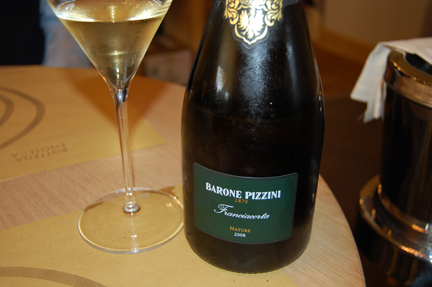
barone pizzini brut nature franciacorta

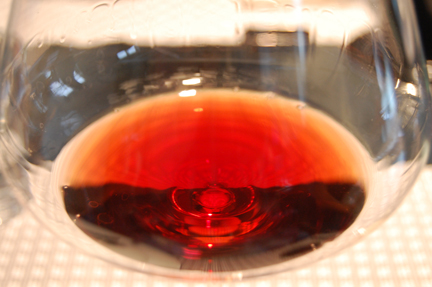
We paired with Barone-Pizzini Franciacorta Nature. In my notes I wrote: incredible balance, very nuanced nose, some tropical fruit, some red fruit, extreme freshness in the mouth, great balance here.

I had the great fortune of being treated to lunch at the “dispensary” by colleague Silvano Brescianini of the Barone Pizzini winery during my recent and very short trip to Italy.

I love the intelligence and elegance of Vittorio’s cooking (I ate there once before, in 2008, with Franco and Giovanni).

And he expresses his devotion to local fisherman through the eloquence of his menu.

I can’t recommend his restaurant highly enough. This meal alone would have made the trip worthwhile…

Soldera: “I’m not afraid. They picked the wrong man” to intimidate (Italian interview)

soldera vandal intervista

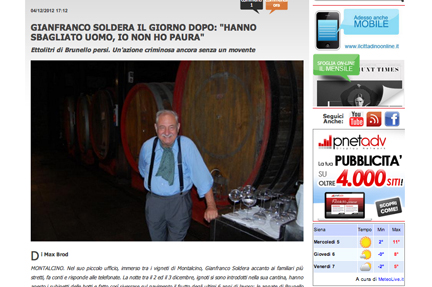
This Italian-language interview at IlCittadinoOnline.it just came to my attention.

In it, Soldera clarifies that he never spoke of mafia.

“I’m not afraid,” he tells the interviewer, describing the vandalism as an act of “intimidation.”

“They picked the wrong man” to intimidate, he says.

You might recognize the photo: they lifted it, without attribution, from my blog.

Posting in a hurry from the road today…

Soldera update: making sense of the unfathomable

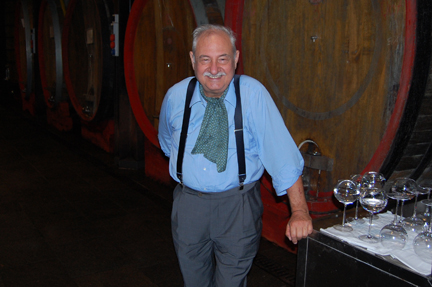
montalcino vendetta wineMala tempora currunt (bad times are upon us), wrote Italian wine writer Franco Ziliani yesterday in an email, one of the tide of messages that pulsed across the internets as we all tried to make sense of the unfathomable: on Sunday night, someone entered the cellars of Gianfranco Soldera (left, photo taken during my visit in 2008) and destroyed more than 60,000 liters of his wines, six entire vintages, spanning 2007 (still in cask) through 2012.

According to a post today by the Consorzio del Vino Brunello di Montalcino (Brunello producers association), “62,600 liters” were destroyed and the site confirms that “the entire production from 2007-2012” was lost.

The site WineNews.it also reports the same figure and vintages, noting that “the valves of 10 casks were opened.”

When reached for comment by the authors of the post, Soldera’s son Mauro told them that the wine was insured, including coverage for vandalism (before becoming a winemaker, Gianfranco Soldera made his fortune in the insurance trade in Milan).

The post also quotes the mayor of Montalcino, Silvio Franceschelli, who expressed the town’s “utmost solidarity with Case Basse for this villainous and cowardly act.”

Franceschelli is also quoted as saying that “any allusion to phenomena that bear the mark of the mafia are entirely imaginary.”

I wasn’t able to reach Soldera winery for comment today (the landline was occupied every time I called and a call to Gianfranco’s cellphone went unanswered). But I did speak to a number of people “on the ground” who concurred that the involvement of organized crime is unlikely.

Most believe that the senseless act was inspired by vengeance, perhaps in retribution for the supposed (but never verified) letter that Soldera wrote to authorities who launched an investigation into adulterated wines in Montalcino, an episode that culminated with judiciary action against a number of major players in Brunello in 2008 (the so-called “Brunellopoli” or Brunellogate affair).

(For the record, in 2008, while visting with him under the pergola of his home, I asked Soldera whether or not he had sent a letter to authorities. He flatly denied that he had and I believed him. He was, however, an outspoken critic of many of those implicated in the scandal.)
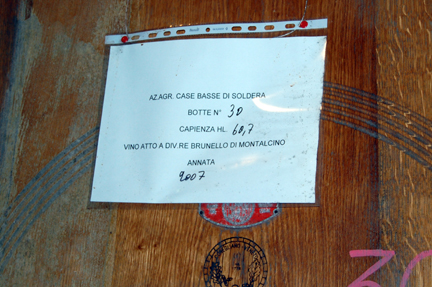
brunello scandal soldera

Above: Photo taken in 2008 during a visit to the winery. Yesterday, when we spoke, wine merchant Ceri Smith told me that she had tasted the 2007 in cask when she visited Soldera in February of this year.

One person I spoke to this morning (afternoon in Montalcino) proposed that it might have been a disgruntled ex-employee of Soldera.

But everyone I spoke to agreed that it’s unlikely that organized crime was the author of the vandalism. There has been no mafia activity there, said one informed person, and it is improbable that such an event would be isolated if the malavita were involved.

“One thing is certain,” wrote Franco Ziliani on his blog today, “today, all those who called Soldera a ‘poison pen’ or ‘snitch,’ accusing him of breaking the curtain of silence and challenging [Montalcino’s] establishment, should recite a sadly belated mea culpa. They are the ones objectively responsible for having prompted the deranged vandals who violated the cellar at Case Basse as punishment of its owner.”

In a phone conversation today, one of my friends in Tuscany noted how easy it would be to empty the casks of their wine. If you’ve ever visited a winery where large format casks like Soldera’s are used, you know that it’s simply a matter of opening a valve (if the wine were aged in 225-liter barriques, for example, this egregious task would be much more complicated).
Exif_JPEG_PICTURE

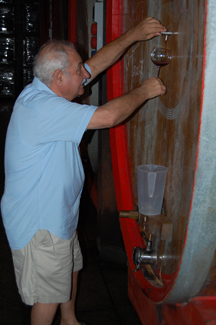
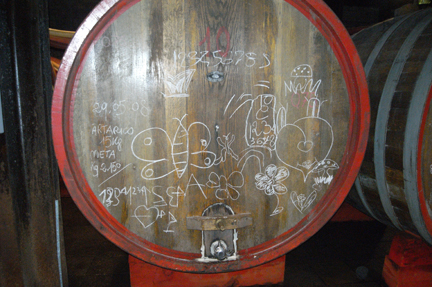
Above: “I let my grandchildren use chalk to draw on the casks,” said Soldera during my 2008 visit. Note the spigot at the bottom of the cask.

“The territory of Montalcino is a small and tranquil territory,” wrote winemakers Alessandro and Fabrizio Bindocci on their blog today, “where many people still leave their doors of their homes unlocked.”

As hard as it is to wrap our minds around this nefarious and senseless episode, it’s easy to imagine how simple it would be to execute the crime. When Tracie P and I stay in Montalcino, we regularly leave our keys in the rental car and the doors to our apartment unlocked.

Italy has a long history of vengeance, spanning ancient Rome, the Renaissance, and the twentieth-century, when many towns and families were torn apart by the brutality of fascism, the extreme violence of organized crime, and the envies and jealousies borne out by the gap between those who prospered in Italy’s post-war economic miracle and those who didn’t.

The English word vendetta, indeed, comes from the Italian (from the Latin vindicta, meaning vengeance).

Today, faced with the thought that no fewer than six vintages of one of the world’s greatest wines have been lost, no one among us has an explanation for the incomprehensible violation of — what we must recognize as — one of Italy’s greatest treasures and one of the most noble expressions of its cultural legacy.

United in our bewilderment, we can only express our solidarity for a man who has lost six precious years of his life.

Soldera vandalized, 600 hectoliters destroyed

If you’ve landed here, please check out the update here.

brunello mafia

Above: I took this photo of Gianfranco Soldera in his cellar in September 2010, the last time I tasted with him.

According to a report first published today by WineNews.it and then reposted by Franco Ziliani, “vandals” destroyed more than 600 hectoliters of Gianfanco Soldera’s wines last night.

After entering the cellar, they simply opened the valves of the large-format oak casks and let the wine pour out on to the cellar floor.

The report, which was based on Soldera’s own account, states that his entire production from 2007-2012 was lost.

No other damage or theft was reported.

Observers of the Italian wine industry have already begun to speculate that this act of vandalism fits the classic model for extortion by organized crime.

I’ll continue to report on this tragic episode as more information comes to light.

How To Not Get Things Done in Italy by @TerraUomoCielo (@Intravino)

Today’s post is devoted to my translation of an article written and published today by my good friend Giovanni Arcari on the Italian wine blog Intravino. It was edited by Alessandro Morichetti, one of Italy’s leading wine bloggers.

umberto d

Above: Umberto D.

“How To Not Get Things Done in Italy”

A case study in vineyard registration in Alta Langa.

Premise: A love for classic method wines and for the Langhe Hills inspired me to partner with a Monforte d’Alba producer who wanted to produce Alta Langa [sparkling wines]. Unfortunately, nothing is ever as easy as it seems and the story that follows is as simple as it is demoralizing. There are appellation regulations to be observed and we followed them to the letter. The producer acquired land; he planted the right grapes (7,500 Pinot Nero and Chardonnay vines in Serravalle Langhe); and then he applied for the authorization to label the vineyard “Alta Langa.” From that point forward, the process was disastrous.

A week later, a message arrived in the form of a cold shower: “registration of vineyards for the production of Alta Langa is closed,” wrote the Classic Method Alta Langa Producers Association.

We asked for an explanation and resigned ourselves to our fate.

But then, by chance, we came across this brilliant declaration on September 5 of this year: “… the association is working to expand the planted surface area intended for the production [of Alta Langa]. This process will be carried out through a ‘targeted’ authorization of new vineyards in the growing zone. Its scope is that of favoring those projects where grape production already has a specific destination that will not inflate the grape market. The goal is to have more bottles on the market that make an even greater difference.”

Well, you might call this good news, especially in the light of the fact that we were asking for authorization for a sole hectare. We already have a project and the “destination” for our roughly 100 quintals of grapes is very clear: a fine, artisanal classic method sparkling wine. Case closed.

Nothing doing! We hear nothing from the producers association but on October 24, we discover that it has been taking applications when we read an announcement on the Coldiretti website. [Coldiretti is Italy’s national growers confederation.] Coldiretti isn’t exactly known for its lightening speed: the application process was opened on August 2 and today [November 30] is the last day.

But that’s not the real problem here.

Do you want to know the criteria by which surface area planted to vine will be expanded? In short, if you sell your grapes to commercial bottlers, you’ll be fine. But if you by land, plant it and sow the seeds of your dreams there, you’re screwed.

Authorization is granted on a points-based model. And it’s not entirely clear how you obtain “points, rights, and priority.” To have the maximum number of points, seven, you need to be a “professional agricultural entrepreneur who already produces and/or sells classic method sparkling wine or owner partner in a cooperative winery that already produces classic method sparkling wine.”

To obtain five points, you need to be a “professional agricultural company or entrepreneur that already owns vineyards with agricultural-environmental characteristics in conformity with the Alta Langa DOCG appellation regulations (but that are not suited for authorization) and that has an at least five-year contract for the transformation [vinification] of the fruit into Alta Langa DOCG that guarantees the total application of the grapes.”

Three points are award to a “professional agricultural company or entrepreneur who has obtained [land] rights, plants new vineyards intended for the production of Alta Langa DOCG, and who possesses an at least five-year contract for the transformation [vinification] of the fruit into Alta Langa DOCG that guarantees the total application of the grapes.”
And for a “professional agricultural company or entrepreneur different from the points above,” the association grants only one miserable point.

It sends a chill down your spine, doesn’t it?

Obviously, we were given only one point. Translation? A new winery CANNOT produce Alta Langa.

Why isn’t the grape market regulated so as to encourage the entry of new players who could enrich the appellation? Why is there such interest in Alta Langa to purchase grapes and not to have anyone else get in your way? Who profits from this?

This system stinks.

—Giovanni Arcari (via Intravino)

Giovanni Arcari

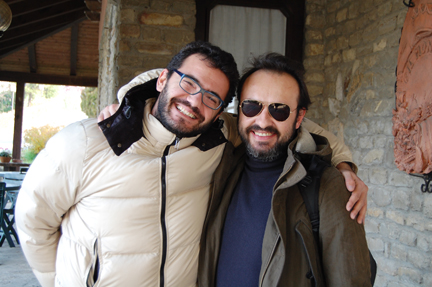
Above: Alessandro (left), Giovanni (right), and I had breakfast in Alta Langa on Sunday morning.

98 Poggio di Sotto unbelievable & the “dinner of dinners” @TonyVallone

Last night, I had the great fortune to be invited to speak at Tony’s in Houston, the namesake and flagship restaurant of my good friend and client Tony Vallone.

He had billed the event as the “dinner of dinners” for 2012 and he didn’t disappoint.

After the welcome wine, we paired 2001 Barolo by Bartolo Mascarello with Alba truffles over tagliarini, my first truffles in this year of drought-impacted foraging.

The 2001 Bartolo Mascarello is simply one of the greatest wines I’ve ever tasted and has many, many brilliant years ahead of it. It had been opened a few hours prior and while it wasn’t entirely generous with its fruit, its elegance and balance are unrivaled.

But the wine that really wowed me was the 1998 Brunello di Montalcino by Poggio di Sotto. I’d been very lucky to taste this wine many times in the past and I was surprised when I saw Antonio Galloni’s tasting note in which he advised that it was in decline. (Antonio’s my favorite Italian wine writer, btw, and while his word is not sacrosanct, I do find his palate to align nearly perfectly with mine when it comes to traditional-style wines.)

This wine had what the Italians call grinta, real grit and spunk… Beautiful acidity and the vibrant dark fruit that you expect from classic expressions of the Castelnuovo dell’Abate subzone of Montalcino.

Tony and his general manager Scott Sulma paired with this medley of guinea hen and Taleggio-stuffed tortellini in brodo.

And wow, I just feel like I need to add a chorus of dayenu as I recount this epic meal. As if the previous two dishes weren’t enough to make his guests swoon, Tony thrilled the room (which reacted with a unanimous gasp as the beef enter the room) with a platter of nearly two-month-aged prime rib.

Dessert — sweet zeppoli stuffed with torchon de foie gras (how’s that for fusion!) paired with 1990 Recioto della Valpolicella by Quintarelli…

I like to joke that Tony’s is an oil moguls commissary. On any given night, you’ll a handful of billionaires in his restaurant — at the very least.

How I ever found my way to a seat at that table, I still don’t really know.

As I sit this afternoon, on the outskirts of Houston in a Starbucks using the free wi-fi and listening to Christmas music as I type and type and type at the keyboard for my clients, I can’t help but take a deep breath and contemplate the extraordinary counterpoints of life.

It’s coming on Christmas
They’re cutting down trees
They’re putting up reindeer
And singing songs of joy and peace

How I ever got here, I’ll never really know. But I sure am thankful for the many gifts life has given me…

Colonization of Cannubi Continues in Barolo

mascarello barolo cannubi

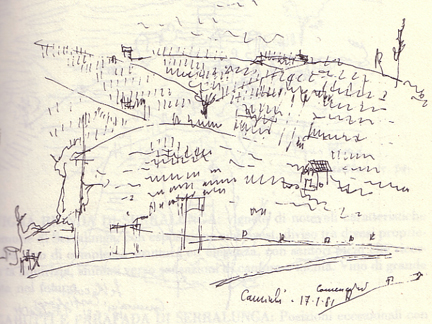
Above: A drawing of “La collina dei Cannubi” (“Cannubi Hill”) by Eugenio Comenicini, 1981 (reproduced from Martinelli’s monograph Il Barolo come lo sento io, 1993).

When Giovanni and I visited the home of Maria Teresa Mascarello and David Berry Green on Saturday for lunch, conversation was dominated by two topics: the primary elections for Italy’s center-left Democratic Party (held on Sunday) and the Marchesi di Barolo’s continued efforts to redefine which vineyards in Barolo can be called “Cannubi.”

For some time now, Marchesi di Barolo has been trying expand the designation, to include adjacent vineyards. Its application to extend the historic vineyard’s reach was thwarted when a group of eleven producers and owners of rows Cannubi successfully petitioned to block the move in June of this year. (Walter Speller delivered this excellent post on the events that lead up to the showdown.)

As Marta Rinaldi — daughter of Giuseppe Rinaldi, one of the eleven wineries who contested the redesgination — reported in this moving post on Intravino, it took a court order to stop the Marchesi di Barolo, whose motive to remap appellation subzones is rooted in desire to exploit the most recognizable crus of Barolo for financial gain.

Cannubi is considered by many to be one of Barolo’s greatest vineyards and one of its most historically significant growing sites. This fact, coupled with foreigners’ ease in pronouncing the toponym (kahn-NOO-bee), have made it one of the most popular (and lucrative) vineyard designations in the appellation.

ferdinando principiano

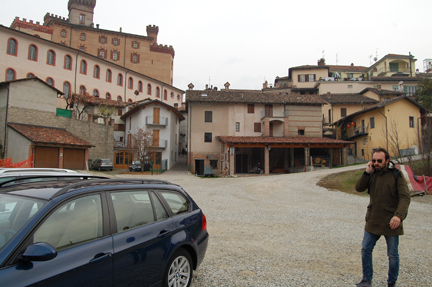
Above: Giovanni and I drove from Brescia to Barolo on Saturday morning.

In October of this year, the Marchesi di Barolo filed an appeal with the court to lift the injunction against them. And its outcome is uncertain.

“On the ground” in Barolo, there is even greater concern regarding the vineyard’s future because the Ceretto and Damilano wineries recently partnered with James Suckling to make a documentary about Cannubi (it was shot during harvest this year). And the movie is to be incorporated, Maria Teresa told me, in a marketing campaign to promote the sale of wines labeled “Cannubi” in the ever growing Asian market, where the thirst for high-end wines seems to know no bounds.

As an owner in Cannubi and one of its most well known producers, Maria Teresa was approached by marketers to participate in the program.

“A campaign like this shouldn’t move forward until the question has been resolved,” she told me. “I’m not going to partner with my quote-unquote enemy… the Marchesi di Barolo in a promotion like this,” noting that the Marchesi di Barolo is planning to be part of the campaign.

Above: Will the color of traditional Barolo be sullied by the green of avarice?

It’s not clear when the court will rule on the Marchesi di Barolo’s appeal and the stakes are extremely high.

As David wrote on his blog last year, “Ernesto Abbona, President of heavyweight Barolo producer Marchesi di Barolo (1.6million bts), is cast in the Machiavellian role making a final desperate grab for vineyard rights. Pitted against him are a band of small growers – let’s call them partisans! – defending the honour of an historical site, Cannubi, row by row, bunch by bunch.”

I’ll be following along closely and will report news as it arrives from Langa. In the meantime, a Google image search for “Cannubi” will deliver a number of photos and maps of this historic vineyard if you’re interested in learning more.

I’ve got so much to tell about my recent trip to Italy, including more on my lunch with Maria Teresa and David. But this was most urgent. Stay tuned…