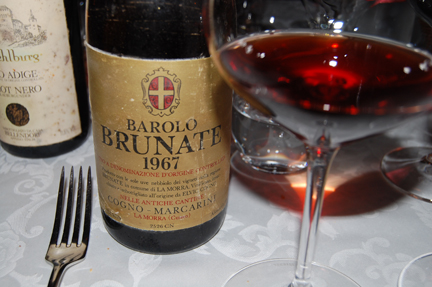
Principiano Barolo & Barbera Romualda thrilled me

From the department of “still catching up on last year’s wines”…
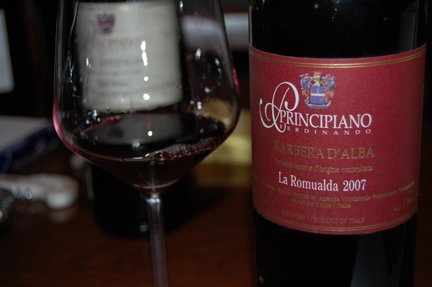
best value barbera alba

Above: Pian Romualdo is a historic cru of Monforte where Barbera trumps Nebbiolo. It’s arguably the best expression of Barbera d’Alba (an appellation where Barbera always takes a backseat to Nebbiolo). Ferdinando’s vines are roughly sixty years old. This wine was incredible.

One of the most thrilling tastings of my 2012 was at the Principiano winery, grower and producer of old school Barolo and historic Barbera in Monforte d’Alba.

When Giovanni and I visited in November, we had the great fortune to taste through the entire line of wines, including some older vintages, with vignaiolo and winemaker Ferdinando Principiano.

Ferdinando’s about my age (mid 40s). His father, he told me, was primarily interested in selling their superb fruit to marquee name bottlers (Prunotto among the most famous). While he made wine, it was never his passion.
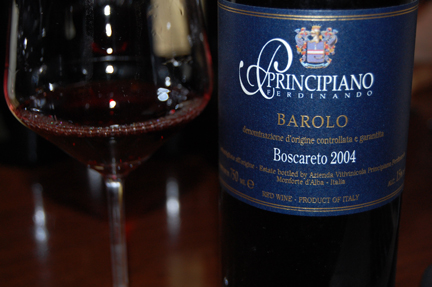
best value cru barolo

Above: This was another highlight for me. In my notes, I wrote “tannic but still so drinkable… rich fruit but there’s a lightness in body that makes it rise up.” Boscareto (or Bosco Areto) is often compared to Francia (as in Cascina Francia) because it lies adjacent to the more celebrated cru. The difference is that I can afford this one.

Ferdinando began making wine there in the 1990s. And after he spent some time flirting wine modern-style Nebbiolo (at the peak of the late 90s Langa boom), he settled into old-school, traditional-style wines by the early 2000s (thank goodness for that!).

Looking back at my notes this morning, I find that “brilliant” and “freshness” reappeared over and over again, a characteristic that Ferdinando attributes (in part) to extremely low sulfuring, which he only applies at bottling.

But beyond Ferdinando’s minimalist approach, it is the fruit, sourced exclusively from his family’s historic vineyards, that is the star here.

I was completely taken with the elegant earthiness and technicolor fruit of these wines.
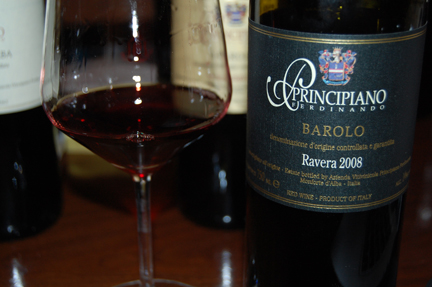
best barolo value monforte

Above: This was my number-one stand-out. Keep in mind, it’s not Ravera from the village of Novello but rather Ravera from Monforte. It was the most “gentle” of his Barolo, I wrote in my notes. Made from the oldest vineyard in the family’s holdings, “it’s what we used to drink at home” in his father’s day, said Ferdinando.

But the most amazing thing about these wines is how extremely affordable they are (including the Barbera Romualda).

I can’t think of a better expression of Barolo, in terms of price and typicity, whether for a middle-class collector like me or someone who is trying to learn about classic Nebbiolo for the first time.

I love, love, love these wines… a Barolo answer to my beloved Produttori del Barbaresco in terms of their classic expression and affordability.
Trinchero Barbera censored by greedy California fascist thugs

sutter home trinchero

The Trinchero family no longer prints its name on labels bound for the U.S.

La reproduction interdite…

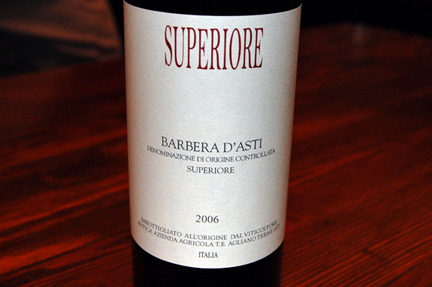
When my friend and client Jeff showed me the new label for Trinchero Barbera d’Asti Superiore (2006 vintage) last night, I thought to myself, either he is playing a practical joke on me or this is a work of surrealist art.

As if plucked from a painting by Magritte or a fountain by Duchamp, a confident label stood before me (above), austere and elegant in its ensemble, yet marred by a glaring omission: A gaping space at the label’s center was bare, unavoidably and inexplicably innominate and anonymous…

Click here to read my post today for the Houston Press on how fascist thugs from California winery group Sutter Home forced the Trinchero family to remove their surname from their label.

Michel Bettane’s diatribe against Natural wine (translation) cc @AliceFeiring

michel bettane

Michel Bettane’s diatribe against Natural wine in the current print-version issue of the Gambero Rosso monthly came to my attention this morning via the popular Italian wine blog Intravino (where I also grabbed the above image of the French wine writer).

The issue also includes an op-ed by editor Eleonora Guerini in which she writes, “every time that I hear someone talk about natural wine, I begin instinctively to laugh.”

I didn’t bother translating her piece (for obvious reasons) but, in the interest of transatlantic dialog, I have rendered excerpts from Bettane’s harangue in English below.

The image of the page comes from the Facebook of Jonathan Nossiter (via @AliceFeiring). Click the image for PDF version.

*****

We sincerely hope that Italian wine lovers will not be subjected to what has been happening in France: an invasion of so-called “natural” wines — in other words, so called “zero sulfur” wines — with the complicity of numerous sommeliers, wine merchants, and irresponsible journalists…

[These winemakers] insist on making wine without sulfur and they peddle their “beverage” as if it were true terroir.

Their products are easily recognizable: the red wines stink and all of their grape varieties and terroirs end up resembling one another because the nasty native yeasts with which they are made — yeasts that greedily cannibalize the good yeasts if the vinifier allows them to do so — are the same yeasts that you find all over the planet. The wines are cloudy and unstable and they show an excessive presence of carbonic gas, giving the impression that the wine is incomplete.

The white wines — when possible — are even worse: more or less oxidized from the moment of birth and therefore stillborn. Their decomposition is then “managed” posthumously! We are amazed by the ingenuousness of the many excellent chefs who now only include such wines on their lists. They are so careful about their food: they should be the first to be ashamed of such rotten wines!

…

It’s up to their clients to point out that what they believe is a wine closer to “nature” is actually nothing more than a bad wine whose only intention is to give you a headache.

With some luck and perseverance, it’s possible to make wines without the addition of suflur. These are simple and very pleasant fruity wines that should be consumed where they are produced. But they need to be stored in a cool cellar and — most importantly — they mustn’t travel!

For every cuvée that turns out well, there will be two or three that are completely wrong.

But who has the means to not sell them and accept responsibility for one’s own errors?

—Michel Bettane and Thierry Desseauve
Gambero Rosso
January 2013

bettane gambero rosso

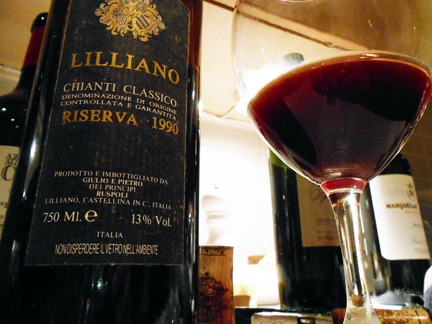
1990 Lilliano Chianti Classico Riserva, the Gambelli touch

From the department of “still catching up on remarkable wines that I tasted in 2012″…

old chianti sangiovese

This extraordinary bottle was the gift of an overly generous friend who sent it to me from Italy, where the bottle once resided in his cellar.

After it had rested in my San Diego cellar for a few weeks in November-early December, I picked it up from my locker and took it to the Jaynes Gastropub staff party on my last visit to California for the year.

There were many incredible wines opened that night, including a 2000 Amarone della Valpolicella from my cellar (always a thrill and always a joy to share).

But the wine of the night was this otherwise unassuming 1990 Chianti Classico Riserva by Lilliano, a venerated but quiet and often overlooked estate in Castellina (one of the core townships of historic Chianti).

It was unbelievably fresh and the fruit wonderfully vibrant and bright. And its singing acidity and judiciously balanced alcohol gave it that gentle zing that makes Chianti — when done right — so food friendly and moreish (we paired with a spread of California charcuterie, cheese, and crusty bread).

One of the most delightful surprises and best wines of my year.

I’ve been thinking about this wine because it was around this time last year that Giulio Gambelli — the legendary “taster” of Sangiovese — passed away (see also this collection of remembrances that I culled from the internets). Gambelli made his mark on so many iconic expressions of Sangiovese of our generation — Soldera, Poggio di Sotto, Monte Vertine, and so many others. But he also continued to consult for taste the wines of many of the historic Chianti estates, like Lilliano (Bibbiano is another one that comes to mind).

There are lightyears between a wine like this earthy and earthly Chianti and ethereal wines like Soldera’s or Poggio di Sotto’s. But there is also unmistakable red thread that unites them: it’s that gentle electricity (I don’t know how else to describe it) that makes traditional Sangiovese so unique in the world of fine red wine.

Many who have followed and observed Tuscan winemaking over the last generation would attribute that signature to Gambelli.

Thank you, FB, for this truly splendid bottle of wine, shared with a group of people I care about deeply.

It reminded me that great Sangiovese was, is, and can always be…

Anti-racist pizza & a studly view of Proseccoland (required reading) cc @Bele_Casel

racist pizza

This “kebab” pizza, prepared by pizzaiolo and restaurateur Alberto Barban of Pizzeria La Torre in Caerano di San Marco (province of Treviso) almost made it into my “best meals of 2012” series.

However delicious, this pizza just couldn’t compete with the many memorables meals of the year.

But it was unforgettable nonetheless: in a part of Italy where xenophobia and separatism sometimes trump human dignity and common sense, the notion of a pizza topped with kebab stands defiantly in the face of often unbridled racism.

Remember: in at least one Italian city, kebab (and kebab purveyors) has been banned from a historic city center. And in many urban areas, kebab and other Middle Eastern street food has been subject to de facto marginalization (you’ll find no kebab stands in the village of Caerano). While young Italians enjoy kebab as much as young people anywhere do in the West (Paris, London, New York, Los Angeles…), the dish has become synecdoche for the north Africans and Arabs who reside in Europe.

When Georgia P, Tracie P, and I stayed in Caerano di San Marco last September, we ate at the pizzeria on three different occasions. And after becoming friendly with Alberto, I asked him to make me his favorite pizza.

We didn’t speak of its underlying social commentary. But I couldn’t help reflect and remark on the fact that it makes perfect gastronomic sense: after all, pizza’s origins fall somewhere in a shared Mediterranean culinary legacy that includes pita and myriad expressions of flatbread.

Chapeau bas, Alberto!

The pizzeria was recommend to us by our friend and client Luca Ferraro, Prosecco producer in Asolo (a short drive from Caerano).

On Luca’s blog today, we posted amazing photos of his mountain bike ascent to a pre-Alpine pass.

italy alps mountain bike

The images are impressive as they are picturesque. But, beyond the studly ascent, I can’t think of a better way to illustrate the unique combination of topography, altitude, and marittime influence that define Proseccoland.

I highly recommend the post to anyone trying to wrap her/his mind around what makes Prosecco, Proseccoland, and the Veneto so special (at least to me).

Buona lettura, yall…

Neb[b]iolo and Politics in 1950s Italy

luigi einaudi vignetta large

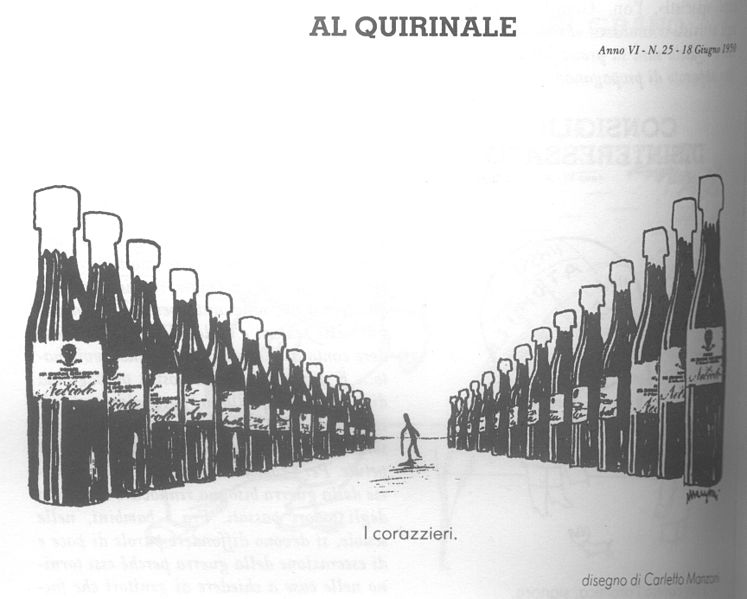
Above: This caricature of the second president of the Italian republic Luigi Einaudi, farm owner and producer of Dolcetto and Nebbiolo, was published in 1950 in Italy. The monarchist publisher was convicted of libel. Click on the image for a larger version and note that Nebbiolo is spelled with one b.

The often workaday nature of my professional life is balanced by my insatiable curiosity and the unmitigated access to all kinds of information via the internets.

Yesterday, as I was roaming around the web and trolling for nuggets about the Einaudi winery in Dogliani (for one of the many restaurant sites that I curate), I came across this wonderful caricature of Italy’s second president (and winemaker), Luigi Einaudi, a figure whom I admire immensely for his opposition to historic fascism.

The Einaudi family has played impressive roles in Italian contemporary history, society, and culture, including Luigi’s son Giulio’s legacy as a publisher (the bookshelves of our home are line with works of literature and critical essays published by Einaudi, including collections of Pasolini’s writings), his son Ludovico’s legacy as a musician, and son Mario’s strident anti-fascism.

In 1950, when Luigi Einaudi became the second president of the Italian Republic, the monarchist review Candido parodied him in the caricature above.

Einaudi is the figure in the center, guarded by corazzieri (a presidential guard of Neb[b]iolo) at the Quirinale, Italy’s presidential palazzo.

The episode reveals how fine wine, and Nebbiolo in particular, was viewed as an elitist indulgence at the time. It also gives us an indication of how wine visionaries like Einaudi (he was among the first to modernize his winery and he was a pioneer in his vision of building the wine export industry in Italy) were seen as misguided.

The satirical message of the vignette is this is how our new president expects to rebuild our country… with wine.

Einaudi sued the publisher for libel and won.

An Einaudi Dolcetto was Eric and Levi’s top pick this week in their The New York Times tasting panel. I’m a big fan myself… for the wine’s traditional and classic style… and for the family’s legacy as anti-fascists and intellectual celebrities…

Best Meals 2012: w/ Frank Cornelissen @SottoLA

We’ve had so much fun sharing new foods with Georgia P and taking her to eat at our favorite restaurants this year. She visited Sotto (above) in Los Angeles twice in 2012. She ate meatballs, long noodle pastas, burrata, and discovered ragù, one of her favorite dishes of the year.

Sotto was also host to one of my most memorable dinners of the year, an event we hosted for winemaker Frank Cornellisen (btw, Levi, I posted some of my notes from the dinner here).

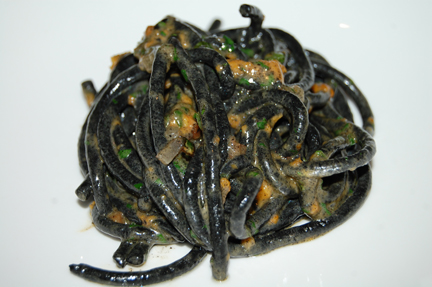
The squid-ink noodles tossed in uni (below) was my favorite dish for the year, for its purity of flavor and for its inspiration (via classic Sicilian cuisine).

I’ll never forget when Frank took a first bite of the food that night.

“This is the restaurant for my wines,” he said.

Best Meals 2012: Sotto (Los Angeles, November).

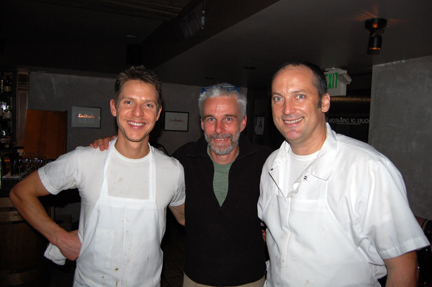
We had a truly epic dinner at Sotto last night with Frank Cornelissen (above with chef Zach Pollack, left, and chef Steve Samson, right).

Even though I’ve followed the wines for years, I’d never met Frank, who was visiting the U.S. for the first time with his wines (he had visited before he started making wine many years ago).

With all the mystery and aura that seems to surround him, I wasn’t sure what to expect. But I discovered that he’s a super cool dude, very approachable and just fun to talk to.

We spoke at length about what he calls the “zoo of Natural wine.”

“Natural wine hasn’t been defined and so we really can’t call wine Natural,” he said, noting that he doesn’t care for the term.

I was thoroughly impressed by his concept of “high definition” wines and I admired the respectful tone with which he spoke of his neighbors on Etna.

He speaks impeccable Italian, btw.

Levi always gets mad at me for doing this but I’m so slammed today (while on the road in southern California) that I’ll have to post my complete notes, including Lou’s thoughts, when I have a moment to catch my breath…

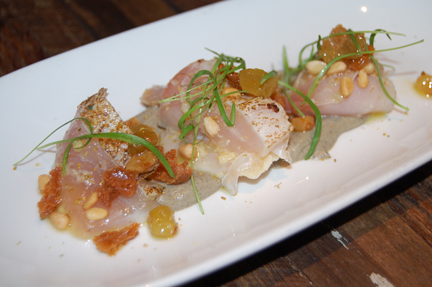
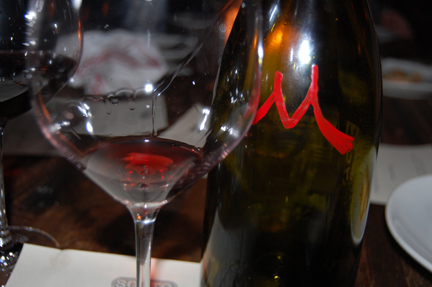
In the meantime, the seared tuna with raisins, pinenuts, and bread crumbs was INSANE (first food photo). And the squid ink spaghetti with uni was possible my top dish for 2012… amazing… And wow, what a thrill to finally get to taste the (declassified) Magma.

Levi, I promise to post all my notes asap!

Stay tuned…

Best Meals 2012: Tony’s with @TerraUomoCielo

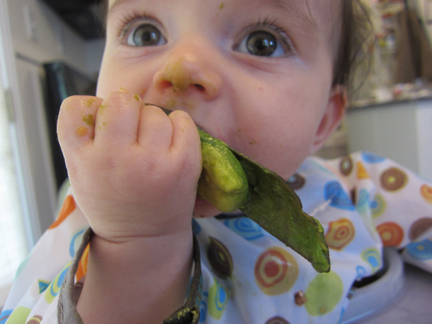
Tracie P and I have had so much fun sharing new foods with Georgia P this year. Leafing through posts on favorite meals this year, I am reminded of my friend Melanie Rehak’s wonderful book Eating for Beginners, where she chronicles her young son’s food awakenings along with her own.

The above photo of Georgia P, where she’s eating avocados for the first time, was taken around the same time that I visited one of my favorite restaurants in the world, Tony’s in Houston, owned by my friend and client Tony Vallone. The occasion was bromance Giovanni’s first visit to Texas.

Best Meals 2012: Tony’s (Houston, June).

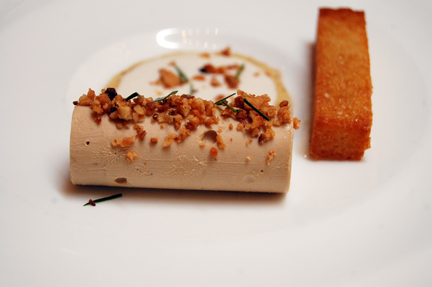
Above: Tony’s foie gras au torchon is one of his signatures and one of the dishes where simplicity and purity of flavor is offset by detail in the presentation.

How could Giovanni’s visit to Texas be complete without a meal at Tony’s in Houston?

Tony is my client (I curate his website and his media relations) but he’s also become one of my best friends in Texas and he is the architect and author of some of the most stunning meals I’ve ever had. Yesterday, Giovanni and I drove to Houston to meet Cousin Marty for lunch and a confabulatio that centered around… yes, of course… food and wine…

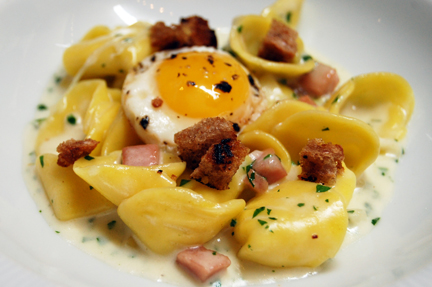
Above: Orecchiette with seared mortadella cubes and runny quail egg.

The secret to the rich yellow color of his pasta, said Tony, is locally sourced, organically farmed eggs. “But it’s also the fact that I use only flour and mineral water imported from Italy,” he added. Some would argue that sparkling mineral water is key to super pasta like this. But Tony insists that still water (acqua naturale) is a sine qua non.

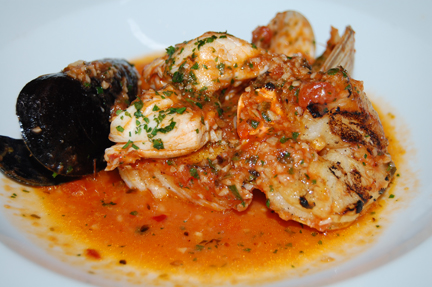
Above: Halbut and seafood medley “al Mare Chiaro,” named after the neighborhood in Naples.

Tony’s is the only place in Texas where we eat fine seafood (a category we reserve otherwise for our trips to California). This dish was simply stunning in its simplicity and presentation (and my camera didn’t do it justice, frankly).

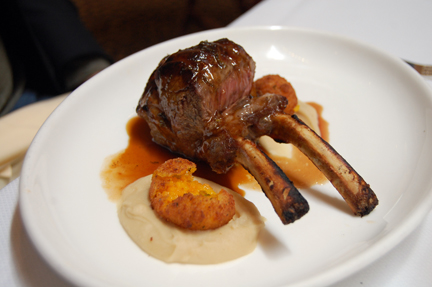
Above: Lamb chops.

Tony likes to tease me, calling me the chiodo (the nail) because I’m so careful about what and how much I eat. Lamb chops would have been a bit much for me for a Tuesday lunch but Giovanni dove in with gusto.

Above: General Manager and wine director Scott Sulma’s selection was right on.

And the wine? A tall order considering the fact that one of Italy’s top winemakers was seated at our table. And let’s face it, my general disdain for the Californian style is well known to my colleagues at Tony’s. But it also seemed right to have Giovanni taste something from my home state. GM Scott’s selection, Palmaz Vineyards 2007 Cabernet Sauvignon, delivered acidity, earth and gorgeous dark fruit, and balanced alcohol and wood. It was superb with the Bucatini all’Amatriciana that I had as my second course, playing beautifully against the savory guanciale in the dish. Chapeau bas, Scott!

Above: Nobody does it better than Tony.

I can’t conceal my pride in sharing the Tony’s experience with my good friend Giovanni, who made the trans-Atlantic crossing to see, hear, taste, and feel what life is like in Texas, California, and America.

Above: Two of my favorite fressers.

Thanks, again, Tony for yet another fantastic meal and an unforgettable experience. Ti ringrazio di cuore…

Best Meals 2012: Scarbolo’s Frasca

Our 2012 delivered more than a fair share of opulent meals. But looking back on our annus gastronomicus, the most memorable repasts — more often than not — stand out in my mind for the purity of their ingredients and the marvel of discovery, like Georgia P’s first encounter with burrata and ripe peaches (above) or this meal at one of my favorite restaurants in the world, Scarbolo’s Frasca…

Best Meals 2012: Valter Scarbolo’s Frasca (Lauzacco, province of Udine, April).

Valter Scarbolo makes wines in Grave and so there was no way for me to include him in the Colli Orientali del Friuli 2012 blogger project itinerary. But there was no way that I was coming to Friuli without spending an evening with him at his amazing Frasca. I’ll have to recount our conversation on Pinot Grigio and his 1995 trip — his first — to the U.S. in another post when I have more time. In the meantime, here’s what we ate…

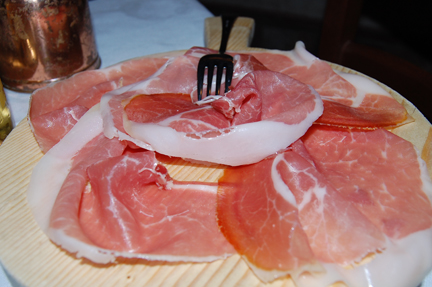
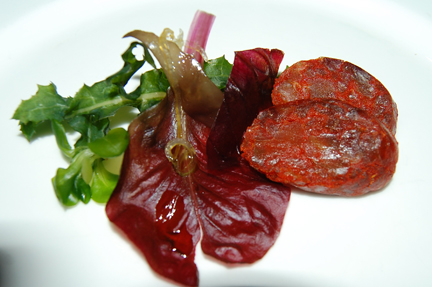
As James Bond would say, “if it’s Prosciutto d’Osvaldo, you must have been expecting me.”

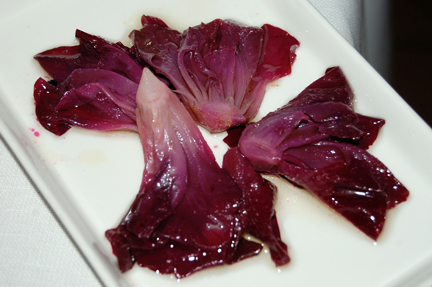
Rosa di Gorizia (Rose of Gorizia), a radicchio cultivar unique to Gorizia that resembles a rose.

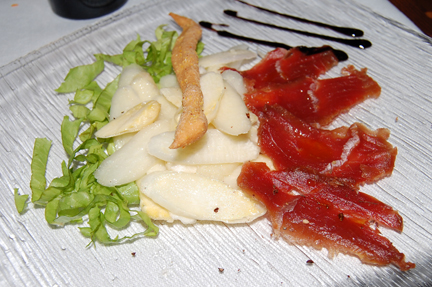
White asparagus is in season. Valter served it raw, thinly sliced, dressed with extra-virgin olive oil and accompanied by delicately marinated goose breast. “It had to be extremely fresh,” he said, “to serve it raw like this.”

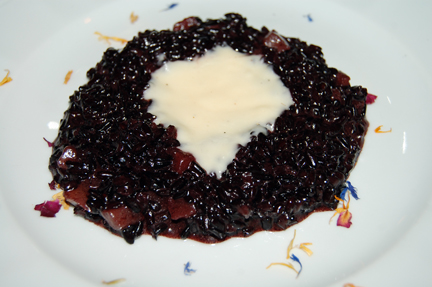
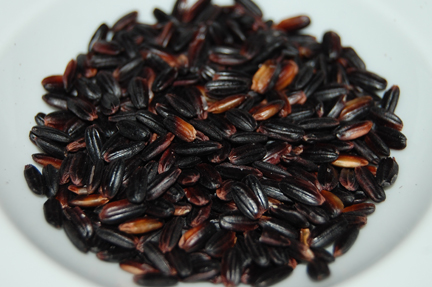
Riso nero Venere (black Venus rice) is a hybrid of Asian and Italian cultivars and, besides being delicious, is purported to have health-enhancing properties. Valter makes his with formadi frant, the truly unique, piquant cheese made from discarded and otherwise imperfect cheese — an ingredient that appears repeatedly in his cooking.

I asked Valter to show me the rice uncooked.

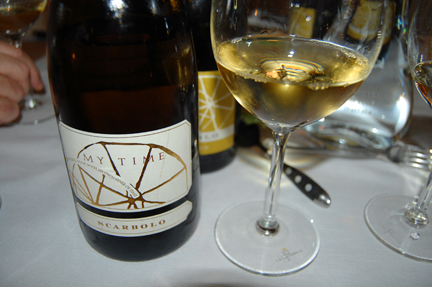
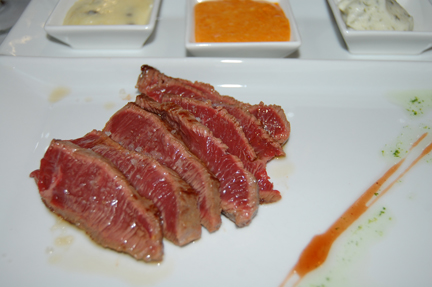
His My Time is always a treat to look forward to. The 2009 was unctuous and richer than previous vintages I’d tasted. And while it will undoubtedly become more elegant with some bottle age, its more muscular expression paired well with blood-rare pan-roasted and thinly sliced Prussian rumpsteak served with herbed formadi frant and montasio cheeses.

I’m posting this from the Colli Orientali del Friuli where the COF2012 trip has just begun… Stay tuned!

Best meals 2012: Le Logge (Siena), first visit

homemade pizza orange texas

Looking back on the best meals of 2012 (a mnemonic indulgence to which I treat myself every year between the Christmas holiday and New Year’s Eve), I can’t help but think about how the standouts were marked as much by the people with whom I shared them as much as the foods we ate and the wines we drank. Isn’t that what it’s all about?

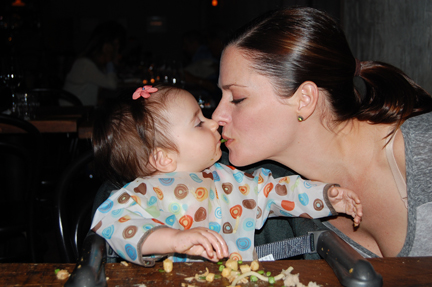
That’s Georgia P, above, eating her first pizza (homemade, by Tracie P, of course), a few nights before Christmas. Whether Parisi eggs and birth-year Barolo or mushroom and peperoni pizza, 2012 delivered some of the most memorable meals of my lifetime. Buona lettura e buon appetito!

Best Meals 2012: Osteria Le Logge (Siena, March).

Alfonso and I met up in Siena yesterday afternoon and joined good friends Laura and Francesco at Laura’s restaurant Osteria Le Logge for dinner.

As I prepare to head up to Friuli today, there’s not enough time to post properly on the brilliant meal and stunning flight of wines. But here’s a “taste” of the “intellectual provocation”… THANK YOU, again, dear friends, Laura and Francesco, for opening your hearts to two weary Americans traveling along the wine trail in Italy…

Atlantic croaker sausage with mineral-water-macerated lettuces sous-vide

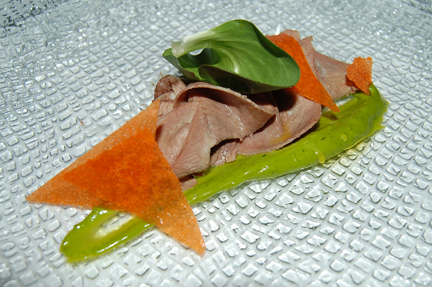
veal tongue Carpaccio in salsa verde

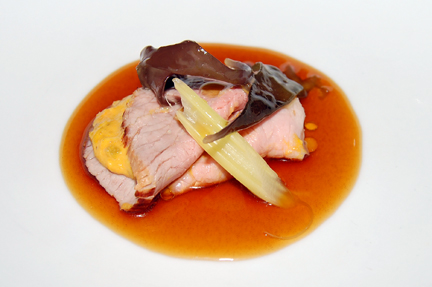
vitello tonnato with seaweed and ポン酢醤油 (ponzu jōyu)

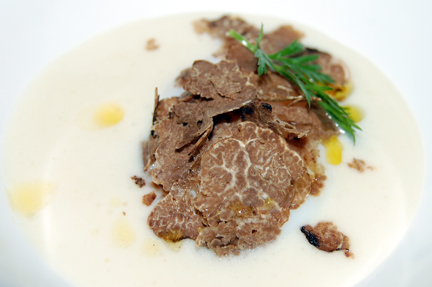
Parisi egg with potato foam and marzolino truffles

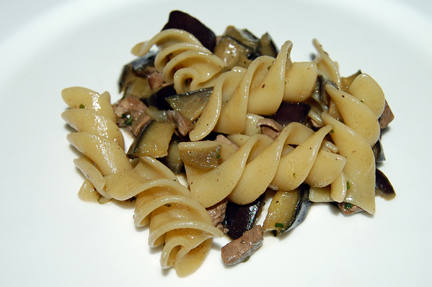
fusilli with chicken livers and eggplant

Marcarini 1967 Barolo Brunate