And when in Brescia, at the Osteria al Bianchi, here’s what you pair with expertly sliced prosciutto…
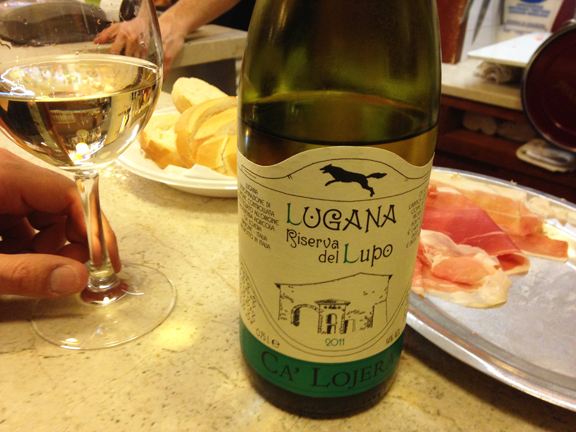
A delicious Lugana (from Torbiana or Trebbiano di Lugana) by Ca’ Lojera, the winery’s top-tier Lugana del Lupo.

And when in Brescia, at the Osteria al Bianchi, here’s what you pair with expertly sliced prosciutto…
A delicious Lugana (from Torbiana or Trebbiano di Lugana) by Ca’ Lojera, the winery’s top-tier Lugana del Lupo.

I love my job but it’s not as glamorous as it sounds.
The travel is draining and now, more than ever, it’s so hard to be away from my girls.
And the Italian wine trade fair, as anyone in the business knows, is a major slog.
And so, it was wonderful to be welcomed in Brescia (where I’ll be staying during the fair) with open arms, a glass of Franciacorta, and BBQ party in my honor by my bromance Giovanni Arcari (aka Terra, Uomo, Cielo).
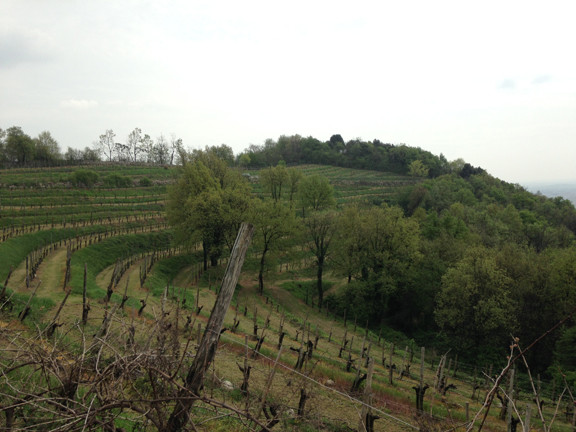
The setting was the Arcari-Danesi winery (that’s one of the property’s vineyards above, a south-facing amphitheater). Giovanni and his partner Nico Danesi acquired the site a few years ago and are slowly building a new home for their new eponymous label. They are Franciacorta consultants who help growers vinify, bottle, and market their wines. And now they have begun to grow their own grapes and bottle under their own label.
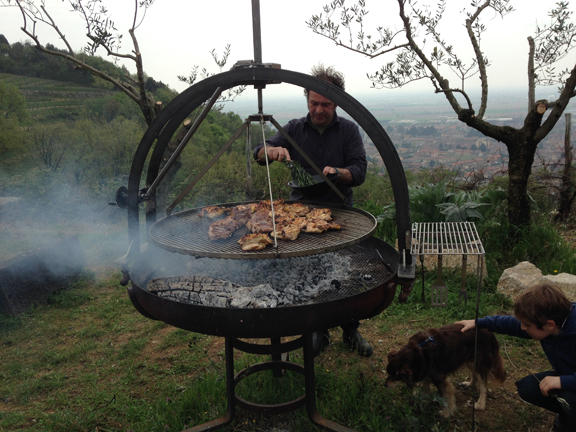
The chicken was grilled first. Giovanni’s dad, Gigi, built that grill. The upper grill rotates. It’s a brilliant idea (I told him he should patent it).

Then sausage patties, pork ribs, and bell peppers. Note how the griller used a bunch of rosemary to brush the meats with olive oil.
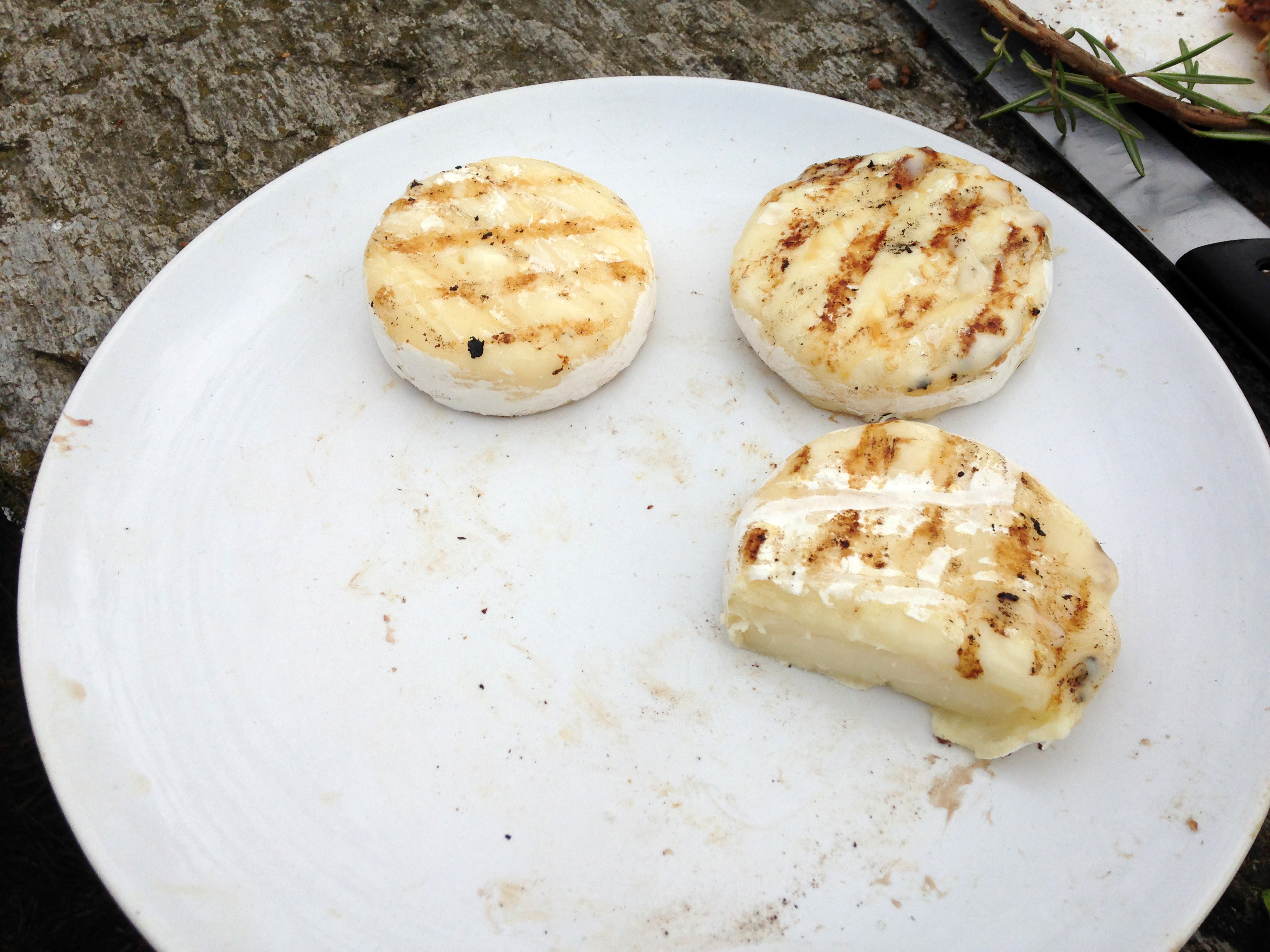
Grilled tomino for dessert.
All of my friends from Brescia came, including the city’s new vice mayor, Laura Castelletti. She and I decided that we should open a Brescia consulate in Houston (with me as consul, of course).
Thank you so much, man. It was a bright moment for a weary traveler who misses his home.
Ragazzi, coraggio! Tutti al Vinitaly!

On Friday, as Francesco and I were driving down to Montalcino from Siena, I couldn’t help but overhear him as he attempted to expedite a shipping of classic Sienese cookies and cakes to a client in Faenza in Ravenna province in Emilia-Romagna (I was driving).
Now that Francesco’s wine shop is part of the historic Nannini patisserie in Siena, he helps out with shipping logistics.
A customer’s package had been lost. And she was desperate to receive the cookies and cakes because she was throwing a milestone party celebrating “her second life”: ten years ago she suffered and survived an aneurysm and she had invited loved ones to commemorate the ten years since this blessing.
She is originally from Siena and the pastry was a sine qua non and centerpiece of her gathering.
The delivery had been scheduled for Thursday. But after a mishap in Florence, the courier reported that the package wouldn’t arrive until Monday.
Knowing that I would be driving north the next day and that I would be passing not far from Faenza on my way to Brescia, I offered to become a Nannini employee for the day.
And so signora Carla and I spoke on Saturday morning and coordinated a handoff on the highway, just south of the Modena Sud exit.
And this is how some ricciarelli from Siena made the world a better place.
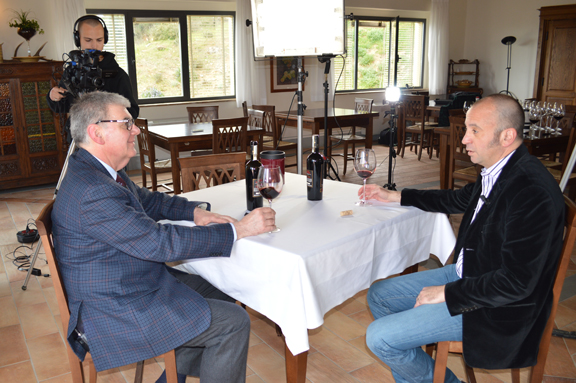
Yesterday found me in Sant’Angelo in Colle at the Tenuta il Poggione, producer of one of my favorite expressions of Brunello di Montalcino.
My good friend and mentor Francesco Bonfio (left) had asked me to appear with him in a short film that will be part of a new installation at his wine shop’s new location in Siena (as part of the historic Nannini pastry shop in the city’s center).
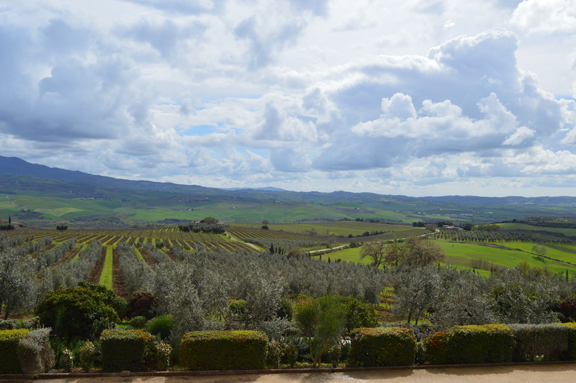
It was incredible to drive through the preternaturally green Tuscan countryside on our way from Siena to Montalcino.
Unusually warm temperatures, a lack of colder temperatures, and high amounts of rainfall have brought spring early here.
That’s the view from the dining room at Il Poggione where we shot yesterday.
As beautiful as it is, the vibrant color doesn’t bode well for the vintage: if the growing cycle isn’t decelerated, the grapes won’t have sufficient time to ripen as slowly as winemakers would like.
But as one winemaker noted this week in Chianti Classico, the story has yet to be written and things could change from one day to the next.

Francesco and his lovely wine Marina treated me to dinner at the excellent Ristorante Casalta in Monteriggioni, where Chef Lazzaro Cimadoro and his wife Barbara also run a great little hotel.
Many Americans think that Tuscan cuisine is centered solely around pork and beef, but the seafood here is always abundant: Cecina, on the Tuscan coast, lies just an hour and a half away by car.
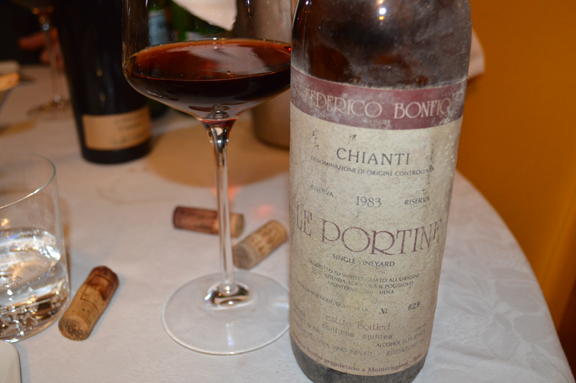
The biggest treat of the evening, beyond the food and lively conversation, was Francesco’s last bottle of Federico Bonfio Chianti from the 1983 vintage.
Man, this wine was light and bright and right on, with gorgeously balanced alcohol and acidity. Francesco and I paired with delicious roast squab. The fruit in this baby sang.
Today, I’m headed to Brescia where I’ll be staying during Vinitaly (and commuting to the fair).
More enogastronomic adventure to come. But not before I stop off for a brief visit near Bologna to perform a mitzvah.
Stay tuned…
I have enjoyed the immense fortune of meeting and tasting with one of Italy’s greatest winemakers, Giorgio Grai, on a few occasions.
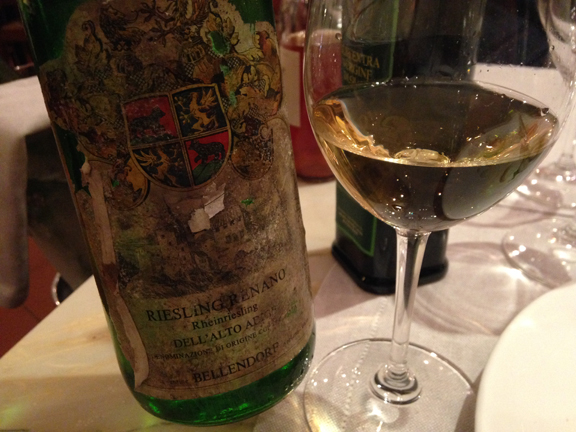
But I have also been blessed by the even greater fortune of tasting older vintages of his wines, like the 1985 Bellendorf Alto Adige Riesling Renano (Rheinriesling) that my friend and mentor Francesco Bonfio opened for our table last night in Siena.
Just look at the color of that wine!
It was fresh and bright in the glass and as it warmed up, it revealed layered, nuanced notes of minerality laced with white and stone fruit. To taste it blind, you would have thought it were ten years old.
There isn’t a winemaker in Italy today who doesn’t owe something to Giorgio Grai, an icon in his own time. And in an era when Italian wine is increasingly dominated by international monochromatic tastes, young winemakers continue to look to him as the benchmark, one of the authors and architects of Italy’s wine renaissance.
As much as I cherish the memories of my few, brief encounters with him, the wines speak even more loudly in my mind. They have left an indelible impression that has informed and shaped my palate and my perception of Italian wine’s greatest expression.
Thank you, Francesco. I am eternally grateful.
Most years, my annual trip to the Italian wine trade fairs begins in Venice. But this time around, I started out in Rome because I’ll helping a friend with a video project tomorrow in Tuscany.
It was also an excuse for a much overdue realtime meeting with Hande Leimer, aka Vino Roma, and her lovely husband Theo, a wine nerd in his own right. Hande is a Rome-based wine educator and super cool lady with whom I’ve enjoyed a virtual friendship for a number of vintages now.
As it turned out, friend and Italian wine writer extraordinaire Monica Larner was in town (ever the jet-setter, she was between trips to Bolgheri and France) and so she joined us last night at the Gatta Mangiona — the “glutton cat” — Hande’s choice for our get together.
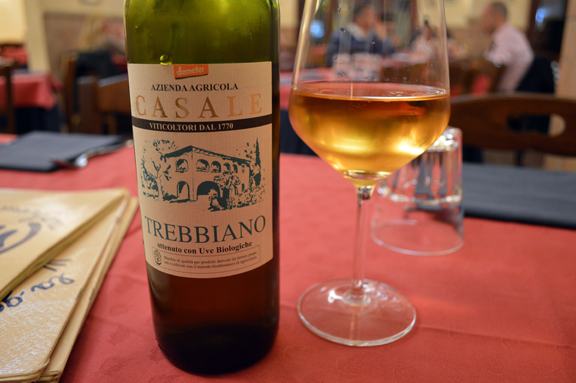
Posting in a hurry (as always from the road) but I just had to share the joy inspired by the entirely groovy wine list at this excellent Roman trattoria/pizzeria, where they serve a Neapolitan pie.
The gently macerated Casale Trebbiano d’Abruzzo (above) was lip-smacking delicious (who imports this in the U.S.?)
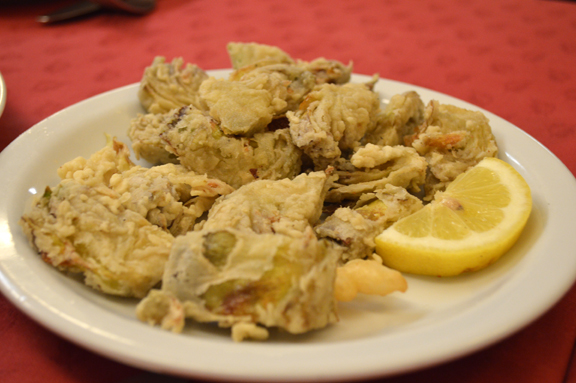
Some might say that fried artichokes aren’t ideal when tasting wine. To them I say, when in Rome… you find artichokes everywhere. These were so tender.
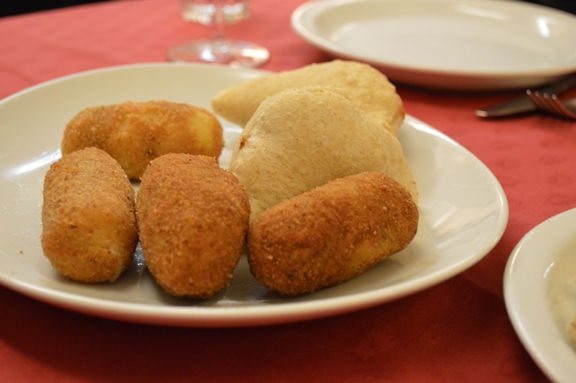
Classic Roman supplì and calzoncelli.

What a thrill for me to get to taste the 2007 Ribolla Gialla by Terpin, one of the Friulian radicals! (I don’t believe that it’s available in the U.S.) It was tannic and very closed but by the end of the bottle its gorgeous fruit had begun to emerge.
This place is a dream for people who dig this kind of thing (like me).
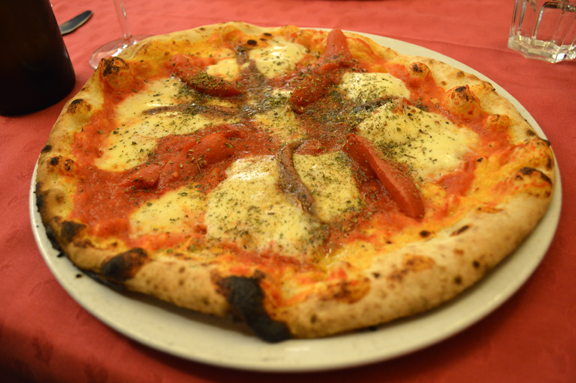
The pizza is Neapolitan in style. I had to do the Romana (my go-to because I’m a lover of salt-cured anchovies). I loved how they did raw pelati combined with seasoned passato. I could eat (and drink) here every night.
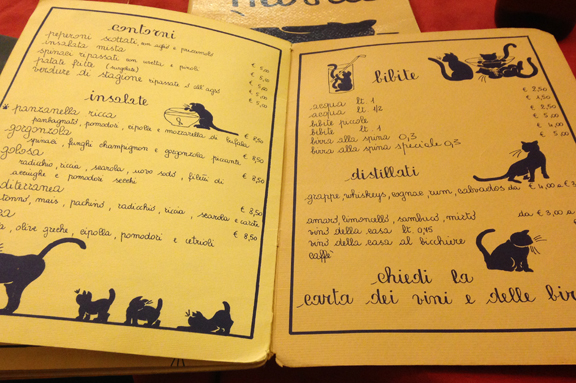
The “fat cat” also wins the award for cutest menu design.
Hande had reserved for us at 8:30. By 9:30 it was packed (and I believe reservations are required). I highly recommend this place. I loved it.
I’ll post more on our Roman adventure when time permits.
In the meantime, thanks again Hande, Theo, and Monica for making the first night of my trip so memorable! A truly unforgettable evening…
Stay tuned… posting from Siena today…

Landed early this morning at Roma Fiumicino and took a regional train from the airport to Trastevere, a roughly twenty-minute ride for €8.
Checked into my budget “four-star” hotel, washed up, took a stroll, ate a sandwich (thinly sliced prosciutto cotto and mozzarella on delightfully unctuous focaccia) and had a coffee before returning to my room, where I’ve been working all afternoon.
Snapped the above photo in this working-class section of Rome, the edge of Trastevere, where you won’t find a lot of tourists.
I love how the Eternal City teems with gardens and plants, like those you can see hanging from the terraces in the photo above.
It reminds me of how, even in Italy’s supreme urban environment, this narrow strip of sun-drenched land in the upper Mediterranean is one of G-d’s gifts to humankind.
I’ll be heading out shortly for dinner with some wine folks… tomorrow on to Siena… stay tuned…
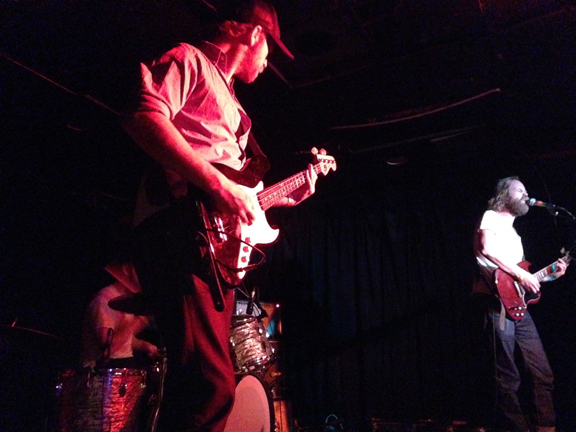
Above: my buddies Lain, Jennings, and Van Carney. They’re from the Blue Ridge Mountains and they form the band Pontiak. I caught their set on Tuesday night in Denver. Their record is doing well in the U.S. and in Italy they are huge stars (no joke).
The month of March is finally coming to a close.
Work has taken me to Atlanta, Chicago, Los Angeles, Boulder, and Denver, and next week I leave for Italy for the Italian wine trade fairs and scores of meetings with clients, friends, and colleagues.
I’ll land in Rome where I spend the night. Then on to Siena for a few nights and a short documentary that I’ve been asked to appear in.
Then I head to Brescia… Then Verona for the fair…
I know, I know: it’s starting to sound like “Kiss me Kate”…
When I caught the Carney brothers set in Denver on Tuesday night, in a club where my band once played a raucous New Year’s Eve show, my mind was filled with memories of my life as a working musician on the road, in the U.S. and Italy.
I miss the shows and the people but I can’t say I miss the travel: now, every day on the road is a day away from the family I love, the family that loves me.
But I can’t complain: business is going well and there always seems to be something interesting in my glass for me to taste and to share.
I’ll be taking a few days off from the blog as I get ready for my next adventure in Italy. Thanks so much for being here and for following along. It means the world to me that people enjoy the bog and find it useful.
I’ll see you next week on the other side…
We open in Venice,
We next play Verona,
Then on to Cremona.
Lotsa laughs in Cremona.
Our next jump is Parma,
That dopey, mopey menace,
Then Mantua, then Padua,
Then we open again, where?

Above: career newspaperman Ricardo Baca — music and film writer, entertainment editor, a twelve-year veteran of the Denver Post’s staff, began forging a new language when he was tapped by the paper to launch the Cannabist, an online column devoted to the evolving marijuana culture in Colorado.
In his landmark essay “Éléments de Sémiologie,” originally published in French in 1964 (and translated into English as Elements of Semiology in 1968), critical theorist and semiotician Roland Barthes wrote on the nature of language and writing using culinary parlance as an example of the equilibrium between “collective usage” and “idiolect.”
“The alimentary language is evolved only from a broadly collective usage, or from a purely individual speech,” he observed.
“One might consider cookery within one family, which is subject to a number of habits,” he proposed, “as an idiolect,” or a language intelligible only to one person or, in Barthes’ application of the terms, to an intimate family unit.
(Here’s an online translation of the first half of the essay posted on Marxists.org.)
This notion echoed a theme addressed in a previous work, Writing Degree Zero, in which he criticized the socialist realist writers of his time for their reliance on literary cliché: writing is always a balance between “collective usage” and the purely intimate language of the individual, he wrote.

Above: the housemade pâté at Coohills in Denver, where Ricardo and I met for glass of wine earlier in the week.
These notions on the nature of language and writing were on my mind when I met with Ricardo Baca (above), who made history last year when he became the editor of the first mainstream column on the culture of marijuana: the Cannabist, published online by the Denver Post, the city’s “paper of record.” Since the launch, Ricardo has appeared on the Colbert Report, MSNBC, NPR, and has been featured in the New York Times and the Boston Globe, among other high-profile mastheads.

One of the fringe benefits of my new gig writing for Brett Zimmerman’s Boulder Wine Merchant is access to one of my favorite restaurants in the world, Frasca, in Boulder.
That’s Brett’s fellow Master Sommelier Bobby Stuckey (right), with his father (left), in case you didn’t notice the resemblance.
I’m a big fan of Bobby’s dad.
I traveled with Bobby in Italy in 2010, not long after their family’s home state, Arizona, passed legislation that required law enforcement to determine people’s immigration status during a “lawful” stop. (See the Wiki entry on the controversial law here.)
After the law’s passage, Bobby’s dad had issue pins printed up. A simple white button with black typeface, the pins read “I could be illegal.”
I still wear my pin proudly on my camera bag, which follows me nearly everywhere I go. And I was thrilled to meet Mr. Stuckey and thank him for his subtle yet powerful protest of this dishuman law.

I didn’t have time for a proper meal at Frasca. But there was no way I was leaving Boulder without a taste of the restaurant’s charcuterie plate, dressed with Prosciutto di San Daniele, speck, and cacciatorino.
 Do Bianchi