Best artisanal beer and best burger I tasted on my April trip to Italy

Facebook friends: you can see photos from Lila Jane’s baptism here.

best micro brewery italy

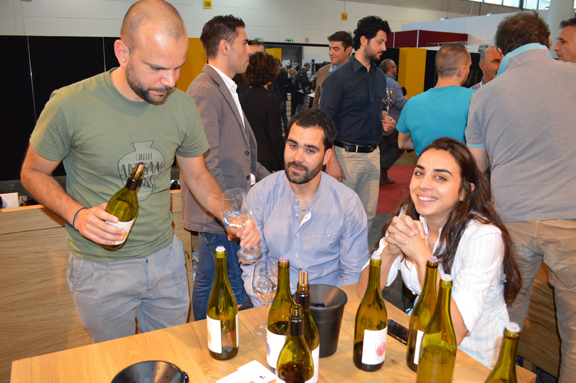
Anyone who’s ever attended the annual Italian wine trade fair, Vinitaly, in Verona, knows that after a day of tasting wines nonstop, you crave beer. I’m not sure why this is. But it’s widespread phenomenon among trade people who are tasting and spitting wine all day at the fair.

This year, my fair was more about schmoozing than it was about tasting but I still managed to get in 40-50 wines every day I was there (in years past, when I would go on buying trips, I would taste up to 90 wines a day, spitting all the while, of course).

By the Tuesday night of the fair, our palates were completely fried. Our teeth were stained purple and our gums were numb from tannin.

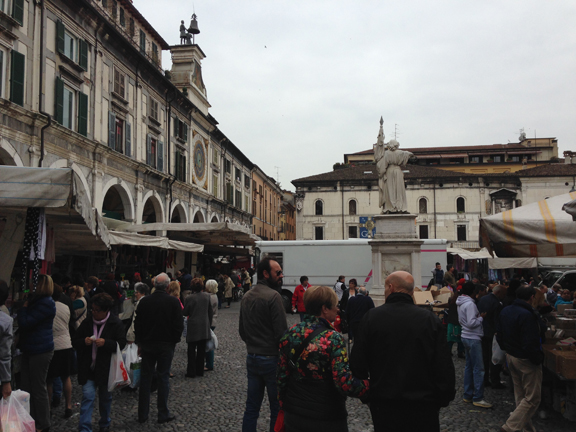
So Giovanni and I decided to go out for a beer and burger in Brescia, where I was staying and where he lives.

A lot of folks don’t realize that there is a beer and brewing renaissance happening in Italy right now. Artisanal beers, natural beers, “extreme” microbreweries, and a lot of downright delicious beers. 32 Via dei Birrai is probably the most well-known label in the U.S. But in Italy, there are literally hundreds and hundreds of microbreweries that find their way to market.

I really loved the Rurale by the Birrificio Montegioco (from the village of Montegioco in Alessandria province, Piedmont). It showed a wonderful balance of citrus and herbaceous notes with a peppery finish. It had rich texture and an overall wholesome character that really took it over the top for me.

best hamburger italy

It paired beautifully with the Hamburger Rustico at the Bar Torre d’Ercole in the historical center of Brescia.

I’ve written about the new wave of hamburger mania in Italy today.

Milan may be its epicenter. But Brescia, where the quality of beef is marvelous and where locals love to indulge in steak and hamburger, is another flash point in the Italians’ burger mania.

The quality of this beef was great and it was perfectly grilled: crunchy on the outside, with a charcoal note; rare to medium rare inside with just the right amount of fat to keep it juicy and tasty.

The rustico at the Bar Torre is stopped with melted cow’s milk cheese (I’m not sure which Lombard cheese it was), arugula, and onions that had been caramelized with juniper berries.

Bacon is optional and the server asked us if we wanted “bacon,” using the English term even though we were speaking in Italian.

The Italian beer revolution actually began more than twenty years ago in the Veneto (I remember well because I was touring with my cover band there then).

But even five years ago, it would have been difficult to find a burger of this quality in Italy.

All in all, a great way to end another long day at the fair with one more day to go.

I’ll start posting on the wines I tasted tomorrow, I promise!

Thanks for reading… Buona Pasquetta, as the Italians say! Happy day after Easter!
Happy holidays, everyone! A special Easter for the Parzen family

best colomba easter cake italian

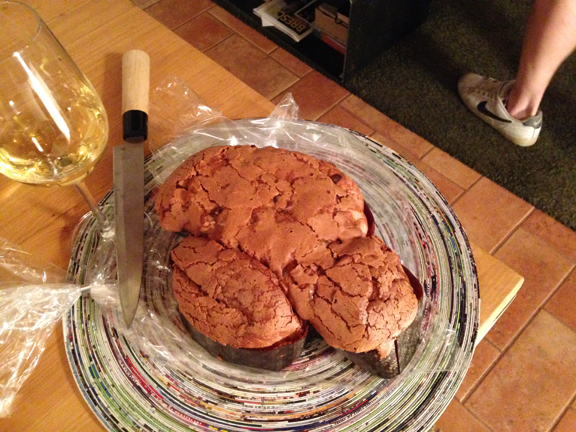
Above: a Colomba di Pasqua, the “Easter Dove,” a traditional Italian Easter cake by Iginio Massari, one of Italy’s favorite pastry chefs. My friend Laura Castelletti, the vice-mayor of Brescia, Italy, graciously shared it with Giovanni and me last week while I was visiting their city.

It’s going to be a very special Easter for the Parzen family this year.

This Easter Sunday, Lila Jane will be baptized by her grandfather, “pawpaw,” Rev. B, at the Wesley United Methodist Church, where he presides as Pastor, in Orange, Texas, where Tracie P grew up. Lila Jane will be nine months old on Tuesday.

methodist pastor

Above: Rev. B holding Lila Jane in our garden at the new house in Houston.

I wish you all could have seen the grin on Rev. B’s face when we decided that Lila Jane would be baptized this Easter Sunday.

“We haven’t had an Easter baptism in a long time,” he said with his contagious smile.

This spring, I’ve been thinking a lot about what the season represents, no matter what your beliefs: delivery from bondage, redemption, renewal…

Just as the vine begins again to bud and flower each year, the yearly cycle of life reminds us to take stock in what has come before and what lies ahead.

Nature reflects our rhythms because, after all, no matter how removed we are from her, we are inexorably linked to her syncopation. All of the springtime observances derive, ultimately, from our connection to her.

Continue reading

Wine, Easter and the Passover: the miracle of the grape vine

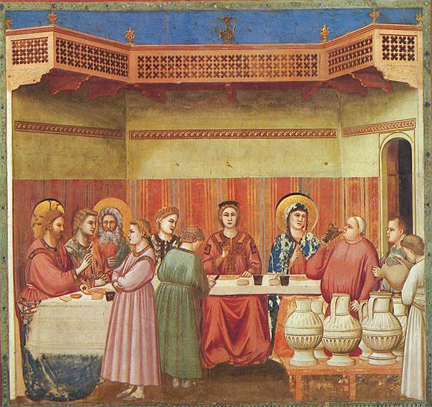
giotto marriage at cana

Above: Giotto’s “Marriage at Cana,” 14th century (image via Wikipedia).

We all know the story of Jesus turning water into wine at Cana, as recounted in the Gospel According to St. John.

The miracle is significant, of course, because “it is the first of the seven miraculous signs by which Jesus’s divine status is attested, and around which the gospel is structured” (Wikipedia).

But therein is also another miracle, a human and much more mundane one. According to Jewish tradition, a marriage cannot be performed without a blessing over the wine. Had Jesus not transformed the water into wine, there would have been no marriage that day.

Anyone familiar with Jewish liturgy knows that a blessing over the wine and a sip thereof is a fundamental element of nearly all Jewish ritual. Neither wedding nor circumcision can be performed without wine; the Sabbath cannot be welcomed without wine; a young person cannot become Bat or Bar Mitzvah without wine.

Here’s the short version of the blessing “over the wine,” the Kiddush or sanctification:

“Blessed are you, Lord, our God, sovereign of the universe, Who creates the fruit of the vine” (click here for the complete Sabbath Kiddush).

Why was wine so important in Jewish liturgy at the time?

Please click here to continue reading my post for the Boulder Wine Mechant.

And Happy Easter and Hag Sameach to all!

Wines that Italian wine bloggers liked at #Vinitaly @Intravinocom

Please also check out Alfonso’s post on the newly unveiled upper-tier Chianti category Gran Selezione. Definitely worth reading.

vinitaly verona 2015

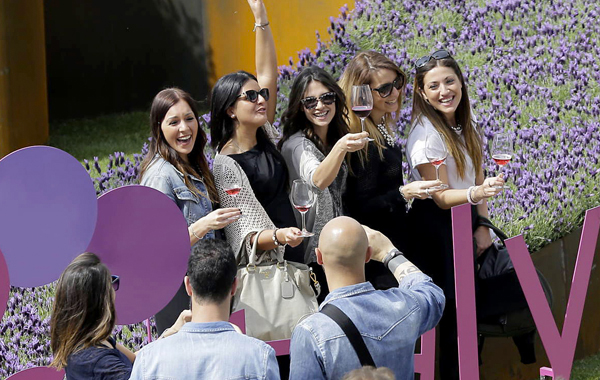
Above: yes, it’s true, that’s what Vinitaly is really like (image via Intravino).

The blogging team at Italy’s most popular wine blog, Intravino, takes a lot of shit from the Italian wine establishment.

Many say that its content can be overly sensationalist in nature (and, as for most Italian food and wine blogs, it can be at times).

Others accuse it of subversive tendencies.

I, for one, am a fan of subversion and often partake in it myself.

Like it or not, over the last few years, Intravino has emerged as Italy’s most widely followed wine blog. It has an extremely loyal following that easily outpaces that of the mainstream wine media who cultivate an online presence.

And each year at Vinitaly, Intravino hosts a lovely meet-and-greet event, where nearly everyone, from nearly every walk of the Italian enoblogosphere, gathers for a glass of wine (it was hosted by the Franciacorta consortium this year).

Yesterday, the Intravino editorial staff published a multi-author post on its stand-out wines at Vinitaly 2014 (in Italian).

Read the Google Translate version here.

Italians’ favorite (Italian) wines don’t always align seamlessly with American’s favorite Italian wines. In fact, Italians are often nonplussed by the wines that American media embrace as “best” or “authentic.”

You might be surprised by some of the wines that you’ll find among the Intravino editors’ picks. And I hope you’ll check it out (especially if you’re an importer looking for new properties).

As Intravino’s Foucault-inspired motto goes, un altro vino è possibile: an other wine is possible (space between an and other is mine).

Thanks for reading. I’m still catching up and catching my breath in the wake of my trip. But I’ll begin posting my favorite wines from the fair starting next week. Stay tuned…

Arrivederci, Roma. Now it’s time to head home…

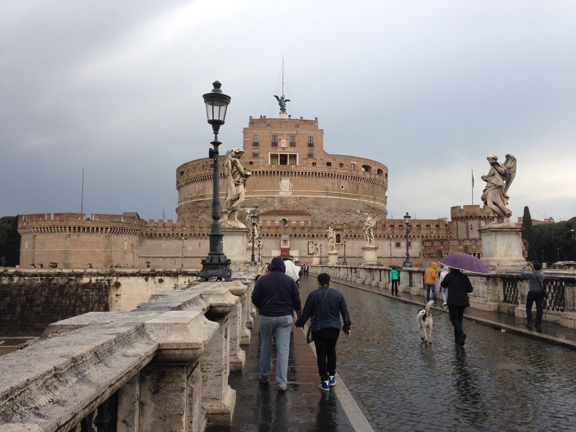
castel sant angelo rome

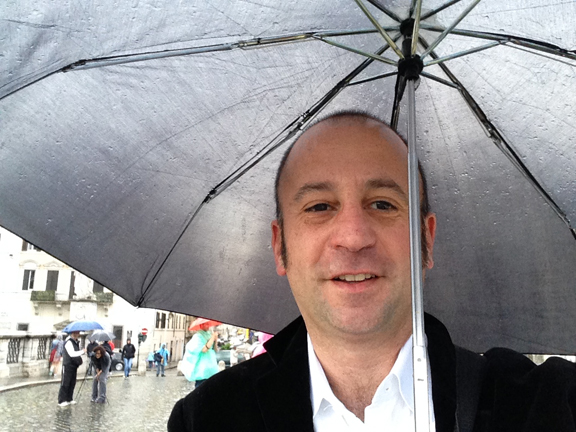
The rain wasn’t going to stop me from strolling around Rome yesterday.

Ever since my early years as a student in Italy, the Eternal City has always thrilled and fascinated me. And even though I’ve visited countless times, Rome never fails to inspire me as it shares its ceaseless beauty.

jeremy parzen blog

This trip has been a good one: my days at the fair in Verona were productive and my travel was seamless.

Thanks to everyone who hosted and tasted with me.

I have many tales to tell and many wines to share.

But now it’s time to pack it in and head back to Texas where I belong.

Thanks for following along… I’ll see you on the other side.

Leaves of grass: Primo Franco & the “battle for Prosecco” @NinoFranco1919

Love the earth and sun and the animals, despise riches, give alms to everyone that asks, stand up for the stupid and crazy, devote your income and labor to others, hate tyrants…
—Walt Whitman
preface to Leaves of Grass

herbicide vineyard

Above: Primo Franco stops to chat with a Prosecco grower in Cartizze.

Spring has come early to Proseccoland (as it has across Italy). And as I drove from Cison di Valmarino (where I stay with my good friends at the Villa Marcello Marinelli) to Valdobbiadene yesterday, I saw many grape growers cutting the grass between the rows of their vineyards.

In other vineyards, there were brown stripes between the rows: they demarcate the use of a crop dessicant (or defoliant), a form of herbicide.

For every “green” vineyard, there seemed to be a “striped” vineyard, as it were, on either side.

Last year, Alfonso wrote about the “Battle for Prosecco” (a post I highly recommend): with each passing vintage, it seems, that struggle and the challenge to preserve what is unique and wholesome here only intensifies.

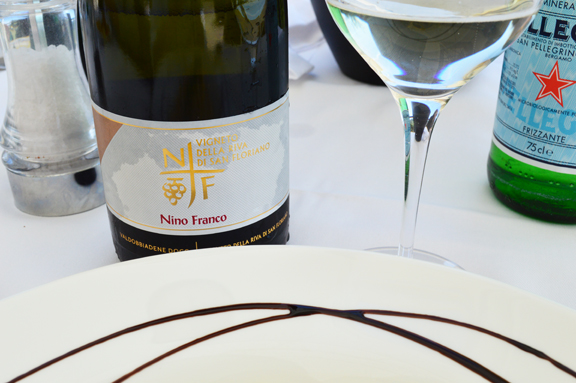
As legacy Prosecco producer Primo Franco (above) noted as we drove back to the Nino Franco winery after lunch yesterday, the use of desiccants in the vineyards results in the effetto saponetta or bar of soap effect: when the grass is killed by a dessicant and a crust of dead leaves of grass is formed and as result, the soil absorbs less rain water.

Primo stopped along the road to praise a grape grower who was trimming his grass by hand, unlike his neighbor who had used desiccants (see the photo above).

“My cousin is an idiot,” replied the grower, referring to his next-door neighbor. “I’ve told him not to do it like that. But he doesn’t listen.”

best restaurant prosecco

Above: anyone who’s ever traveled with me knows that I rarely drink wine at lunch. But how could I resist a glass of Primo’s San Floriano, my favorite among his crus. The pairing with tagliatelle and asparagus was rivaled only by the pairing with the view from the Ristorante Enoteca Salis in Santo Stefano. The nose on that wine is gorgeous.

As Alfonso wrote in his post last year, there’s a lot of money at stake in Prosecco, where sales have rivaled and even surpassed those in Champagne in recent years.

Prices of land in Cartizze, the most famous of the Prosecco crus, are higher than Napa Valley, one grower told me a few years ago as we sat atop his family’s parcel in the famed designation.

But grape prices, even in Cartizze where only Prosecco DOCG is grown, are now being driven by the fact that fruit costs in the Prosecco DOC, which lies in the Piave river valley below (and beyond), are much lower.

English-speaking end consumers don’t recognize the distinction between the DOC and the DOCG and as a result they generally reach for the cheapest Prosecco on the supermarket shelf.

This phenomenon, which has only expanded in the years since the DOCG was created in 2009, ultimately prompts growers to cut corners in order to compete with their fellows on the valley floor.

And those dead leaves of grass are an expression of that struggle.

wine tours prosecco

Above: my beloved Veneto, my beloved Proseccoland. This is my Italy, the Italy where I feel most at home. I speak like they do. I eat like they do. I’m saddened to see what is happening here.

All is not lost in Prosecco and although some battles have been lost, the outcome of the great war has yet to be written.

Primo — a man whom I admire immensely and whose legacy has shaped the tastes of our generation — is fighting a valiant fight.

Last year’s crop was so good, he told me, that he and his winery could have bought fewer grapes for their projected production.

But he bought the same amount as he regularly does: “In order to protect our land,” he said, “we have to protect our growers.”

As he stopped along the road yesterday to chat with that grower (above), I couldn’t help but think of the above passage from Leaves of Grass. Primo is this appellation’s Whitman — in more ways than one.

I have so much more to tell about my trip and my Vinitaly tastings. I have just three more appointments to go between today and tomorrow. And then on to Rome for one night before heading back to Texas. Thanks for following along and please stay tuned…

Mingling with the stars: Vinitaly highlights day 3

arianna occhipinti

Writing in a hurry, as always, this morning as I prepare to head to Verona for the last day of Vinitaly, the annual Italian wine trade fair.

My yesterday was star-studded: I caught up with über cool Sicilian winemaker Arianna Occhipinti (right) while tasting with one of my favorite Abruzzo producers, Francesco Cirelli (far left).

emidio pepe anniversary

What a treat to have been invited by the Pepe family to attend their 50th anniversary vertical tasting of Emidio Pepe’s wines (post forthcoming; very interesting stuff)!

All the top Italian wine writers were there and the tasting was phenomenal (1967-2007). Thank you again, Sofia and Chiara, for including me.

cascina gilli

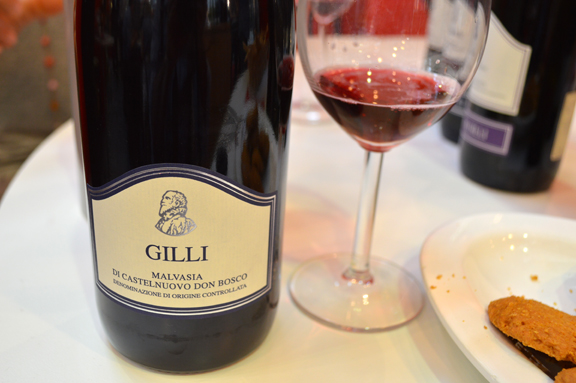
Chiara Gilli told me that her delicious sparkling Malvasia di Schierano is on its way to Texas. This is going to be a huge hit in the U.S. Loved the wine and was geeked to finally meet Chiara, whom I’ve followed through social media for some time now. She’s super groovy.

aldo vajra

The boys were back in town hanging with one of my favorite Piedmontese winemakers, Aldo Vajra (far left). Those are my buddies Nathan Smith from Houston (center) and Justin Gallen from Los Angeles (right).

The 2010 Vajra Barolo Bricco delle Viole was smokin’ good.

passerina best abruzzo

Very stoked about this Passerina — probably the best I’ve ever tasted — from a new entry in Abruzzo, the Abbazia di Propezzano.

Look for this by-the-glass at Sotto in the fall of 2014. Another big winner for me.

vigne alice prosecco

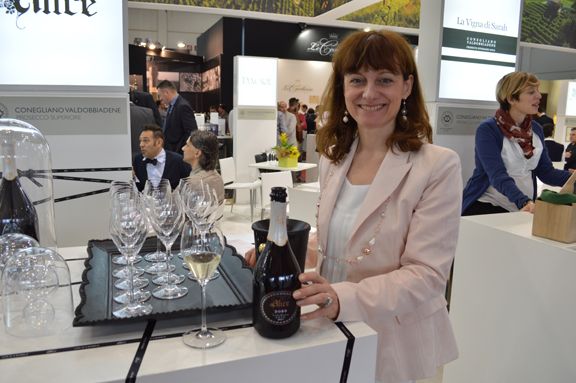
One of the most fun things about the fair is running into fellow U.S. wine professionals. Shelly Lindgren recommended that I taste Cinzia Canzian’s Le Vigne di Alice Prosecco. Beautiful, focused wine, fresh and bright, with lovely mineral notes.

My friend Lars Leicht of Banfi likes to say, you haven’t experienced Vinitaly until you’ve been “vinitalizzato” (Vinitalized).

As any veteran fair-goer will tell you, the experience is always stressful and exhausting, in part because of the sheer number of wines and people, in part because of the haywire logistics.

One more day to go… See you on the other side.

Donkey ragù and a Pieropan red Vinitaly day 2

donkey sauce

Writing on the super fly this morning as I try to keep up with work and get to the fair on time.

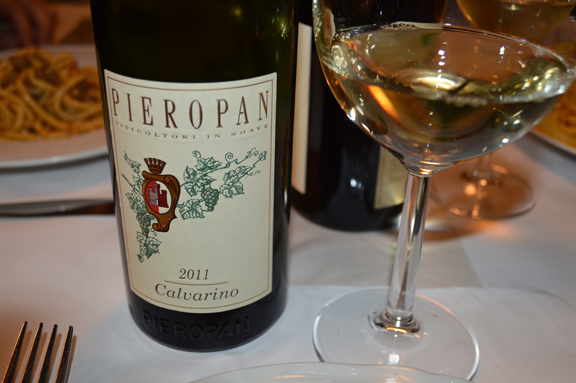
But had to share this pic of classic Veronese bigoli with donkey ragù at the excellent Osteria al Duca, where I joined some colleagues for a late dinner last night after our day at the fair.

I LOVED this place.

calvarino soave

Paired superbly with Pieropan 2011 Soave Calvarino.

ruberpan

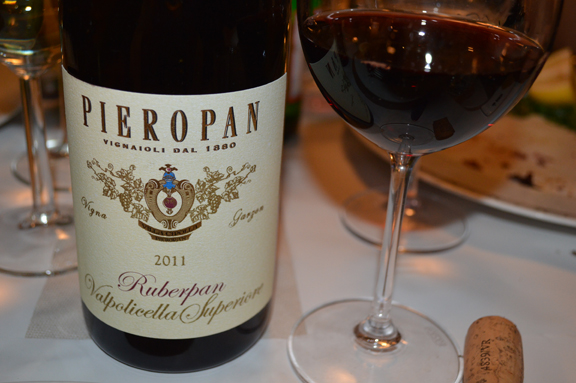
And who knew that Pieropan was making a Valpolicella (and an Amarone)? A lot of discussion about this 2011 Ruberpan at the dinner table last night but all agreed it was great.

burlotto rosato

My yesterday at the fair was more about schmoozing and a panel where I spoke.

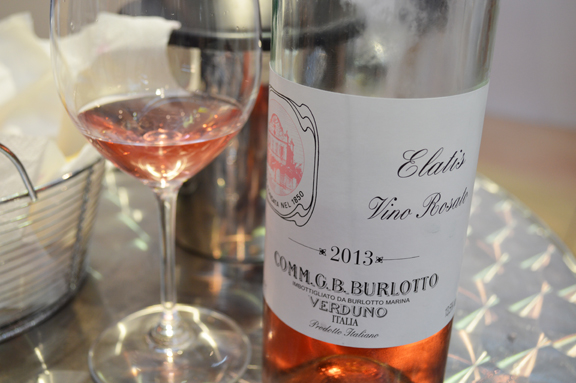
But I did get to taste this fantastic rosato by Burlotto with Jamie Wolff, owner of Chambers Street Wines in New York.

I am a huge fan of Jamie and it was a thrill to taste and trade notes with him and a producer whom we both love. Jamie’s Italian is great.

Gotta run!

Canaiolo Bianco? GORGEOUS! Vinitaly highlights day 1

vinitaly wine trade fair

It’s become a sort of tradition: my first visit at Vinitaly each year is with my good friend Filena Ruppi (above, right, with her daughter Emiliana). Filena and her husband Donato d’Angelo make one of my favorite expressions of Aglianico del Vulture.

vezzoli

I loved this Franciacorta by Vezzoli, a wine made with a new and perhaps revolutionary approach to classic method vinification (more on that later; very groovy stuff).

tauma montepulciano

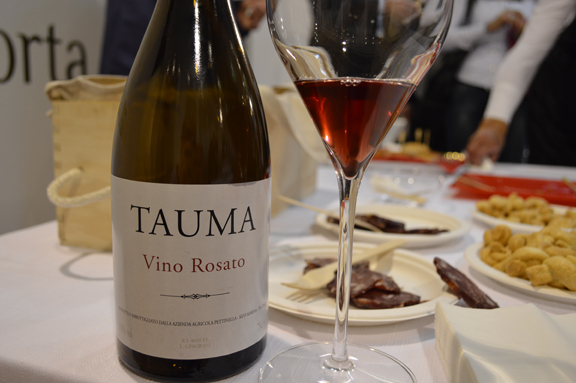
Alessandro Morichetti, one of the editors of Italy’s most popular wine blog, Intravino, insisted (rightly) that I taste this superb and extremely hard-to-find expression of Cerasuolo d’Abruzzo, Tauma. Stunning, elegant wine. I need this wine.

gianni paolo cantele

My clients and good friends Gianni (left) and Paolo Cantele were in top form.

fanoi primitivo cantele

I was blown away by their new Primitivo Fanòi, an IGT from Sava that they do in a lighter and more traditional style. The acidity in this baby is zinging. This is going to be a big wine for the Cantele cousins.

canaiolo bianco

I was thrilled by this Canaiolo Bianco by the Grati family at Villa di Vetrice. They’re currently working on an ambitious survey of Tuscan ampelography and this is one of the fruits of their labor. I was impressed by the acidity and vibrancy of this wine. Only a few thousand bottles made but they plan to make the grape part of their stable of traditional Tuscan wines.

And now on to day 2… wish me luck! I’m going to need it.