groovy folks, groovy wines in sunny LA (was it just a dream?)

fico pizzeria los angelesTexas was on my mind yesterday, as I floated through gilded, bigoted, face-lifted Beverly Hills, as if in a THC-induced dream.

I was raised here… vinified in La Jolla and bottle-aged at UCLA. But as my high school chum Gary Jules likes to point out, I spent my whole adolescence trying to escape.

Today, I’m a Texan, husband to a Texan and father of two little Texans. But these are my roots, for better or for worse.

I really loved chatting with John Tierney at Pizzeria Il Fico (above) and shouldn’t have been surprised to learn that he speaks excellent Italian. He studied Italian at Stanford, I learned. Super cool guy who shares my passion for Italian wine and food in a historical and cultural context and a top-notch restaurant pro.
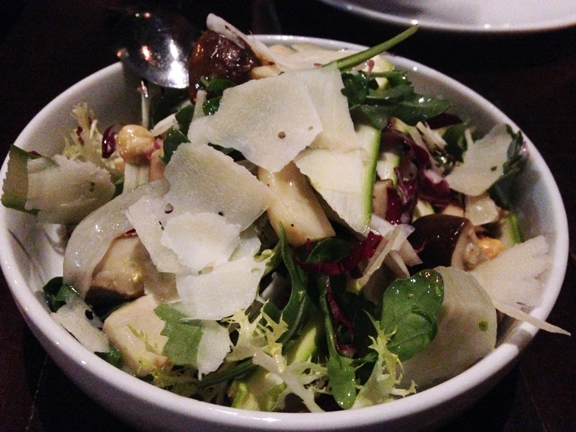
porcini salad republiqueThe porcini salad (above) was just one of the great things that I ate last night at the super sexy République on La Brea, where I met my good friend and music agent Michael Nieves.

Some of the porcini were lightly sautéed with garlic and others were sliced raw. It was one of the best things I’ve eaten this year. Really fantastic…

The place was slammin’ packed and I was geeked to catch up with my friend and colleague Taylor Parsons, who runs a superb and mostly French wine list there. He changes the list nearly every day, he told me, reacting to specials and changes in the menu with new and different by-the-glass selections.

Taylor is so sharp and focused and his wine list was orthographically impeccable — not to mention delicious. He tasted us on two ten-year-old expressions of Muscadet, approachable but classic Chablis, and Anjou blanc that blew my nugget.

We were seated without delay and our server was also spot-on. I was really impressed by this restaurant on every level.

radoar muller thurgauThe folks from Farm Wine tasted me on the Radoar Müller-Thurgau from German-speaking Italy.

What a beautiful, focused expression of this grape, electric in the glass! Not much of this wine is brought in by Louis/Dressner, they told me. And I was very geeked to get my first taste.

People still get thrown out of Louis/Dressner tastings, they also told me. I was glad to learn that the tradition continues.
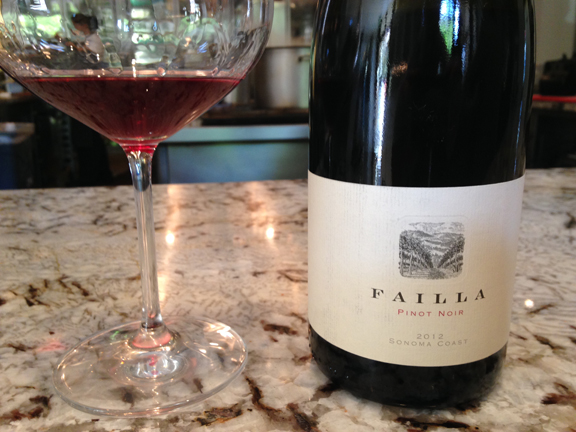
failla sonoma pinot noirAnd the dudes from Chambers & Chambers, with whom I did a “ride with” yesterday, tasted me on this awesome Pinot Noir from Sonoma coast, Failla. This elegant wine had brilliant acidity, gorgeous fruit, and lovely balance. They told me it should retail for around $35. We don’t drink a lot of Californian at our house but I would happily see this on our dinner table on a Saturday night. Really loved this wine from my home state.

All in all it was a good visit to sunny LA, where the tits are fake and the homeless are real.

Our Festa del Rosato tasting at Sotto was a mad house and it was fun talking to guests about the virtues of rosé and why we drink so much of it.

Was it just a dream? I don’t think I’ll ever know… I’ll just keep on keeping on, trying to understand where I came from and how I got here (some weird family shit has been hard on me lately)…

Now it’s time to hop back on a plane and get my ass back to the armadillo, where I belong. Thanks for reading this oneiric post of mine.

Believe the hype: why the 2009 vintage is good for middle-class collectors like us

We’ve opened up seating at our Festa del Rosato tasting tonight at Sotto in Los Angeles. We usually only seat on the patio for these events but the demand has been so great that we’ve taken over the entire restaurant. If you happen to be in LA tonight, please stop by and taste with me and Rory. Here’s the registration info.

gregorian chants italyAbove: the Abbazia di Sant’Antimo in Castelnuovo dell’Abate in the southern subzone of Brunello di Montalcino.

One of the things that sets the wine trade apart from other luxury goods categories is the rapport between storage and cash flow. Grape growers and winemakers — especially those who produce high-end wines — often have to wait years before they can sell their products. For them, every vintage is an investment and a gamble.

And when the wines don’t sell, winemakers are faced with a sometimes insurmountable problem: with unsold vintages in the cellar, they need to make room for the new wine being bottled. The storage and cash flow problem is compounded by the fact that many domestic distributors and international importers do not pay for the wine upfront.

External factors can also exacerbate these issues. The dark period following 9/11 and the 2007-2008 financial crisis are examples of this.

Of course, there’s also the other side of the coin. When a great vintage is followed by a tough low-yield vintage, bottlers have to scramble to fulfill their orders.

Beginning in the 1970s, when far-sighted bottlers began to see the potential of the export market, growers and winemakers started to become acutely aware of how market perception of a given vintage could drive or kill sales.

As various bottler associations began to emerge and come into focus during that period (the Brunello consortium, for example, was founded in 1967), producers began to align their marketing efforts. Like the growers who sold them the fruit, they realized that they could influence the way a given vintage was perceived and received by the trade and by consumers.

Collusion is too strong a word. But when pressed, any older Langa grower, winemaker, or bottler will quietly concede that there was a concerted effort within the trade to pump up the 1974 vintage in Barolo and Barbaresco. It was a strong vintage, although not a great one. But it followed a disastrous, rainy vintage in 1972 and a challenging vintage in 1973.

The 2007 vintage in Langa is an analogous case, in my view. It was a great vintage for certain producers, a good one for others. But at the time of its release, with the financial crisis still looming and a lot of wine from 2006 still in the cellar, I can remember distinctly how export managers tended to inflate its quality, even though it wasn’t one of the great, balanced, “classic” vintages of the decade.

As the great Italian wine writer Antonio Galloni noted on his excellent site Vinous Media last week, “every vintage can’t be epic.”

In an article entitled “2009 Brunello di Montalcino: The Day of Reckoning,” he writes:

    The 2009 growing season in Montalcino will be remembered by the massive heat wave that arrived suddenly in August of that year… The intense August heat caused sugars to mount faster than phenolic ripeness could be achieved. In some places, it is obvious the heat caused plants to shut down, blocking ripeness. In other spots, yields were too high for plants to carry their fruit through to full maturity.
    The 2009 Brunellos are some of the most uneven, problematic young wines I have ever tasted. As a group, the 2009s are forward, light in color and built for near-term drinking. Readers will see obvious signs of maturity in wines with advanced color and flavor profiles. In fact, many wines are already alarmingly evolved and mature.

(The complete article is available to all readers here. I can’t recommend it to you highly enough and I feel it’s such a great example of why Antonio is one of the best wine writers working today. His critical palate is always balanced by his judiciousness and his encyclopedic knowledge of Italian wine and wisdom in tasting are impeccable.)

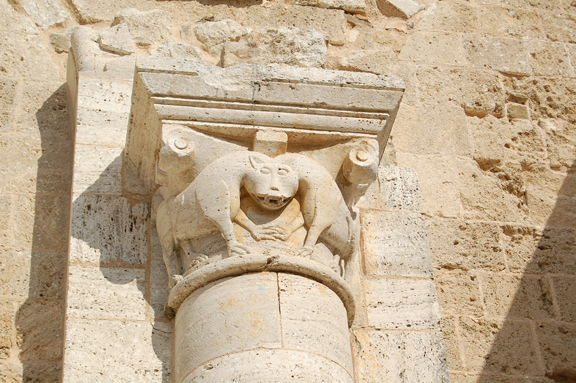
abbey sant antimo montalcinoAbove: the Abbey is from the Romanico or Romanesque period of Italian architecture, when many Roman temples were converted to churches. That’s why there’s a pagan symbol in this capital.

But when Antonio advises the Brunello collector to make her/his purchases carefully where the 2009 vintage in Brunello is concerned, he’s not talking to me. He’s addressing buyers with much greater financial means than I will ever have. I do have a few bottles of Brunello in my 27-case locker in San Diego. But I can’t afford to collect Brunello, at least not the ones that I like. At $80+, they are out of my price range: my ceiling for wines I collect aggressively is around $65 and most of the bottles in my long-term aging collection fall between $35-50.

Ultimately, 2009 will prove to be a good vintage for middle-class collectors like me. Many producers have reclassified their wines, in part because the fruit isn’t as age-worthy and in part because they fear they won’t be able to move it out of their cellars.

And the wines, if not already ready to drink, will come around sooner. I don’t have unlimited storage space and I tend to drink most of the wine purchase on the earlier side. The 2009 Produttori del Barbaresco (classic) Barbaresco is such a great example of this, in my view. It’s not a wine that I will put down for long-term aging in my cellar. I’ll drink it now and over the next few years (although I will put a few bottles down so that I can maintain my complete vertical).

Writing this post, I can’t help but think about the 2002 Poggio di Sotto Rosso di Montalcino. Piero Palmucci didn’t make a Brunello that rainy year and he bottled all of his top fruit as Rosso. In 2006, when I was working for a high-profile wine seller in New York, you could buy it for a song. And it was ready to drink.

Poggio di Sotto lies a stone’s throw from the Abbazia di Sant’Antimo (pictured, above), where the monks still perform Gregorian chants every year, despite the weather conditions.

I agree wholeheartedly with Antonio that the 2009 harvest in Brunello won’t be the harvest that some growers have hyped it up to be. But sometimes, when you’re an average bourgeois punter like me, you just gotta have faith…

The story of the Ferrari horse & what it has to do with wine

ferrari horse yellowI spent my early Friday morning researching and writing this post for my client Barone Pizzini producer of Franciacorta and Verdicchio dei Castelli di Jesi. Buona lettura e buon weekend… I hope you enjoy the post as much as I did writing it and have a great weekend…

He was called the “ace of aces” and was one of the most famous aviators of World War I: Francesco Baracca (1888-1918), “the Prancing Horse,” author of 34 aerial victories during “the great war,” and one of the most celebrated wartime figures of the era.

(Click here for his English Wiki entry and click here for a detailed technical account of his missions.)

As a young cavalry officer in training at the Scuola di Cavalleria (Cavalry School) in Pinerolo township (Piedmont), he befriended Baron Edoardo Pizzini Piomarta Delle Porte (1882-1966), founder of the Barone Pizzini winery.

(Click here for a description of the school by British contemporary of the Baron and Baracca.)

Some time after Baracca became fascinated with aviation and abandoned horsemanship to become one of the most decorated “fly aces” of early aerial combat, he wrote to his friend Edoardo, inquiring about a favorite horse at the school.

Please click here to continue reading the story of the “prancing horse”…

07 Barolo Ravera & 05 Muscadet drinking nicely & a visit to a famous Texas smoker

From the department of “some how, some way, I get to drink funky-assed wines like every single day”…

Barolo Ravera CognoA friend who works in the trade was able to pick up some bottles of 2007 Barolo Ravera by Valter Fissore of the Cogno winery on a close out and he generously shared the above with me.

Man, whatta wine! I haven’t tasted Valter’s 08s since Vinitaly a year ago (when it was still very young and closed) but his 07 — at least this one, which Tracie P and I opened this week — are drinking splendidly.

07 was the “year without winter” and the wines, in my experience, are already beginning to show wonderfully, with ripe berry and red fruit gently emerging. I don’t think it’s going to rival 08 in Langa, a more classic and balanced vintage. But I do think it’s a vintage that we can already begin to reach for with the expectation of vinous reward.

Valter’s Barolo is vinified à la “old school” (extended submerged-cap maceration) and aged in traditional large cask. His wines tend to fall on the cleaner and more focused side and in 07, the richness of the fruit he achieved in the vintage, combined with its electric acidity, sings in this wine. I thought it was stunning, a brilliant balance of earth and fruit.

muscadet 05 luneau papinAnother treat this week was the 2005 Luneau Papin Muscadet Sèvre & Maine sur Lie “L” d’Or, one of the winery’s top labels.

I’m not sure how this nine-year-old Muscadet made it to the Texas market but I was geeked to see at a more than moderate price on the list at the chic Gemma in Dallas (opened in late 2013) where I had poured wine at a consumer tasting on Wednesday.

A lot of folks up there are talking about Gemma’s new and adventurous list and this wine delivered stunning and highly focused white fruit and stone fruit flavors offset by the winery’s signature saltiness, in this case so delicate it was as if someone had gingerly sprinkled Trapani sea salt over apple jelly. A truly remarkable bottle of wine (and such a great value if you can find it)…

hinzes barbqueFamily matters took me Saturday to the town of Wharton, about an hour southwest of Houston. There, my cousins Ben, Marc, and Debbie unveiled the stone on the grave of their mother Marlene, my father’s first cousin.

Wharton is a really interesting town: in the 1850s, it became one of the early settlements for the so-called “Galveston Jews,” who were part of a wave of immigrants who landed not in New York but instead on the Gulf Coast.

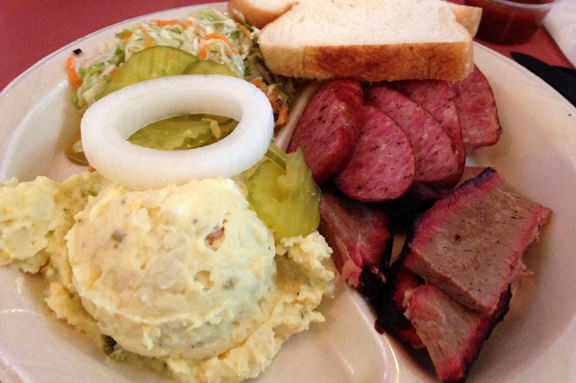
It’s also home to one of the most famous smoke houses in the state, Hinzes, where I had brisket and sausage (above).

I’m glad I got to know Marlene before she passed and hear her stories from the “old days” and I was happy to share Hinzes with my cousins, who are rightfully proud of the joint (note the perfect, pink smoke ring on the beef).

In other bbq news, my good friend Chris Reid has begun authoring a weekly bbq column for the Houston Chronicle.

He’s written about bbq for the New York Times, among other mastheads, and I am so glad to see that he finally has the platform his work merits. Check it out here.

That’s all the news that’s fit to print blog about. Please stay tuned and over and out…

Soldera prize, a great opportunity for under-35 wine pros

soldera case basse prizeAbove: I’ve had the opportunity to taste with Soldera at his Case Basse estate on a few occasions. It’s true that he can be a grumpy old man sometimes but the conversation is always fascinating.

Now in its fourth year, the International Brunello di Montalcino Case Basse Soldera Award for Young Researchers is currently taking submissions for the 2014 prize (there’s no permalink on his site for the rules and regulations but there is this image file and you can find the info on the news in English page).

Papers may be submitted in Italian or English and although the research must be related to Brunello di Montalcino and Sangiovese, topics are not limited to hard science, viticulture, and ampelography. Wine marketing, for example, is one of the fields included.

According to the competition rules and regulations, applicants — who must be under 35 — may “carry out their research in more depth and benefit from hospitality at [the] Case Basse [estate].”

How cool is that? I can tell you from personal experience that chatting with Soldera and drinking iced tea under the pergola of his courtyard is always a fascinating experience. A visit to his white flower garden alone is worth the price of admission.

News of the new call for submissions came to my attention via Terra, Uomo, Cielo.

Barolo gives Italy its first grape grower political party

barolo political partyAbove: Uniti per Barolo (United for Barolo), a new “civic list” and Italy’s first de facto political party comprised of grape growers and winemakers.

“For the first time in the history of the Italian Republic,” writes today Alessandro Morichetti for the popular Italian wine blog Intravino, “a civic list comprised of grape growers has been born in Barolo with [Vittorio] Toio Manganelli as mayoral candidate.”

A lista civica (a civic or municipal list) is “a party list presented at an Italian local election which has no official connection with a national political party and which campaigns on local issues” (Wiki).

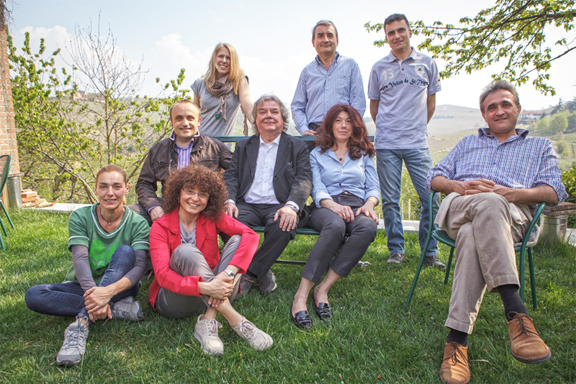
It’s commonly formed around a central candidate. In the case of the newly formed Uniti per Barolo (United for Barolo), Vittorio “Toio” Manganelli, a noted Langa enogastronome and cultural entrepreneur (pictured above, center), is facing off against Barolo village superintendent Renata Bianco in a race to become mayor in the township’s upcoming elections (May 25, 2014).

The lists consists of a number of well-known faces (above) in Langa wine: Achille Barberis, Cecilia Pati, Daniela Viberti, Enzo Brezza, Ferruccio Barberis, Gianni Canonica, Luisella Bussolino, and Marta Rinaldi.

The group’s slogan is “transparency, engagement, and equality in rights and responsibilities.”

Franciacorta’s Yellow Brick Road

maurizio zanella wineAbove: Maurizio Zanella of Ca’ del Bosco is Franciacorta’s Wizard of Oz. The technological advances he’s made in his pursuit of zero-sulfur wines are astounding.

The most amazing thing happened on the last day of Vinitaly, Italy’s annual wine trade fair, held each spring in Verona.

A couple of colleagues from New York, high-powered wine buyers, had asked me to walk them through the Franciacorta pavilion. Both of them work intimately with Italian wines and have years of experience in the Italian wine trade. But neither, they told me, had ever “wrapped his mind” around Franciacorta.

And so we set out together to taste. When they arrived at our first appointment, they were nonplussed. Why, they asked me, in the late afternoon on the last day of the fair, when the grounds were practically empty, was the Franciacorta pavilion brimming with consumers?

Welcome to Franciacorta’s Yellow Brick Road.

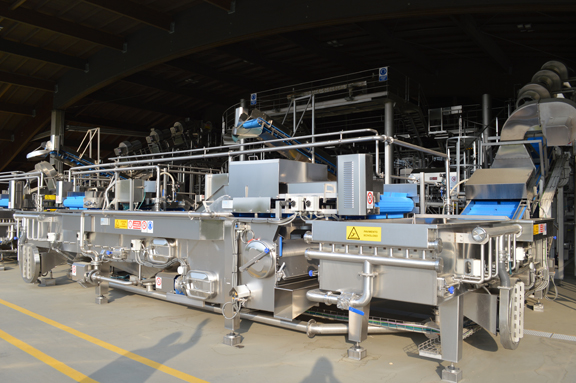
grape washing machineAbove: Zanella’s new multi-million-dollar grape washing machine, which he conceived and developed personally. As the winery has expanded its organic farming, Zanella has worked assiduously to eliminate oxidation and the application of sulfur by means of his ingenious contraptions.

Italians love Franciacorta. Here in the U.S., we hardly understand the category. But over the last decade Italians have developed an insatiable thirst for the wines.

On the last day of the fair, the pavilion was still bustling with tasters. On the first three days of the fair, the entrances to the Franciacorta section of the Lombardy pavilion were blocked by security guards who were charged with controlling the overflow of people trying to get in. I had to use my press pass to enter every time I visited.

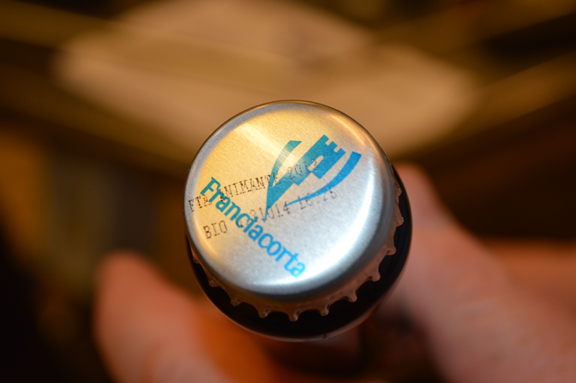
organic wine italyAbove: my client Barone Pizzini became the first Franciacorta winery to produce certified organic wines in 2001 (note the “bio” or “organic” designation on the seal of the bottle (the day I visited they were rebottling the wines for second fermentation and lees aging). Today, more and more growers are experimenting with organic and biodynamic farming there.

Franciacorta is among the youngest of Italy’s high-profile appellations. Even though fine wines have been produced in Brescia province since the Renaissance, the Franciacorta classic method DOCG was created relatively recently (1995).

Sparkling wines were first made there in the 1960s by a handful of wealthy landowners. For the most part, they were Italian industrialists who had vacation villas in the beautiful wine country that lies to the south of Lake Iseo, part of Lombardy’s chic lake district (Como is the most famous). And three decades would pass before classic-method wines would become the focus of winemaking in Brescia province.

Today, the viticultural landscape has changed radically, thanks in no small measure to a new generation of growers and homegrown winemaking consultants.

Most of the small growers used to sell all of their fruit to the big négociant houses. Today many are bottling their own fruit and marketing the wines themselves. Family-run estates like Camossi and Colline della Stella have become the darlings of Italian wine insiders, for example.

Franciacorta’s new wave has begun to reshape Italian consumers’ perception of the wines and their ethos in the marketplace. But there are still a number of factors working against the success of winemakers’ efforts. Chiefly, the wines continue to be marketed as an alternative to their transalpine counterparts. Another major problem faced by growers and bottlers is a boom-and-bust approach to production and pricing (33,000 bottles of Franciacorta were recently sold at auction for just €8,000, for example).

In my view, Franciacorta is one of the most exciting appellations in Italy today and I have a number of posts lined up on the wines I tasted on my recent visit there. I’ll also be posting on new and potentially revolutionary approach to classic-method winemaking. Stay tuned…

Please see this post that I wrote for Barone Pizzini on “What makes Franciacorta so unique in the panorama of Italian wines.”

Native American sparkler from Los Pilares

Taste with me this week in Texas (Dallas, Houston, San Antonio).
Click here for details.

michael christian pilares san diegoIt’s always a treat for me to catch up and taste with Michael Christian (above), founder of Los Pilares in San Diego.

In 2012, the winery made a big splash on the American wine scene when top wine writers like Alice Feiring embraced it as the new voice of Southern Californian viticulture.

Until Michael began making wine in Southern California (where I grew up), consumption was almost entirely local and few bottles shipped beyond San Diego county. Today, Michael’s wines can be found as far north as San Francisco, where competition in the domestic market is fierce.

sparkling wine pilares ladonaWeekend before last, when I was visiting San Diego (my hometown), Michael reached out and asked if I’d like to taste his new wine, a méthode ancestrale made from Muscat Blanc grapes grown on the Rincon Indian Reservation in San Diego County, where the Rincon Band of Luiseño Indians live and thrive today.

There is a long tradition of growing Muscat Blanc in this far corner of the U.S. and he wanted to make a wine (a new one in his portfolio), he said, that would be an expression of historical viticulture there.

I liked the wine a lot. It was fresh and bright on the nose, with notes of herbs and dried stone fruit, and in the mouth it had a wonderful and delicate bitterness that offset the ripeness of the citrus notes. He said that some of the clusters had been crushed whole and he ascribed this balance to the fact that not all the fruit was destemmed.

There’s no doubt in my mind that this wine, when released, will become another hit among the Californian wine cognoscenti. The wine will be called Los Pilares LaDona 2013 San Diego County Sparkling Muscat, a homage to local radio personality LaDona Harvey.

(That’s my older brother Tad, btw, in the background of the photo, playing guitar with his jazz quartet, Sounds like 4, at the Café-Bar Europa in Pacific Beach, where Michael and I met. They sounded great.)

pilares grenacheI also liked Michael’s new 2012 red, which is made from 100% Grenache. In that vintage, he had some issues with his Carignan, he said, and so this release is monovarietal.

As with the LaDona, the thing that struck me about this wine was its freshness on the nose. And in the mouth, the wine was vibrantly delicious, with notes of ripe dark red fruit and a wonderful lightness in body that made the wine very food friendly and very “drinkable,” as the Italians like to say.

I thoroughly enjoy Michael’s wines and I love that he’s spearheaded a new wave of Southern Californian viticulture. It’s taken too long for the wave of the “new Californian” wines to take root in San Diego, where a heavy metal approach to winemaking still prevails.

Thanks again, Michael, for the wine and for taking the time to connect.

May you feast on fat things full of marrow and wines on the lees well refined!

Taste with me this month in Texas & California @CanteleWines @SottoLA @CaptainWine

jeremy parzen canteleI’ll be pouring Cantele wines at Central Market locations in Dallas (Southlake) Weds. May 7, Houston Fri. May 9, and San Antonio Sat. May 10.

Please click here for details.

And I’ll be pouring some of my favorite Southern Italian and Californian rosés when Rory and I lead our rosati tasting at Sotto (where he and I co-author the wine list) in Los Angeles on Tues. May 20 (details to follow).

Buon weekend, yall!