Double-digit growth in exports says Franciacorta Consortium panel

best franciacorta“Exports grew by 17.4 percent with respect to the first half of 2013,” write the authors of a press release issued today by the Franciacorta Consortium, “resulting in an overall increase in the number of bottles sold of 12.6 percent.”

“Once again, Japan is the top foreign market for Franciacorta, followed by the United States, Switzerland, Germany, and Belgium. Growth continues in the United Kingdom where sales have grown notably (100.4 percent) thanks to marketing efforts that began there last year and heightened brand visibility.”

You can read my translation of the entire release over at the Barone Pizzini blog.

My post on Franciacorta yesterday here on Do Bianchi generated a lot of positive feedback. I am a huge fan of the wines and I’m thrilled to learn that the appellation continues to build its market presence abroad.

Thanks for reading. Buon weekend!

Image via FranciacortaBlog.com.

The “other” Roagna, a lovely Nebbiolo d’Alba by Roagna Igino

roagna igino barbera nebbioloThere are actually a handful of wine-producing estates named Roagna in Piedmont. But the one we all know is Roagna “I Paglieri,” producer of one of the greatest expressions (imho) of Barbaresco.

But of all the Roagna (pronounced roh-AHN-yah) who make wine in Piedmont, there’s a little and little-known farm run by the Igino Roagna family in the village of Priocca in Cuneo province (the male name Igino, ee-GEE-noh, is akin to Hyginus in English).

I can’t find any website or notice of the winery beyond its listing in the Cuneo chamber of commerce site.

But you can drink the wine in Houston. Some years back, my friend Houston Chronicle sports and wine writer Dale Robertson “discovered” the wine on a trip to Langa. After he introduced it to local importer Doug Skopp of Dionysus Imports (based in Houston), Doug picked up the wines.

As far as I know, Texas is the only state where you’ll find it.

best steak house houstonWhen Tony’s sommelier Scott Banks poured the Roagna Igino 2011 Nebbiolo d’Alba for me and cousin Marty during our birthday week earlier this month, I couldn’t help but think about how we often overlook this wonderfully approachable expression of my favorite red grape.

All too often, Barbaresco and Barolo elide our impressions of the grape’s more humble incarnations. And it’s a pity because young, fresh Nebbiolo — like this one — is so delightful at the dinner table.

It paired beautifully with aged steak and morels on a Tuesday night at Tony’s, the flagship restaurant of my good friend and client Tony Vallone.

The wine was lithe in the glass and its acidity and gentle touch of tannin danced marvelously with the rich steak and the earthy flavors of the mushrooms.

During my birthday week, I tasted current vintage of two of my all-time favorite wines, the 2008 Bartolo Mascarello Barolo and the 2010 Produttori del Barbaresco (classic) Barbaresco, each a legacy expression of Langa in its own right.

But the little-known Roagna Igino was just right for steak with cousin Marty on a Tuesday night. It was great to be reminded that Nebbiolo doesn’t need to be “the best” or “the greatest” to hit the spot.

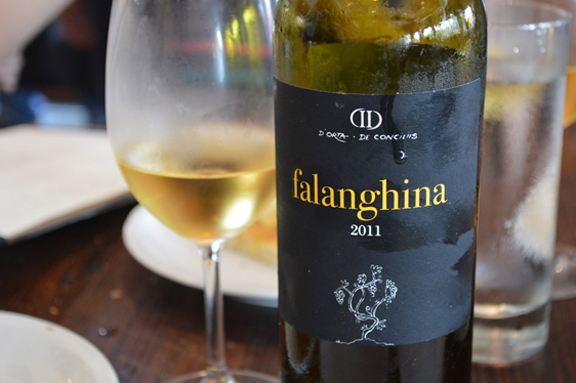
D’Orta-De Conciliis 2011 Falanghina SUPER! @ColtivareHTX

orta conciliisWhen I first spied a bottle of 2011 Falanaghina [sic] by “Conciliis” on the wine list at the hipster Italianate concept Coltivare in Houston’s Heights neighborhood last night, I was nonplussed.

Did Bruno de Conciliis make a Falanghina? I had never seen one.

Was this an old, tired vintage of Falanghina that had been forgotten or pawned off on an unwittingly wine buyer by an unscrupulous distributor?

I ordered it, of course.

With just enough skin contact to give it a deeper color and a gentle dose of oxidation, this wine sang in the glass, with notes of ripe stone fruit and fantastic minerality.

Our party loved it so much and the price was so good that we ordered a second bottle for our table of six. Fantastic wine, one of my favorites of 2014.

It turns out that the label is a joint biodynamic project shared by Bruno, his siblings, and his German-speaking cousin “Vinny.” So glad to see a lot like this in Houston.

I handicapped the wine list at Coltivare today for the Houston Press.

Franciacorta and the “C-word”

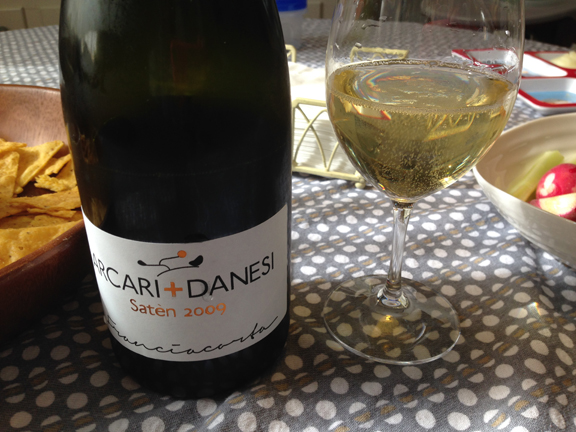
arcari danesi saten franciacortaOne of the great travesties of the Italian wine world is the way that Franciacorta has been incessantly compared to… no, I’m not going to use the C-word here.

Just Google “Italy’s answer to …” in quotes and you’ll find that a great number of the most revered English-language mastheads have published articles with this abhorrent title.

But I don’t blame their editors or contributors for this.

If there is blame to assign, it lies with those historically responsible for marketing Franciacorta in the U.S. and U.K.

Sadly, the powers-that-be have always positioned Franciacorta as a “luxury” brand akin to its more famous counterpart on the other side of the Alps.

The fact of the matter is that Franciacorta is radically different from its transalpine Doppelgänger.

And the main difference is the fact that Franciacorta growers can allow their grapes to ripen fully before harvest (in France, classic-method sparkling wines are made from underripe fruit that has been picked with overly high acidity and relatively low sugar).

Did you know, for example, that Franciacorta producers rarely need to provoke the first fermentation with the addition of cane sugar?

This is because the berries already have enough sugar to enable fermentation.

On the other side of the Alps, the practice is de rigueur.

The richer ripeness of the fruit expresses itself in even the most commercial Franciacorta bottlings, giving the wines greater depth of flavor.

But the thing that strikes me the most about Franciacorta (and we drink a lot of Franciacorta in our home) is its wonderful vinous character. The greatest expressions of Franciacorta, in my experience, share a kinship with my favorite still wines inasmuch as they have a wonderful food-friendly quality about them.

We drink a lot of French sparkling wine as well (made mostly from Pinot Noir). Bollinger Rosé — our all-time favorite — and rare steak, for example, has made for an unforgettable pairing at our dinner table. But the French astringency and more tannic nature often limits the breadth of dishes we’ll pair with the wines.

Great Franciacorta, made mostly from Chardonnay, tends to have a rounder and richer fruit component that makes it pair exceedingly well with a wider variety of savory dishes.

On the night of my birthday, when the B. Mascarello 2008 Barolo turned out to be too tight for pairing with the main dish, the Arcari-Danesi 2009 Satén, 100 percent Chardonnay, with its profound white fruit and gently nutty flavors, was ideal with Tracie P’s fried chicken.

It’s one of the wines that my close friend Giovanni Arcari and his partner have created without the use of any sugar whatsoever: they use frozen grape must, reserved at harvest, for the tirage and dosage of this wine (I wrote about their revolutionary method here).

I count many Frenchpeople as good friends. I play in a French rock band and have performed many times in France. I love Bollinger so much that my writing partners and I wrote a song about it.

But when it comes to talking about and enjoying my favorite expressions of Franciacorta, you’ll never hear me use the C-word.

Is 2008 Nebbiolo “closing down”?

bartolo mascarello barolo 2008Another one of the wines that we drank for my birthday week (week before last) was the 2008 Barolo by Bartolo Mascarello (above).

I’ve tasted the wine on a number of occasions since it was released and there’s no doubt in my mind that this is going to be a fantastic vintage for Maria Teresa Mascarello and for Langa Nebbiolo in general.

In my experience, the wine has shown that classic balance of acidity, fruit, earth, and tannin that you find in “balanced” growing cycles with “four seasons.”

On my birthday eve, Tracie P made me a “by-request” dinner of her breaded and fried chicken, mashed potatoes, and wilted spinach sautéed with garlic and a light dusting of chili flakes.

I opened the wine early, around 5 p.m. And when we first tasted it around 7 p.m., its fruit was dominated by its earth and tannin. It began to open up as the evening progressed and we ended up enjoying it as a meditative wine, listening to Chopin performed by Rubenstein and 70s and 80s Paul McCartney (music also by request).

By mid-evening it was gorgeous, but I believe that we’ve entered into a new phase in the development of traditional-style Langa Nebbiolo. These wines, in my experience, go through an initial stage of brightness and generous fruit but then “shut down” a few years after their release.

I’m so glad to see that this wine is now widely available throughout the U.S. (Italian wine insiders know, all to well, the vicissitudes of this wine’s legacy in our country). It’s a classic and a benchmark and Bartolo’s daughter Maria Teresa is making some of the estate’s greatest wines ever (I really believe that and I know, anecdotally, that some of her top collectors share this impression).

By no means am I saying that you shouldn’t drink it now. But do give it time to open up (gently, by simply aerating the wine; but don’t expedite it is my advice).

mashed potatoes recipeAnother highlight from my birthday eve, was the Arcari-Danesi 2009 Franciacorta Satén by my one of my best friends, Giovanni Arcari, winemaker extraordinaire and enocultural entrepreneur.

That’s on deck for tomorrow… thanks for sharing my birthday wines with me!

Counterfeit wine scandal: who are the real victims?

italian wine scandalAbove: we see through a glass bottle but darkly.

More than seven months have passed since Rudy Kurniawan became the first person to be convicted of wine fraud in the U.S.

The story first broke in December 2009, when my friends and colleagues Peter Hellman and Mitch Frank began reporting it for Wine Spectator.

(Here’s the Rudy Kurniawan entry on Wikipedia.)

It’s not entirely clear to me why the story has begun popping up again on a wide variety of media platforms. A few weeks ago, I inadvertently stumbled upon an evening “news” show, on a major broadcast network, that devoted an entire segment to it. And just yesterday, I heard yet another story about it on one of my favorite public radio programs.

My suspicion is that this new “news cycle” on a stale story was borne out of a short Associated Press article on a wine counterfeiting ring in Italy that appeared at the end of May of this year. It was followed by two sensationalist reports, both by major mastheads, that erroneously linked the Italian story to Kurniawan.

Until all hell broke loose this month in Eastern Europe and the Middle East, there were no new major stories for the major mastheads to cover. It’s that time of year when the “summertime blues” takes over — the so-called “silly season” — and editors and producers search desperately for stories to report. Ultimately, less-than-newsworthy coverage rises to the surface (the Kurniawan reports are typical of this; the story hasn’t been “news” for more than a half of a year).

I’m deeply saddened by this.

Not because I feel bad for Kurniawan. Everyone I know who’s ever met the guy says he’s a real jerk.

Nor do I feel bad for Bill Koch, the billionaire who crusaded to put Kurniawan behind bars. Koch was featured, btw, in both of the stories (TV and radio) that I mention above.

Please click here to continue reading my post today for the Boulder wine Merchant.

Buon weekend, yall!

What Mayor De Blasio ate & drank yesterday in Sant’Agata de’ Goti

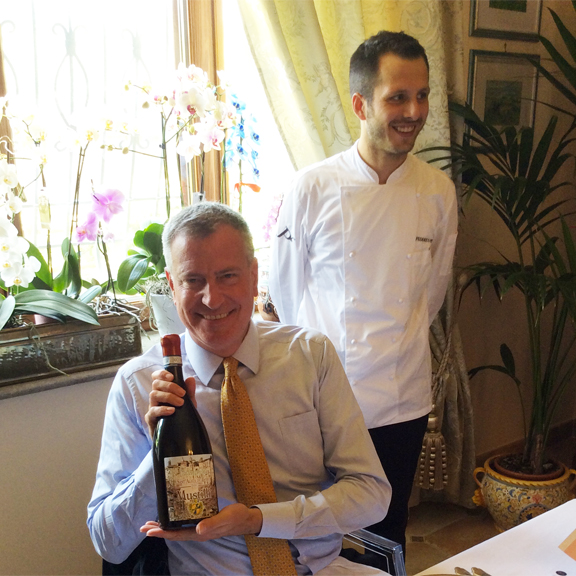
blasio italy menuYou may remember my post from January of this year on the label that winemaker Paola Mustilli created especially for NYC Mayor De Blasio.

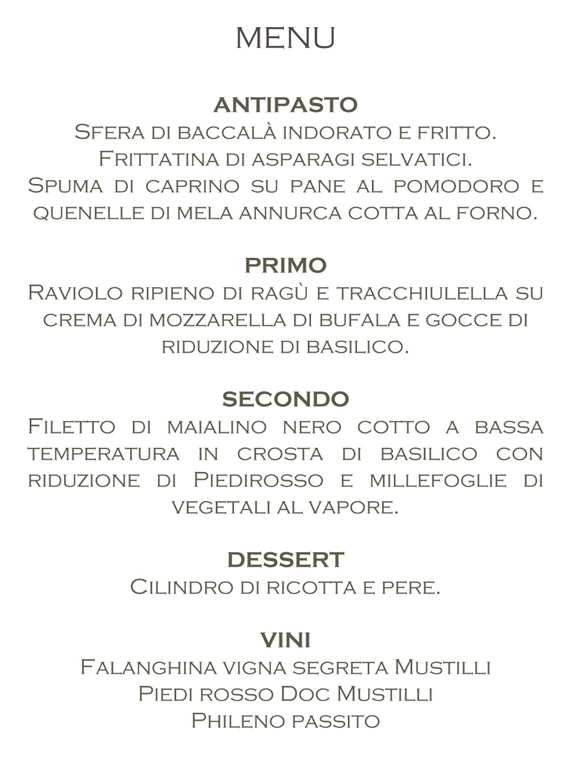
In Paola’s words, “my dreams came true” when Hizzoner visited Sant’Agata de’ Goti yesterday and enjoyed a meal in the home of the town’s mayor, Carmine Valentino. The menu was created by chef Federico Petti, a native of Sant’Agata de’ Goti who currently works in Pavia.

That’s the Bill de Blasio label, above.

The Times covered the mayor’s spectacular “homecoming” here.

Mayor De Blasio’s grandfather was born there and “Sant’Agata remains at the core of Mr. de Blasio’s self-identity,” the paper of record reports. “It was a visit to the town as a teenager that prompted him to embrace his mother’s Italian heritage, at a time when his father’s alcoholism was tearing the family apart.”

Luciano Pignataro posted notes and more photos from the meal on his blog today.

And I just had to share this image and the menu (which Paola sent to me this morning).

mayor menu sant agata goti

Colfondo trademark owner Drusian says he will give the designation to Prosecco consortia

“Colfondo” trademark owner Francesco Drusian appears poised to give the designation to the Prosecco DOCG consortia, according to a report published today by the popular Italian wine blog Intravino.

“After twelve years,” writes Intravino contributor Giovanni Corazzol, “Drusian has expressed his willingness to give the trademark to the two consortia [Conegliano-Valdobbiadene and Montello-Colli Asolani]. The consortia will safeguard the trademark and they will incorporate the production method into their appellation regulations. By doing so, they will bring clarity to a field threatened by low-quality products that have been created using illicit means, often outside the DOCG area and often with different grapes.”

At present, the Prosecco DOCG (which applies to both consortia) recognizes and allows for Prosecco re-fermented in bottle as a sanctioned category. But the appellation regulations do not mention nor regulate the designation colfondo.

News of Drusian’s willingness to share the trademark arrived during a Prosecco producers conference organized in Valdobbiadene township last week by Turin university wine law professor Michele Antonio Fino.

Today, the editors of Intravino also shared Fino’s slides, including the following, which addresses the issue of how the term colfondo is used liberally by winemakers and even beer and wine-cooler producers outside of the Prosecco DOCG where it originated.

The Franciacorta designation Satén, created by the Bellavista winery and then given to the appellation’s consortium, offers a precedent, writes Fino.

Click here to continue reading my post today for the Bele Casel blog.

Chianti deserves better

In other Sangiovese news, please have a look at the new video by Fattoria dei Barbi owner Stefano Cinelli Colombini on the (short) history of Montalcino. Italian wine trade observers will note a few lacunae and the self-promotion is front and center. But the historic and contextual insight will surely surprise even the most jaded among Italian wine insiders and the production value is excellent (the film was produced by Cricket Productions in the UK).

wine folly best blogWine Folly is one of my favorite wine blogs.

It’s well written and beautifully composed. Its posts are informed and informative. And its entertaining entries always seem to hit the right balance of neophyte accessibility and street cred.

It’s in my Feedly and I often recommend it to newly minted wine lovers who ask me which wine blogs they should follow as they dive into the world of fine wine.

When I saw “A Poster Shows What’s Inside Famous Wine Blends” in my Feedly, I was eager to check it out.

But you can imagine my disappointment and dismay when I read the entry for the primary grapes in Chianti: “Sangiovese, Cabernet Sauvignon, Cabernet Franc, others.”

(For the record, the traditional grape varieties in Chianti are Sangiovese, Canaiolo, and Colorino. A wide range of “authorized” international grape varieties are also allowed. Cabernet Sauvignon and Merlot are the most commonly used, especially in American-geared, international-style expressions of the appellation.)

I remain a loyal fan of Wine Folly and will continue to recommend the site. And I don’t blame the editors for this (sadly egregious) oversight.

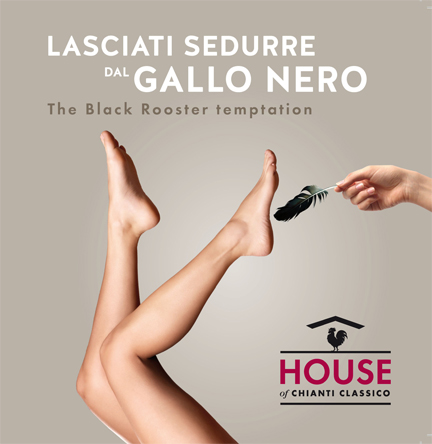
chianti black roosterIn my view, the blame lies with a bottlers consortium that creates marketing campaigns like the one above.

Translated, the Italian copy above reads: “let yourself be seduced by the black rooster.”

The recently launched campaign hinges on a new tasting room in Radda in Chianti, “The House of Chianti Classico.”

Awkward English aside, this new “Chianti Classico center” is to be host to events, tastings, and seminars. (The English- and Italian-language calendars don’t seem to align and the site loads in different ways depending on whether or not the host sees your browser as English-speaking or not. It’s all very confusing and clumsy.)

If the ludicrous nature of this campaign isn’t immediately apparent, here’s what a Tuscan wine trade veteran wrote about it on the Italian-language blog Accademia degli Alterati (translation mine).

“We have a sense of humor,” noted Raffaella Guidi Federzoni. “We’re still applying ourselves to that end and every once in a while we make a great leap forward, as in this case.”

“Let’s hope that it doesn’t happen again. Let’s hope that for a wine and appellation like Chianti Classico, future campaigns are modern, yes, but not laughable.”

The powers-that-be at the Chianti Classico consortium really need to step up their game and take their marketing seriously.

Otherwise, who can blame the editors of a well-intentioned and otherwise well-informed site for such a grave misrepresentation of one of the world’s greatest wines?

See also Alfonso’s post on the misogynist tone of the Chianti campaign, “Sex and the Cittadella.”