¡Qué nostalgia! Tacos al pastor at Borrego Viudo in Mexico City

tacos al pastor¡Vamos a los tacos! was what my Mexican friends used to say back when we were in high school together in San Diego. Just like the midnight spaghettata in Italy, a late-night taquería after an evening of drinking was and is a cherished ritual.

It’s hard to imagine — at least in my life — a dish that inspires greater nostalgia than tacos al pastor.

On our friend Mai Pham’s recommendation, I visited the classic Borrego Viudo last night on the earlier side of the evening (after all, I’m not 17 anymore!).

There’s really no other way to say it: this place was simply awesome. From the way the parking attendants cheerfully greet you to the polite, dutiful service of the tidy waiters who carry literally ten plates at a time, this joint is one that continues to stand the test of all time.

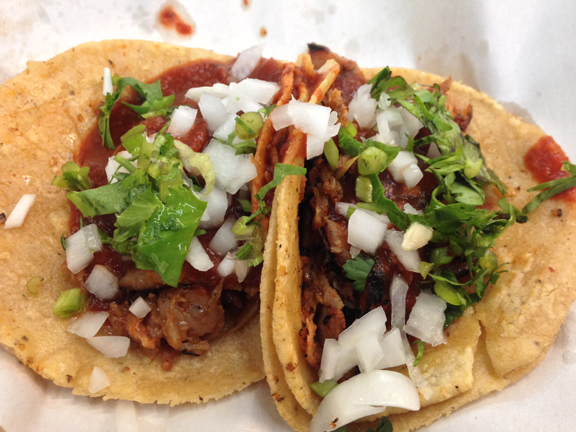
Those are the tacos al pastor above (see the carver in the video below).

taco de cabeza mexico city ciudadThis was a taco de cabeza, two tortilas de maíz filled with head.

It’s not hard to understand why Mai insisted that I visit this place. It was joyful and brimming with all kinds of people, young and old, families and friends.

I was there on the early side, around 7:45. But by the time I left, there were so many people that the parking lot was full of people eating in their cars (the servers will wait on you in the parking lot as well).

I adored this place. Go there…

See you tomorrow in the Ciudad de México

xochimilcoHeading out today for Mexico City where I’ll be pouring Franciacorta and Verdicchio dei Castelli di Jesi tomorrow for my client Barone Pizzini (click here for event details).

It’s never easy to say goodbye to my girls but I have to admit that I am really looking forward to this trip. I haven’t been to Mexico City since I was a teenager and am really excited about my eating itinerary there (thanks again, Mai!).

See you on the other side…

Image via Alejandro.

Italy is so much more than wine

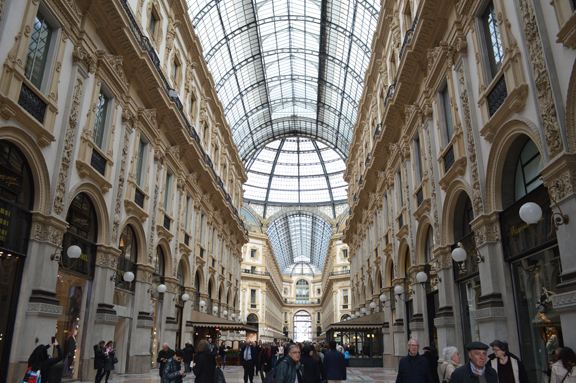
galleria milan photoAbove: a view of the Galleria in the historic center of Milan. The city is so much more than just “art and amazing churches.”

“Should I spend an extra day in Milan after a wine trip?” asked Houston-based sommelier Vanessa Treviño-Boyd on her Facebook the other day. “So far the savvy say ‘not worth it.'”

A number of wine tradespeople weighed in, with varied responses.

“If you like art and amazing churches, yes,” wrote venerated Italian wine critic Levi Dalton. “If not, no.” (Please accept my apologies in advance for the Google alert, Levi.)

It’s disheartening to see exchanges like this. But it happens all the time: wine professionals head to Italy for winery-funded trips and they head straight to wine country and then back to the airport without experiencing Italy’s immeasurable cultural treasure.

In many cases, especially for young people, it’s their first trip to the country.
Continue reading

As ministers gather to discuss EU alcohol policy, FIVI president Maltide Poggi previews grape growers’ concerns

matilde poggiAs European Union ministers prepare to gather in Riga on Monday for meetings on Health and Consumer Affairs, including a discussion of EU alcohol policy, Matilde Poggi (above, president of the Italian Federation of Independent Grape Growers [FIVI]) has previewed a brief she plans to send to send to Italian health minister Beatrice Lorenzin.

According to a post published today on the Slowine blog, which paraphrases but does not quote the document directly, there are three major points covered in Poggi’s letter to the minister and her colleagues:

1) Paraphrasing Poggi’s brief, the author of the post writes that restrictions on interstate sale of alcohol would counter current agreements between member states.

2) In a document published by the European Commission’s Committee on National Alcohol Policy and Action, there is a proposal for minimum pricing requirements for wine. Minimum pricing regulation would give large producers of commercial wine an unfair advantage, the author writes.

3) A proposition to reduce alcohol levels should not be applied to wine. While it can be applied to industrial products like beer and liquor, wine should be exempt because it is an artisanal product that “depends on climate, grape ripeness, and grape health, etc.”

The “Informal Meeting of the Ministers for Employment, Social Policy, Health and Consumer Affairs” is to be held in Riga next week because Latvia currently holds the EU presidency (the author of the Slowine post reports erroneously that the gathering is to be held in Lithuania and that Lithuania is the current EU president).

According to a post on website of the Lativian Presidency of the Council of the European Union:

“Every year around 70-80% of healthcare costs in the European Union are spent on non-infectious diseases. At the same time, by limiting the main risk factors – smoking, unhealthy diets, lack of physical activity, and alcohol abuse – it is possible to improve quality of life and increase the number of healthy life years, thus making considerable financial savings.”

“The Health Ministers will discuss current alcohol and nutrition policies and future challenges.”

As EU policy on alcohol and Common Market Organization regulation (known as OCM in Italy) continue to evolve, there are growing concerns among Italian winemakers that European wine culture will be stifled by over-regulation and disregard for local tradition.

Poggi, who was recently elected as the vicepresident of the Confédération européenne des vignerons indépendants (European Confederation of Independent Grape Growers [CEVI]), has taken an active role in voicing concerns of independent grape farmers and winemakers.

She has served as the president of FIVI since 2013.

Click here for the Committee on National Alcohol Policy and Action’s “scooping paper” and its recommendations. Image via FIVI.

Vinitaly highlights (still wine) and an AMAZING prosciutto hybrid discovery

The following are just a few of my still wine highlights from my Vinitaly 2015 tastings. Still working on putting together my notes for the sparkling tastings…
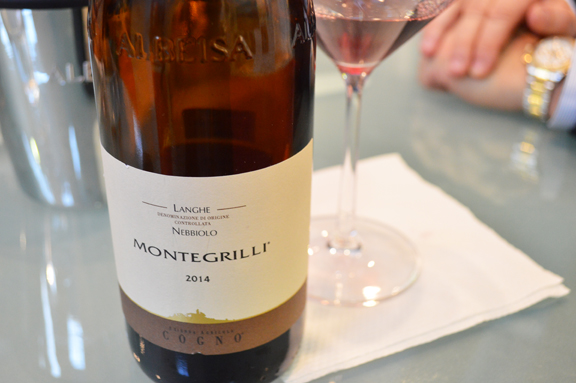
cogno barolo raveraIt would be too easy to simply post a panegyric on Valter Fissore’s extraordinary expressions of Barolo. I was blown away by the focus and elegance of the wines he showed at the fair this year.

But the wine I can’t stop thinking about is the 2014 Elvio Cogno Langhe Nebbiolo Montegrilli.

Even in a challenging vintage, this wine delivered on every level. Great Nebbiolo with wonderful freshness and transparent fruit. I loved this wine.
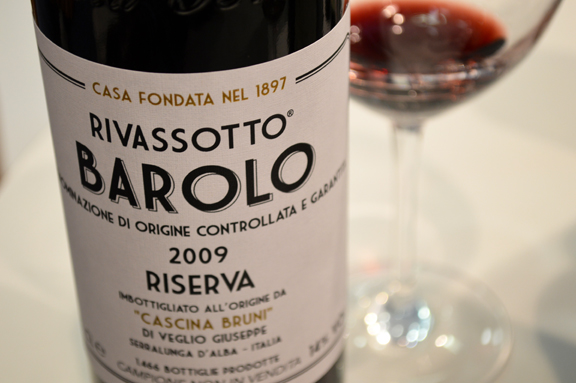
rivasotto barolo bruniIn the days that led up to the fair, there was a lot of talk about the Veglio family and their Cascina Bruni’s new partnership with famed Italian enologist Riccardo Cotarella. Offline, a lot of people wondered if this meant a new “modern” approach to the wines (because Cotarella is known for his love of modernity in winemaking).

I was stoked to sit down with Cristiano Veglio and taste through the wines: the old school style hasn’t changed at all. The family has merely used Cotarella’s consulting to improve vineyard management and winemaking practices, he told me.

I really liked the 2009 Barolo Rivasotto, which is already starting to show nicely despite its youth.

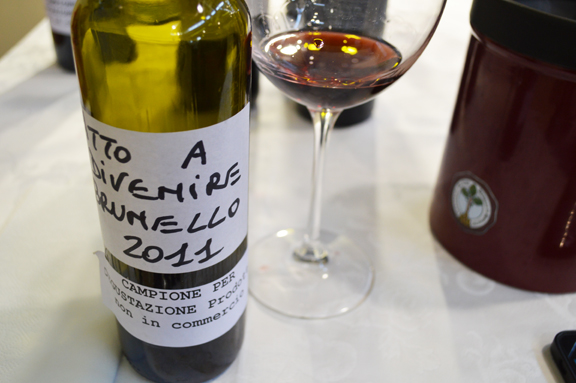
best brunello 2011 brunelli gianniThe 2010 vintage in Brunello has received so much media attention, said Laura Brunelli, one of my favorite Montalcino producers, that she’s already sold-out of her wine. A lot of people told me that actually.

It’s always great to sell wine, she noted, but she fears that the 2010 will eclipse other solid vintages like the 2011.

The cask sample she shared was gorgeous.
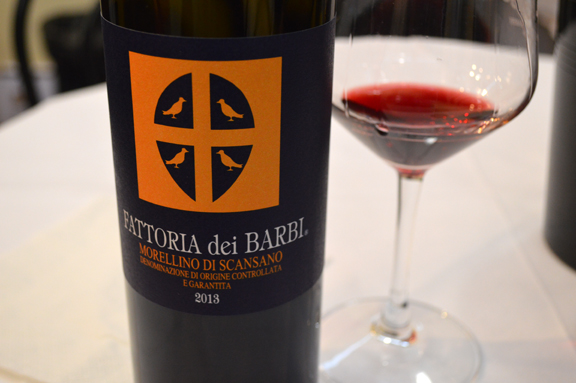
barbi brunelloI really liked Barbi’s Brunello 2009, which showed beautifully in the flight that they poured for me. The warm temperatures of that harvest made it a challenging vintage for many growers but Barbi delivered a great wine from that crop.

But my discovery wine from Barbi was its 2013 Morellino di Scansano. The 2013 vintage is going to be such a great one for Brunello and Tuscany (and many other regions and appellations, as well).

I loved the meatiness and texture of this wine and its fantastic, electric Sangiovese character. A great wine to pair with a piece of charred beef.
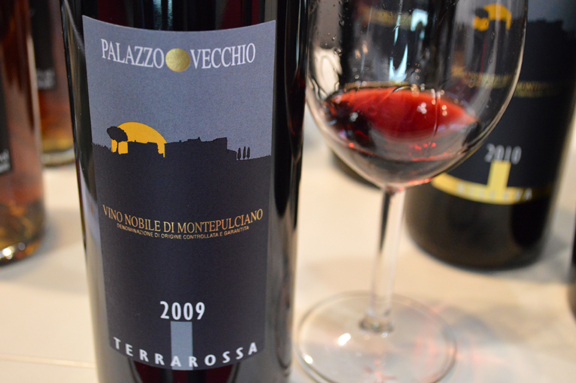
best montepulciano vino nobileAnother discovery was the Palazzo Vecchio Vino Nobile di Montepulciano. This youthful winery has the growing sites and the know-now to deliver vibrant, traditional-style expressions of Sangiovese.

So much crappy wine comes out of Montepulciano these days, which is sad because even I am old enough to remember when Montepulciano produced a lot of solid wine.

It was great to chat with them — however briefly — and taste these stellar wines. Welcome, new Mohicans!
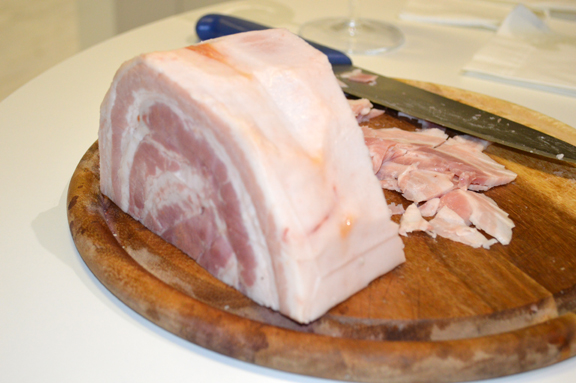
best ham italyAnyone who’s ever been to Vinitaly knows that the better winemakers always have something great to nosh on.

My friend and client Silvano Brescianini turned me on to a new — yes, new! — category from Emilian prosciuttoland: it’s a pancetta that’s cured like a prosciutto cotto.

It’s called “Giovanna” by the producer Capitelli (here’s the fact sheet; in Italian).

Man, a taste of the Giovanna and a glass of Silvano’s Barone Pizzini Franciacorta Rosato is pretty much all you need in life beyond love, sex, and rock ‘n’ roll…

Please stay tuned for my sparkling tasting notes next week. Thanks for being here!

Taste with me next week in… MEXICO CITY!

jeremy parzen canteleLong before I ever dreamed of traveling to Italy to study, Mexico was a refuge from the trappings of my American dream.

I grew up in San Diego, California. Baja California (or “Baja” as it was known to me in my youth) and Tijuana were only a thirty-minute drive from our home.

It was the time of the devalued peso, when many believed that revolution was coming to the country. As a result, many affluent citizens resettled in Tijuana and San Diego. And with them came some extraordinary restaurants on the Mexican side of the border, including the legendary Puerta del Sol.

During those years — my teenage years — my family life was in turmoil. It wasn’t an easy time for an adolescent. Luckily, the year I turned 16, the family of some of my Mexican friends offered to take me to Mexico City for the summer.

“La Ciudad” changed my life forever. Xochimilco, the Plaza Garibaldi, and the many culinary adventures of that summer opened my eyes and cast my gaze far beyond the gilded prison — at least it felt like that to me — of La Jolla.

And so I was thrilled when my client Barone Pizzini asked me to pour their Tre Bicchieri-winning wine at the Gambero Rosso Tre Bicchieri World Tour tasting on Thursday, April 23.

As with everything run and managed by the Gambero Rosso, it’s nearly impossible to find the registration info online. And so I aggregated it here on the Barone Pizzini blog (Barone Pizzini CEO Silvano Brescianini will be in Houston on Tuesday of next week to pour the wine for the tour; he just couldn’t make the Mexico date and so he asked me to attend in his place.)

If you happen to be in Mexico City next week, please let me know. And if you have any recommendations on where to eat, I’d greatly appreciate your insights. Please just shoot me an email and/or leave a comment below.

Nos vemos la semana próxima en la ciudad de México!

In an increasingly demotic wine world, there’s room under the sun for all

In a world where wine is becoming increasingly demotic, we lovers of the “new old” need to remember to be fair and gentle with our fellows.

saved wineLast week, I inadvertently accepted an invitation to a preview of an outdoor weekend “wine fest” here in Houston. I won’t go into the details but by the time I realized what kind of wines were being poured, it was too late to decline politely.

The centerpiece wine in the tasting was a California red blend by a legacy Napa grape grower and winemaker and a celebrity tattoo artist.

Curious about the wine, I looked it up on the winemaker’s site. Here’s how the tasting notes and technical info read:

A robust, powerful wine with a big personality and a generous finish. It is big, bold and rich, with pedigree sourcing from California’s finest regions.

An eclectic blend of grapes deliver rich color and full-bodied flavors: red currant, black cherry and black olive. Soft tannins balance well with distinct oak flavors – French oak for vanilla and coconut; American oak for caramel, créme brûlée and coffee.

[The wine is made using] 31% Zinfandel, 23% Carignane, 12% Petite Sirah, 11% Malbec, 10% Merlot, 9% Petit Verdot, 2% Mixed Blacks, 1% Ruby Cabernet, 1% Syrah.

In the age of the “new California” wine and in a time when fruit bomb Merlot and oaky and buttery Chardonnay trends seem to have faded among the wine intelligentsia, it may be hard for some — like me — to believe that wines are still made and marketed like this: “Big, bold and rich… with distinct oak flavors.”

But the fact is that the “big” California style still enjoys an immense and intensely loyal following throughout the United States.

Click here to continue reading my post today for the Boulder Wine Merchant…

Chianti, a new theory on the choronym’s origins

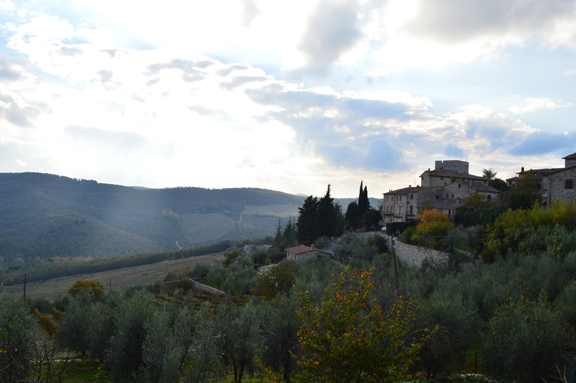
vertine village tuscany chiantiAbove: the village of Vertine in the heart of Chianti Classico.

I’ve spent the better part of my day reading up on all the literature devoted to the origins of the place name Chianti.

Chianti is what is known in toponomastics (the study of place names) as a choronym (Greek for chorus name), in other words, a place name that refers to a number of different places in the same general area.

In the early twentieth century, two theories as to its origins emerged.

On the one hand, scholars have speculated that it came from the Etruscan clante or clanti (the Etruscans were the ancient people who inhabited Italy before the rise of the Roman Empire).

Click here to continue reading my post today for La Porta di Vertine’s blog…

Grillo and Zibibbo as spoken by Antonino Barraco (and bonus track)

antonino barraco marsala grillo zibibboAbove: who better to “speak” Zibibbo and Grillo than winemaker and grape grower Antonino Barraco? He and I connected at the Vini Veri fair last month in Cerea (Verona province).

Here’s the latest installment of the Italian Grape Name and Appellation Pronunciation Project: Grillo and Zibibbo as pronounced by Antonino Barraco (a super cool dude, whom I met for the first time this year at Vini Veri).

While the pronunciation of Grillo (GREEL-loh) is relatively straightforward, the scansion of Zibibbo is not as intuitive as some may think.

In Italian grammar, words that come from Arabic (like Zibibbo) are pronounced with a stress on the first syllable — even when there is a stress on the syllable that follows.

Zibibbo, which comes from the Arabic zabib, is an example of this. Note how Antonino gives equal stress to the first and second syllable in his scansion.

Zabib means dried grape or raisin in Arabic. And it’s one of the many words that found their way into Sicilian during the height of Arabic culture in the Middle Ages, when, for example, Arabic mathematicians and philosophers were welcomed at the court of Holy Roman Emperor Frederick II in Palermo.

As a bonus track, I’ve included Antonino’s pronunciation of zbib, the Sicilian dialectal inflection of zabib.

Thanks again, Antonino!

Vittorio has left the building: Franciacorta icon heads to Milan to cook at Pont de Ferr

vittorio fusari pont de ferrIt felt like the end of an era: when Giovanni, Arianna, and I connected at the Dispensa Pani e Vini in the heart of Franciacorta on my second night in Italy last month, we were all a little blue because we knew that it was one of Vittorio Fusari’s last nights in the kitchen there.

I ate at the Dispensa for the first time not long after it opened in 2008. It was the same day that I met Giovanni for the first time. He would become one of my best friends and the accomplice in many of my capers.

In 2013, when Tracie P was pregnant with Lila Jane, she, Georgia, and I ate at the Dispensa three times in the course of 36 hours (although one of those meals was a to-go repast shared in our hotel).

THAT’s how much I love this restaurant and Vittorio’s cooking.

A few days before I arrived in Italy last month, Vittorio had announced that he had accepted a position as executive chef at the Michelin-starred Pont de Ferr in Milano.

“It’s a big commitment and although my family supports my decision,” he told me that night, “it’s going to be hard for all of us.”

It’s going to be hard on Franciacorta, too.

I wrote about our conversation and what it will mean for Franciacorta today for the Franciacorta, the Real Story blog.

I’ll be heading back to Franciacorta in a few weeks and I’ll visit the Dispensa for sure. After all, it’s the ideal location for Franciacorta visitors and franciacortini to congregate over a glass of sparkling wine. And I’m sure that the kitchen and verve of Vittorio’s cooking will continue to thrive there even as he oversees his staff from a distance.

But in the meantime, Vittorio has left the building…