“Cannelloni waits for no one”: scenes from Tony Vallone’s 50th anniversary celebration

salt encrusted fish whole recipe bestAbove: Tony served salt-encrusted Gulf of Mexico red snapper for 300+ persons last night.

In coming hours and days, much will be written about last night’s charity gala celebration of my friend and client Tony Vallone’s fiftieth anniversary as a restaurateur at his flagship restaurant in Houston, Tony’s.

It was back in 1965, he recounted when he took the mic, that he answered an ad for “a $500-a-month rental for a small wooden-framed restaurant where the Galleria now stands on Sage road.”

The landlord? Developer Gerald Hines.

best gulf red snapper recipeAbove: the snapper was served in a Barolo reduction, a Tony’s classic. In the arc of the menu’s narrative, this dish represented the 1970s and America’s “culinary awakening,” said Tony.

“In those days,” Tony told the 300+ crowd of rapt diners, “there were no refrigeration trucks. You couldn’t get fresh clams. You couldn’t get fresh mussels. Either you used canned or you used [gulf] oysters. That was all we had here. For calamari, I had to go to a bait camp to buy it because it wasn’t sold [in food shops].”

“There weren’t many Italian restaurants here in Houston in the 1960s. They were mostly American. And so you didn’t get pasta and seafood. When I started cooking these dishes, which Neapolitans had been doing for centuries, it was new here and it clicked.”

“This was the point of the original Tony’s. A very small and very Italian restaurant.”
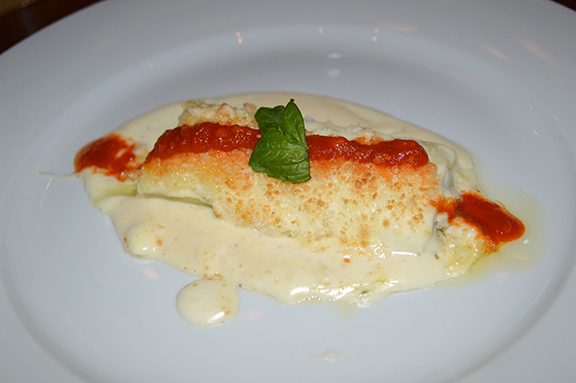
cannelloni sausage recipe best brooklynAbove: he served sausage-filled cannelloni as a nod to the 1960s and his beginnings as an Italian restaurateur, “a modern interpretation of a classic,” as he put it. To my palate, there were countless layers of meaning in this ineffably delicious dish. Even when Tony does passé, he does it with unrivaled panache.

Each of the dishes that Tony served last night was inspired by a decade of cooking at Tony’s.

The cannelloni (above), a homage to Italian cuisine in the United States circa 1965.

Salt-crusted Gulf of Mexico red snapper (top), an allusion to the 1970s and Americans’ “culinary awakening” as they embraced fresh seafood and locally sourced ingredients.

The “decade of America’s opulence,” the 1980s, was represented by heirloom veal served with Ossetra caviar (below).
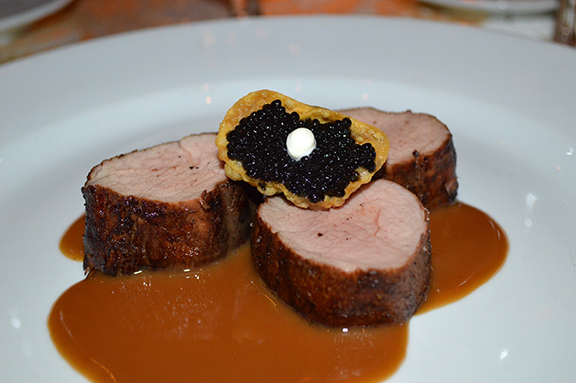
veal provimi recipe bestAbove: over my years working with Tony, he’s talked to me about how much fun it was to cook in Houston in the 1980s during the first oil boom when the sky was the limit for opulent eating. I loved how he served caviar and veal as a metaphor for those times.

The crème de la crème of Houston society and the energy-and-gas crowd was in attendance at last night’s event.

The cheapest seats cost $500 per person and table could be had for a cool $10k.

The dinner sold-out within two days of when it was first announced by the co-presenter Memorial Hermann, the largest not-for-profit hospital system in Houston (according to its Wiki entry).

More than 300 persons attended and there was a waiting list of 260+. The only crasher I spotted was Houston mayoral candidate Bill King.
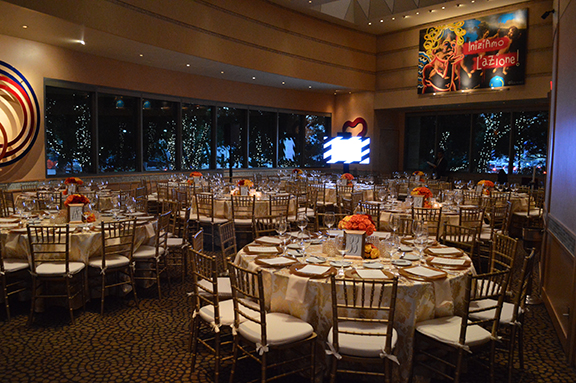
best private dining houstonAbove: Tony’s is one of the most beautiful restaurants I’ve ever had the pleasure to dine in. But last night, with the entire house open for the event, it shimmered like the star it fêted.

It’s understandable that Houston’s elite would be so eager to attend the gathering and support its featured charity, Life Flight, Houston’s “critical care air medical transport service,” for which the event raised more than $400k.

After all, for five decades, Tony’s has been the backdrop of their finest moments, from marriage proposals to wedding receptions, from dinners-with-an-important-client and nights-out-with-the-boss to anniversaries and milestone birthdays.

chef kate mclean houstonAbove: many of Tony’s team members have worked with him for more than 40 years. They are fiercely proud of their work together. Tony insisted that we snap pics with all the staff last night, front and back of the house.

For me, the nearly five years that I’ve worked with Tony have truly been one of the most fascinating and culinarily rewarding experiences of my professional life.

In so many ways, the contours of Tony’s career shape a gastronomic narrative that arches over all of us.

I am old enough to remember a time before words like trattoria, risotto, and al dente were commonly used in American culinary parlance; a time when we still said Parmesan in place of Parmigiano Reggiano; a time before Barolo, Barbaresco, and Brunello when there was only Napa Valley Cabernet Sauvignon, Merlot, Zinfandel, and Chardonnay.

For five decades now, Tony — himself, an ante litteram foodie — has been and continues to shine as a pioneer of the American real food movement.

Just think of how many people tasted arborio or radicchio for the first time in his restaurants over the years. Contemplate how many diners had their first kiss with prosciutto di San Daniele or extra-virgin olive oil from Sicily at his tables. Consider how many wine lovers first drew Nebbiolo, Corvina, or Sangiovese to their lips from stemware that had been polished in Tony’s kitchen (when I first moved to Texas in 2008, he was the only restaurateur who had Bartolo Mascarello and Giuseppe Quintarelli on his wine list, btw).

He is a bona fide national treasure and I am unabashedly proud to call him amico.

Thank you, Tony, and mazel tov for 50 years well spent as you have shared your passion for great food with us.

Our city, our nation, and my family are all the better for it.

As you put it so sagely and succinctly last night as you encouraged your guests to turn their attention to the rolled, stuffed housemade pasta on the plates before them, the first dish served on an unforgettable evening: cannelloni waits for no one…

best birthday cakes houston

Bruno Giacosa Barolo fetches potentially record price in rare wine auction

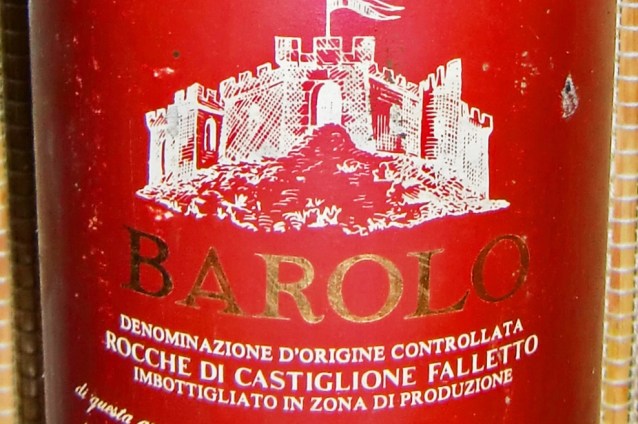
rocche castiglione fallettoAt an auction of rare Italian wines held yesterday at Bolaffi in Turin, a buyer paid €17,500 (with fees) for an 11-bottle lot of Bruno Giacosa 1971 Barolo Rocche di Castiglione Falletto (Red Label), a potentially record price for Italian wine at auction.
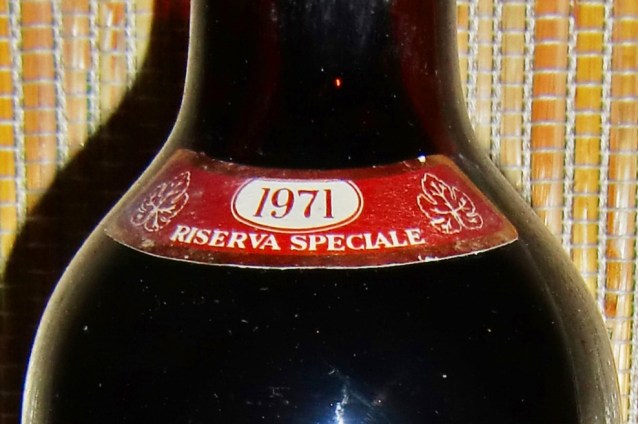
According to a blog post published today by Slow Wine editor Giancarlo Gariglio, the wines were included in a selection of 579 lots from the private cellar of Italian food and wine writer Luigi Veronelli (1926-2004), who has been called “one of the architects of Italy’s current food and wine renaissance.”

At €1,590 per bottle, the sale (when adjusted for the current exchange rate) could top the $1,680 paid for a bottle of Giacomo Conterno 1961 Barolo Monfortino in 2009, an auction price considered by wine trade observers to be the highest ever paid at the time for a single bottle of Italian wine.

Slow Wine was an official co-presenter of the auction, which netted €922,000, noted Gariglio, a record for the auction house.

“We finally have our Henri Jayer!” he wrote with unabashed pride.

bruno giacosa 1971

Label images via FineWineGeek.com.

“You opened the Merlot without me?” My Thanksgiving recommendations for @HoustonPress @EatingOurWords

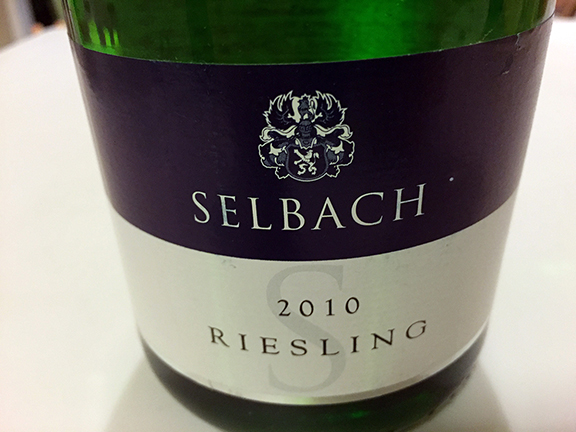
selbachAbove: there are handful of one-liter bottles of the 2010 Selbach Riesling that — I’m guessing — have been sitting on the shelves at the flagship Spec’s in Houston (the behemoth Texas retailer) for a few years now. I snagged one for around $15 and it is drinking nicely.
My friend and colleague Cathy Huyghe recently blogged about her new experiment, the “Blue Collar Wine Guide,” for Forbes.com.

She was prompted, she wrote, by her revelation that “I don’t spend much time writing about how most people actually drink it.”

“Maybe… just maybe,” she opined, “we’re writing about wine as ‘wine people’ and not as real people. Maybe we’re too busy writing for people who are already in some imaginary inner circle. Maybe we aren’t listening well enough to what people actually like and what people actually drink.”

Whoever the we in her pluralis majestatis, I took inspiration from her post for my post today for the Houston Press, “5 THANKSGIVING WINES UNDER $20 OR ‘YOU OPENED THE MERLOT WITHOUT ME?'”

Capping my selections at $20 ($5 less than Eric Asmiov’s Thanksgiving “fret-free” picks for the New York Times), I set about shopping for wines that readily available in southeast Texas with the added criterion of familiarity.

I generally don’t care for slightly oaky Cabernet Sauvignon from Argentina. But I recognize that a lot of people like wines like it, including many of my fellow Texans and the people who read the Houston Press, the weekly rag in America’s fourth-largest city.

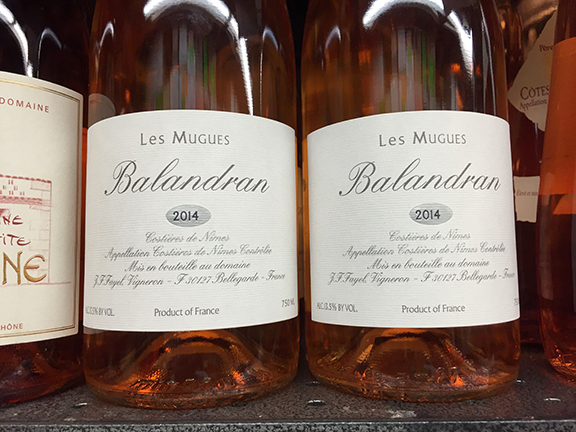
balandranAbove: my go-to wine shop, the Houston Wine Merchant, is sold out of the 2014 Costières de Nîmes rosé by Balandran (a wine imported locally). But there are still a few bottles left on the shelves of Spec’s. Great value, great wine.

Is it wrong to recommend wines that I don’t particularly like myself, even though they represent objective value for the average American wine drinker today?

In my mind, Eric remains the best wine writer in popular American wine writing today. A Solomon among wine scribes, he always manages to strike a healthy balance between writing about what he personally likes and what he may not drink in his off time.

picpoul de pinetAbove: Tracie P and I both really liked the citrus and dried-citrus fruit in this Picpoul by Gérard Bertrand that I picked up about the Houston Wine Merchant.
The three wines featured in this post’s photos didn’t make it into my piece for the Houston Press. I really liked each one of them but I didn’t think they worked well for the average Joanne who’s out shopping on her once-or-twice-a-year wine-finding mission.

When I shared a draft with Tracie P this morning, she approved.

“Am I a sell-out?” I asked her, hoping that my personal wine-culture-war crisis wouldn’t be the demise of our felicitous union.

“No,” she replied, “you’re writing about wines that people can actually find and that they want to drink at Thanksgiving.”

And even though she made me edit out some of the more off-color humor about our homelife, I had fun writing about what it’s like for a La Jolla-raised grandson of eastern-European Jewish immigrants to play sommelier for his southeast-Texan family.

Here’s the link. Buona lettura! And thanks for reading.

The siege of Paris circa 1532. Today, as she shudders and weeps, so do we…

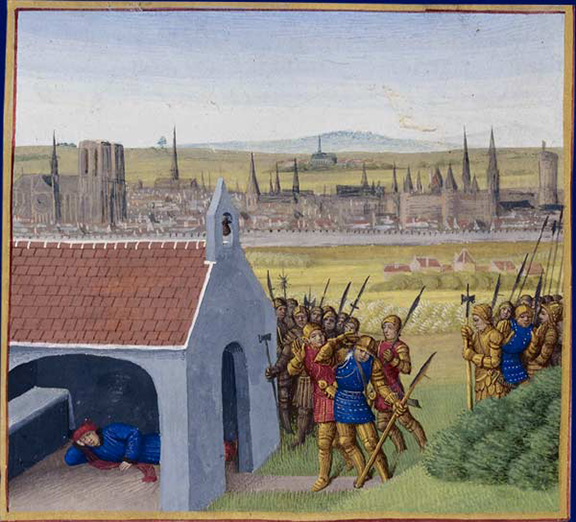
siege paris terrorismAbove: Paris as it appeared around the mid-fifteenth century in a painted manuscript. The panel depicts Merovigian king Dagobert I (603-639 C.E.; see attribution below) in Saint-Denis (just north of the city’s center). But the image of the “skyline” of Paris is what it looked like in the time of artist fifteenth-century French artist Jean Fouquet.

With hushed tone on Friday afternoon, Tracie P asked me if I had read the news of the siege of Paris when I had wrapped up my work week and turned my attention to our daughters.

We didn’t want to betray our alarm as we furtively glanced at the feeds on our phones, which bubbled over with horrific dispatches from the capital.

Our thoughts turned to an American wine writer colleague and friend who’s currently visiting there; to another friend, a Turkish-German wine educator from Rome who was visiting there.

Our memories turned to our many friends who live there, fellows from my days performing there: in February 2009 Tracie P accompanied me to Paris to play a few shows with my then-active French-language band; over the years, I’ve played guitar in Parisian rock venues on maybe ten occasions.

By Saturday morning, one of the New York Times accounts of the terror began: “a wine consultant and rock music fan, thought the concert he was attending Friday night had simply taken a particularly raucous turn.”

It all hit too close to home for us.

My mind turned (escaped?) to Ariosto’s sixteenth-century epic poem, Orlando furioso, and its chilling account of the siege of Paris by Saracen king Rodomonte. In the now nearly twenty years since I obtained my doctorate in Italian studies, I had forgotten that one of the similes employed by Ariosto in those famous stanzas was viticultural.

In its time and beyond, Orlando furioso was and is of the most influential and popular texts in the Western canon (although we hardly remember it today). When it was published in its entirety in 1532, it was already a blockbuster.

In one of the most celebrated examples of “military poetry” in all of literature (below), Ariosto conveyed the panic, mayhem, and terror of Rodomonte’s siege of Paris through a series of analogies.

The translation comes from David R. Slavitt’s 2010 rendering (Harvard Press; available on Google Play, btw, for less than $14 with tax). The original (from the 1974 Garzanti edition) follows for Italian readers.

Think of a bull, a different one this time,
that has been penned in the square all day and young
children have teased and poked it without rhyme
or reason, and then it breaks out and runs among
the crowd in the street and suddenly all that prime
beef turns into a weapon. Some are flung
up into the air and some are gored…
That was Rodomonte and his sharp sword.

He cut off the heads of fifteen or twenty as though
he were pruning vines and lopping the weak
runners that sap the plant. But there was no
wine but only blood that came from this freak
viticulturist pantomime. His slow
but gory progress through the throng to seek
an egress left arms and heads strewn in the street
so that it hardly seemed to be a retreat.

Chi ha visto in piazza rompere steccato
a cui la folta turba accaneggiato,
stimulato e percosso tutto ‘l giorno;
che ‘l popul se ne fugge ispaventato,
ed egli or questo or quel leva sul corno:
pensi che tale o più terribil fosse
il crudele African quando si mosse.

Quindici o venti ne tagliò a traverse,
altritanti lacsiò del capo tronchi,
ciascun d’un colpo sol dritto o riverso;
che viti o salci par che poti e tronchi.
tutto di sangue il fier pagano asperse,
lasciando capi fessi e bracci monchi,
e spalle e gambe ed altre membra sparte,
ovunque il passo volga, al fin si parte.

Orlando furioso, Canto 18, 19-20.

Maybe I turned to Renaissance Italian poetry to avoid the overwhelming fear and terror in my heart. Maybe I turned to Ariosto because I am unable to come to wrap my mind around the absolute horror experienced by our fellows.

Thank you for letting me share it here. Today, our thoughts and hearts go out to our Parisian sisters and brothers. In a way, Paris belongs to all of us and we to her. As she shudders and weeps, so do we.

*****

See also Gustave Doré’s nineteenth-century illustrations of Orlando furioso, including this panel depicting Rodomonte’s rampage through the streets of Paris.

Image source: “Dagobert Ier réfugié à Saint-Denis” by Jean Fouquet. Licensed under Public Domain via Commons.

Vive la France!

Solidarity for our French sisters and brothers… thoughts and prayers for all those affected by yesterday’s attack on French citizens and Parisian visitors… vive la France!

french flag vive la franceFrench flag image via Wisegie.

Hapless lexicography: Italian Wine Glossary updated and revised (with help from @MaurizioGily)

Please click here for the updated glossary (March 21, 2019).

petrarch bee ape“It may all be summed up by saying with Seneca, and with Flaccus before him, that we must write just as the bees make honey, not keeping the flowers but turning them into a sweetness of our own, blending many very different flavors into one, which shall be unlike them all, and better.” Petrarch to Boccaccio, 1365 (photo snapped in August at the Ca’ del Bosco winery in Franciacorta).

“Such is the fate of hapless lexicography,” wrote the great 19th-century English lexicographer Samuel Johnson in the preface to his 1755 dictionary, “that not only darkness, but light, impedes and distresses it; things may be not only too little, but too much known, to be happily illustrated.”

I’ve been reminded of this all-too-true observation as I continue to expand my Italian wine terms glossary (see the updated and revised version below).

Many have written me expressing their support for the project while others have rightly pointed out oversights and errors.

Like translation, lexicography is an inexact science and I apologize for my inadvertences in the hope that the overarching spirit and intent of my work eclipse my shortcomings. But, alas, I am only human — all too human.

This most recent version includes revisions and notes from my friend Maurizio Gily, one of Italy’s greatest wine writers (imho) and consulting enologists.

Justifiably, he nudged me to revise my entries for giropoggio and ritocchino (see below). There are no precise English renderings of these terms (at least as far as I can find). But I did discover that ritocchino may have Tuscan origins and that it most probably derives from the Italian china (KEE-nah) or slope.

Another revision worth noting was suggested to me by both Maurizio and Finnish winemaker Jarkko Peränen who lives and works in Chianti Classico: alberello, which, as both of them correctly observed, should be rendered head-trained bush vines (see the revised entry below).

Not that it has any bearing here, but my research led me to this wonderful entry in UNESCO’s “intangible cultural heritage” list on the “head-trained bush vines” of Pantelleria (worth checking out).

As I continue to expand, revise, and edit the project, I encourage everyone in our community to offer suggestions, corrections, and observations. It is a work in fieri and its hypertextual nature is what makes it so valuable (for me personally and, I hope, for our community at large).

I only ask you to be gentle in your disapprobation for I am only a man of modest intellectual means who is trying to see through both the darkness and the light.

Post scriptum: a hand-list of sparkling wine terminology is also forthcoming.

ITALIAN ENGLISH
a giropoggio vines planted across a slope (along the contour of the slope; compare with a ritocchino)
a ritocchino vines planted up and down a slope (from peak to valley, as it were; compare with a giropoggio)
acciaio [inossidabile] stainless-steel [vat/tank]
acinellatura millerandage [alt.: shot berrieshens and chicks, or pumpkins and peas]
affinamento aging
alberello head-trained bush vines
allegagione fruit set
allevamento training
argilla clay
arresto di fermentazione stuck fermentation
assemblaggio blend
azoto nitrogen
barbatella rooted cutting
barrique barrique [small French oak cask]
bâtonnage stirring on the lees
biodinamica biodynamics/biodynamic
biologico organic
botte traditional large cask
bucce skins
Cabernet [Sauvignon] Cabernet Sauvignon
Cabernet Franc Cabernet Franc
calcare/calcareo limestone/calcareous [limestone-rich]
capo a frutto fruit cane
cappello sommerso submerged cap maceration
chioma canopy
cordone cordon
cordone speronato cordon-trained spur-pruned [vines]
cru vineyard designation/single vineyard
cuvée blend
délestage rack and return
diraspare/diraspatrice de-stem/de-stemmer
diradamento pruning/thinning grapes/dropping fruit
diserbante termico weed torch/weed flamer
DOC DOC [designation of controlled origin]
DOCG DOCG [designation of controlled and guaranteed origin]
DOP PDO [Protected Designation of Origin]
doppio capovolto double-arched cane [training]
drenaggio drainage
esca esca [alt.: black dead arm or black measles]
escursione termica [diurnal] temperature variation
fermentazione arrestata stuck fermentation
femminella lateral shoot
flavescenza dorata grapevine yellows (flavescence dorée)
follatura punching down
galestro galestro [a marl- and limestone-rich subsoil unique to Tuscany]
giropoggio vines planted across a slope (along the contour of the slope; compare with a ritocchino)
grappa grappa
grappolo cluster/bunch
grappolo spargolo loosely clustered grape bunch
Guyot Guyot
IGP PGI [Protected Geographical Indication]
IGT IGT [typical geographical indication]
leccio holm oak
lievito naturale native/ambient/indigenous/wild yeast
lievito selezionato cultured yeast
limo silt
macchia mediterranea Mediterranean maquis [shrubland]
maestrale (vento di maestrale) north-westerly wind
malolattica malolactic fermentation
marna/marne marl
monovitigno single-grape variety [wine]
mosto must
oidio oidium [powdery mildew]
pedicello pedicel
peduncolo stem (peduncle)
peronospora peronospora [downy mildew]
pied de cuve pied de cuve [native yeast starter]
pigiatura crush/crushing
pirodiserbatore weed torch/weed flamer
pirodiserbo weed torching
portinnesto rootstock
pressa press
pressare to press
quercia oak
rachide rachis
raspo stem
rimontaggio pumping over
ritocchino vines planted up and down a slope (from peak to valley, as it were; compare with a giropoggio)
sabbia/sabbioso sand/sandy [sandy soil]
Sauvignon [Blanc] Sauvignon Blanc
scacchiatura shoot-thinning and disbudding
siccità drought/drought conditions
sistema di allevamento training/trellis system
sottosuolo subsoil
sovescio cover crop/green manure
spargolo (grappolo spargolo) loosely clustered (grape bunch)
sperone spur
spollonatura disbudding and suckering
stralciatura shoot-thinning
stress idrico hydric stress
sulle bucce skin contact [macerated on the skins]
sulle fecce nobili lees aged [aged on its lees]
sur lie lees aged [aged on its lees]
svinatura racking (devatting, drawing off)
terreno/terreni soil
tignola della vite vine moth [Eupoecilia ambiguella]
tralcio shoot/cane
tramoggia hopper/feeder
tufo tufaceous subsoil [porous limestone]
vasca vat/tank
vento di maestrale north-westerly wind
vigna/vigne vine/vineyards
vigneto vineyard
vinaccia/vinacce pomace
vite vine
vitigno grape variety

Branchini Reno Pignoletto, great value and great wine from an appellation I’d never tasted

From the department of “just when you thought you knew everything about Italian wine, think again”…

best pignolettoWhile visiting my new restaurant client in Austin last night, Al Fico, I was thrilled to discover this super Pignoletto by Branchini from the Reno DOC, which lies northwest of Bologna overlapping the provinces of Bologna and Modena (check out the Google map screenshot below).

Most of the Pignoletto I’ve tasted this year comes from the Colli Bolognesi (southwest of Bologna), where I visited in June of this year for the first time.

It’s one of the most exciting appellations in Italian wine right now imho.

If the selection in the wine shop at Amerigo dal 1934 in Savigno in the heart of the Colli Bolognesi DOC is any indication, this designation is brimming with organic and biodynamic growers who are churning out super groovy, value-driven wine.

So when I saw the above Pignoletto on Al Fico’s list, I just had to order it and I assumed it would be from the Colli Bolognesi.

But when it arrived, I realized it’s from a DOC I’d never heard of before: Reno (here’s a link to a description of the DOC in Italian).

reno doc mapThis wine was fresh and bright on the nose and in the mouth it delivered surprising minerality and white fruit with a hint of citrus.

Gauging from the on-premise price, this wine is a fantastic value for the quality. I really loved it and if I can find it retail, it’s going to enter into rotation in the Parzen family’s “Monday through Thursday” wines (with an occasional appearance, I’m sure, on Sunday afternoons thanks to its restrained alcohol and lovely freshness).

al fico new italian restaurant austinO and Al Fico, you ask?

I’m kinda jazzed about the above photo I snapped of Chef Clinton Bertrand’s linguine al nero di seppia, which he tosses with cherrystone clams.

Pretty cool, right?

The restaurant’s still working out some of its kinks but both Chef Clinton and wine director Tom King have really been nailing it. I’ve only eaten there twice now but both meals have been spot on. The housemade pasta, in particular, has really impressed me, as has the ambitious all-Italian wine list.

The funniest thing is that Chef Clinton, an A16 alumnus, went to high school with Tracie P in Orange in southeast Texas!

It’s a small world, after all… but my wonderful world of Italian wine just keeps getting bigger and bigger.

Post scriptum: check out Alfonso’s excellent post in which he reflects on that expanding universe of Italian wine in the U.S.

Boulder, mon amour! Thank you! And my new career as a culture wars blogger

boulder wine merchant franciacortaI’m kinda getting blue as my year-long project blogging about and pouring Franciacorta wines as the Franciacorta Consortium trade ambassador for the U.S. comes to its end.

Just one more tasting (Seattle) and a few more weeks of blogging to go. But, man, what a way to go out!

That was my tasting (above) at the Boulder Wine Merchant on Wednesday, where the store now carries four skus from Franciacorta (previously none).

And yesterday, I led a seminar and tasting of 11 wines (below) for one of the most engaging and enthusiastic groups I’ve encountered all year.

st julien hotel conference event roomI’ll never forget the moment when my good friend, Master Sommelier and Boulder Wine Merchant owner Brett Zimmerman, talked to our group about how he feels that Franciacorta is going to be one of the next big things in the U.S.

It was a truly magical moment for me: in part because I love these wines so much and in part because I’ve put some real blood, sweat, and tears into this campaign this year (more blood and tears than I had imagined).

And dulcis in fundo, Master Sommelier Bobby Stuckey is about to add a Franciacorta by-the-glass to his stellar list at Frasca, one of me and Tracie P’s favorite restaurants in the world.

It’s really too bad that the project has to come to an end. Mishegas aside, I’ve really enjoyed it.

tuna crudo frascaThe food and wine community and culture in Boulder are among the most sophisticated and engaged in the U.S. today in my experience.

That’s the tuna crudo at Frasca (above) btw. Can you think of a better pairing for Franciacorta?

It was remarkable to interact with the team members at the Boulder Wine Merchant and Frasca over these two days that I’ve been working here. I can’t think of anywhere else in the country where young people are more excited about enogastronomy or more motivated to deliver the highest level of service.

Thank you, Boulder! You really made my year with your warm reception and your embrace of the wines I was showing. Thank you!

In other news…

In a first for me, I’ve been published in the Arts and Culture section of a major urban weekly.

Today, the Houston Press, where I usually blog about wine, published my recent post about my bizarre predilection for using women’s bathrooms in Houston.

I’m wedged in between a review of a “bodacious” cabaret performer and another of a locally produced opera.

My post on how so many Americans look down on Houstonians and this more recent post (which is actually about Houston’s horrific repeal of its equal rights ordinance) have had such an overwhelming response that I’m thinking of becoming a culture wars blogger.

That’s all the news that’s fit to print blog about. Now it’s time to get my ass on a plane in Denver and get back to the Parzen womenfolk down on the bayou where I belong. Thanks for reading and buon weekend a tutti!

Can you be Cannubi? A great post on how the subzone designations are applied in Barolo Cannubi

best barolo cannubiPosting from the road today in Boulder, Colorado, where I spoke at an in-store Franciacorta tasting yesterday at the Boulder Wine Merchant and where I’ll be leading a formal seminar and tasting of 11 Franciacorta wines today for trade and consumers.

But I just had to share this post by my new client in Piedmont, Tenuta Carretta: “The importance of being Cannubi (and its subzones).”

In it, the winery’s CEO (and my friend) Giovanni Minetti shares his insights into why it is virtually impossible to determine how many bottles of Cannubi and subzone-designated Cannubi are produced each year.

Alfonso had written a fantastic post on this very subject a few months back and now we’ve published Giovanni’s take on the situation.

Giovanni is a former president of the Barolo consortium and you might be surprised at what he had to share and say about the situation (one of the most hotly debated issues in Barolo today).

It’s a must-read for anyone trying to wrap their mind around Cannubi.

Check it out here.

Will “big” marijuana go the way of “big” wine?

This just in:

Please have a look at Alfonso’s provocative post on Franciacorta here.

Details for my Franciacorta tastings this week in Boulder (Weds. and Thurs.) here.

marijuana ohio ballotImage by Ryan Williams Photography.

When I read this New York Times article about a ballot measure in Ohio that would create a marijuana growing monopoly, it hit me like a brick of weed: will “big” marijuana in the U.S. go the way of “big” wine?

In the era following the repeal of Prohibition in 1933, the U.S. federal government basically told states that they could decide internally how they wanted to regulate the production, distribution, and sale of wine and alcohol.

Intended to hamper monopolistic and unfair business practices in our country, the Interstate Commerce Act (1887) would continue to apply to nearly every other commercial category. But alcohol would remain a matter for states to decide.

As a result, every state of the union has its own laws regulating the distribution and sale of alcohol.

More than 80 years after the end of Prohibition, this anti-system had led to the rise of virtual monopolies in many states. Just last month, a new merger of family-owned wine distribution companies in the U.S. created yet another behemoth among behemoths of wine sales. According to Tom Wark, a California-based marketer and wine blogger who has devoted much of his career to battling the forces of “big” wine in this country, “five companies (families) [now] control well over 50% of the alcohol box moving business in the United States.”

Today, as I write this, voters in Ohio are deciding whether or not to pass an amendment that was “bankrolled by wealthy investors [who have spent] nearly $25 million to put it on the ballot and sell it to voters. If it passes, they will have exclusive rights to growing commercial marijuana in Ohio” (New York Times).

The parallels are uncanny.

As more and more recreational marijuana comes online in this country, the wine and spirits industry has been paying close attention.

In September of this year, Republic National Distributing Company, one of the biggest distributors in the U.S., published a report on marijuana’s effect on wine sales in Colorado (recreational marijuana became legal there on January 1, 2014).

According to the author of the study, marijuana sales have had a positive effect on wine sales.

Republic (as it is known in the trade) isn’t the only “big” wine company to look carefully at marijuana sales. I know of least one other major U.S. wine and spirits distributor who has received state funding for marijuana sales feasibility studies (you might be surprised by the state government that funded the research but that’s a story for another day).

Currently, marijuana is completely legal in Alaska, Colorado, Oregon, and Washington. Today, Ohio could become the fifth state to legalize marijuana and at least six other states — including California — are considering legislative paths to legalization.

However you feel about the issue, there’s no getting around the fact that marijuana prohibition is rapidly coming to an end in our country.

When Prohibition was repealed in 1933, Americans were still a long way from the current fine wine culture.

During Prohibition, wine and spirits were produced and sold legally in the U.S. as tonics, in other words, medicine — another uncanny parallel with historic marijuana in this country.

In the more than 80 years since the end of Prohibition, the wine and spirits industry has grown into a major force in the luxury product industry. It’s possible — and in my view likely — that marijuana will follow the same path.

Will “big” wine be the model for “big” weed? We’ll see…