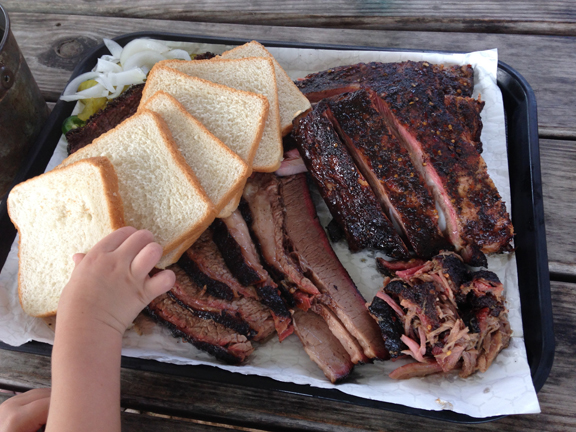
 Above: BBQ waits for no one at Cork Screw BBQ in Spring, Texas, where the line begins to form at 8 a.m. for an 11 a.m. open.
There was a time in Texas, I’ve been told, before citizens would begin lining up early in the morning to get a taste of limited-edition cult BBQ.
Some say that Snow’s in Lexington (about an hour east of Austin) was the first pit master to attract such an early morning crowd.
But it was Franklin’s in Austin (proper), opened in 2009, that irrevocably created a new BBQ vernacular: BBQ zealotry punctuated by early-morning commitment and/or long waits under the Texas sun to savor the coveted gelatinous beef fat or pork product of choice.
With Killen’s, which opened earlier this year, Houston got its first high-profile cult BBQ destination — including the long waits and disappointed customers who don’t make it to the front of the line in time for their favorite cut.
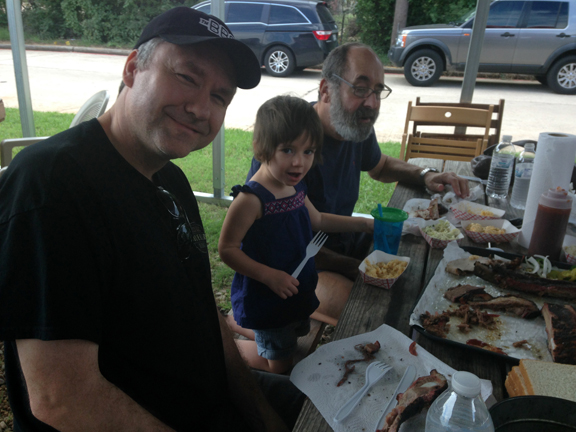
 Above: J.C. Reid, left, travels across Texas and the United States writing about BBQ. Georgia P and cousin Marty sit to his left.
On Saturday morning, Georgia P, cousin Marty, and I joined J.C. Reid — the foremost authority on Texas BBQ in my view — and his beautiful wife Tamara for a meal at Cork Screw BBQ in Spring, about forty minutes north of Houston.
“Chris,” as he is known to his friends, was the first in line when the cashier opened at 11 a.m.: he had been there since 7:30 holding his place (read the Cork Screw FAQ for queue etiquette [please excuse the pun on ‘cue]).
In his weekly BBQ column for the Houston Chronicle (launched in April 2014), Chris wrote that Cork Screw’s “smoked meats now rank with the city and state’s best, and the bar will likely keep getting raised higher.”
Click here for the article. It’s a great window into the commitment and unbridled passion that go into great BBQ (I love the line about the “thousand-yard stare”).
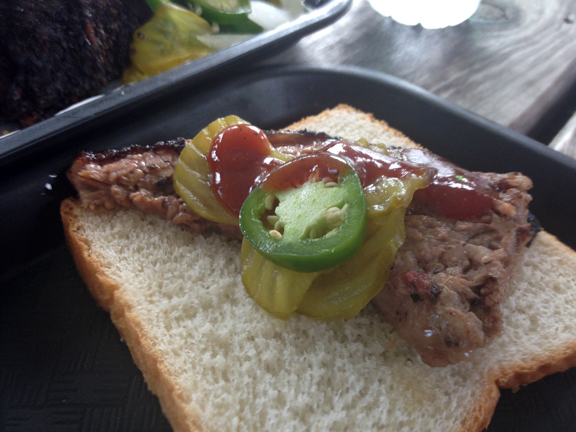 Above: a “fold over,” in southern parlance, when you make a sandwich using one slice of bread. The brisket — the sine qua non of BBQ in Texas — was outstanding, with melt-in-your-mouth texture, well balanced rub (seasoning), and integrated smokiness (a key factor in the best BBQ in my experience).
Chris has written about BBQ for a number of top mastheads (including the New York Times).
We became friends a few years after I moved to Austin in 2008 via social media thanks to our shared love of central Italian cookery (we’re planning a carbonara-fueled trip together to Rome in spring 2015).
The thing that sets him apart from the current and past generation of BBQ chroniclers in Texas (blowhards, for the most part) is that he sets his sites beyond the state’s borders.
He and his wife are world travelers and gourmets and he’s acutely aware (and self-aware) of BBQ’s role in the americana gastronomic canon (a grad of USC, he has also worked as an architect in New York and the chief of a web hosting company here in Houston).
When I thanked him for holding our place in line, he smiled and told me he was happy to do it.
“It’s my job,” he said.
The best place to follow Chris is his Twitter, where he posts a subscription-free link to his Houston Chronicle column each week. See also his article, published last week, on favorite BBQ destinations beyond Houston and the Texas tradition of the “BBQ run.”

 Yesterday I managed to snag a press pass and sneak into the Third Annual Houston Barbecue Festival. The event was co-founded by Houston Chronicle barbecue columnist Chris Reid, my good friend here.
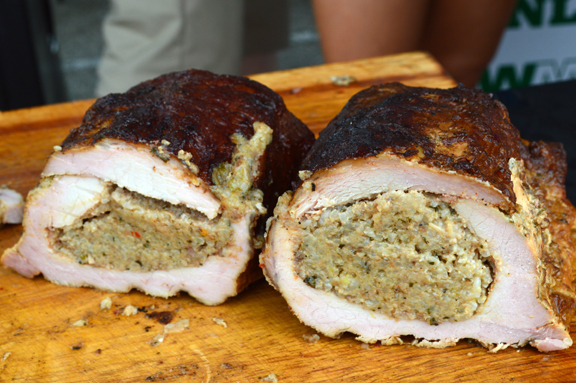 I didn’t visit every stand but CorkScrew’s was my number one for taste and presentation. I loved the Boudin-Stuffed Pork Loin, above, the best thing I tasted at the festival.
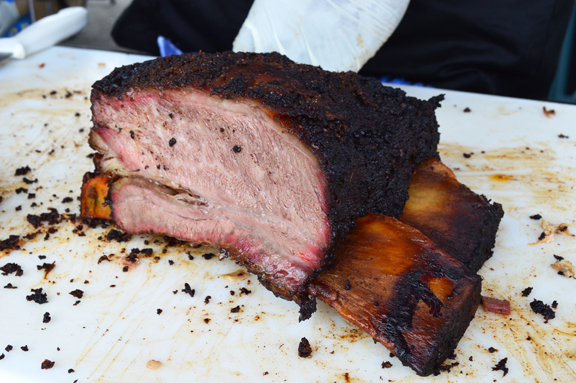 Bigger is often considered better in Texas barbecue. That’s the Brooks’ Place beef rib, above (the cut is often called a “brontosaurus rib,” even though it is now believed that the brontosaurus never actually existed).
  I overheard one of Houston’s highest-profile food writers say that Patrick Feges’ pulled pork, above, was the best thing he tasted yesterday.






 Do Bianchi