When Céline, the band, and I returned to La Dama Bianca on our way back to Venice to lunch with our friend Marco Fantinel, we were served these delicious paccheri (homemade ring-shaped pasta) with shrimp and squid.
My post the other day on La Dama Bianca in Duino (Italy Day 7) generated a tide of comments, including a number of messages from fellow fans/lovers of the the restaurant/hotel: it’s one of those truly magical places and once you’ve been, you count the days until you can return (Céline Dijon liked it so much that we decided to stop there for lunch on our way back from Slovenia).
Céline (left), the band, and I met Marco (right) on our way back to Venice. The weather was beautiful and the food… ah… the food at La Dama Bianca always puts you in a good mood.
The name “Dama bianca” came from a legend, inspired by a white rock that, seen from the sea, it seems a female figure wrapped in a long veil. The legend tells of the evil owner of the old castle of Duino (today only ruins) during the Middle Ages, who threw his wife from a precipice and God, moved to mercy by the shouts of the “pure” lady, transformed her into stone before touching the water.
I’m not quite sure the origin of paccheri (see photo at top), although I know that some believe the pasta shape was created to smuggle garlic cloves. Maybe Simona can help us to resolve the paccheri mystery…
Above: tasters nap in the springtime sun outside Villa Boschi where the Vini Veri tasting was held again this year. I don’t know why but my day at Vini Veri made me think of the northern Italian folk song “L’uva fogarina”: “Quant’è bella l’uva fogarina, quant’è bello saperla vendemmiar!” (The Fogarina grape is so good! So good for the pickin’!). See below…
Let’s face it: we all go to Vinitaly every year because we have to: by the second day of the massive trade and consumer fair, the pavilions are a slosh of deal-making, true and otherwise would-be wine professionals, the occasional parasitic wine writer, and a sea of reveling imbibers who show up to get their drink on. Every year, the same parties, the same dinners, the same 45-minute back-and-forth drive from Verona because who can afford a $700-a-night room downtown? Well, I can’t.
But a breath of fresh air awaits those true lovers of real wine who attend the increasing number of satellite, alternative fairs. My favorite is the Vini Veri tasting, held at the Villa Boschi in the heart of the Veronese heartland (Isola della Scala township).
Above: I was captivated by Dario Princic’s whites, all of them macerated with skin contact, like this Pinot Grigio (in the photo). Few realize that Pinot Grigio is a red grape — a light red, but red nonetheless. It was the Santa Margherita white Pinot Grigio craze (which began more than 25 years ago) that made Pinot Grigio a white grape. Princic’s wines are fantastic.
Highlights:
Dario Princic (Friuli, see above, his Tocai was among the best I’ve ever tasted), Vodopivec (Friuli, I tasted some aged Vodopivec Vitovska later on in the trip and will report in an upcoming post), Coste Piane (Veneto, Prosecco aged sur lies and fermented using metodo classico – double-fermented in bottle – in magnum, freakin’ killer), Monte dall’Ora (Veneto, great Valpolicella and his top Amarone is off-the-charts good, need to taste with Brooklynguy) and, of course, Paolo Bea (the inimitable producer of Sagrantino).
But that’s not to exclude so many awesome producers who make natural, real wines: Cappellano, Trinchero, Rinaldi (Giuseppe), Cos, just to name a few (Maria Teresa Mascarello was not at Vini Veri this year).
Above: Gianpiero Bea of Paolo Bea. Gianpiero is one of the founders of Vini Veri.
Dario Princic told me that there is a movement within Vini Veri to reunite with the splinter group Vinatur and the Triple A tasting next year: the idea is that of organizing a fair at the Vicenza fair grounds with 200-250 producers, a fair that “could truly rival Vinitaly,” Dario said.
When I asked Gianpiero Bea about this, he didn’t seem too pleased.
Above: it was great to see my old friends Steve and Sita, high-school sweethearts (they met on an exchange program in Spain), married to this day, with two beautiful daughters. Sita’s friend Giovanni Baschieri got me my first gig in Padua way back in 1987!
My college roommate (from my first year at the Università di Padova) Steve Muench (above left) and his wife Sita Saviolo (above center) drove down from Padua to taste with me. I saw them a few times on this trip and they even made it up to Ljubljana to see Nous Non Plus perform there.
I can’t recommend Vini Veri enough: if you have the chance next year, be sure to make it down there. To me Vini Veri represents a mix of all the best things about Italy: real wine, real people… winemaking as ideology, winemaking that expresses place… heavily-left-leaning politics and homegrown, grassroots organizing… Vini Veri is a wine fair that even Pier Paolo Pasolini would be proud of (especially in the light of his Friulian origins, since so many great Friulian producers present their wines there). Does anyone remember Poesie a Casarsa?
Even if you don’t understand Italian (or Friulian dialect), check out the images in this short on the collection of poetry that won Pasolini fame at an early age:
There are many versions of L’uva fogarina on YouTube but I liked this one the best. Most believe the Fogarina grape to be a type of Lambrusco found near the town of Gualtieri in Emilia. Something about that beautiful spring day in the middle of the fields made me think of L’uva fogarina. I’ll leave the rest to your imagination…
Above: Da Felicin in Monforte d’Alba is one of Langa’s classic old-school trattorie and it boasts one of the best cellars in the area. The current proprietor and chef, Nino Rocca (pictured below), grandson of Felice (hence the name), makes traditional Piedmontese fare. His colorful wit and spirited one-liners reminded me of the classic tavern-keepers you read about in nineteenth-century Italian novels.
After my meeting with Maria Teresa Mascarello in Barolo, I made a pilgrimage of sorts as I headed to Serralunga d’Alba to visit Fontanafredda, the oldest producer of Barolo: before her grandfather Giulio bought the now historic rows in the vineyards Cannubi, Rocche, San Lorenzo, and Ruè and began to make and bottle his own wine, he worked as a mediatore, a mediator or négociant of grapes for what was and remains the largest producer of Barolo, Fontanafredda.
Together with Ricasoli (Chianti Classico) and Cavour (Piedmont), Fontanafredda was one of the three Risorgimento-era winemakers who shaped the birth of a wine nation: Ricasoli established the primacy of Sangiovese in Tuscany, Cavour obtained nuanced bouquet and created world-class expressions of Nebbiolo in Grinzane, and King Vittorio Emanuele II produced Barolo on a large scale and converted his granaries into wine cellars, gathering together the first great Barolo “library” at his Fontanafredda estate.
The king essentially lost control of Fontanafredda during the Fascist era and the royal family was exiled from Italy after the second world war. But before the war began, Giulio Mascarello negotiated the purchase of fruit for Fontanafredda. According to Maria Teresa, this was one of the reasons he knew the growing sites so well and why he was able to chose so wisely when he decided to purchase select rows in some of Langa’s most coveted vineyards.
More on the “birth of a wine nation” in another post…
Felicin is a favorite gathering place for local and extra-communitarian Barolisti alike. Its cellar is replete with old bottlings of Nebbiolo (as well as a few unfortunate bottles of La Spinetta that Nino thankfully hides away in a corner of his cellar lest brazen thieves attempt to ferry them away in the middle of foggy night).
The asparagus with zabaglione were decadent, worthy of Louis XIV.
Tagliatelle generously dusted with grated black truffles and drizzled with extra-virgin olive oil.
In Langa, the cheese course is traditionally served with cognà (center), a jelly made from the must of Dolcetto grapes after pressing.
Saving my energy for the first day of Vinitaly (which began the next day in Verona), I treaded lightly with a bottle of 1996 Lazzarito by Fontanafredda to accompany the cheese course. The nearly twelve-year old wine showed nicely.
The wise-cracking and ever-gracious Nino reminded me of an “oste” that you might come across in a Manzoni novel. He speaks multiple languages. One cannot help but have a felicitous experience Da Felicin.
Above: will Bartolo Mascarello’s real beret please stand up?
Although she was happy to learn that her father has achieved cult status in the über-hipster wine culture of lower Manhattan and she liked the allusion to Che Guevara, Maria Teresa Mascarello (Bartolo’s daughter) told me that the beret pictured in the Terroir wine bar t-shirt below is a photomontage. Maria Teresa didn’t know about the tee until someone printed out a copy of my post Is Mascarello the New Che Guevara? and brought it to her (she doesn’t use the internet). When I got back to NYC, I put in a call to Paul Grieco, owner of Terroir, who sells the tee. But he never called me back. I guess I’ll just have to go buy a t-shirt and send it to Maria Teresa myself.
Maria Teresa and her mother Franca (below, left) concluded that the Terroir t-shirt (below) is a photomontage.
Italy Day 2…
On April 2, I awoke in the guest room of the Castello di Zumelle, the fairy tale serenity of the Piave river valley broken only by the sound of a rooster’s cock-a-doodle-do in the distance. I bid the Dalpiva family farewell and headed south to the A4 autostrada and then west toward Piedmont and the Langhe hills where I had an appointment with Maria Teresa Mascarello of the famed Bartolo Mascarello winery, ardent defender of traditionally made, blended (as opposed to single-vineyard) Barolo.
When I showed Bartolo’s wife Franca and Maria Teresa an image of the Bartolo Mascarello t-shirt, they couldn’t get over the fact that Bartolo’s physiognomy has taken on such an aura in the U.S. They loved it. (In the photo above, they are viewing an image of the t-shirt on my laptop.) They also greatly appreciated the text written on the verso of the tee, “Bartolo Mascarello, my wine revolution…”
Before we went to tour the cellar and taste some wines together, Maria Teresa told me that her father only allowed her to install a phone in their home and adjoining winery in 1989, “after the Berlin wall fell.” He insisted that the phone be listed not under the winery’s name but rather in Maria Teresa’s name, as it remains today.
As we were tasting the 2004 Barolo, the cellar master came up to the tasting room and brought us a taste of the 2005: they had just finished blending the wine in that instant and we were literally the very first to taste it. What a thrill… (I’ll be posting a tasting note together with a profile of the Bartolo Mascarello winery next week on VinoWire.com.)
Above: a collection of old bottles in the Bartolo Mascarello cellar.
In other news…
Tonight is the first night of Passover and I’m very happy to report that I am spending the holiday with my family in La Jolla (something I haven’t done in too many years).
Last night I had dinner at my favorite San Diego restaurant, Jaynes, where I met owner Jayne Battle’s father Frank Battle (above, left with daughter Jayne).
Frank grew up in Liverpool and is the “same age as Paul McCartney.” He knew all the Beatles growing up and he also knew their long-time confidant, the true “fifth Beatle,” Neil Aspinall, who recently passed away. Frank told me that he also met Beatles’ impresario Brian Epstein when he went to buy records at his record shop. How cool is that?
Above: the fresh halibut served over pea tendrils and fingerling potatoes at Jaynes, paired with 2006 Robert Sinskey Pinot Noir. Yes, there are some California wines that I like.
Above: the Castello di Zumelle rises above the historic town of Mel nestled at the foot of the Dolomite Alps. Zumelle is the ancient name of Mel (in the province of Belluno, about an hour and a half south of Cortina d’Ampezzo). It means “two twins” in Bellunese dialect. According to legend, the castle was built in the 700s by twin brothers whose sarcophagus still resides within the castle walls.
So here goes: Italy Day 1…
I arrived in Venice on April fool’s day, picked up my Fiat Idea, and headed toward the hills. My first destination was the Castello di Zumelle, lunch, dinner, and sleep over with some of my oldest Italian friends, the Dalpiva family. I first met Renato and Lucia (left with their son, Nicola) in 1989 when I was in my second year at the Università di Padova and was making a living by playing blues and covers with my good friend Elvis (more on him later) in the many pubs and beer gardens that line the Piave river. At the time, they ran the Casa Rossa, one of the most successful venues, and in 1991, they were asked to manage the famous Birreria di Pedavena, a beautiful 1930s beer garden and botanic garden, where I spent three summers playing six nights a week with a cover band comprised of friends from California (including Charlie George, John Krylow, Ted, and Shawn Amos).
Today, they live atop a hill in a castle… yes, a castle, just like in fairy tales. A few years back, after they had retired (at a very young age, I might add), Renato won the local competition to open a restaurant in the town’s medieval castle. Not only did he build a beautiful restaurant there, but he also refurbished the living quarters and the family moved in. The ever-industrious Renato also created a medieval re-enactment walking tour for children: three or four times a week, he dons his medieval garb (as in the photo above) and teaches school children how to make chainmaille and medieval dumplings, he lectures, accompanied by music, on life in the Middle Ages.
For dinner, Renato threw some fiorentine on the grill (Tuscan porterhouse steaks, butchered from Chianina cows). Note how he chars the top of the steaks before grilling them — a sine qua non.
After our steaks, Lucia served a salad made with tarassaco (Taraxacum), a local variety of dandelion green known in Veneto dialect as pisacane or dog pisser. The name is not very appetizing but the bitterness of these tasty greens was offset by a drop or two of balsamic vinegar.
The castle armory is a highlight of Renato’s tour. He’s like a kid in a candy store…
A diorama of the castle as it appeared in the Middle Ages.
Sunset in the valley as seen from the castle tower.
Next post: a visit with Maria Teresa Mascarello, Bartolo’s beret, and the mystery of his Che Guevara star…
Above: winemaker Aleš Kristančič draws off a barrel sample of his 2005 Pinot Noir.
Sunday morning found me in Mira along the banks of the Brenta River, which leads from Venice to Padua. I was lucky enough to snag a room in what has now become my officially favorite hotel, the Villa Alberti, one of the many summer villas built by Venetian nobles built during the eighteenth century.
I leave today for New York and will begin blogging again once stateside. The trip to Europe was amazing and I have many posts in store, including a post on how biodynamic winemaker Aleš Kristančič of Slovenia (above) gave me new insights into the use of barrique… yes, barrique…
It took a little bit longer than we had expected but Franco Ziliani and I have finally launched our new project, VinoWire.com, a “news wire” devoted to the world of Italian wine (click on the image above to view).
Franco (left) is one of Italy’s leading wine writers and one of its most respected wine critics. Those of you who read my blog know I consider his blog, Vino al Vino, the best source for cutting-edge Italian wine news (in Italian) undiluted by the Italian wine industry’s PR machine.
Vino al Vino takes its name from the Italian proverb, vino al vino, pane al pane, call wine wine, call bread bread. Franco is not afraid to call a spade a spade and his blog is at once informative, enlightening, and entertaining — and often controversial (as Italophones can gather from reading his comment threads).
Call it another one of my Quixotic adventures: Franco and I hope to fill a gap that we perceived in the English-speaking world by creating an unmitigated transatlantic news source (see our press release below).
Please have a look, send it to your friends, and add it to your blogrolls… Thanks!
Esteemed Italian journalist and wine critic Franco Ziliani and American writer, blogger, and translator Jeremy Parzen, Ph.D., announced the launch of VinoWire (www.VinoWire.com) today, a news wire devoted to Italian wine. VinoWire, conceived by Ziliani and Parzen, provides a “wire service” feed of current news and events from the world of Italian wine.
“Italian wine is now the number one imported category to America,” said Parzen, “and while North American and British editors do devote attention to Italian wine and food, relatively little news coverage reaches the English-speaking world directly from Italy. VinoWire’s primary goal is to offer English-speaking wine lovers an unbiased, direct, timely, and journalistic source of information on Italian wine, the people who produce it, and the places where it is made.”
What began as a trans-Atlantic virtual conversation between Italian wine writer and pundit Ziliani and food and wine historian and Italian translator Parzen has evolved into an online editorial collaboration, providing unfiltered, balanced news direct from Italy’s base of media and wine professionals.
“The goal is that of creating something different, a confluence of news, ideas, comments, recommendations, tasting notes, opinions, and much more – a site that helps wine enthusiasts around the world to come into contact with Italian wine, to understand it better and appreciate it even more,” said Ziliani. “We hope to open the eyes of American readers who wish to reach beyond the official vulgate of popular magazines with their glossy photographs.”
“Regrettably,” noted the VinoWire creators on their site, “much of the news that makes the crossing to North American loses something in translation: As a twentieth-century Italian poet once said, there is no greater misunderstanding than the Atlantic Ocean.”
In addition to VinoWire’s weekly coverage of Italian wine-related breaking news and events, it will include feature-length editorial addressing a broad range of issues, points-free tasting notes and guest opinion editorial by additional journalists.
“Americans have had a long-standing love affair with the cuisine of Italy,” write Nina and Tim Zagat in the preface to Zagat’s America’s 1,000 Top Italian Restaurants. “Americans say that they prefer Italian food to any other type of food — even American food — in survey after survey.”
Leafing through the new guide, I was impressed by the radical transformation of Americans’ perceptions of Italian food and how they have changed over the last ten years. When I finished my doctorate in Italian in 1997 in Los Angeles and moved to NYC, people still thought of Italian cuisine as “northern” or “southern” (the former being preferable at the time) and few Americans could tell you the difference between gnocchi and cavatelli.
The appearance of the Zagat’s national Italian restaurant directory comes ten years after The New York Times published two articles that — in my opinion — marked the dawn of a new era in Americans’ perceptions of Italian cuisine.
One was Ruth Reichl’s 3-star review of Babbo, “A Radical Departure With Sure Footing” (August 26, 1998), where she anointed Mario Batali as the new prince of Italian cuisine in the U.S. (Just two months earlier, on June 26, she had written of Mario’s previous effort: “I should probably start by telling you that I am not a big fan of Po. So when I heard that Mario Batali, its chef and owner, had taken over the old Coach House on Waverly Place in Greenwich Village…, I was not particularly impressed.”) At the time, 3 stars from The Times for an Italian restaurant were practically inconceivable.
The other was Amanda Hesser’s “A Southern Italian Renaissance; After red sauce, America is discovering the real thing” (October 21, 1998). Albeit not the first but certainly one of the earliest fans of genuine southern Italian food, Amanda wrote convincingly that southern Italian cuisine deserved the epicure’s attention. Her interest in Salvatore Anzalone’s Sicilian restaurant, Caffè Bondi, and Nicola Marzovilla’s Apulian, I Trulli, showed readers that serious food writers (and restaurateurs) were taking southern Italy seriously. Regional Italian cuisine had arrived.
“In the past,” write Nina and Tim, “Italian restaurants in America described themselves as either Northern or Southern, but in recent years more and more Italian chefs have proudly emphasized their regional roots. Thus, Americans are coming to understand the distinct tastes of the many regions of Italy.” [There are 20 regions of Italy, btw.]
The Zagats were among the pioneers of “user-generated content” and the success of their guides is testament to their vision. The downside is that the user-generated reviews are not always reliable. The 2008 Zagat NYC restaurant guide named Babbo — surprise, surprise — the city’s top Italian restaurant. Number 2 was Il Mulino, one of the city’s worst tourist traps and most disappointing landmark restaurants: last year, I had what was possibly the worst and most expensive (adding insult to injury) meals of my life there.
America’s 1,000 Top Italian Restaurants wisely omits a top-5 listing and it includes a useful (however poorly translated) primer to Italian food and wine and regional Italian cuisine.
Whatever your favorite Italian restaurant or regional cuisine, one thing’s for certain: North America’s taste for Italian food has come a long way.
Above: Google’s “terrain” map shows the “wrinkles” of Valpolicella. The topography of the Valpolicella or “valley of alluvial deposits” is defined by a series of small rivers.
From the Greek topos or place and onoma or name, toponymy is the study of place names.
As is the case with many wine-related place names, the names themselves reflect the vine-growing practices of the place. One of my favorites is the Côte-Rôtie or the roasted slope, so-called because the slopes are “roasted” by the sun and there are countless others.
While many erroneously claim that the toponym Valpolicella comes from a hitherto undocumented Greek term for valley of many cellars, it is widely accepted that the name first appeared in the twelfth century (in a decree by Frederic I of Swabia, aka Barbarossa or Red Beard) and by the sixteenth century was widely found in Latin inscriptions as Vallis pulicellae, literally the valley of sand deposits, from the Latin pulla, a term used in classical Latin to denote to dark soil and then later to denote alluvial deposits.
In fact, Valpolicella is not a valley but rather a series of “wrinkles” defined by the Marano, Negrar, Fumane, and Nòvare torrents (streams).
If you’ve ever traveled through that part of Italy, you’ve seen how the hills roll gently across the landscape. There are other Veronese place names that reflect this tradition, like the towns Pol, Pol di Sopra, and Santa Lucia di Pol where pol denotes the presence of a stream or torrent and the pebbly, sandy deposits it forms.
There are some who point to the lass or pulzella portrayed in the device (emblem) of the town of San Pietro in Cariano as the origin of the name. But this theory seems as unlikely to me as the oft-repeated valley of many cellars (another facile faux ami or false cognate).
Valpolicella’s wines were praised highly by Latin authors, notably Virgil and Cassiodorus. Etruscan and proto-Roman winemakers recognized early on that Valpolicella’s undulating landscape was ideal for growing wine grapes.
As Virgil wrote famously, Bacchus amat colles, Bacchus loves hills.


 So here goes: Italy Day 1…


 Franco (left) is one of Italy’s leading wine writers and one of its most respected wine critics. Those of you who read my blog know I consider his blog,
  “Americans have had a long-standing love affair with the cuisine of Italy,” write Nina and Tim Zagat in the preface to Zagat’s America’s 1,000 Top Italian Restaurants. “Americans say that they prefer Italian food to any other type of food — even American food — in survey after survey.”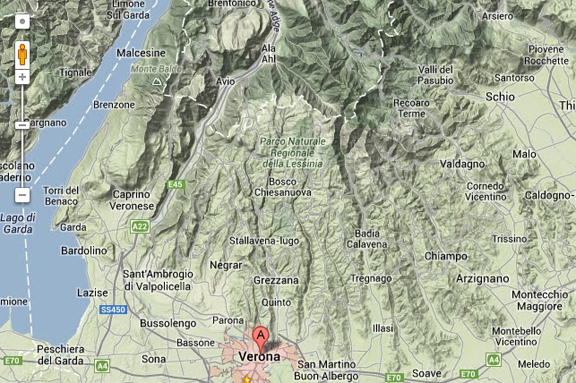
 Do Bianchi
