Gambero Rosso abruptly fires respected director Stefano Bonilli

I am sorry to report that one of Italy’s most respected and beloved food and wine writers, Stefano Bonilli, has been abruptly fired by the Gambero Rosso. Franco and I have reported the story at VinoWire (click here).

The circumstances of his being let go are dubious and the Italian food and wine blogosphere is up in arms. Even the usually smug Kelablu is quaking in his boots. But Nerina seems unfazed.

Montalcino on my mind

In the nineteenth century, Nietzsche wrote famously that “God is dead.”

In the year of my birth, 1967, Roland Barthes informed us that the author was dead.

Sometime in the 1970s, and I can’t seem to track down where or when exactly, Woody Allen told us that Marx is dead and “I’m not feeling so well myself.” (And he wasn’t talking about Karl.)

The other day, Italian Wine Guy shared his feeling that “Brunello is dead.”

I don’t think that Brunello is dead but I do share Italian Wine Guy’s sentiment that the so-called “scandal” is more about the scandal itself rather than the quality of wines produced there.

During the five days I spent last week between Montalcino and Bolgheri, I talked to countless winemakers, growers, restaurateurs, enologists, and agronomists and I tried to get to the bottom of what has happened and what we can expect over the next few months as the Brunello controversy hopefully plays itself out.

The most insightful observation on Brunello and Sangiovese was offered by a winemaker who worked for many years in Montalcino and who now works in Bolgheri.

“Sangiovese is a very easy grape to sell,” he told me, “but it’s very difficult to grow for the production of fine wine.”

No matter who you talk to, there is one thing that everyone agrees on: as the Brunello “trademark” grew in popularity and in profitability, Montalcino wineries began planting Sangiovese in vineyards not suited to its cultivation.

No matter who you talk to (even though none will go on record), everyone who works in Montalcino will tell you that it was common knowledge: Merlot has been widely planted and used in the production of Brunello for years and bulk wine has regularly been carted into the appellation to top off the wines.

“When the tankers come in to Montalcino, you can see their axels are weighted down,” one winemaker told me. “When they leave, you can see that they’re empty.” This was the same song sung by everyone — from winemakers and consultants, to restaurateurs and hoteliers.

No one seems to have hard data, but all agree that far less than 1 million bottles of Brunello were produced annually in the 1970s. Today, roughly 14 million are produced: according to people “on the ground,” there is simply not enough acreage under vine to produce that much wine. And of that surface area, conventional wisdom reveals that the majority is not suited for the cultivation of Sangiovese to be used in fine wine.

Follow the money… Put all of these factors together and one thing becomes clear: the large expansion-team producers (and maybe a few of the original league) over-planted and promised the American market abundantly flowing Brunello. As a result, they needed to cut corners in order to make ends meet. Twice, I learned, the majors have lobbied to change appellation regulations and allow for the use of international grapes. Twice a vote was called but a majority never reached in the Consortium because the votes of even the smallest producers carry the same weight as the biggies (Delawares to their Californias). Certain smaller producers, probably egged on by point-hungry flying winemakers, blindly followed the advice of their consultants.

But there’s something even more important, that nearly everyone agrees on (except those implicated in the controversy): of the more than 250 Brunello producers who belong to the Consortium, only a handful have indulged in such practices.

But I’m probably not telling you anything that you don’t know… Here are some insights I gleaned that might surprise you.

— While the use of Merlot was a well-known fact in Montalcino, the magistrate’s inquiry had more to do with sloppy documentation than reckless blending.

— In the case of at least one of the majors implicated in the controversy, the use of Merlot was never at issue. It was simply a question of mislabeling in the winery and a disallowed assemblage of different vintages.

— The “100% Sangiovese” certificates are being issued by the Italian government. The certificates, however, are not based on testing for the presence of certain flavonoids in the wine but rather on documentation in the wineries. The wines themselves are not being tested.

— The certificates are being issued regularly to those wineries who have kept their houses in order, so to speak. But the government has reserved the right not to issue the certificate in certain instances and the wineries have no reasonable recourse in such cases. In other words, even if your certificate gets held up for bureaucratic reasons, you’re screwed. Not everyone is going to get one.

— At least one winemaker told me that he’s not sending his current release to the U.S. He was concerned that the current controversy could taint the reputation of his wine and has decided to focus on other markets. Could it be that the real loser in the Brunello controversy is the American consumer?

Epilogue

Whenever people ask me “how do you tell if a wine is good?”, I tell them: “if you like it, it’s good,” whether traditional Brunello (my preference) or buttery Chardonnay (clearly not my preference). If you like modern-style Brunello, then go for it. If you like traditional-style, look for clear bright color in the wine and good acidity. I agree with Italian Wine Guy: too much fuss has been made about Brunello. Drink what you like…

Now, more than ever, Brunello and the folks who live in Montalcino — and especially the honest producers of Brunello, traditional and modernist alike — need our support. As summer comes to an end, get out that BBQ one more time, grill up a mean piece of meat, and decant that Sangiovese.

My friend Alessandro Bindocci is posting nearly every day about the harvest at Il Poggione in Montalcino over at his blog Montalcino Report. Check it out… It’s pretty cool.

In other other news…

I DON’T LIKE IKE!

La dolce vita, after all

Above: a pensive moment at dusk outside La Pineta, a fantastic seafood restaurant where I dined with Cinzia Merli and Luca d’Attoma last week, in Marina di Bibbona, on the Tuscan coast (photo by Ben Shapiro).

Strappo is sure to remind me that Fellini’s labyrinth of semiosis often led him to revise his explanations of signifier and signified in his films. But I believe the great Romagnolo director was telling the truth when he said that the expression la dolce vita referred not to the glamour of the Via Veneto but rather the sweetness that we find in life, even in our darkest moments of existential crisis.

[SPOILER: if you’ve not seen La dolce vita, I am about to reveal the final sequence!]

As Ben and I were waiting to meet our dining companions, Cinzia and Luca, the other night at La Pineta in Marina di Bibbona on the Tuscan riviera, I took a stroll alone and gazed out at the sea in one of those “what’s it all about, Alfie?” moments.

Just over a year ago, my life fell into turmoil when my mid-life crisis hit me like a freight train and I wished that I had gone straight but was side-swiped by a simple twist of fate. Today, I find myself in the Munich airport, on my way back to the States, exhausted but invigorated, excited about music and work, thankful to have so many wonderful folks in my life — some of them my oldest friends, some of them my newest.

Marcello turns his back on Paola, the young girl he met one day in a seaside trattoria. But before he returns to the party, he looks back and sees her irresistible smile — sweetness in his otherwise bankrupt existence. Maybe it’s the sweetness in a young girl’s smile, a plate of wholesome pici with ragù, a bunch of Greens dancing to Nous Non Plus in a forgotten border town along the Polish-East German border, or maybe it’s the waters of March. I believe there is a sweetness in life, to be revealed when you least expect it.

You don’t need to speak Italian to enjoy the clip below. Marcello has been partying all night with a lascivious crowd and the revelers find their way to the beach shortly after dawn…

In other news…

Yes, you can now add R.D. to my post-nomial Ph.D.: I was recently ordained as a Rock Doctor in the Universal Life Church and I’ll be officiating at the wedding of Jayne and Jon next Saturday.

*****

What’s it all about, Alfie?
Is it just for the moment we live?
What’s it all about when you sort it out, Alfie?
Are we meant to take more than we give
or are we meant to be kind?
And if only fools are kind, Alfie,
then I guess it’s wise to be cruel.
And if life belongs only to the strong, Alfie,
what will you lend on an old golden rule?
As sure as I believe there’s a heaven above, Alfie,
I know there’s something much more,
something even non-believers can believe in.
I believe in love, Alfie.
Without true love we just exist, Alfie.
Until you find the love you’ve missed you’re nothing, Alfie.
When you walk let your heart lead the way
and you’ll find love any day, Alfie, Alfie.

— Hal David and Burt Bacharach

Viva gli sposi!

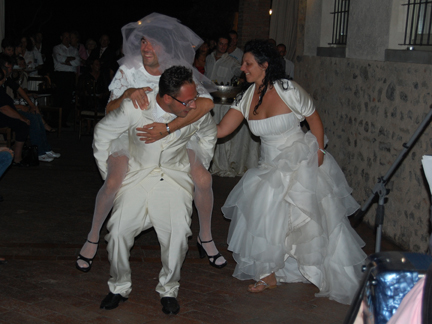
Above: there was a wedding last night in the agriturismo where we stayed in Nigoline near Erbusco (province of Brescia). Newlyweds Sabrina and Emanuel partied long into the night. They seemed like really nice folks and didn’t mind a bit that I got in on the fun. Viva gli sposi! That’s Italian for mazel tov!

Believe it or not, one of the best places to get online in Italy is the Autogrill, the ubiquitous and beloved highway rest stop where the sandwiches are reliably good and the tchothckes abundant. (Does anyone remember Gregoretti’s contribution to the 1962 film RoGoPaG, “Il pollo ruspante”? It’s a wonderful Marxist study of the Autogrill phenomenon in economic-miracle Italy.)

Ben and I are on our way down to Rome and I’m posting today from an Autogrill.

Yesterday, Franco and I tasted some fantastic Franciacorta together.

So much to post and so much to tell… Stay tuned…

Say it ain’t so: reporter claims that Banfi’s 03 Brunello contains grapes other than Sangiovese

Above: “no hunting allowed.” Photo courtesy VinoalVino.

Ne nuntium necare. I’m really sorry to report that, according to at least one Italian news service, Banfi’s 03 Brunello contains grapes other than Sangiovese. Read our post at VinoWire and for those of you who speak Italian, read Franco’s post.

I’m in Montalcino as I write this and I am speechless. Non ho parole. This sucks.

Montalcino: the next step? Angelo Gaja weighs in.

Above: that’s my good friend Robin Stark (center right) tasting with legendary Piedmontese winemaker Angelo Gaja on one of her wine-themed bike trips in Piedmont. Our mutual friend Terry Hughes over at Mondosapore likes to call me Zelig but Robin makes me look like Forrest Gump!

Legendary winemaker Angelo Gaja made news today when he published an open letter calling for changes in Brunello appellation regulations that would allow for the use of grapes other than Sangiovese. I have translated an excerpt at VinoWire.

As I get ready for my trip to Germany and Montalcino, I wish I had time to translate the entire letter, which is already creating waves in the blogosphere. But I’ve been busy working on the production of our record, getting ready for my trip (see below), and taking some time out to stop and smell the roses (yellow roses, in this case).

Angelo Gaja is one of the most charismatic and interesting figures in the world of Italian wine — and the world of wine period. I’ve met and tasted with him on a few occasions, including once at the winery. The Gaja winery is a unique experience, an objet d’art in and unto itself, where modern sculpture and architecture live side-by-side with the wine. Years ago, Gaja caused a controversy when he proposed that the Barolo and Barbaresco appellations be changed to allow for the use of international grape varieties. And after he was unsuccessful in his bid to revise the appellations, he declassified his site-designated wines. No one knows exactly what he puts in them but they are among Italy’s most collected — if not the most collected. A long-time proponent of barriqued Nebbiolo, Gaja makes wines that even the most fervent detractors of new oak aging will gladly drink. I’ve tasted Gaja back to 1971 and have to say that his wines are simply exquisite. He also produces high-end wines in Montalcino and Bolgheri.

Here’s a interesting passage that I translated but didn’t include in the post at VinoWire.

    In the 1960s, there were less than 60 hectares of vineyards planted to Sangiovese earmarked for the production of Brunello di Montalcino. There were roughly twenty producers, and no more than 150,000 bottles were produced [every year]. In the same period, there were 500 hecatres planted to Nebbiolo in Barolo, 115 producers/bottlers, and 3,000,000 bottles of Barolo produced annually. While Barolo did not have a leading figure, Brunello di Montalcino already had Biondi Santi: its founding father, an artisan who over time had raised the flag of quality high and he had also raised the price of his aristocratic, rare, and precious Brunello, available only to the few who could afford it.

    And then came Banfi…

He doesn’t take issue with Banfi but he reveals how the expansion of Sangiovese vineyards, spearheaded by Banfi, led to many “large” producers (as he puts it) planting Sangiovese in growing site that don’t have the right soil and climate conditions to grow superior Sangiovese. This phenomenon, he says, is what led to the current controversy there. It’s important to note that Banfi’s expansion and extremely successful marketing of Brunello made the appellation a house-hold name in the U.S. I remember the first time I saw a bottle of Brunello at the supermarket in La Jolla in the early 1990s: it was Banfi.

I wish I had time to translate the entire letter but you can read it in Italian here.

Worth reading: “Monty Waldin lets off steam about Brunellopoli”

Monty Waldin’s recent and extraordinary post at the Jancis Robinson subscription site has been making the rounds among wine bloggers: my partner over at VinoWire, Franco Ziliani, wrote to Jancis who graciously gave us permission to repost it here. Monty’s insights as a winemaker living in Montalcino are fascinating and he pulls no punches in this piece. A must-read for anyone who’s trying to wrap her/his head around the greed that led to the controversy now known as Brunellopoli or Brunellogate.

Thank you, Franco, for making that happen!

A virtual conversation: I am such a fan of Franco Ziliani’s blog Vino al vino that one day I wrote him and said, “why don’t we start an English-language blog devoted to the world of Italian wine where I can translate posts from your blog?” Three months later — without Franco and I ever meeting in person — we launched VinoWire, a blog devoted exclusively to the world of Italian wine. Franco is one of Italy’s top wine writers and — without a doubt — its most polemical. He reminds me of Italian literary figure Giuseppe Baretti (left), one of the great writers of the Italian Enlightenment: in the same spirit as Baretti’s critical journal La frusta letteraria or The Literary Whip, Franco’s excellent blog combines erudition, wine and travel writing, and an expertly critical approach to the field — where, too often, so-called wine writers are too timid to call a spade a spade. The title of Franco’s blog, vino al vino, comes from the Italian expression, pane al pane, vino al vino or call bread “bread”, call wine “wine”, in other words, say it like it is.

Par condicio: Pian delle Vigne 2003 sample sampled

Par condicio is a Latin expression used historically by the Italian legislature and subsequently by the Italian media to denote, among other things, “equal [air] time” for Italian political candidates (it’s modeled after the expression par condicio creditorum or as per agreement with creditors).* It’s an Italian political campaign convention much criticized by the hegemonic Forza Italia (Go Italy!) party and its leader Silvio Berlusconi, who happens to own and control a majority stake in Italian national television — private and public. (Silvio made The New York Times today for his prudish — yes, prudish! — attitudes. See below.)

When my buddy Lance invited me to attend an Antinori tasting over at Wine House in West LA, I felt a sense of moral obligation to swirl, sniff, savor, and spit. In particular, I was curious to taste the 2003 Pian delle Vigne, Antinori’s controversial, once-impounded, and now-cleared 2003 Brunello. (See this recent interview with Antinori winemaker Renzo Cotarella here.)

Anyone who reads my blog knows that I am not a fan of modern-style Brunello and frankly, Pian delle Vigne is not a wine that I drink. But in the spirit of “fair and balanced” coverage, I am compelled to report that, judging from the color of the wine and its flavors and aromas, it was 100% Sangiovese (see the bright, clear color of the wine in the photo above). And although it was wooded, it did taste like Brunello: frankly, I found it to be more traditional-leaning than other bottlings of Pian delle Vigne. In all fairness, it’s a very well made wine.

One question remains, however: why were we tasting hand-labeled “samples” of the 2003 Brunello when the wine was presented in the U.S. as early as January 2008 with printed Antinori labels? There are certainly bottles of 2003 Pian delle Vigne in this country — many undoubtedly shipped before the April controversy, when Siena authorities impounded the wine. The wine has since been “cleared” by the Siena magistrate (as has Banfi’s, as of yesterday). So, why the need for “samples”? Food for thought…

Americans continue to adore Antinori’s wines and gauging from the stampede for the Guado al Tasso, Solaia, and Tignanello last night, the Marquis has not suffered from the recent Brunello controversy. It’s remarkable how much wine he makes and in how many regions. I had no idea, for example, that he makes a nice Franciacorta (Montenisa) and I was really impressed by his La Brancesca 2006 Vino Nobile di Montepulciano Santa Pia, traditional in style, for under $40 retail.

In other news…

Separatist Italian agriculture minister Luca Zaia approves bag-in-box packaging for DOC wines. See this report.

In other other news…

Tiepolo’s titties tethered by Italian chieftain in “The Truth Unveiled by Time” tela!!!

In an unusual act of prudish countenance, the Berlusconi government ordered the nipples in Tiepolo’s “The Truth Unveiled by Time” covered. The painting appears in the backdrop of the Italian prime minister’s press conferences. See this report in The New York Times.

* “One of the cardinal principles governing the liquidation of insolvent estates is the equal treatment of creditors—the classical par condicio creditorum. Debtors on the eve of bankruptcy, either of their own volition or under pressure, may accord preferential treatment—by way of payment or security—to certain creditors.”

Source: “bankruptcy.” Encyclopædia Britannica. 2008. Encyclopædia Britannica Online.

The ashes of Dante: exile rescinded but Count Serego Alighieri refuses Florentine Golden Florin

You may remember my recent post about Dante Alighieri and the Florentines’ attempt to bring his remains back to their city by rescinding his exile. According to a report published today in the Italian daily Corriere della Sera, the motion to rescind the exile was approved by the Florence city council but Dante’s descendant, winemaker Pieralvise Serego Alighieri, has refused to accept the Golden Florin, the city’s greatest honor. Dante (left) was exiled in 1302 and died in Ravenna, where his tomb remains a popular tourist attraction.

“When I see things like this, I pray to heaven that they will leave poor Dante in peace,” said Serego Alighieri, the 20th and current generation of Dante Alighieri’s family. “That’s why I thought the Florence ‘full rehabilitation’ initiative was good. But even on that front, things didn’t go so well: at the city council meeting where they were supposed to rescind the 1302 banishment decree, the measure passed with just one vote. It was approved but by just a small margin and it was immediately sullied by base controversies that touched even me — and I have nothing to do with the whole affair. It got to the point that I decided not to accept the Golden Florin.”

Italophones can read the entire account here.

Slovenia Day 3: Ljubljana rocks

The tales of my April Italy/Slovenia trip have been interrupted by other pressing posts. Here’s a short photo essay of gig day in Ljubljana where we played one of our most fun shows ever to an adoring crowd.

Ljubljana is a beautiful city and the people are very friendly there.

It seemed that everywhere we went, they were expecting us with open arms.

We ate goulash in a medieval re-enactment restaurant that had been recommended to us. It looked really touristy but the food was actually very good. Goulash is not a very sexy dish to photograph but it was delicious and warmed our bellies on this rainy April day.

The girls autographed copies of our CD for fans who had won a radio contest to get their pictures taken with us. They also won a Nokia phone, courtesy of Mobitel, the Slovenian cellphone company that used our track Lawnmower Boy in a TV commercial.

They looped the commercial on the flat-screens at the club (click image to view, in case you’ve not seen it and are so inclined).

The changing face of Europe: the check-point is no longer manned at the border crossing. We headed back to Italy the next day.