A voice of reason in Montalcino? A top producer addresses the absurdity…

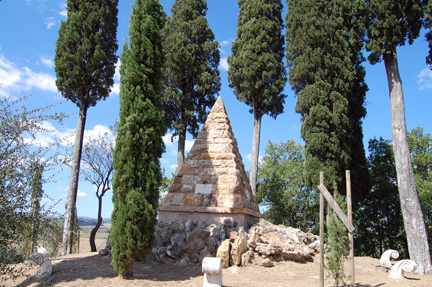
Above: A monument rests atop Montaperti, not far from Montalcino. It commemorates the 1260 battle between the Guelphs and the Ghibellines, when the temporal and spiritual [im]balance of power in the Western World lay in precarious uncertainty. In the wake of the battle, a cloud of darkness fell over Italy for centuries to follow.

Italy’s top wine blogger, Mr. Franco Ziliani, has obtained and yesterday posted (with the author’s permission) a letter addressed to members of the Brunello Producers Association by the scion of a storied Montalcino family, Stefano Cinelli Colombini, owner of the Fattoria dei Barbi. Even in the wake of an aborted call for a vote early this year to allow international grape varieties in Rosso di Montalcino (which, by law, must be made with 100% Sangiovese grapes), certain members of the body are asking its technical advisory council to consider calling again for a vote on the matter.

I have translated the letter in its entirety and believe that its truths are self-evident.

*****

Dear friends and producer colleagues, I have just attended a meeting organized by the Consortium [Brunello Producers Association] where we discussed the inclusion of other grapes [besides Sangiovese] in the Rosso di Montalcino [appellation]. And I am writing to share my deep-seated reservations. We are faced with a serious problem because an overwhelming majority voted against the inclusion of other grapes in the Rosso di Montalcino [appellation] in a recent assembly.

An assembly vote should not be put up for discussion just a few months later. With all due respect, I would like to remind you that we have just put a tremendous rift behind us. It happened because the [fifteen-member technical advisory] Council was too stubborn to call for votes on votes [sic] on an argument (the blending of Brunello [with grapes other than Sangiovese]) for which the assembly had already expressed its clear dissent.

The message conveyed by the members is more than evident: appellation regulations are to be changed only if there is clear and broad consensus beforehand. All it takes is to ask for signatures from the members who wish to modify the appellations. We were just a handful of members but it took us just a week to gather the signatures of more than two thirds of the members against the blending of Brunello. I am certain that the Consortium has the means and the personnel to do a better job than we did. If as many producers were to sign [a call for a new vote], it would only be right and correct to call an assembly vote on whether or not blending should be rejected. Otherwise, you should stop.

Anyone who lives in this community knows that [a proposal for] blending will be voted down by the assembly, that such a vote will once again create a rift among members, and that a media storm will inevitably follow.

We must avoid such a useless confrontation. A new conflict between the assembly and the Council will lead only to paralysis and paralysis helps no one.

I’m not interested in who’s right and who’s wrong. Now, more than ever before, we need a Council that knows how to win the trust of its members. We don’t need a Council that opposes them.

The only plausible reason to allow blending has fallen by the wayside: the sale of Rosso di Montalcino is no longer falling. [Consortium] director [Stefano] Campatelli says that during the first six months of 2011, 500,000 more bottles have been shipped than in the first six months of the previous year. This represents phenomenal growth.

Previously, there could have been some doubt but now the numbers show that the sales of Rosso di Montalcino depend on the price of Brunello and not on the Sangiovese. When Brunello was sold in bulk at Euro 300 per hectoliter, no one wanted to buy the Rosso anymore. With Brunello at Euro 800, the Rosso is soaring with a 40% increase in sales.

If you think about it, it’s only logical that if a bottle of Brunello only costs a few Euro more than the Rosso, everyone will buy the Brunello. The cure for the Rosso di Montalcino malaise is higher prices for Brunello and not blending, which would not make the Rosso technically better. Blending would only make it the same as many other excellent wines that cost much less. It takes a lot more than slapping a Ferrari label on a [Fiat] Panda to sell it for Euro 100,000. And it takes more than the Montalcino name to set a high price for a wine that may be technically perfect but otherwise indistinguishable from many others that cost three or four Euros.

Your colleague, Stefano Cinelli Colombini, Fattoria dei Barbi

*****
In unrelated news, have you noticed that Franco has announced the winner of his recent “make me a new blog banner” competition? His new banner was created by Ms. Stefania Poletti, a native of Bergamo who now resides and works in Boston. Congratulations, Stefania! Nice work!
Sensuous world: Marx, Gramsci, Pasolini, food and wine

Just as nature provides labor with the means of life in the sense that labor cannot live without objects on which to operate, on the other hand, it also provides the means of life in the more restricted sense, i.e., the means for the physical subsistence.

—Karl Marx, Economical and Philosophical Manuscripts, Paris, 1844

One of the things I couldn’t stop thinking about on this last trip to Italy (where I stayed at a 5-star resort, ate in a Michelin-starred restaurant, and tasted verticals of some of Southern Italy’s most famous wines) was Marx’s concept of alienation (estrangement), Gramsci’s concept of reification (objectification), and Pasolini’s “fear of naturalism” (“the natural being”) and the insight that they provide us in viewing the current global epicureanism as an expression of the bourgeoisie’s (and I count myself and you, my readers, as members of this privileged class) deep-seated yet unanswered yearning to cast off the yoke of consumerism.

Even though we know that sunlight is bad for us, we all know that wonderful feeling of feeling the sun on our skin, watching a sunset, or walking through a park on a bright summer day.

And even though we know it’s not bad for us, a view of verdant pastures or ancient olive groves somehow soothes us. The same way we enjoy reading Virgil’s Bucolics, viewing an 18th-century painting of a pastoral scene, or reading about “hardcore” natural winemaking in Spain on a favorite wine blog, food and wine writing allows us to escape the workaday din of the consumer-driven, globalized, and frighteningly reified world in which we live.

Sadly, in the post-second-world-war industrialized and globalized world, our bodies have become mere objects and the nutriments which give us life have become mere objects and we have lost touch with the pre-industrial expressions of the one and the other. Even as we consume “heirloom” food and wine products, as good and as healthy and as wholesome as they may taste, we cannot ignore (however much we would like to) the fact that the chain of supply that has delivered them to our dinner tables has rendered them into mere objects for consumption (it has reified them) by polluting the world with its carbon foot print as it couriers otherwise nutritious sustenance to consumers.

Marx would have called this “estrangement” (or “alienation” is some circles of Marxist parlance). There are very few among us who have any direct contact with the origins of the foods with which we nourish ourselves. As for Marx’s worker, food as become a mere object for us, even though it is the very substance that gives us life:

    The more the worker by his labor appropriates the external world, sensuous nature, the more he deprives himself of the means of life in two respects: first, in that the sensuous external world more and more ceases to be an object belonging to his labor — to be his labor’s means of life; and, second, in that it more and more ceases to be a means of life in the immediate sense, means for the physical subsistence of the worker.

From his jail cell, as he witnessed Mussolini and the fascists industrialize Italy (“the trains ran on time,” etc.) and promote an exodus from the countryside and a migration to the great urban centers (because they needed humanpower to populate the factories), Gramsci distilled Marx’s estrangement into his notion of the cultural hegemony, whereby the capitalist cultural model drives humanity to negate its humanness.

Pasolini took this notion a step further, I believe, when he wrote of the bourgeoisie’s “fear of naturalism” and the “natural being.” As he witnessed Italy’s youth embrace the materialism and aesthetic models of middle-class America (in part thanks to the Marshall Plan and in part thanks to the emergence — for the first time — of globalized media), abandoning the values of the generation who had come before them, he recognized that this was a result of consumerism’s revulsion toward the natural being and the natural world (this theme pervades Pasolini’s work, from his early Friulian poetry to his last films; Pasolini was born in 1922, the year Mussolini marched on Rome and rose to power, and he was assassinated by a Roman prostitute in 1975, at the peak of the Christian Democrats’ hold on power and the hegemony of its capitalist model, both economic and ethical).

Now, more than ever, I am convinced that food and wine writing represents can represent, however powerless, a subversion of the hegemony of consumerism in the world today. Whether we take joy in reading or writing about a farmer who casts off chemicals to grow grapes and shuns industrial yeast to make wines that “taste of place,” we are subconsciously repelling the yoke of consumerism as we attempt, however unaware, to recoup, recuperate, and recover the humanness that has been negated by the human condition in the industrialized and globalized world.

Food and wine and food and wine writing offer us a historically unique confluence of the objectification of the sensuous natural world and the means for living. Unlike the natural substances transformed by Marx’s worker as she/he worked in a pre-world-war factory (like iron used to build arms, for example), food and wine as Marxist objects in today’s world are at once the transformed object and a source of nourishment. As such, it gives us a historically unique opportunity to express our humanity through its exegesis (and in many cases, its worship and fetishization).

This is the reason why I continue to post here on my blog and this is the reason — I hope — why you’re reading. Thanks for making it this far into the post.

And buona domenica

1,000-year-old olive tree

It’s difficult to convey the ubiquity of olive trees in Apulia. Our hosts at the Masseria Le Fabriche in Maruggio believe this beauty to be more than 1,000 years old.

There’s so much to be said about these trees and their fruit… but not enough time today… posting in a hurry as I prepare for the first day of the Radici Wines festival devoted to indigenous grapes of Southern Italy…

Pappa col Pomodoro, Wertmüller, Rota, Pavone, and REVOLUTION!

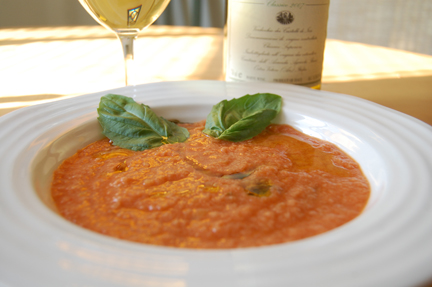
Last night, on a happy quiet Saturday evening at home, I used the leftover stale bread from Paolo’s birthday party to make one of my favorite summertime dishes, Pappa col Pomodoro — the famous tomato bread soup of Tuscany.

And what a wondrous dish this workaday dish is! A text that can be deconstructed linguistically, literarily, ideologically, and gastronomically in so many delicious ways — including the Marxist reading in the video above.

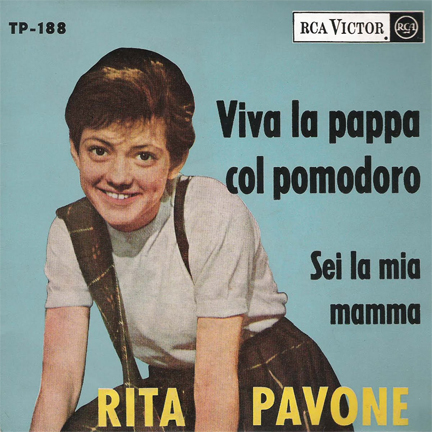
Piddling around the internets on a lazy Sunday morning (after scrambling some eggs the way Tracie P likes them and before diving into my Sunday workload), I came across this fantastic video of 60s Italian pel di carota (carrot top) Rita Pavone, the great Italian director Lina Wertmüller (the first woman to be nominated for a Best Director Oscar), and the Italian composer Nino Rota (considered by some the greatest film composer of all time).

But what’s truly remarkable about this clip — above and beyond the fact that it was created by three of the greatest names in Italian film and music — is the Marxist and Leninist rhetoric of the song lyrics, Pavone’s Bolshevik costume and choreography, and the set inspired by the Russian revolution.

I’ve translated the lyrics for you:

    Long live Pappa
    Col Pomodoro
    Love live Pappa
    It’s a masterpiece
    Long live Pappa
    Col Pomodoro

    The history of the past
    Has finally taught us
    That a hungry people
    Will make a revolution
    That’s the reason we the hungry
    Have battled
    And so buon appetito
    Let’s eat!

    A belly that grumbles
    Is the cause of the conspiracy
    It’s the cause of the struggle
    Down with the boss!
    The soup’s on!
    And so we’ll all sing
    No sooner said than done, we want
    Pappa with Pomodoro

There’s no doubt that the performance resonated with Tuscan audiences of the era, when Tuscany was one of the strongholds of the Italian Communist Party and — together with Emilia-Romagna — home to the largest Communist Party outside of the Soviet Union and China.

Berlusconi’s Italy is so ugly these days (did anyone follow the reaction to Berlusconi’s gaffe during his meeting with Obama during the G-8 gathering this week?). We often forget that there was a time in Italy not so long ago when a simple dish — one of its most proletarian — was inspiration for art and ideology by some of Italy’s greatest artists.

Looking for the ethos of southern Italian wine…

Above: A scene from last year’s Radici (Roots) Wine Festival in Apulia (photo by Brunellos Have More Fun).

My year in southern Italian wine continues as I prepare to head back to Apulia in a few weeks for the Radici (Roots) Wine Festival in the province of Bari, where I’ll be tasting literally hundreds of wines made from native southern Italian grape varieties.

I’m going to be seeing some old friends and making some new ones. And as tired as I am from too much travel and too much time away from the love of my life Tracie P, I accepted a spot on this trip because I believe in the festival’s mission of promoting awareness of native Italian grape varieties.

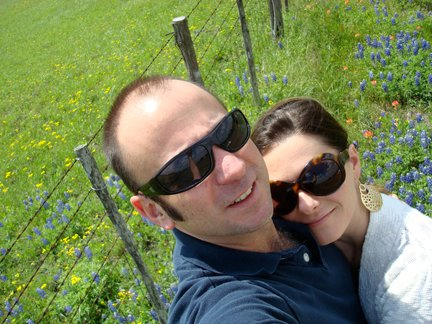
Above: I’d rather be here, holding Tracie P tight and smelling Texas springtime bluebonnets!

Believe me: as glamorous as these trips sound, they are a complete drag (ask Alfonso, a 30-year veteran of what we call “death marches” in the trade, and he will tell you the same thing). You begin tasting scores of wines at 9 in the morning and you taste all day with just a short break for lunch. You have to listen to every local fat cat bureaucrat give the same speech (and the subsequent poorly and slavishly translated version in English, “We wish to valorize the territory” etc.). The wifi never works (the Atlantic Monthly reports that “Internet penetration is only around 50 percent” in Italy, thank you very much Mr. Berlusconi). And ultimately, you are a prisoner of the festival organizers: you eat when and what they tell you to eat (although I have become a master of politely moving my food around my plate so that it looks like I have consumed some of it).

But when Italy’s top and most politically charged wine blogger Mr. Franco Ziliani asked me to join him and an international group of colleagues in Apulia later this month, I gladly accepted out of solidarity and camaraderie with those who share my belief that Italy’s greatest wines are made from native grape varieties by people who believe that wine is a cultural and ideological expression.

There will be foreign buyers there: they’re looking for new wines to import and distribute. There will be some of the usual suspects who continue to live on the gravy train of Italian wine press junkets: some of our older and hard-on-their-luck colleagues will be there looking for a meal ticket. But there will also be some of us — observers (writers/bloggers) and actors (winemakers/grape growers) — who are looking for the ethos of these wines: their characteristic spirit, prevalent tone of sentiment, of a people or community (definition from the OED online edition).

Stay tuned and I’ll let you know what I find (the trip begins in early June)… Thanks for reading…

Quo vadis romae? An app for the Rome-bound pilgrim.

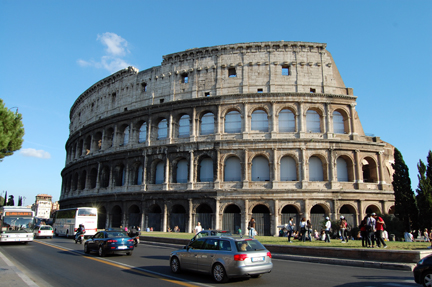
Above: Rome is the most beautiful city in the world, imho, and it’s the greatest place in the world to drink Italian wine. I snapped this shot of the Colosseum when I was there last September.

Quo vadis romae? (Where are you going, Rome-bound pilgrim?)

It seems that nearly every week I receive a message from a romeo or romea — a Rome-bound pilgrim (pronounced roh-MEH-oh, btw), the original meaning of the proper name that Shakespeare’s play made so famous in the English language.

Yesterday, I received two (no kidding)! In both emails, the romeos asked me where to eat and drink in the Eternal City.

Above: Katie Parla is my go-to when I go to Rome. Here’s the post about our amazing dinner at Pizzeria La Fucina last year.

As much I know and love Rome (I spent six months studying the Petrarchan manuscripts at the Vatican library when I was a Fulbright fellow) and as much I know and love the wine and restaurant scene there (it is, imho, the greatest city of Italian wine), ubi major, minor cessat: my favorite expert on all things Roman, the inimitable (and aptly named) Katie Parla has released a Rome guide app for smartphones.

I highly recommend her blog and her app. She is my number-one resource for what’s cool and cutting edge in the Roman food and wine scene.

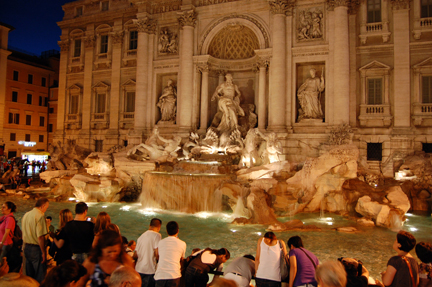
Above: Rome always takes my breath away. I snapped the above photo in September.

On this Good Friday, it seemed appropriate to post about Rome and Katie’s blog.

My best advice about visiting Rome? When a Roman cab driver takes you the long way so that he can charge you a little bit extra, he’s not ripping you off: he’s showing you around the most beautiful city on earth.

Dorona, a lagoonal wine (aàh Venezia aàh Venissa aàh Venùsia)

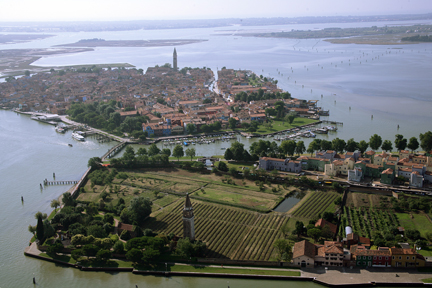
Above: The Bisol family is growing Dorona, a clone of Garganega, on the island of Mazzorbo, adjacent to the island of Burano in the Venetian lagoon.

When Matteo Bisol passed through Austin the other day (and graciously posed and uttered grape and appellation names for my camera), he brought news of his family’s newest project: Venissa a cloistered vineyard and high-concept restaurant and agriturismo on the island of Mazzorbo in the Venetian lagoon (above).

For a few years now, the family has been growing Dorona, a clone of Garganega, a grape traditionally and historically cultivated in the Venetian lagoon for the production of urban — and in this case, lagoonal — wine (if you’re wondering how to pronounce the ampelonym Garganega, btw, you’ll find the pronunciation here).

Above: I wrote to Matteo’s publicist, who was kind enough to share this photo of Dorona. The ampelonym probably refers to the golden color of the berries.

Being a consummate Venetophile, I am entirely geeked to taste the wine (which will be released for the first time next year) but in the meantime I would like to make a clarification regarding the name of the estate and the project, Venissa.

Venissa is not an ancient name of Venice or the Venetian lagoon, as many complacent readers of press releases have erroneously claimed.

In fact, Venissa is an erudite paronomasia from one of the greatest works of dialectal poetry by one of the greatest poets of our lifetime, Andrea Zanzotto (from Pieve di Soligo, one of my favorite places on earth).

Above: The Veneto poet Andrea Zanzotto. Photo via Engeler.

It’s actually the name of a mythical figure from antiquity, a fictional daughter of the Roman emperor Claudius.

The name appears in Zanotto’s poem in Veneto dialect, “Filò,” composed for Fellini’s 1976 Casanova.

It is the second name in the triad aàh Venezia aàh Venissa aàh Venùsia, where Venice (Venezia) is likened to a temptress or evil woman:

    Eyes of a snake, eyes of a queen,
    head of fire that inflames the ice,
    we beg you: burst loose, break free,
    we implore you, everything implores you;
    show yourself above, rise up,
    let’s all pull together, you and us

    ah Venice ah Venissa ah Venùsia

Venùsia is the ancient name of modern-day Venosa, a city supposedly so-called because it was dedicated to Venus by its founder Diomedes.

(Here’s a link to a preview of the excellent translation of Filò, where the lines appear in the Veneto, Italian, and English. And here’s a link to some background on this work and its significance in the canon of dialectal poetry.)

With these lines, the poet partly alludes to Venice’s place in history as Western Civilization’s capital of prostitution.

I could go on and on (aàh Venissa, if only my professional life were devoted to poetry instead of wine!). But I’ll close this post and clarification with a wonderful passage that I found in a nineteenth century dictionary of Veneto dialect, in the entry for the word filò, which denotes an all-night gathering of women who stitch and sew as they gossip.

    Queste le xe cosse da contàr al filò!

    These are things [only suited] to be told at a sewing vigil!

Sculpture Saturday: Mattiacci’s Eye of the Sky @UCLA

The entire “north campus” of my alma mater, U.C.L.A., is a wonderful sculpture garden, including works by Rodin and Matisse.

On my recent trip to Los Angeles, I visited with my putative father (as he likes to call himself), close friend, and dissertation advisor, Milanese poet Luigi Ballerini.

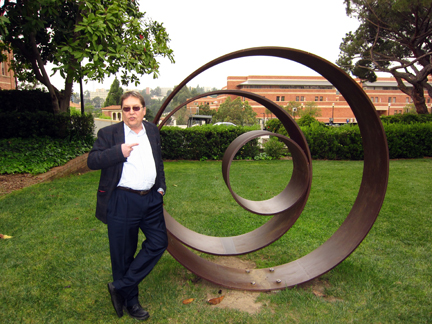
That’s Luigi, above, with the newest installation in the Murphy Sculpture Garden, “L’occhio del cielo,” by Eliseo Mattiacci, known for his seemingly impossible and often precarious pieces.

It was great to catch up with Luigi and stroll around the campus. The work by Mattiacci stands behind Royce Hall, just below the building’s chapel (which is used as a classroom by the Italian Department). Royce, the symbol of U.C.L.A., is inspired by Milan’s Basilica di Sant’Ambrogio, a place dear to Petrarch who lived, studied, and composed there.

A year in Southern Italian wine and the unknown etymology of Puglia

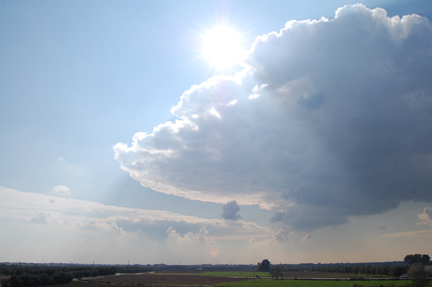
Above: The Salento peninsula is “big sky” country. I was thrilled to visit for the first time in February of this year. And I’m looking forward to going back in June. You don’t need to be a great photographer to capture beauty there. You just point and shoot.

My relation to Southern Italian wine stretches back to the late 1990s when I began working as a magazine editor in New York and you could often find me at the bar at the Enoteca I Trulli in Manhattan, chatting with Italian wine industry veteran and my good friend Charles Scicolone (who then ran one of the most popular wine programs in the U.S., with a focus on Southern Italy). I was thirty years old then and Charles became one of my Italian wine mentors.

This year, as it turns out, is my year in Southern Italian wine: I’ve authored an exclusively Southern Italian wine list for my friends at Sotto in Los Angeles, next month I’ll be leading seminars on Southern Italian wine at the Atlanta Food and Wine festival, and in June, I’m heading back to Apulia where I’ll be a member of the jury for the Radici Wines festival.

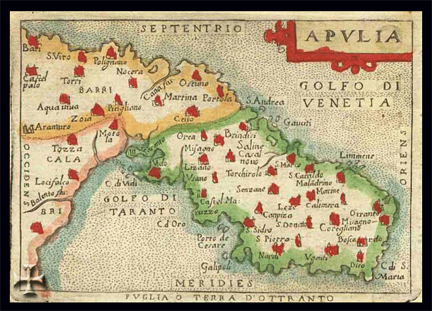
Above: I found this Renaissance-era map of Apulia on a somewhat scary but interesting website devoted to the Knights Templar.

Here on the blog, By the Tun asked me the other day about the origins of the toponym Apulia or Appulia, the name that the Romans used for this region (and the name that gives us the modern-day Puglia).

Many online sources report the erroneous and folkloric etymology a pluvia, which ostensibly means without or lacking rain. There are so many reasons why this etymon is improbable. I won’t bore you with the fine linguistic print but the thesis quickly falls apart when you note that a in this instance is used in a Greek context (a privative prefix, meaning without, as in apathy, without feeling) while pluvia (rain) is Latin. The other reason is that Apulia doesn’t lack rain. In fact, it is the unique combination of plentiful sunlight and precipitation that makes the Apulian peninsula ideal for farming (a fact not lost on the ancients, btw).

Others would have that Apulia and the ancient apuli (the ethnonym used for the region’s inhabitants) comes from ancient king Epulon (Aepulon or Apulo in Italian), an Illyrian ruler of Histria. But this etymology, as most serious scholars note, is equally unlikely.

According to my trusty UTET Dictionary of Toponymy, the name comes from the Greek Iapudes or Iapigi, a toponym or ethnonym that denoted a place or people on the other side of the Adriatic. The ethnonym Apuli appears before the toponym Apulia in ancient Latin and it’s likely that the name comes from pre-Roman settlers of the region.

The meaning of Iapudes is unknown… another beautiful mystery of this mysteriously beautiful place…

Thanks for reading and buon weekend!

WARNING: CONTAINS EXTREME OFFAL (More awesome stuff I ate in Puglia, part II)

Tracie P and I still haven’t had the chance to travel to southern Italy together. (We’ve made three trips to Europe so far, one to Paris and the Loire Valley, one to Tuscany and Piedmont, and most recently to Friuli and the Veneto.) As much as we’ve enjoyed our Italian sojourns, she’ll often gently lament the fact that in the north and in central Italy, meals tend to focus around meat dishes. (Anyone who’s ever been to Piedmont knows that the classic meal consists of raw chopped veal, veal with tuna sauce, and then long noodles with ragù…)

The south — as Tracie P often pines — is all about vegetables, a culinary culture due in part to the fact that the climate and terrain of southern Italy (and Apulia in particular) are ideal for the cultivation of vegetables and in part to the fact that the south has never enjoyed the accumulation of wealth as has the north. (Did you know there are more pigs and Ferraris pro capite in Emilia than anywhere else in the world? Go figure!)

On that Monday evening in mid-February when I dined with Paolo and company (at one of the few decent places to eat on a Monday night there, La Vecchia Lecce — no website, not even a Google page), the meal began with a medley of vegetables, including the classic fave e cicoria (above), puréed fava beans and sautéed green chicory served together.

Next came zucchine.

Artichokes.

Eggplants.

Ciceri e tria, chickpeas and flat noodles (one of the most fascinating dishes, IMHO, in terms of its linguistic and cultural ties to antiquity, but more on that another time).

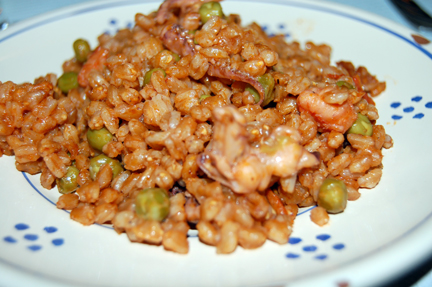
Then came barley with seafood. (Does anyone know the proper name of this dish? I bet Food Lover Kathy does!)

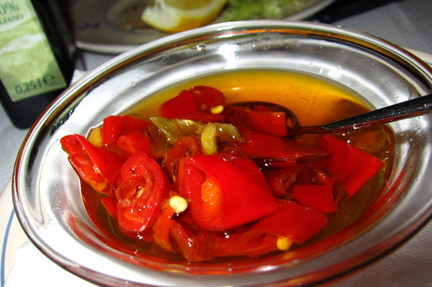
I loved how spicy peppers macerated in olive oil were served as a relish: each diner can “heat up” their food (served family style) as desired. Needless to say, I did my best impression of James Brown, as Tracie P likes to tease me (Eh, what can I say? Jews sweat when they eat!)

The only meat dish we ate that night were turcinieddhri. Don’t let the anemic lettuce and tomato fool you: these lambs intestines stuffed with lambs liver, heart, and lung were delicious.

Thanks again, Paolo!