Notes from Santorini

I read the news today o boy: Greece’s “jobless rate for people ages 16 to 24… is 48 percent”; and on Monday “After violent protests left dozens of buildings aflame in Athens, the Greek Parliament voted early on Monday to approve a package of harsh austerity measures demanded by the country’s foreign lenders in exchange for new loans to keep Greece from defaulting on its debt.”

Honestly, I wasn’t planning on posting again this week on the Boutari blog.

It seemed like it would be in bad taste to post about things as frivolous as wine and winemaking when our sisters and brothers in Greece are facing some of the hardest times since the end of the of the second world war.

But then, this morning, I received the following, simple however deeply moving message from Santorini…

    Location: Santorini Megalochori
    Date: 2/16/2012, early morning

    The sun is rising, the sky is taking a marine blue color and the vine is still sleeping.

    The vine grower has already removed the unavailing branches. Now remains the time that vine grower will come and weave the young branches into a shape of basket.

    Petros Vamvakousis
    Winery Manager

They’ve been growing grapes using bush/basket training on Santorini since the Middle Ages and beyond. And come what may, the vine grower will come and weave the young branches into a shape of basket.

I love the wines that they grow on Santorini and thank goodness for them.

Click here for the Boutari blog.

Best meals 2011: Boutari winery Crete

I’ll never forget this June night in Crete, the eve of the first Greek austerity vote and one of the defining moments of the European debt crisis. In Athens, that same evening, protesters fire-bombed one of the luxury hotels in Syntagma Square. But in Crete, just outside the village of Skalani, the air was still and the food was delicious…

Many great meals were thoroughly relished by a wine blogger last week in Greece but the one that he cannot stop thinking and dreaming about was a dinner prepared by Maria Constandakis, who — together with her husband and agronomist Yannis — oversees the Boutari winery in Crete.

The meal began with a Cretan dakos, a wholewheat rusk, a bit larger but similar to the frisa of Apulia, where they top it with diced mozzarella, tomatoes, and tuna. Here, tradition calls for fresh tomato purée and crumbled feta. And while the Apulians gently soak their frisa before dressing it, the Cretans use the water naturally purged by the tomato when it is tossed with the salty cheese.

Next came the classic Greek zucchini “meatballs,” the kolokithokeftedes. The wine blogger had experienced this dish before but in his own words, “to have Maria’s, made from zucchini she grew herself in the winery’s garden, is a game-changer.”

The next morning, said wine blogger photographed Maria’s zucchini.

When you travel in Greece during summer, horiatiki — the classic village or summer salad — is served at nearly every meal. But there was something different about Maria’s. Upon further inquiry, the blogger discovered that Maria included freshly torn glistrida or purlane in her salad, also grown in her garden.

Still used as an effective folk remedy for certain ailments of the mouth, purlane grows wild in Greece (the blogger even found it along the sidewalks of one of the small towns he visited in Northern Greece). Like nettles, it slightly stings the tongue and according to legend, those who consume it are prone to loquaciousness. (Said blogger has never been accused of being long-winded! But true to legend, he stayed up late into the night discussing philosophy and politics with his companions over many glasses of raki.)

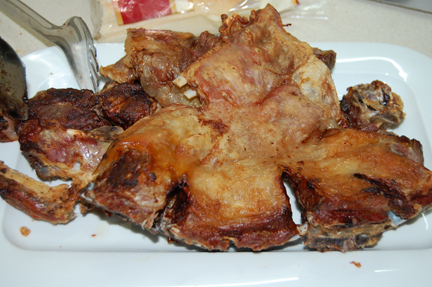
The pièce de résistance, however, was Maria’s slow-roasted lamb. Even though, technically, the meat had not been smoked, the effect was the same: the bones were so tender that that crumbled gently in the blogger’s mouth, rewarding him with their sweet marrow.

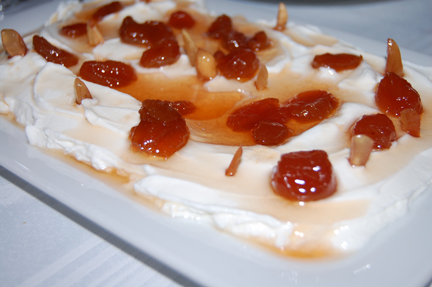
Said blogger is rarely said to eat dessert but there was no way for him to resist Maria’s yogurt topped with cherries she had stewed herself.

Said blogger enjoyed many great meals in Greece but none came close to that prepared by Maria.

In other news…

In the days that followed, said blogger, an accomplished linguist, learned that he had been incorrectly pronouncing the name of the most noble red grape variety in Greece, Xinomavro.

Click here to listen to the correct pronunciation.

Christmas Letter 2011

So many great things happened for Tracie P and me in 2011 but they are all eclipsed by the miracle of Georgia Ann Parzen, who arrived on Monday, December 12.

Around 3 a.m. this morning, as Tracie P and I cleaned the soiled linen in the bassinet and changed another dirty diaper, I couldn’t help but be reminded of the prayer that Jews say after going to the bathroom: Asher Yatzar ([Blessed Are You] Who Has Formed [Humankind]).

Blessed are You, HaShem, Our G-d, King of the universe, Who created the human with wisdom and created within him many openings and many cavities, exposed and known before Your Throne of Glory, that if one of them were to be ruptured or one of them were to be blocked it would be impossible to survive and to stand before You for even one hour. Blessed are You, HaShem, The physician of all flesh who acts wondrously.

Over the course of the year, Tracie P and I have been blessed with many miracles: the miracle of Georgia’s conception, the miracle of our healthy pregnancy, the miracle of Georgia’s delivery, and the miracle of our family, who supports us with their love and devotion.

This morning at 3 a.m., we paused again to reflect on the miracle of a dirty diaper and the health of our baby girl.

On this Christmas 2011, I’m happy to report my business has continued to expand and Tracie P’s been loving her new position selling fine wines. I launched a new wine column for the Houston Press and my band released a new record. My first wine list was well received in Los Angeles and I was invited to speak on Italian wine and wine writing at a number of conferences held this year in the U.S. and Italy. I’ll never forget my first Cretan sunrise on the day of the first European austerity vote, nor the Venetian sunshine on Tracie P’s face on a bright winter’s day on the Grand Canal.

This year’s blessings are too many to count and not a day goes by that I don’t look in the mirror without remembering the long and often challenging road that delivered me to this special moment in our lives.

And so, on this early December morning, as Georgia and Tracie P slumber, and I can hear the first birds begin to chirp with the Texas dawn, I’ll say a prayer for a dirty diaper and I’ll thank my lucky stars that it turned out so right for strangers in the night.

Goumenissa, mon amour @Boutari

Una faccia, una razzaOne face, one race… The Greeks love that Italian saying (which refers to the two nations’s shared Mediterranean kinship).

Some people call me a Zelig: I have one of those faces and no matter what Mediterranean country I visit, I generally fit in. And such was the case when I visited Greece in June for the Boutari blog.

But when we visited the small and wonderful village of Goumenissa in Northern Greece, the villagers could pick me out as a foreigner from a mile away.

And they couldn’t understand why an American, with a camera, was so fascinated by their town.

My money was no good there: when I photographed the fish monger, he prepared a package of fish for me; at the bakery, the baker wouldn’t let me pay for her breads…

Sometimes, when life becomes to hectic and I feel overwhelmed by the rhythms of modern living, I think about and long for Goumenissa, mon amour

This slideshow requires JavaScript.

No Berlusconi but sadly still Barrique

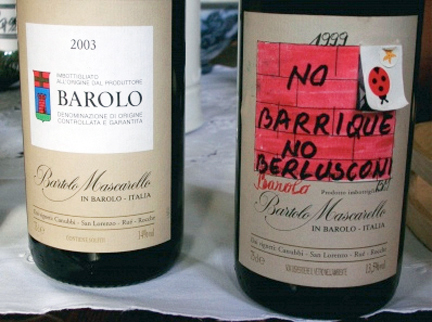
Bartolo Mascarello’s famous label, “No Barrique, No Berlusconi,” a now iconic image that empowered wine as an ideological expression. Photo via Spume.

The great 20th-century novelist, poet, essayist, and politician Leonardo Sciascia employed Sicily as synecdoche for Italy in his novels Il giorno della civetta (The Day of the Owl, 1961) and A ciascuno il suo (To Each His Own, 1966). The works were parables of what he would later call the “Sicilianization” of Italy: a phenomenon whereby the Sicilian model of bureaucratic and political bankruptcy and clannish self-interest had contaminated the entire Italic peninsula as the nation first tasted the sweetness of prosperity thanks to the “economic miracle” of that decade.

Today, as I joyously read the news that Berlusconi has pledged to resign, I am reminded of Sciascia’s parables. In many ways, Berlusconi’s 17-year tenure as Italy’s leading politician is a parable of the Italian nation’s overarching abandonment of the social ideals that emerged in the period immediately after the second world war, when social and economic equality, dignity, and liberty were paramount in the hearts and minds of Italians who had suffered through the tragedy of fascist and Nazi domination. The memory of those wounds was still vibrant in 1994 when Berlusconi first took power. Today, the generation that embraced the humanist ideals of Italian post-war communism has greyed. And the greed and moral bankruptcy embodied by Berlusconi will remain as the legacy that has reshaped Italy and swept away the renaissance of Italian greatness — in design, technology, fashion, cuisine, etc. — of the decade that preceded his reign.

His tenure corresponds neatly to the tragic Californianization of the Italian wine industry that took shape in the 1990s when scores of Italian producers abandoned the values of the generation that had made wine before them.

Berlusconi may be on his way out. But, sadly, barriques are here to stay.

In the face of the European debt crisis and the social and economic turmoil that has gripped Italy (my first love) and Greece (my new love) — “Crisis in Italy Deepens, as Bond Yields Hit Record Highs,” New York Times — it’s been difficult to write about wine here on the blog.

Tonight Tracie P and I will raise a glass of traditionally vinified Nebbiolo to Italy’s future… and tomorrow I’ll pick it up again…

Civic mourning today in Genoa, crisis in Greece @Miti_Vigliero @MariaKaramitsos

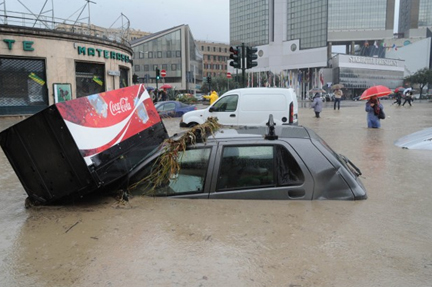
Photo via Genova.Repubblica.it.

Our hearts and prayers go out to the families of victims of torrential rains in Genoa (Genova) and northwestern Italy: 6 persons died in Genoa on Friday and the city government has declared a day of civic mourning today.

The city is still under a flash flood watch, with more rains expected today and tonight.

Like many residents, writer, poet, humorist, educator, blogger Mitì Vigliero (aka Placida Signora, one of my favorite Italian-language blogs) has left the city for higher ground but she’s posting updates on the weather and emergency resources on her Twitter feed here.

Our thoughts and prayers also go out to the people of Greece, whose economy continues to be paralyzed by its government’s inability to move forward with the European Union debt deal.

I’ve been following Chicago-based Greek-American writer Maria Karamitsos’s Twitter feed for updates on the crisis.

Harvest on Santorini!

Posting in a hurry today but just had to share the above photo of Aidani grapes sent to me by winemaker Ioanna Vamvakouri of the Boutari winery on Santorini.

A gun blogger for hire, I continue to curate the Boutari blog (a project dear to my heart) and I am thrilled to post the first images of harvest on the island. (And I posted another one over on the Boutari blog.)

In September, I’ll be expanding the Greek Grape and Appellation Name Pronunciation Project and I’ll also be posting more images and stories from my June trip to Greece.

Stay tuned and thanks for reading!

Tarallucci e Vino (biscuits and wine), an attempt at documenting the proverb

From the “una faccia una razza (one face one race)” department…
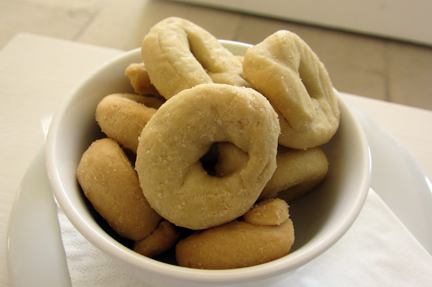
Above: Generic however delicious taralli served to us in Apulia at the Radici Wines tasting.

It all started back in June when Jancis tweeted: “Best inter-wine nibble ever: taralli from Puglia.” For three days, we had been sitting next to each other tasting and scoring Southern Italian wines at the Radici Wines festival in Apulia.

It was our last day of tasting together and one of our Italian counterparts (I can’t find the tweet) quipped back, tweeting “Finiamo a tarallucci e vino,” literally, “we finish [the tasting] with [small] taralli and wine.”

The irony in this context is owed to the proverbial meaning of the expression in Italian. To end with tarallucci [an affectionate diminutive of taralli] and wine means to resolve a dispute by pretending there were no dispute to begin with. In other words, we argued, we disagreed, but let’s have some savory biscuits and wine and pretend that there is no acrimony between us.

While the saying can be applied to express the sentiment that all’s well that end’s well, it can also be used ironically to denote that I believe you’re wrong but there’s no use fighting about it. (The sentiment and expression are by no means unfamiliar to Italians or those who frequent Italy and Italians; it’s often used in Italian journalistic parlance to allude to the hypocrisy of Italian politicians.)
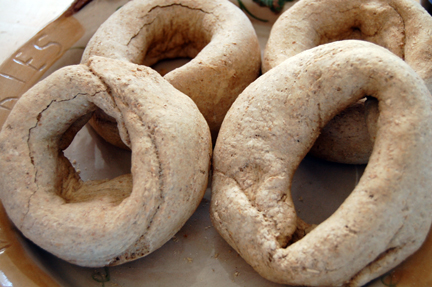
Above: Taralli probably share a kinship with Greek koulouri (I believe the unleavened biscuits in the photo, tasted at Boutari’s Santorini tasting room, fall in the category of koulouri in the Hellenic culinary canon).

Not much is known about the origins of the term tarallo. The Cortelazzo (Zanichelli) etymological dictionary notes that the etymology is obscure, possibly from the Latin torrere, to dry up, parch, roast, bake, scorch, burn. Some point to the Greek δάρατος (dàratos), a type of Thessalian bread.

I have yet to find any reliable source that addresses the origins of the expression tarallucci e vino but the tarallo’s significance as a gesture of hospitality clearly emerges in 19th century literature. It was one of the earliest street foods of pre- and post-Risorgimento Southern Italy (Pitré, Biblioteca delle tradizioni popolari siciliane, 1883) and was presented by and to travelers when they arrived. In The Bagel: the surprising history of a modest bread (Yale 2008), Maria Balińska suggests that the tarallo may be the predecessor of the bagel.
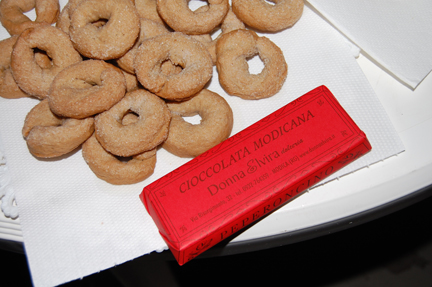
Above: Jancis and the rest of our group paired sweet taralli and spicy Sicilian chocolate with aged Primitivo at the Pichierri winery in Sava (Taranto, Apulia).

Browsing the Henry George Liddell, Robert Scott, A Greek-English Lexicon, I read that the Greek δάρατος (dàratos) was a type of unleavened bread “offered at marriage and registration ceremonies” in Hellenic Greece. And I cannot help but wonder if the tarallo’s circular, adjoined shape does not belie its use as a symbol of friendship (Balińska addresses the Italian ciambella, a similarly round unleavened bread, its relation to the bagel, and the ancient custom of presenting it to one’s host). There’s no doubt that the tarallo travels well and is easy to preserve (in Campania taralli are made with shortening and are often adorned with almonds; in Apulia, they are made with olive oil and adorned with fennel seeds).

If anyone has any insights to share, I’d greatly appreciate them. As a devout philologist, I will not rest until I get to the bottom of this conundrum and we will genuinely be able to conclude a tarallucci e vino.

Thanks for reading!

The best meal in Greece, the most beautiful Greek woman, and the CORRECT pronunciation of Xinomavro

Many great meals were thoroughly relished by a wine blogger last week in Greece but the one that he cannot stop thinking and dreaming about was a dinner prepared by Maria Constandakis, who — together with her husband and agronomist Yannis — oversee the Boutari winery in Crete.

The meal began with a Cretan dakos, a wholewheat rusk, a bit larger but similar to the frisa of Apulia, where they top it with diced mozzarella, tomatoes, and tuna. Here, tradition calls for fresh tomato purée and crumbled feta. And while the Apulians gently soak their frisa before dressing it, the Cretans use the water naturally purged by the tomato when it is tossed with the salty cheese.

Next came the classic Greek zucchini “meatballs,” the kolokithokeftedes. The wine blogger had experienced this dish before but in his own words, “to have Maria’s, made from zucchini she grew herself in the winery’s garden, is a game-changer.”

The next morning, said wine blogger photographed Maria’s zucchini.

When you travel in Greece during summer, horiatiki — the classic village or summer salad — is served at nearly every meal. But there was something different about Maria’s. Upon further inquiry, the blogger discovered that Maria included freshly torn glistrida or purlane in her salad, also grown in her garden.

Still used as an effective folk remedy for certain ailments of the mouth, purlane grows wild in Greece (the blogger even found it along the sidewalks of one of the small towns he visited in Northern Greece). Like nettles, it slightly stings the tongue and according to legend, those who consume it are prone to loquaciousness. (Said blogger has never been accused of being long-winded! But true to legend, he stayed up late into the night discussing philosophy and politics with his companions over many glasses of raki.)

The pièce de résistance, however, was Maria’s slow-roasted lamb. Even though, technically, the meat had not been smoked, the effect was the same: the bones were so tender that that crumbled gently in the blogger’s mouth, rewarding him with their sweet marrow.

Said blogger is rarely said to eat dessert but there was no way for him to resist Maria’s yogurt topped with cherries she had stewed herself.

Said blogger enjoyed many great meals in Greece but none came close to that prepared by Maria.

In other news…

In the days that followed, said blogger, an accomplished linguist, learned that he had been incorrectly pronouncing the name of the most noble red grape variety in Greece, Xinomavro.

Click here to listen to the correct pronunciation.

Greek grape name pronunciation project and my Greek artichoke flower

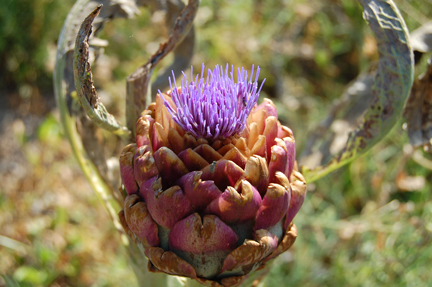
Fortune smiled on me today when it delivered me at the doorstep of Roxani Matsa (above), the most super cool lady and winemaker in the Attica appellation just outside of Athens. She took me on a tour of her garden and her vineyards, insisting that I stop to smell the artichoke flowers…

We chatted about winemaking and films as we sat outside her home and winery, sipping frappè coffees (ubiquitous here in Greece), munching on pastries, and leafing through photo albums.

Before I headed out to Mantinia in the Peloponnese, she graciously recited some Greek grape and appellations for the fresh-off-the-presses Greek Grape Name and Appellation Pronunciation Project, which I launched yesterday at the Boutari Social Media Project blog.

There’s so much more to tell and so many more photos and videos to post from my trip. But now it’s time to relax and get some sight-seeing in before I head back home with the armadillo.

I’ll be taking the next few days off from blogging but will pick up again early next week where I left off…

Thanks so much, to everyone, for the kind words here, on the Twitter, and on the Facebook about the review of Sotto and my wine list there in Los Angeles. They mean the world to me. :)

See you next week!