WWIII is here and children are dying. We must save the children.

When I first moved to Texas to be with Tracie, her father was still working as the pastor of a modest church in Orange where Tracie was born and grew up — a small Texas town straight out of central casting. I began helping out with the church website and we attended services regularly.

I’ll never forget Randy leading a prayer for “enemy combatants” (Obama was president and there were troop surges in Afghanistan and Iraq during those years). I’m not a Christian. I’m a Jew. But I was profoundly inspired by his prayers. This, I thought to myself, is what true Christianity is about: knowing, first and foremost, that all people are the children of G-d. Even enemy combatants.

Today, children of G-d are dying every day in Iran, Lebanon, Gaza, Israel, and Ukraine. Lives of honest, earnest young people are being destroyed for wars over weapons and oil: who gets to keep the weapons and who gets to keep the oil.

World War III is here. In Ukraine, it’s Russia vs. the West. In the Middle East, it is the U.S. and Israel who havelaunched a war of aggression on Iran, a conflict that has drawn in multiple countries in the region and beyond. The crusades of all actors are deeply intertwined.

The current American president campaigned on — let me see if I can get this right! — immigration, the economy, and world peace. When it comes to the first issue, he has delivered what he promised. I vehemently disagree with the policy and the tactics. But he has partially achieved what he set out to do. Fair enough.

But when it comes to the economy and world peace, we are clearly moving in the opposite direction from his stated goals.

Now, as always, is a time to pray for vulnerable children. But it’s also time to stand up and speak out: the war on Iran is wrong! It’s being driven by the interests of the powerful. Children — innocent children — are paying the price for the imperial aspirations of world leaders in their 70s.

There are so many things I’d like to be writing about here. But I can’t scribble another word until I say this. War is wrong. Children are dying. Stop the wars now! G-d bless the children. G-d bless us all.

“We’re cooked.” A 12-year-old’s take on the world wars.

“At least we’re not invading North Korea.”

That’s what our 12-year-old daughter said wryly we watched the evening news yesterday. The president of the U.S. had just said that the U.S. plans to take control of Cuba.

“I think I can do anything I want with it,” said the leader of the (no longer) free world as we watched.

Either way, said our daughter, “we’re cooked.”

Tracie and I struggle with how to talk to our girls about the world wars that unfold nightly on television. We feel strongly that they need to be engaged with world events. They will be exposed to the news, our thinking goes, no matter what we do. But we can help them deal with their feelings by guiding them through nuanced issues they may not understand. Giving them the opportunity to articulate their emotions is the key to their better health, we believe.

But how do you talk to your 12- and 14-year-olds when you can’t contain your weeping at the sight of children dying every day?

Here in America, it can be easy to tune out the wars. In other parts of the world, from what we can see, that’s not the case.

I have an Italian friend, a woman roughly my age, who posts updates on the number of children killed in Iran and Gaza nearly every day. She has kids not much older than ours. As hard as it is to see each night, I try to check in with her feed regularly. We mustn’t ever forget, I say to myself over and over, that children are dying every day in imperial wars driven by petroleum and humans’ will to power.

“All things are subject to interpretation,” wrote Nietzsche. “Whichever interpretation prevails at a given time is a function of power and not truth.” The philosopher’s (in)famous aphorism seems more relevant than ever, especially in the age and rage of social media.

We teach our children to look beyond the projections of power, to seek truth, however ethereal it may be.

Our truth? We must stop these wars before more children die. G-d bless the children.

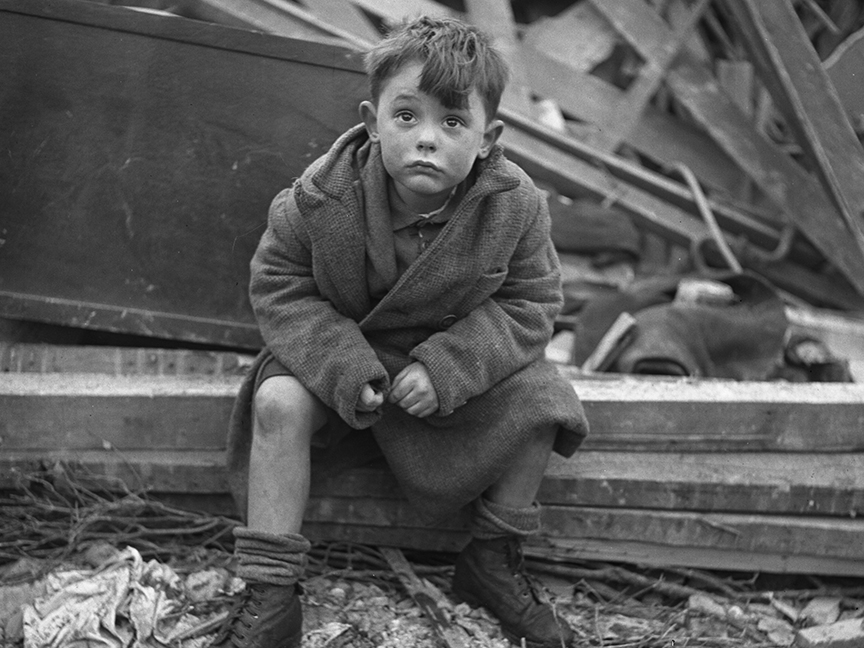
Image: “Boy seated in wreckage of building after a bombing raid of London during World War II,” Library of Congress, 1945.

The Oscars won’t be the same without her.

Everyone who knows me well knows that I used to speak to my mother nearly every day.

Even when I was living in New York in the late 1990s, we always made time to catch up, if not every day, then every other day.

After she passed in October of last year, it’s been really hard to fill those 30 minutes we would spend on the phone.

This is the time of year that she would be telling me about the Oscars, one of her favorite events of the year.

She would watch nearly all the films in competition and handicap them with her friends. And then on Oscars night, she would cook dinner and host a watch party for a friend (usually Marie; I would provide the wine).

It was a sine qua non day in her calendar.

There’s a great line from the song Gram Parsons wrote for his mother, “Brass Buttons”: “And the sun gets up without her/doesn’t know she’s gone.”

That’s how I’m feeling today knowing that I can’t call Judy and ask her who her favorites-to-win are. And she won’t be drinking that bottle of Etna white that I left her in her fridge.

Tracie, the girls, and I will watch the red carpet tonight. It’s the first year of the Oscars without Judy. I miss her so much.

A need for joy as the world falls to pieces.

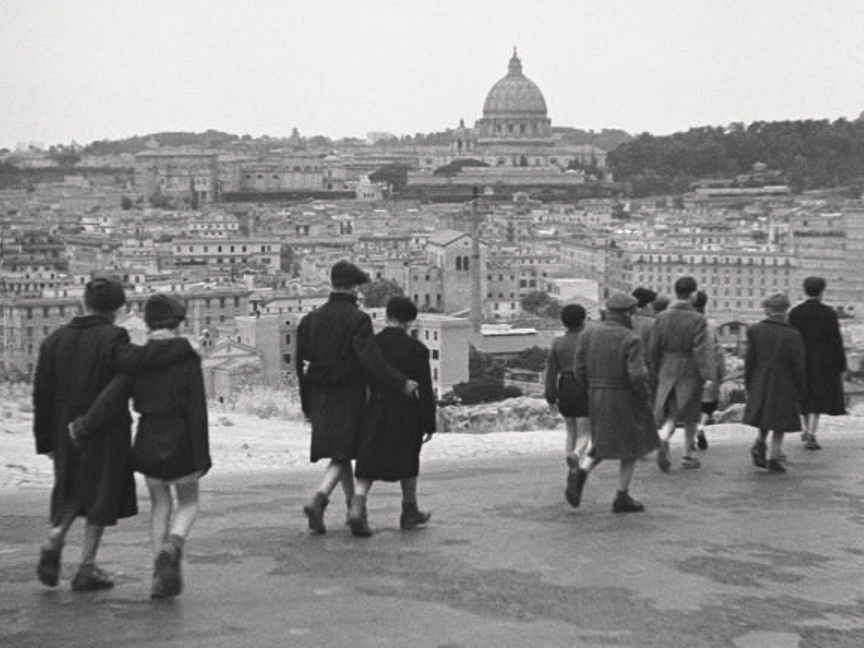
As a 19-year-old student of Italian, I was obsessed with Neorealist cinema.

That’s a shot from the closing scene of “Rome Open City,” Roberto Rossellini’s iconic 1945 film, one of the most famous works made during the war era.

Watching those movies — “Paison,” “Bitter Rice,” “Bicycle Thieves”… — as a young adult was a life-changing experience for me. Their characters were superhumans in my mind, capable of facing the worst that life could deal them: war, persecution, hunger, loss of liberty, death. It helped me to understand the hardship endured by my paternal great-grandparents, who were born into deep poverty in Russia (they fled the Cossacks in the first decade of the last century).

Yet those characters, often real people who had been recruited from the street, were also all too human. Italian filmmakers’ brilliant work brought their suffering to the screen in a (neo) real way that the world had never seen before.

I dreamed that I could be as strong when confronted by the life-and-death decisions that people in war are forced to make. I hoped that I could be as graceful were I ever to find myself in the bellic worst-case-scenario like those victims of imperialist war.

Today, Tracie, the girls, and I watch scenes on TV that seem plucked from a Neorealist film: the raids targeting brown people in our country, protesters being shot by federal agents, the concentration camps where brown people are treated like animals (see Pontecorvo’s “Kapò”), the imperial wars in Iran and Ukraine, the plight of Palestinian children…

Sometimes I wonder if we are just another bourgeois family in 1933 quietly pretending that the world isn’t falling apart. Actually, it’s more like 1939 at this point.

At our dinner table, we talk every night about the tragedies unfolding across our planet.

But like those Neorealist characters, we also try to find beauty and joy in the world around us, in the mundane as it were, in each other. If we didn’t, all would be lost. Maybe it was those characters’ fleeting joy, however ephemeral, that gave them the courage to withstand the unthinkable. I hope so.

Stop using the word “ghetto” unless you really know what it means!

Something that blew my mind: when my post about my support for Jasmine Crockett blew up (300+ comments and counting), people assailing me from both hard right and hard left used the word “ghetto” in their attacks.

Do they even know what the term means?

Many will be surprised to learn that the word ghetto is Italian in origin. And to be more exact, Venetian in origin.

The first ghetto in history was founded in Venice in the early 16th century, in the neighborhood where the city’s foundries were located. The word “gheto” in Venetian dialect denotes “foundry” (its Latin origins bring it back to iectare, “to throw,” gettare in Italian).

That was the first ghetto in history, created by the Venetians to concentrate the Jews.

The term spread through Europe as other cities mirrored the Venetians’ racist policy.

By the mid-19th century, ghetto came to denote a place where a racial or ethnic group was segregated from the greater community.

The Oxford English Dictionary gives this definition from 1855 forward: “Any area occupied predominantly by a particular social or ethnic group, esp. a densely populated urban area which is subject to social and economic pressures, tending to restrict its demographic profile; an enclave. Also in extended (and sometimes ironic) use.”

An example from Melville: “The belittered Ghetto, forward of the main-mast, wholly occupied by the blacks.”

By the late 19th century, a new meaning emerged: “Originally and chiefly in the United States: a socially and economically disadvantaged inner-city area predominantly populated by African American people” (Oxford English Dictionary).

We don’t use or teach our children to use the word in our house. It’s a historic term in our view, a word that has been used to disparage Black people in our country since before I was born.

If you didn’t vote for Jasmine Crockett because she’s Black and you think that other white people wouldn’t vote for her, well, I’ve got news for you. Your doubly racist. (I’m echoing the words of one of my favorite Houston-based political bloggers, Erika Harrison, @blackgirlswhobrunch; thank you Erika for your awesome writing on the campaign!)

And oh yeah, stop using the word ghetto unless you are going to use it correctly and respectfully!

Photo credit: “Venezia – Cartello di ingresso al Ghetto” by Luca Paolini, CC BY-ND 2.0.

American trolls: 200+ comments, many racist and nasty, from people I don’t know.

Since when is temperate civil discourse about politics considered intolerable in this country?

Oh yeah, I forgot, it became officially intolerable when in 2016 when Trump disparaged Ted Cruz’s wife and Rubio’s hands.

In case you had any doubts, in May 2024, Taylor Green insulted Jasmine Crockett about her eyelashes and we barely batted one. Crockett responded by commenting on Taylor Green’s “bleach-blonde, bad-built, butch body.”

When I posted my preference for Crockett in yesterday’s Texas primary race, I was expecting to get maybe 30-40 interactions.

Instead I got three times that much and more than 200 comments, many of the overtly racist and nasty, from people I don’t know.

The trolls on Facebook have been out to get me for a while (since I started posting about FIEL). But the oversized response to my simple expression of political joy and hope shows that people like me are targets.

I’ve lived in Texas now for nearly 20 years. Over those decades, I’ve observed the trollification of our state government and the Texasification of the federal government.

One of the best overviews of the Texan political panorama I’ve read is “Paxton Is a Texas-Size Troll. Is That What G.O.P. Voters Want?” by conservative political commentator Kevin Williamson, published today by the Times.

“Texas is more closely divided than you might think,” writes Williamson. “That is in part because Texas is no longer entirely the land of ‘wide open spaces’ but an increasingly urban state, home to six of the 25 largest cities in the country and two of the five largest metropolitan areas. Republicans do not typically fare well in urban areas — they haven’t won a mayoral election in Houston in more than 40 years.”

Williamson calls out Paxton for his corruption and trolling (see the title): “Paxton might be described, without exaggeration, as the most scandal-plagued politician in the country.”

He also calls out Jasmine Crockett for her own brand of trolling: “Ms. Crockett rode that pony a long way.”

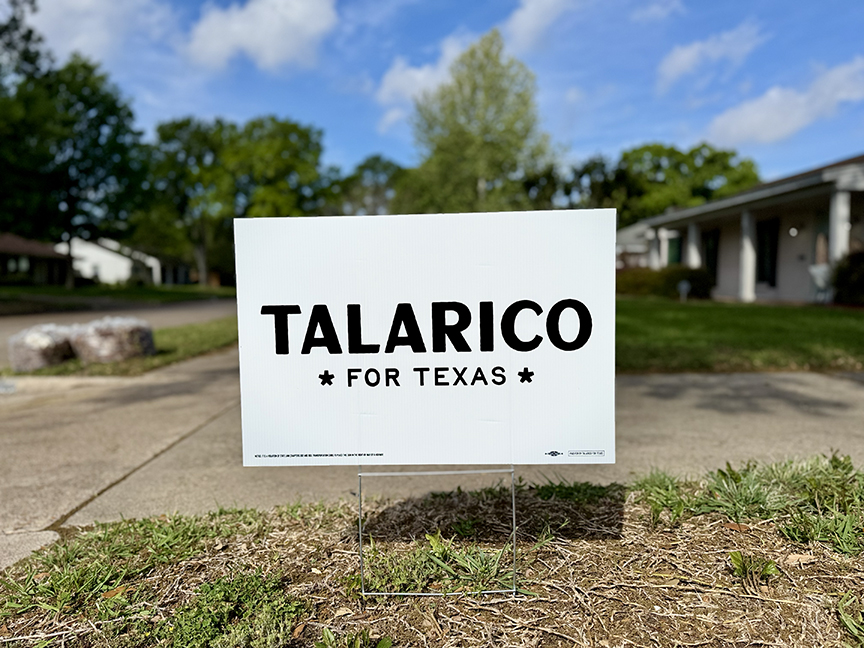
I’m disappointed by Crockett’s loss but am giving my 1,000 percent support to Talarico. Let’s hope it’s Paxton v. Talarico, that’s a fight I’d like to see.

Vote Jasmine Crockett! Texas isn’t just a bunch of John Waynes (despite what the white people think)!

One of my favorite California-Texas put-downs was voiced by sister-in-law, my little brother’s wife.

“How can you live in Texas with all those awful people?” she chided me not long after I moved here to be with Tracie.

People outside our state love to put us down.

Back when she said that to me, I wanted to (but didn’t) tell her: what about all the Brown and Black people who live in my state? Are they awful, too? Or is it only the white people who look like you?

Guess what! There is more to Texas than John Wayne and the movies!

Anyone who’s ever spent time here knows the answer to that, unless they’ve only hung out in the Woodlands and at the Yacht Club.

According to the pundits, Texas has the largest number of eligible Black voters in the U.S.

And a lot of folks here are getting excited about Jasmine Crockett’s campaign for senate.

I like both James Talarico and Jasmine Crockett. But I am convinced that she is the stronger candidate for the moment.

I believe that she can mount a more compelling campaign against Cornyn or Paxton.

Can you imagine a race between Paxton, one of the most corrupt politicians in Texas history (and that’s saying a lot!), and Crockett? Even if she didn’t prevail, her ability to reveal GOP hypocrisy would further our cause.

G-d bless both Dems. But my vote is with Jasmine!

If you haven’t already, please vote, my fellow Texans! Either way, we need to show up on voting day if we want to change our country’s racist and imperial policies.

We’ll send all the awful people to San Diego to be with my brother and his wife. They deserve each other.

How you can help the immigrant community under siege: stand up, speak out, volunteer, donate.

Many thought Trump couldn’t be elected in the first place.

Many trusted that he couldn’t even stand as a candidate after the January 6 siege of the Capitol.

But all those things came to pass.

Many thought his administration couldn’t organize extra-judicial ICE goon squads that would profile brown people. Many people believed that even if he did, ICE would be subject to accountability — not to mention common sense and decency.

It’s happening, people, even though we wished it wouldn’t.

It’s time to act. It’s time to act NOW.

A lot of folks have read about my pro bono work as a media consultant with FIEL, the largest immigrant advocacy group in Texas, based here in Houston. And many have reached out asking how they can help.

Despite lies about FIEL recounted by Houston Mayor Whitmire and Texas attorney general Paxton, FIEL helps the vulnerable in the immigrant community every day through education, hands-on advocacy, and emergency interventions for those facing wrongful deportation.

FIEL needs volunteers and donations.

FIEL is an education resource, especially for DACA recipients.

It also mounts stations outside of supermarkets and similar community hubs where they distribute literature on immigrants’ rights (“what to do if ICE knocks at your door,” etc.).

FIEL organizes ICE awareness groups (few in our neighborhood realize that ICE did a massive raid at an apartment complex a mile from our home).

FIEL organizes rallies and protests that force politicians to face their hypocrisy.

FIEL sends out court observers to monitor immigration cases (this is one of the hardest tasks but also one of the most important).

I could go on and on about what FIEL does not just for the immigrant community but for our ENTIRE COMMUNITY.

Please start the process of becoming a volunteer by filling out a FIEL volunteer intake form. And please, please, please, if your finances permit it, please give to FIEL.

Thank you for your solidarity with the vulnerable in our community.

Image via the us_icegov Flickr (public domain).

ICE agents “dressed like clowns, with the rough fabric with rancid stench.”

The American government’s terror campaign against brown people and the murder of white American protesters in Minneapolis are as terrifying as they are wholly wrong and morally indefensible.

No matter your political stripe, there’s no longer any way to deny that cruelty, the expression of raw power as violence, and dehumanization have been revealed as key elements of the MAGA platform and ethos.

And watching the horrific, tragic events unfold in Minneapolis, there’s no doubt that the seeds of a (soon to be hot) civil war are taking root.

I’m reminded of Pasolini’s letter to student protesters after the 1968 Battle of Valle Giulia (wiki it) where Italy’s paramilitary police (the Carabinieri) and protesters clashed violently.

And then, look at them, Pasolini wrote, referring to the Carabinieri with their black and red uniforms:

And then, look at them: dressed like clowns,
with the rough fabric with rancid stench
Worst of all, naturally, the psychological state
to which they are reduced
for about forty liras a month:
without a smile,
with no more friendship with the world,
separated, excluded (in an exclusion that has no equal)
humiliated by the loss of human qualities
in exchange for those of a policeman
(being hated makes you hate).
They are twenty, dear young men and women, your age.

(Translation from primolevicenter.org.)

Reading the letter (a poem published at the time as opinion piece), it occurred to me how ICE agents are also victims of our government’s awful policy — not unlike the way U.S. soldiers were victims of U.S. policy in Vietnam (or Afghanistan or Iraq).

But then you look at the agents’ abject violence against U.S. citizens and rightful residents: it’s hard not to see MAGA’s hateful, emotionally-driven cruelty in the heart of their actions.

I pray for them just as I pray for the victims of MAGA’s sadism. I pray for us all.

Image via the us_icegov Flickr (public domain).

There’s no thunder in heaven.

I’m awfully sorry to report that we lost our beloved dog RooRoo (Rusty) at the end of last year.

The doctors believe that he had a brain tumor and possibly suffered a stroke.

RooRoo was one of two dogs I have loved more than any other in my lifetime.

He was a rescue, severely traumatized when we got him.

But he grew into the fun-loving and affectionate if sometimes standoffish dog that we all adored — me especially.

Before I sorted through our photos of him (for this post), I was worried that seeing images of him would make me too sad to write about him.

But instead the opposite happened: they reminded me of how much fun he had in life and how fun he was to be with.

That’s one of my favorites: him cooling down after a long walk at Willow Water Hole. He loved going on long walks and exploring new scents.

During the early months of Covid, when I was struggling to pay the bills, he would sit up with me through the long cold nights, my faithful companion in some of the toughest times.

For all his peccadillos, he was the best dog I could have had. I genuinely loved and still love and miss him with every fiber in my body.

RooRoo, you were and will always be the ‘best dog ever,’ just like I used to tell you in the truck on the way back from the reservoir, remember? Your brother Paco and I talk about you every day and he misses you chewing on his ear, the price of admission to the bed. RooRoo, when you were dying, I told mamma that I didn’t know how I could live without you. I’m still here, RooRoo, but our lives will never be the same. You used to hate the Houston storms, sweet boy. There’s only one thing that gives me comfort: there’s no thunder in heaven. I’ll find you there as soon as I can, I promise, and we will be together again. I promise, sweet RooRoo. I love you.