Chablis by the Sea

Above: a classic Southern California Caesar salad, tossed tableside on a guéridon by Meliton Lescana at The Marine Room in La Jolla, CA – a relic of Cold-War-era “continental” dining (click image for animation).

A trip home for New Year’s conjured up nostalgia of growing up in a sleepy seaside community where the waves are big and the beach is your backyard. Besides an excellent dinner at my mom’s (braised brisket, roast potatoes, and wilted spinach with a López de Heredia Viña Tondoñia 1999 that I found on sale at the local BevMo), great sushi (So. Cal. has some of the best in my book), and a bevy of burritos, tacos, tostadas, and flautas (look for a post next week on Mexican culinary adventures), we made a trip down to The Marine Room in the La Jolla Shores, a blue-blazer, khaki-pants-and-docksiders restaurant that sits right on the beach with floor-to-ceiling waterfront windows.

Above: 2002 Montmain (Premier Cru) by La Chablisienne. Sommelier Jeff Hoover surprised and impressed me with a list that offered some options to those of us who cannot drink barriqued Chardonnay. The shrimp cocktail is no longer on the menu but they made it for me anyway.

The once strictly “continental” menu has undergone some changes since I was a kid and although the surf and turf still makes an appearance (at $70+), most of the classics have been replaced by things like the “Mulberry Kalbi Glazed Organic Pompano,” which I ordered.

The pleasant surprise was the wine list. I wasn’t expecting to find a lot of things that I could drink and indeed the list was comprised mostly of heavily oaked Chardonnay, Merlot, and Cabernet Sauvignon (for the most part, Marine Room diners get what they deserve: at the table behind ours, I heard a gentlewoman pontificate about wine, extolling the virtues of Merlot, which, she informed her companions, “is a blend”). But after leafing through the heavy-handed California chapters of the list, I was relieved to find one of my all-time favorite Chablis producers, La Chablisienne.

Chablisienne makes traditional-style wines that show the characteristic minerality of distinctive Chablis. The wines are very reasonably priced: the premier crus generally retail for less than $30 and the Petit Chablis and Chablis AOCs can come in under $16. I had never tried the Montmain Premier Cru and it went great with a jumbo shrimp cocktail (the latter doesn’t appear on the menu anymore but can still be ordered). I just love these wines…

We also drank a 375 ml of Guigal’s 2003 Condrieu, a 100% Viognier that definitely sees some time in barrique (about a third of the wine was vinified and aged in new wood according his website). It was unctuous and rich, perfect for the Pompano and the fruity flavors of its sauce.

The Marine Room isn’t cheap, the food is somewhat affected and slightly tired, but the views and the Cold-War-era feel are worth every penny (that you don’t put in your loafers).

Above: an image of the Marine Room, battered by the surf in 1949. The Marine Room sits right on the beach and has been closed numerous times over the years because of weather damage. It’s not cheap but the views are worth it. The night I was there, sandpipers scurried and danced across La Jolla Shores beach like ballerinas.

War Is Over if You Want It

Photo credit: Heather Bowden, La Jolla Local, December 2008.

Thankfully, I’m getting out of town for a while. I can’t reveal where I’m heading but my destination may look like the holiday card I received from a high school classmate Heather Bowden, a graphic designer and photographer.

Thanks to everyone for reading and clicking the blog this year. The 2007 vintage was a tough one for me: special thanks to my family and friends who have stood by me and lent me their support and love. I couldn’t have done it without “a little help from my friends [and family].”

I’ll be taking a little break for the next week or so but check back after the New Year for tales of my travels (and a big surprise that will be announced in early ’08).

If you want it, War is over now…

*****

So this is Christmas
And what have you done
Another year over
And a new one just begun
Ans so this is Christmas
I hope you have fun
The near and the dear one
The old and the young

A very merry Christmas
And a happy New Year
Let’s hope it’s a good one
Without any fear
And so this is Christmas
For weak and for strong
For rich and the poor ones
The world is so wrong
And so happy Christmas
For black and for white
For yellow and red ones
Let’s stop all the fight
A very merry Christmas
And a happy New Year
Let’s hope it’s a good one
Without any fear
And so this is Christmas
And what have we done
Another year over
And a new one just begun
Ans so this is Christmas
I hope you have fun
The near and the dear one
The old and the young
A very merry Christmas
And a happy New Year
Let’s hope it’s a good one
Without any fear
War is over over
If you want it
War is over
Now…

— John Lennon, Yoko Ono

Utterly California

John Yelenosky — a good friend from my La Jolla High School days — and I had dinner last Tuesday at what is clearly one of San Diego’s finest restaurants, Market in Del Mar (about 20 minutes north of La Jolla). His father owned a wine store when we were coming up together and today John is the European Wine Specialist for the San Diego offices of Southern Wine and Spirits, one of the preeminent distributors of European wines in North America.

The concept behind Market is what some in the business call “market fare,” i.e., heirloom produce sourced from artisanal growers. The restaurant is located not far from the legendary Chino Farms,* a once humble roadside produce stand in Rancho Santa Fe that became a flash point in the heirloom vegetable revolution (thanks, in part, to a hearty endorsement from Alice Waters). Nearly all of the fruits and vegetables used in the kitchen, explained our waiter, are sourced daily from Chino Farms.

Executive chef and owner Carl Shroeder (La Jolla High, class of 87, same year as my brother Micah) shows a deft hand in the kitchen — especially with the entrées — and his food was excellent if not entirely original. The wine service by Brian Donegan was impeccable but our waiter was a little overly enthusiastic and too precious for my taste.

The dish that impressed me the most was the “Market salad,” which strangely does not appear on the menu.

The salad consists of fresh and lightly steamed heirloom fruits and vegetables (note the light green, pine-cone shaped broccolo romanesco florets above), dressed in olive oil and cask-aged vinegar, served over different types of heirloom lettuce. The pasta-bowl serving dish was warmed before assembly and the heat gently wilted the lettuce leaves and delicately accentuated the flavors of the dressing. We matched with a 2005 Vin de Savoie Apremont by Pierre Boniface, made from Jacquere grapes — an unusual and commendable wine-by-the-glass. This utterly Californian dish needed the bright fruit and acidity of the Vin de Savoie and the pairing of the seemingly just-picked vegetables and this fresh wine was great.

Above: the “Hot and Sour and Wonton” soup that the chef sent over didn’t exactly overwhelm me but was tasty.

Above: wine director Brian Donegan really knows his stuff and his wine service was top-knotch. I liked the 2004 Spätburgunder by Julius Wasen und Söhne that he poured for us by the glass. I was nonplussed, however, to see only a few tables ordering by the bottle on this busy evening (after all, this decidedly upscale restaurant is located in one of San Diego’s most ritzy neighborhoods, Del Mar/Rancho Santa Fe. Do Californians not drink wine at dinner? This one does!).

Back in the day, John and I used to play in a band together, ditched fourth-period art class together, and generally had a good time growing up in a sleepy beach town where nearly everyone surfed and/or played guitar (I only did the latter). Neither of us would have imagined in 1985 (when we graduated from high school) that — at age 40 — we’d both be working in the world of wine.

Above: John Yelenosky circa 1985.


Above: despite my doofus looks (and all the trouble I got into), I did well in high school.

* Chino Farms
6123 Calzada del Bosque
San Diego, CA 92067
858-756-3184
Hours: Tue-Sat 10 am-3:30 pm, Sun 10 am-1 pm

Chardonnay in them there hills…

Above: many private gated, luxury communities in the Temecula, CA wine country have names like “the Vineyards,” “the Harvest,” or “Chardonnay Hills.”

Chardonnay is the name of the prevalent white grape variety grown in Chablis, Côte de Beaune, Côte de Nuits, and the Mâconnais (Burgundy, France). Chardonnay is a toponym, the name of a village near Mâcon (Burgundy, France), where some believe the Chardonnay grape originated (perhaps once called Pinot Chardonnay or Pineau Chardonnay).*

Chardonnay Hills is the name of a luxurious gated community in Temecula, California.

Chardonnay is also a label that many California winemakers use for their oaky, buttery bottlings of 100% Chardonnay, which generally don’t taste anything like naturally vinified, traditional-style Chardonnay.

Above: it should take you about 30 minutes by car to get to Chardonnay from Mâcon (according to Google Maps).

This morning, my mother and I enjoyed a leisurely drive from Palm Springs (where we spent the holiday with family) to San Diego, stopping in Temecula, this time to drive through the wine country (on the way up, we made a quick stop in Old Town Temecula for lunch). The altitude climbs gently as you drive up Rancho California Road from Interstate 15. About a quarter of an hour from the freeway, you find yourself in a small valley lined with vineyards and wineries. I imagine vine growers decided to plant here because of the altitude and the breeze that blows through what is now called the Temecula Valley American Viticultural Area.

Above: some of the private roads in the Temecula wine country are lined with Cypress trees like in Tuscany.

Do not attempt this at home! I snapped this pic of a tumbleweed from the driver’s seat. I imagine that the same breeze blowing the tumbleweed helps to provide ventilation to Temecula vineyards.

* Some believe the toponym originates from the Latin cardus or “thistle” (akin to the English cardoon).

Out in the Dessert

Yesterday, my mom and I stopped for lunch in Temecula on our way out to Palm Springs. I had a classic ranchero burrito (also called a “wet” burrito or burrito ahogado, a “drowned burrito”). I’m not sure but I believe that the burrito and the ranchero burrito are Californian inventions since I’ve never seen burritos served in Mexico (where smaller-sized tortillas are always served warm alongside grilled and roast meats and fish).* It wasn’t bad, actually.

Click here for my post on the burrito’s origins.

Old Town Temecula is a touristy shopping district.

The main street is lined with tchotchke stores and speakers that play country music. There was a wine store but it was closed.

Made it out to Palm Springs. The house where Micah (my brother) and Marguerite vacation has a salt-water pool. It’s really nice.

Micah’s grilling up some sausage and my other brother Tad cracked a beer open.

Sweet potato, bourbon, and spicy Italian sausages from Siesel’s Old Fashioned Meat and Deli in San Diego (where Micah and Marguerite also got the turduckenTM that we’ll be eating tonight for Thanksgiving).

El Pescador (back in California for the Holiday)

El Pescador on Pearl Blvd. is the classic La Jolla (CA) fish monger. They have a grill behind the counter and there are few seats in the front of the store where you eat facing the display cases filled with fresh fish. Everything about this place — from the freckled-faced, sun-bleached kids that work behind the counter and grill to the laid-back sleepy-beach-town vibe — says Southern California. I had a grilled California yellow tail sandwich with avocado. It was awesome… Tom Wolfe didn’t know what he was missing.


I don’t know why but I love looking at raw seafood displays. I just find the patterns hypnotizing.


Note how the California “spiny” lobsters don’t have the big claws like the east coast kind.


They also have New Zealand salmon (left) and Idaho trout (center) but the yellow tail is always local. Those tuna steaks looked pretty good, too.

Later today I’ll be leaving for Palm Springs where I’m spending the holiday with my whole family…

In other news…

I really like what Eric Asimov said in this interview: “in my blog I’ve tried to take a stand against the tyranny of tasting notes that has overtaken the wine-drinking world. I don’t write about wines that I’ve tasted and spat, I write about wines that I’ve drunk, most often in the context of a meal. So I feel that I’m giving a more complete picture of the pleasures of wine drinking than you get reading the usual litany of wines and scores…”

Mexican Nebbiolo? A night with family at Restaurante Romesco in Bonita, CA

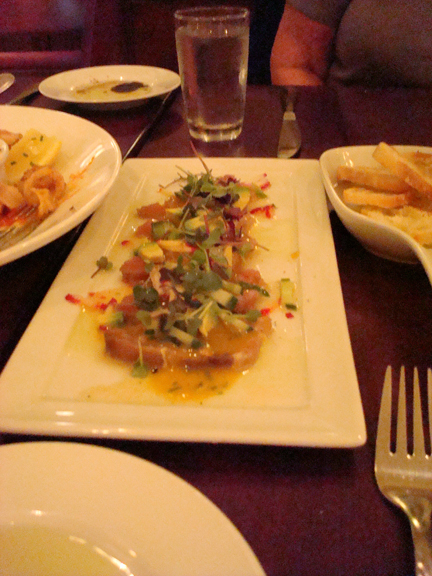
Above: the smoked Sea of Cortez marlin, thickly sliced, was a show stopper at Restaurante Romesco in Bonita, CA.

The Parzen family traveled southward from La Jolla yesterday evening toward the Mexican border to beautiful Bonita (about 10 minutes from the Otay Mesa border crossing) where we celebrated Judy Parzen’s birthday at Restaurante Romesco, a wonderful, elegant strip-mall restaurant that bills itself as a “Baja Med Bistro.”

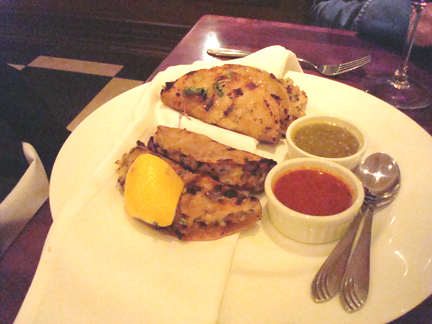
Above: grilled tacos stuffed with shrimp and mozzarella.

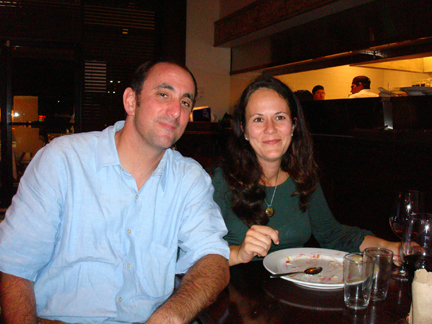
Micah and Marguerite, Tad and Diane, and yours truly raised a glass to celebrate Judy’s birthday (actually the day before, September 22, which happened to fall on Yom Kippur this year). It had been so long since we’d all been together as a family for a holiday and although we’re all sad about how my life has been changing, it was great to be together as a family for the holiday and our mother’s birthday (the last time was four years ago… but things were a lot different then…).

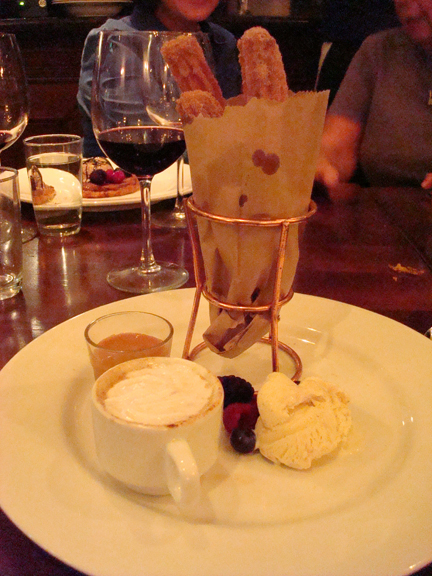
Menu highlights: excellent smoked Sea of Cortez marlin, thickly sliced and drizzled with vinaigrette (made in Ensenada, our waiter, Omar, told me); tacos stuffed with sliced tongue that had been braised in a tomato-chili sauce, very tasty; grilled tacos stuffed with shrimp and mozzarella (I didn’t think I’d like the combination of seafood and plastic cheese, partly, I must admit, because the dairy-seafood combination is a taboo in some parts of Europe, but this taco was fantastic); and piping hot churros, just firm on the outside, their dough creamy on the inside, rolled in cinnamon sugar.

Above: the dough inside the churros was creamy and the dish came with a demitasse of Mexican hot chocolate and a caramel dipping sauce.

The wine list is nothing to write home about. We drank a very forgettable Albariño and commercial and regrettably barriqued Tempranillo, both from Spain. But the cellar at Romesco also features some Baja California wines and when the waiter told me that his favorite was a Nebbiolo, I had to try it.

The 2002 Nebbiolo by winery L.A. Cetto is proudly aged “14 meses en barrica de roble francés” according to the website (14 months in French oak barriques). For those who know me and read my blog, you know that I’d rather drink mayonnaise soda* than barriqued (oaked) Nebbiolo. The wine was concentrated and alcoholic and didn’t taste anything like Nebbiolo. Only a handful of Californian winemakers have grown Nebbiolo (mostly in Central Coast) and I was truly surprised to see that someone was doing it in Baja California. I can’t say I liked the wine but was impressed by its novelty. I wonder how it would have shown if it hadn’t been barriqued. One of the unique things about Italy and its wines is that while international grapes (Cabernet Sauvignon, Cabernet Franc, and Merlot in particular) have been cultivated and vinified in Italy with great success, native Italian grape varieties have yielded disastrously disappointing results abroad. You can take the grape out of Italy but you can’t take Italy out of the grape… I guess.

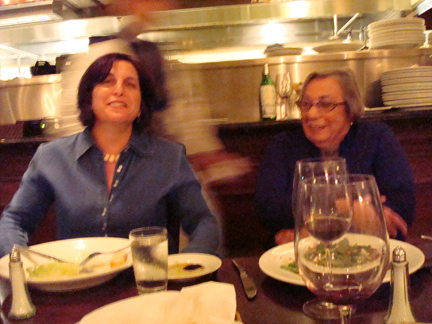
Above: my sister-in-law Diane, left, and Judy share a laugh.

But I believe in drinking wines appropriate to the occasion and the place, and, ideally, wines made by and for the people who prepare your food. It was exciting to drink “locally” and to discover what Baja winemakers are doing. Our waiter, Omar, whose wine service was very good, was proud of this bottle and I was proud to taste it at this excellent restaurant.

Above: brother Micah and my sister-in-law Marguerite.

And… you know… to quote a phrase, sometimes it’s not the wine you drink but whom you drink it with and where that matters.

You may have known that all the time, but I’m learning it these days.**

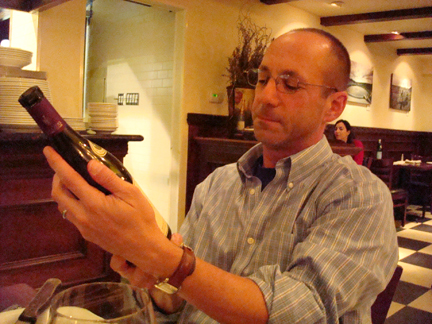
Above: brother Tad contemplates Mexican Nebbiolo.

*Life’s like a mayonnaise soda
And life’s like space without room
And life’s like bacon and ice cream
That’s what life’s like without you

— Lou Reed

**Love is so simple
To quote a phrase
You’ve known it all the time
I’m learnin’ it these days.

— Bob Dylan

No Place Like Home

After all the recent (and drastic) changes in my life, I didn’t have anywhere to attend High Holy Day services in NYC and so I decided to come home, where I spent Yom Kippur with my brother Tad, his wife Diane, their kids, and my mom Judy at Temple Beth El in La Jolla, where I had my Bar Mitzvah some twenty-seven years ago (when this now thriving congregation worshipped in the living room of a house on La Jolla Scenic Dr.).

The services were good, my fast was easy, and it was great to be with my immediate family (hadn’t spent the holidays with them in way too many a moon). Rabbi Graubart, who plays a pretty mean Havdalah service on 6-string (Yom Kippur fell on the Sabbath this year), gave a good sermon on forgiveness (citing the story of Joseph and his brothers), something the world — and my life — is in need of (both to give and to receive). We broke the fast at Tad and Diane’s, where, after dinner, I played guitar with my nephew Cole, who’s getting really really good.

view_bahia.jpg

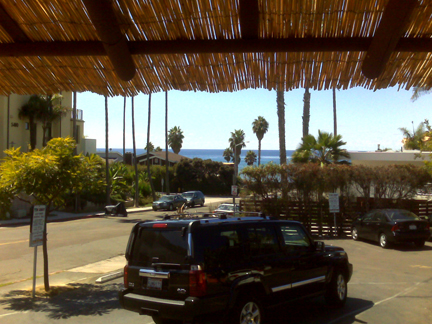
Above: the view from Bahia where I grinded down on a Carne Asada Burrito with Guacamole and drank a beer with my bro Micah.

Today (Sunday), I went to one of my all-time favorite taco stands, Bahia Don Bravo on La Jolla Blvd., with my brother Micah, who, like brother Tad, is a super successful lawyer based in San Diego (he also has a Ph.D. in anthropology from Case Western).

I found this crazy site called Burritophile that lists the address and phone number etc. And I thought that I had too much time on my hands!

The weather is beautiful today (we’re about to go down to the La Jolla Cove and jump in the water) and we sat outside where we both ate Carne Asada Burritos with Guacamole and drank a Negra Modelo.

The burrito’s chopped onions, cilantro, tomatoes, and guacamole were fresh and the beef tasty. And, man, that beer tasted good as we gazed out at the water (which was looking particularly beautiful today, with different layers of blues and greens).

Life sure has been crazy lately and it’s been a really, really hard time for me. It’s good to know that some of the good things in life don’t change… like a Carne Asada Burrito and a beer on La Jolla Blvd. a few blocks from my old elementary school, Bird Rock Elementary.

“The Big Test for High[ly] Alc[oholic] Wines”

A few days ago, my older brother, Tad Parzen (a top-knotch lawyer who owns and runs a governmental/educational/legal consulting firm in San Diego, CA, and who has worked with a number of the state’s biggest school districts), introduced me — via email — to the wine program manager at Jonathan’s, a gourmet grocery and wine store in La Jolla where we grew up (and where Tad, his family, and my mother still live).

Since I had just read the recent article on Darrell Corti and “Zingate” in The San Francisco Chronicle, I sent him the link and asked for his perspective. Here’s what he wrote back:

“Hey Jeremy, The Corti Bros. are definitely stirring the proverbial wine pot out here, but the high alc wines just keep coming. I’m a fan of both old world rustic elegance and new world lush, lip smacking wines. The big test for quality high alc wines is their ability to maintain appropriate amounts of acidity and minerality. [italics mine] Obviously, balance is the key. When people ask me why domestic wines have more fruit and alcohol than the old world versions, my cliche’d response goes something like: when did you start drinking coca-cola and when they tell me, I generally say that is when europeans had their first glass of wine. Speaking of trends, for every 1 bottle of old world wine purchased at the store, at least six domestic bottles are purchased. Definitely stop by the shop next time you’re out here…

Happy drinkin,
Patrick”

I like his analogy about Coca Cola: Americans (and Californians in particular) want their wine to taste like soda pop and not like wine… and I guess there’s nothing wrong with that. In fact, as Patrick points out, “for every 1 bottle of old world wine purchased at the store, at least six domestic bottles are purchased.”

But I am disconcerted by the notion that a highly alcoholic wine can be balanced. With today’s technology (whereby fermentation is accelerated and whereby the water and alcohol in wine are separated — through “reverse osmosis” — and then blended back together), it’s easy to make wine with high alcohol content.

Minerality and good acidity come from nature, from the fruit and the land, and can only be achieved naturally (although many Californian winemakers, even high-end wineries, actually acidify their wines by adding acid! Why do you think that so many people complain of headaches after drinking fancy Californian wine?).

In fact, the highly alcoholic wines of California are by their nature imbalanced and don’t taste like wine. They smell like alcohol and they taste like “tobacco”, “chocolate”, “boysenberry pie”… To me they taste like cough syrup.

Californian wines can tend to have higher alcohol content in part because of the California wine country’s warm climate. But it is the Californian winemaking style — and not nature — that creates “new world lush, lip smacking wines,” wines that — in my opinion — have no business be served at a meal because they lack the balance that makes wine an organic element in the human diet.

Time for me to get off my soap box? Yes, indeed. There’s nothing inherently wrong with liking Californian and California-style wines and Patrick is right to sell and serve his customers wines that they like. De gustibus non est disputandum.

In all fairness, I have tasted many Californian wines that I like, notably older Cabernet Sauvignon from producers like Stag’s Leap Wine Cellars and Corison and others (Keens, my favorite steakhouse in Manhattan, has a wonderful vertical of Corison going back to the early 1990s). And Darrell Corti has introduced me to some excellent Sonoma Coast Syrahs.

It is a pity, nonetheless, that generations of wine lovers will not know the truly mineral flavors of a great Chablis or the tar and manure aromas of an earthy Barbaresco. But, then again, maybe I’m crazy to want my wines to taste like rocks and shit.

Zingate? A Voice of Reason in a World Gone Mad

A few years ago, on a memorable sojourn at the Castello di Brolio in Chianti Classico, the Baron Bettino Ricasoli (great-great-great grandson of the “Iron Baron” Bettino Ricasoli, who reshaped the landscape of Tuscan viticulture in the late 19th century) urged me to visit Darrell Corti in Sacramento, telling me that he was perhaps the most erudite and refined collector of Italian wine that he had ever met. The following year, when I went to make a recording at The Hangar in Sacramento (a great studio), I drove to the other side of town to Corti Brothers, the wonderful gourmet food and wine store co-owned by Darrel. When I introduced myself, Darrell produced a copy of my Maestro Martino translation (UC Press, 2005), which he sells in his store, and asked me to sign it.

darrel.jpg

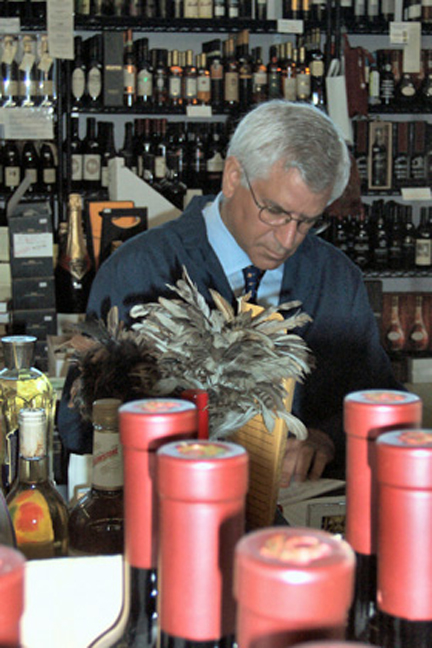
Above: the erudite Darrell Corti in the wine section of Corti Brothers.

Since that time, I have seen Darrell in Sacramento and New York on a number of occasions. His knowledge of wine (and Italian wine in particular), his erudition, his mastery of Italian, and his worldliness are a model to which I aspire. Whenever I have had the chance to discuss wine with him, I come away — as if by osmosis and not by reverse osmosis! — enlightened in ways that surprise and enrich me.

And whenever I travel to Sacramento to record, I shop at Corti Brothers every chance I get: Darrell’s selection of olive oil is among the finest I’ve ever seen and the servers in his charcuterie department never mangle the prosciutto by slicing too thickly or thinly.

Darrell has been in the news lately, following an episode that has been dubbed “Zingate.”

Last week Olivia Wu published this story in The San Francisco Chronicle where she reveals that an internal memo on Darrell’s tasting policy was leaked to the press. But the fact of the matter is that Darrell openly tells wine salespersons that he won’t taste with an alcohol content greater than 14%. As Darrell has told me directly, he feels — and I agree wholeheartedly — the California “modern” winemaking style has spun out of control, with wines that have been deconstructed and reconstructed to have excessive alcohol content and flavors that have nothing to do with wine.

I loved this passage from the interview:

“Look at the description of wine today. What’s the first word? Chocolate! Wines are supposed to taste like fruit. It’s like food these days. They used to make something with three ingredients. Now the chef puts in 12 ingredients. And sometimes they cancel each other out. The same is happening to the wines.”

Thank goodness for Darrell Corti, a voice of reason in a wine world truly gone mad.

I also found this article on Zingate and Darrell, worth checking out.