
I’ll be “working the floor,” as we say in the biz, pouring and talking about wine tonight and tomorrow at Sotto in Los Angeles…
Please come by and say hello and I’ll pour you something great!
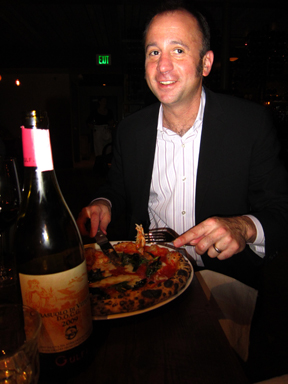

I’ll be “working the floor,” as we say in the biz, pouring and talking about wine tonight and tomorrow at Sotto in Los Angeles…
Please come by and say hello and I’ll pour you something great!
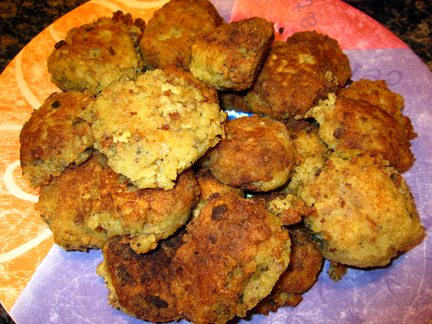
In case yall don’t know what boudin balls are, yall don’t know what you are missing!
Boudin balls are a specialty of Cajun cuisine: you form balls using uncased boudin (pork and rice sausage, commonly found in Louisiana and East Texas where Tracie P grew up) and then you dredge in flour and cornmeal and then you fry.
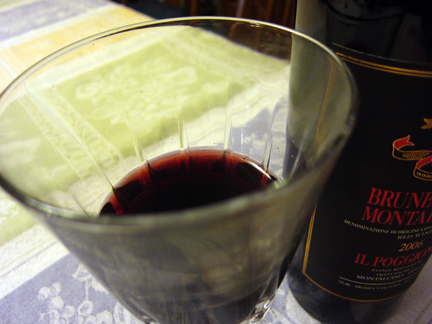
For Easter this year, Pam brought steaming-hot, freshly fried boudin balls over to Mrs. and Rev. B’s house (she lives just a few blocks away). I paired with an 06 Brunello di Montalcino by Il Poggione that I’d been saving for the occasion. I wrote about it over at the Houston Press, the Houston alternative rag, where I am now a regular contributor on wine. Here’s the link. Fun stuff…
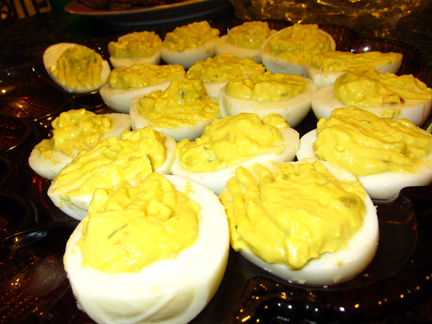
Speaking of Easter, what Easter celebration would it be without memaw B’s deviled eggs?! Man, they’d be worth the drive to from Austin to Orange alone! Love that stuff! Also excellent with the Brunello, where the acidity and tannin the wine cut through the fattiness of the filling like a Bowie knife!
Speaking of balls, I am reminded of something I once heard Ringo Starr say. It was back in 2003 and the French band was asked to open for Ringo at the now defunct Bottom Line in the Village. (You can imagine how thrilled I was to get to do this! It was an amazing experience. Nora Jones — at the height of her fame — also appeared with Ringo that night. Incredible!)
After sound check, Ringo was totally cool and signed autographs for all the folks who managed to make it in through the extremely tight-security (I got to be there because we sound checked after Ringo’s band). At one point, this dude brought him a baseball and asked him to sign it. To which Ringo said, “I’ll sign just about anything, but I don’t sign balls.”
So, there you go…
The inimitable Francesco De Franco (above) first appeared on my blog when I wrote about his use of social media to battle the evil forces of the globalization and industrialization of his appellation, Cirò in Calabria. Even though I’ve never met Francesco, I know we’re going to become friends: anyone who writes “I am trying to avoid that a wine unique and inimitable becoming a wine without soul” is a friend of mine!
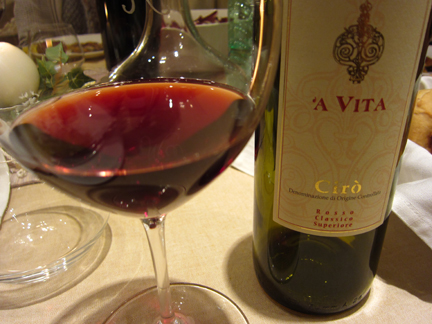
I finally got to taste his wine in February in Italy when my good friend Riccardo (one of Francesco’s distributors in Italy) gave me a bottle. (We shared it over dinner in Quarto d’Altino with Tracie P’s high school friend from her Singapore days.)
Man, I was BLOWN away by how good this wine was… It entirely changed my view and impression of what Gaglioppo can be. While most producers are spoofing their Gaglioppo to be richer in body and color (à la californienne), Francesco lets the real, honest fruit shine through in this gorgeous wine… The best news is that Francesco’s wines should be hitting North American shores in the fall. I CANNOT WAIT to put this on the list at Sotto!
I wrote to Francesco, asking him to send me audio/video of his pronunciation of Gaglioppo (another tough one for Anglophones because of the palatal lateral approximant gli, as in Aglianico).
I’m not sure that Francesco is destined to be remembered as Italy’s 21-century Chopin, but I LOVE what he did for the video… and I can’t recommend his wine highly enough to you…
People are going to wonder why I continue to write about wines imported by Louis/Dressner. In the light of Mr. Joe Dressner’s myriad waspish attacks, I’ll probably regret writing about the below wine. My blog is about our life and the wines and foods and poems and songs and films and joys and challenges that we embrace and face every day and I just couldn’t omit this wine. As the ex-Wine Digger once pointed out to me (and he was right), wines are an expression of the places where they are made and the people who make them — not the tertiaries who import them. And I certainly hold nothing against Mr. Dressner and only wish him a speedy recovery.
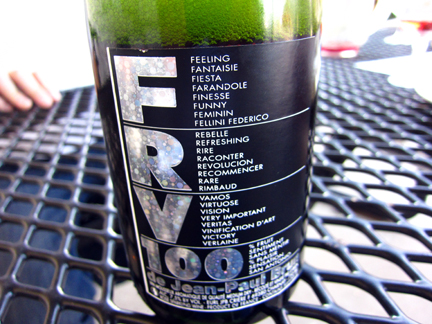
What a thrill to get to taste (FINALLY) the FRV100 by Jean-Paul Brun! The name of this gently sparkling 100% Gamay from Beaujolais is a rebus (as they say at the counter at Brooks Brothers in Manahattan, there are those among us who know Latin and those who don’t): FRV100 for eff-er-ves-cent, effervescent or sparkling in this context.
I loved everything about this wine: the low alcohol (around 7.5%), the gentle fizziness, the wonderful WONDERFUL fruit on the nose and in the mouth, and the playful, bright packaging (the winemaker uses the rebus as an acronym for a wonderful plaisir, a prosodic form adored by the early Occitan poets). FRV100 and barbecue? FRV100 and mole from Polvo’s? FRV100 and Tracie P’s nachos? HELL YEAH! I think it’s safe to say that this will be our wine of the summer of 2011.
But inasmuch as I believe that all wines are an expression of epistemological reflection, this bottling is all the more remarkable because — as I read in Mr. Dressner’s glistening marketese — not only does the Pope of Natural Wine like this wine, but so does Mr. Robert Parker, Jr.! The Emperor of Wine has called Brun’s wines “beautiful” and ranked the winery as a four-star affair, according to the Pope’s site. Felicitously unbelievable!

I loved the wine so much that I’ve paired it with a screening of Fellini’s 1957 Le notti di Cabiria (Nights of Cabiria) on May 18 at the Alamo Drafthouse Ritz in Austin, where I’ll be speaking about the film and the pairings (btw, the paperback version of my translation of Brunetta’s narrative guide to The History of Italian Cinema was recently published by Princeton University Press).
Why did I pair it with Fellini’s transitional classic (one of my favorite movies of his, btw)? You’ll just have to come to the screening on May 18 to find out!
@JoeDressner and @RobertMParkerJr: I’ll be happy to comp either or both of you if you’d like to attend!
at tomorrow’s Tuscan wine party in Austin…
There are still a few spots open… Should be a fun event… Click here for details…
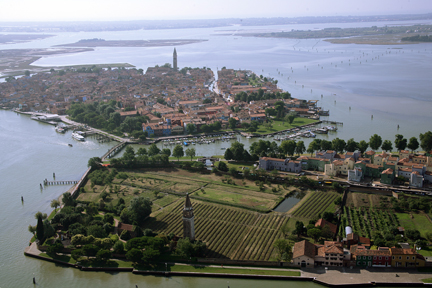
Above: The Bisol family is growing Dorona, a clone of Garganega, on the island of Mazzorbo, adjacent to the island of Burano in the Venetian lagoon.
When Matteo Bisol passed through Austin the other day (and graciously posed and uttered grape and appellation names for my camera), he brought news of his family’s newest project: Venissa a cloistered vineyard and high-concept restaurant and agriturismo on the island of Mazzorbo in the Venetian lagoon (above).
For a few years now, the family has been growing Dorona, a clone of Garganega, a grape traditionally and historically cultivated in the Venetian lagoon for the production of urban — and in this case, lagoonal — wine (if you’re wondering how to pronounce the ampelonym Garganega, btw, you’ll find the pronunciation here).

Above: I wrote to Matteo’s publicist, who was kind enough to share this photo of Dorona. The ampelonym probably refers to the golden color of the berries.
Being a consummate Venetophile, I am entirely geeked to taste the wine (which will be released for the first time next year) but in the meantime I would like to make a clarification regarding the name of the estate and the project, Venissa.
Venissa is not an ancient name of Venice or the Venetian lagoon, as many complacent readers of press releases have erroneously claimed.
In fact, Venissa is an erudite paronomasia from one of the greatest works of dialectal poetry by one of the greatest poets of our lifetime, Andrea Zanzotto (from Pieve di Soligo, one of my favorite places on earth).
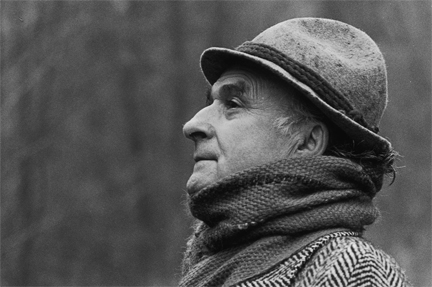
Above: The Veneto poet Andrea Zanzotto. Photo via Engeler.
It’s actually the name of a mythical figure from antiquity, a fictional daughter of the Roman emperor Claudius.
The name appears in Zanotto’s poem in Veneto dialect, “Filò,” composed for Fellini’s 1976 Casanova.
It is the second name in the triad aàh Venezia aàh Venissa aàh Venùsia, where Venice (Venezia) is likened to a temptress or evil woman:
ah Venice ah Venissa ah Venùsia
Venùsia is the ancient name of modern-day Venosa, a city supposedly so-called because it was dedicated to Venus by its founder Diomedes.
(Here’s a link to a preview of the excellent translation of Filò, where the lines appear in the Veneto, Italian, and English. And here’s a link to some background on this work and its significance in the canon of dialectal poetry.)
With these lines, the poet partly alludes to Venice’s place in history as Western Civilization’s capital of prostitution.
I could go on and on (aàh Venissa, if only my professional life were devoted to poetry instead of wine!). But I’ll close this post and clarification with a wonderful passage that I found in a nineteenth century dictionary of Veneto dialect, in the entry for the word filò, which denotes an all-night gathering of women who stitch and sew as they gossip.
These are things [only suited] to be told at a sewing vigil!
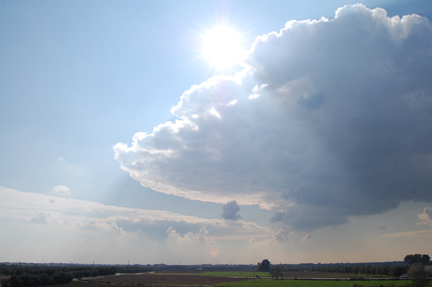
Above: The Salento peninsula is “big sky” country. I was thrilled to visit for the first time in February of this year. And I’m looking forward to going back in June. You don’t need to be a great photographer to capture beauty there. You just point and shoot.
My relation to Southern Italian wine stretches back to the late 1990s when I began working as a magazine editor in New York and you could often find me at the bar at the Enoteca I Trulli in Manhattan, chatting with Italian wine industry veteran and my good friend Charles Scicolone (who then ran one of the most popular wine programs in the U.S., with a focus on Southern Italy). I was thirty years old then and Charles became one of my Italian wine mentors.
This year, as it turns out, is my year in Southern Italian wine: I’ve authored an exclusively Southern Italian wine list for my friends at Sotto in Los Angeles, next month I’ll be leading seminars on Southern Italian wine at the Atlanta Food and Wine festival, and in June, I’m heading back to Apulia where I’ll be a member of the jury for the Radici Wines festival.
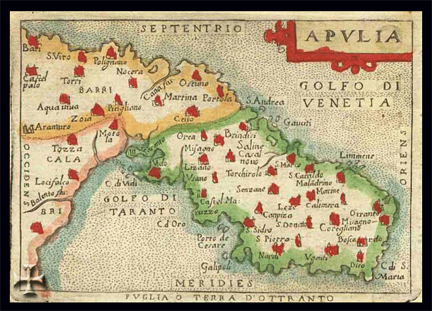
Above: I found this Renaissance-era map of Apulia on a somewhat scary but interesting website devoted to the Knights Templar.
Here on the blog, By the Tun asked me the other day about the origins of the toponym Apulia or Appulia, the name that the Romans used for this region (and the name that gives us the modern-day Puglia).
Many online sources report the erroneous and folkloric etymology a pluvia, which ostensibly means without or lacking rain. There are so many reasons why this etymon is improbable. I won’t bore you with the fine linguistic print but the thesis quickly falls apart when you note that a in this instance is used in a Greek context (a privative prefix, meaning without, as in apathy, without feeling) while pluvia (rain) is Latin. The other reason is that Apulia doesn’t lack rain. In fact, it is the unique combination of plentiful sunlight and precipitation that makes the Apulian peninsula ideal for farming (a fact not lost on the ancients, btw).
Others would have that Apulia and the ancient apuli (the ethnonym used for the region’s inhabitants) comes from ancient king Epulon (Aepulon or Apulo in Italian), an Illyrian ruler of Histria. But this etymology, as most serious scholars note, is equally unlikely.
According to my trusty UTET Dictionary of Toponymy, the name comes from the Greek Iapudes or Iapigi, a toponym or ethnonym that denoted a place or people on the other side of the Adriatic. The ethnonym Apuli appears before the toponym Apulia in ancient Latin and it’s likely that the name comes from pre-Roman settlers of the region.
The meaning of Iapudes is unknown… another beautiful mystery of this mysteriously beautiful place…
Thanks for reading and buon weekend!
This week is going to be “Apulia” (“Puglia”)* week here on the blog: after Tracie P and I traveled to the Veneto and to Friuli in February, I headed — for the first time — to Apulia where I spent a few days with my friend and client winemaker Paolo Cantele. That’s Paolo’s voice above, speaking the grape name Negroamaro.
When Paolo and I met for the first time nearly two years ago (when we first became friends), we had a long discussion on the etymology of the ampelonym Negroamaro, which Paolo and I believe means black black and not black bitter as subscribers to the grape name’s folkloric etymology often report. Here’s the post on Paolo’s thought and my treatment of the grape name’s etymon.
When I met with Paolo in February, it occurred to me that one of the most commonly mispronounced Italian appellation names is Salice Salentino: SAH-lee-cheh SAH-lehn-TEE-noh. I asked Paolo to pronounce it properly for my camera and hence was born the “Italian Appellation Pronunciation Project.” Note that Salice is pronounced with the stress on the first syllable of the word. (BTW, I’ve composed an overview of the origins of the toponym Salice Salentino here, for Paolo’s blog.)
Even though I’ve studied the grapes and wines of Apulia (and I even worked for 3 years as the media director for an Apulian restaurant in NYC, I Trulli), I’d never traveled to the region until recently. The thing that impressed me the most was the ubiquity of olive trees. I’ll have a lot more to say about olive groves and the wonders of Apulia this week (“Apulia Week” at Do Bianchi!). But in the meantime, you’ll note that in the videos above, the olive groves are endless as Paolo and I drive from Lecce along the highway to the airport in Brindisi…
* Even though editorial convention in the U.S. has popularized the usage of Puglia, the proper English toponym for the geographical district that forms the “heel of Italy’s boot” is Apulia (from the classical Latin Apulia or Appulia).
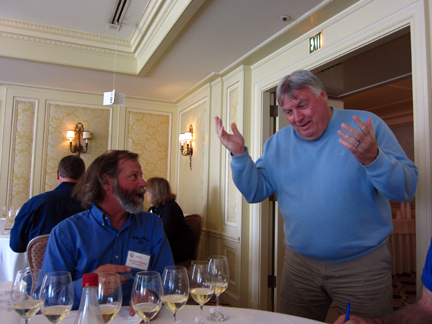
Above: Organizer of the San Diego International Wine Competition Robert Whitley (right) is a “larger than life” kinda guy. The best part of the event was his telling the story of almost getting his lights punched out by Joe Namath in 1969 at Broadway Joe’s NYC bar Bachelor III in 1969. Duncan Williams (left) is the senior winemaker at Fallbrook Winery in northeastern San Diego. He makes an awesome Sangiovese Rosé (no kidding, I tasted it with him a few years ago), writes a column for the San Diego Union-Tribune, and I was stoked to be on the same panel as he.
What does a guy like me feel like at the San Diego International Wine Competition? Like an Italian werewolf.
As flattered as I was to be asked to sit as a judge and as curious as I was to taste such a far-reaching sampling of American wines, I was probably the most unlikely candidate for the job. But I tried to embrace my duties with an open mind and heart: as I judged the wines with my tasting group — Duncan Williams (above) and Ron Rawilson of Ortman Wines (super cool dude) — I tried to evaluate them for the intention of the winemaker and the category for which they were created.
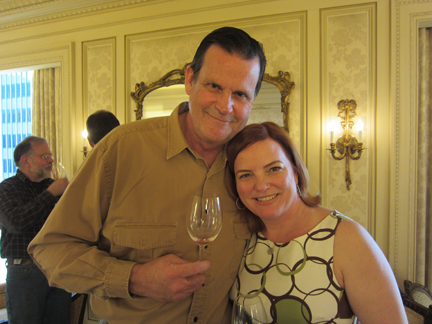
Above: I was psyched to catch up with fellow judges GlobalPatriot (left, author of an awesome geopolitical food and wine blog) and SF publicist extraordinaire Kimberly Charles whom I’ve known since my earliest days of food and wine writing back in NYC more than a decade ago. Nice folks…
Of the 191 Chardonnays submitted to the competition (the largest category), I was faced with the onerous task of tasting 32 of them — all of them barriqued. In the wake of the tasting, I needed a toothpick to extract the oak chips from my tongue.
I regret to report that Chardonnay and Merlot represented the two top categories submitted by the mostly American winemakers. Are we stuck in the 80s? Oops, I forgot to take down the Nagel from my living room.
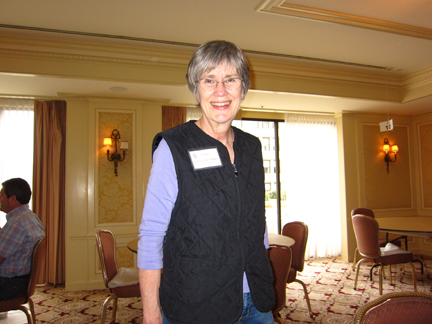
Above: Linda McKee is a winemaker in Pennsylvania and very simpatica lady. It was really cool to hear her talk about Elmer Swenson, a legendary grape breeder who developed hybrids for American viticulture.
The pleasant-surprise wine for me was a Seyval Blanc (yeah, you’ve never heard of it either) grown in New York and vinified in Wisconsin: Prairie Fumé (ha!) from the Wollersheim winery in Prairie du Sac, WI.
The wine, which happened to land in one of our flights, tied for “best in show white.” It was delicious, with bright (clean, not acidified) acidity, good fruit, and balanced alcohol (11%, yes!, according to the fact sheet on the wine). I was thoroughly impressed and I am evermore convinced that hybrid grapes (Blanc du Bois in Texas, for example) are the key to making good, honest wine (that doesn’t need to be “corrected” in the cellar) in our country.
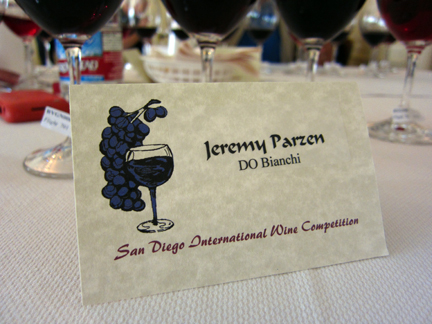
Above: Was it a sort of contrapasso that I had to taste 32 barriqued Chardonnays and 19 barriqued Merlots? And don’t forget the 17%+ Zinfandels. I think I’ve paid my dues at this point!
All in all it was a great experience — if only for the schmooze factor — and I was geeked to finally get to meet and taste with Robert, whose palate and schtick I greatly admire.
The moment that sticks out the most in my mind was when Duncan asked rhetorically, why do winemakers still make Chardonnay like this? It’s really such a neutral grape that doesn’t perform well in this style.
It led me to coin a neologism: ChardonNO!
This week’s episode of the Italian Grape Name Pronunciation Project is devoted to Sangiovese Grosso as spoken by my friend Federico Marconi who was born in Castelnuovo dell’Abate (a subzone of Montalcino) and general manager of the small estate Le Presi (click here for my post on Le Presi and a great photo IMHO of the strata of volcanic soil that define the wines raised in Castelnuovo).
Sangiovese is relatively easy to pronounce for Anglophones. But for the record, it is pronounced here by a bona fide toscano and ilcinese (ilcinese or montalcinese is the ethnonym used to denote an inhabitant of Montalcino).
Also, for the record, please see my post on the Origins of the Grape Name Sangiovese, which most probably does not mean the blood of Jove — a folkloric etymology too often repeated by wine writers who don’t do their homework (I cover all of the current theories of its origins in the post).
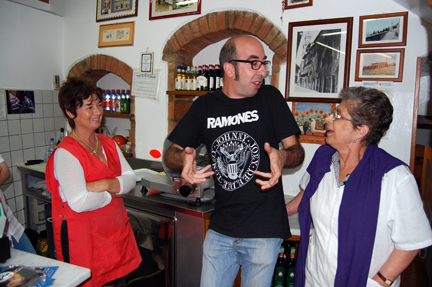
Above: “Due palle così!” My good friend Federico entertained the nice ladies at the famous food shop Nannetti e Bernardini in Pienza (HIGHLY recommended, especially for its legendary porchetta).
Federico is one of the most colorful and lovely people I know in Montalcino and his Ramones t-shirt is his de rigueur uniform (as you can see above). He’s one of those people, to borrow an observation by the great Montalcino winemaker Fabrizio Bindocci, who makes you smile when he walks into the room.
 Do Bianchi