There may be many wine cellars in Valpolicella but…

valpolicella map vineyards crus

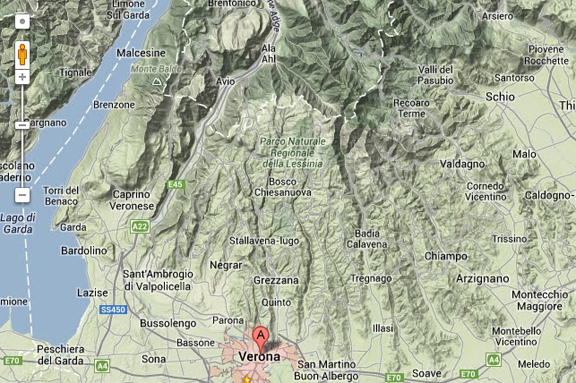
Above: Google’s “terrain” map shows the “wrinkles” of Valpolicella. The topography of the Valpolicella or “valley of alluvial deposits” is defined by a series of small rivers.

From the Greek topos or place and onoma or name, toponymy is the study of place names.

As is the case with many wine-related place names, the names themselves reflect the vine-growing practices of the place. One of my favorites is the Côte-Rôtie or the roasted slope, so-called because the slopes are “roasted” by the sun and there are countless others.

While many erroneously claim that the toponym Valpolicella comes from a hitherto undocumented Greek term for valley of many cellars, it is widely accepted that the name first appeared in the twelfth century (in a decree by Frederic I of Swabia, aka Barbarossa or Red Beard) and by the sixteenth century was widely found in Latin inscriptions as Vallis pulicellae, literally the valley of sand deposits, from the Latin pulla, a term used in classical Latin to denote to dark soil and then later to denote alluvial deposits.

In fact, Valpolicella is not a valley but rather a series of “wrinkles” defined by the Marano, Negrar, Fumane, and Nòvare torrents (streams).

If you’ve ever traveled through that part of Italy, you’ve seen how the hills roll gently across the landscape. There are other Veronese place names that reflect this tradition, like the towns Pol, Pol di Sopra, and Santa Lucia di Pol where pol denotes the presence of a stream or torrent and the pebbly, sandy deposits it forms.

There are some who point to the lass or pulzella portrayed in the device (emblem) of the town of San Pietro in Cariano as the origin of the name. But this theory seems as unlikely to me as the oft-repeated valley of many cellars (another facile faux ami or false cognate).

Valpolicella’s wines were praised highly by Latin authors, notably Virgil and Cassiodorus. Etruscan and proto-Roman winemakers recognized early on that Valpolicella’s undulating landscape was ideal for growing wine grapes.

As Virgil wrote famously, Bacchus amat colles, Bacchus loves hills.

I’m Too Sexy for This Wine

Above: Roman-born Piera Farina makes a line of wines called “Sexy” in Sicily (click the image to read more in Italian).

Does anybody remember the one-hit-wonder Right Said Fred? I’m sure that even Right Said (is that his first name?) wouldn’t be “too sexy” for Barolo… unless it were a Barolo made by a modernist producer like Domenico Clerico, who chimed into the “Barolo is the sexiest wine” debacle a few weeks ago saying, “Of course it’s a sexy wine, because it’s fascinating, just like all things that are hard to attain and conquer.”

Maria Teresa Mascarello, a traditionalist producer (one of my all-time favorites), was a little more even-handed in her comment on the “sexy” that never was: “‘Sexy’ can be an ironic term but I believe that Barolo is more of a intellectual wine. That doesn’t mean it’s any less seductive. I might have used the word ‘intriguing’ [to describe Barolo]. I’d use ‘Sexy’ to define a wine that belongs in a lower category.”

Clerico and Mascarello were quoted in Roberto Fiori’s January 19 article published in La Stampa, “According to Americans, Barolo is the sexiest wine.”

Never mind that Eric Asimov never called Barolo “sexy.”

Here’s my original post on the tidal wave of misunderstanding that followed an Italian news agency’s mistranslation of Eric’s January 16 article on Barolo. (The Agenzia Giornalistica Italiana erroneously claimed that he had called Barolo “the sexiest wine.”)

Italians’ views and attitudes about sex are much more liberal than Americans’ and nudity and sexuality are often incorporated into advertising for food and wine. I find it all the more strange that the “sexy” never written caused such a furor there. Below I’ve collected some “sexy” wine images — Italian in provenance — to put it all into perspective.

Alice e il vino is on of Italy’s most popular wine blogs (click image to read the post).

Even the Gambero Rosso — publisher of Italy’s leading wine guide — isn’t above the fray.

I found these bottlings of Cabernet Sauvignon from Emilia-Romagna on Italian Ebay.

*****

I’m too sexy for this blog…

I’m too sexy for my love too sexy for my love
Love’s going to leave me

I’m too sexy for my shirt too sexy for my shirt
So sexy it hurts
And I’m too sexy for Milan too sexy for Milan
New York and Japan

And I’m too sexy for your party
Too sexy for your party
No way I’m disco dancing

I’m a model you know what I mean
And I do my little turn on the catwalk
Yeah on the catwalk on the catwalk yeah
I do my little turn on the catwalk

I’m too sexy for my car too sexy for my car
Too sexy by far
And I’m too sexy for my hat
Too sexy for my hat what do you think about that

I’m a model you know what I mean
And I do my little turn on the catwalk
Yeah on the catwalk on the catwalk yeah
I shake my little touche on the catwalk

I’m too sexy for my too sexy for my too sexy for my

‘Cos I’m a model you know what I mean
And I do my little turn on the catwalk
Yeah on the catwalk on the catwalk yeah
I shake my little touche on the catwalk

I’m too sexy for my cat too sexy for my cat
Poor pussy poor pussy cat
I’m too sexy for my love too sexy for my love
Love’s going to leave me

And I’m too sexy for this song

— Right Said Fred

Aglianico ≠ Ellenico?

Does the grape name Aglianico come from ellenico or Hellenic as so many claim? A look at the earliest references leads me to believe that it probably doesn’t. May the philologically curious please read on…

Above: the frontespiece of Giambattista della Porta’s Villae or On Country Houses (Frankfurt, 1592) in the rare books collection at the Brooklyn Botanical Garden.

“As philologist, one sees behind the sacred texts,” wrote Friedrich Nietzsche in The Twilight of the Idols.* While most think of Nietzsche as a philosopher, few remember that his early training was in philology, the (inexact) science of the history and development of language and literature, literally the “love” (Greek philo-) of the “word” (Greek logos).

My philological curiosity recently led me to the Brooklyn Botanical Garden where I hoped to get to the bottom of a a etymological conundrum that has bothered me for a long time: does the grape name Aglianico come from the word ellenico or Hellenic as so many oenophiles claim or does it come from Aleatico (literally, a grape that ripens in July, from the Italian lugliatico or of the month of July) as many Italian philologists believe?

The excellent rare-book collection at the BBG includes a rare copy of Villae (On Country Houses, 1592, Frankfurt), an almanac of farming, vine-tending, and winemaking in sixteenth-century Campania by Giambattista della Porta (1535? – 1615), the great Neapolitan scientist, agriculturist, and viticulturist. Most ampelographers agree that Della Porta’s book was earliest to refer to the Aglianico grape as hellanico or Hellenic (ampelography is the study of grapes, from the Greek ampelos or “vine” and graphê or “writing”).

Above: folio 501 and a detail highlighting the line, “Ergo nostras hellanicas helvcolas [sic] antiquorum dicerem.”

The reference is found in the chapter on grape varieties and wines (folio 501): “Ergo nostras hellanicas helvcolas [sic] antiquorum dicerem.” “Therefore, I would say that the helvola [yellowish] grapes of the ancients are our Hellenic grapes.” He is referring to a passage from the Historia Naturalis (14.29) where Pliny (23 – 79) describes grapes that grow in the shadow of Mt. Vesuvius (it’s not clear that Della Porta and Pliny were describing the grape we know today as Aglianico because both of them refer to it as helvola or yellowish in color).

The earliest known occurrences of the word Aglianico in print occur around the same time as Della Porta’s Villae (Andrea Bacci, De naturali historia vinorum, 1596, and Jean Liébault, L’agriculture et maison rustique, 1586 [I’ve been able to verify the mention in Bacci but — to date — I haven’t been able to get my hands on a copy of Liébault]).

There is no question that the Aglianico grape has been called hellenico, hellanico, and ellenico since the sixteenth century. But is there really a reason to believe that Aglianico comes from ellenico (besides the fact that the words sound somewhat similar)?

It is unlikely that Aglianico comes from ellenico because the the terms Hellenic and ellenico were coined around the same time Aglianico first began to emerge as a grape name.

According to the Grande Dizionario della Lingua Italiana (The [Unabridged] Dictionary of the Italian Language, edited by the great twentieth-century philologist Salvatore Battaglia), ellenico and ellenismo were coined in Italian after the French hellénisme, for which the earliest known reference dates to 1580 in France. It is a term derived from Hellenes (a tribe of ancient Greece) and came into use during the Renaissance to denote the Grecian realm and Grecian culture (according to the Oxford English Dictionary, the earliest occurrence in English is 1609). Pliny and his Roman contemporaries wouldn’t have recognized the word hellenicus because it did not exist in their time (they used graecus).

Della Porta did not claim that Aglianico comes from ellenico. He simply speculated that the grape described by Pliny (helvolas antiquorum, the yellowish grapes of the ancients) was called hellanico (hellanicas nostras, our Hellanico grapes) in his day (i.e., as of 1592).

Does Aglianico come from Aleatico and/or lugliatico? Most Italian etymologic dictionaries report that it does (and my research won’t stop here). What’s clear is that Aglianico and ellenico first appeared at roughly the same time and are related historically but probably not etymologically.

Pardon the pun: when I look “behind the text,” I find it’s not all Greek to me.

Above: the Rare Books reading room at the Brooklyn Botanical Garden. In another lifetime, I worked many nights as a guitar player in a wedding band in the Garden’s atrium, a popular NYC wedding venue.

* The Twilight of the Idols/The Anti-Christ, trans. R.J. Hollindale, New York, Penguin, 1990, p. 175.

Guanciale and Barolo in The Times

The Wednesday edition of the The New York Times and its Dining and Wine section is a weekly event for food and wine writers and culinary professionals (New Yorkers and the rest of them west of the Hudson river).

Today’s section caused many of us in the wine world to drool with envy: Eric Asimov published a great story about Barolo and a recent tasting he attended. It was one of those once-in-a-lifetime affairs (unfortunately not yet in my life!). I really like how Eric puts Barolo — a wine so misunderstood by so many — into perspective. Check out his post on the tasting at his blog (essential reading for me). It will surely make your mouth water (and bring tears of envy to your eyes as it did to mine).

Florence Fabricant doesn’t have a blog but she did do a great piece on guanciale in today’s somewhat Italophile edition of the Dining and Wine section. She writes: “Guanciale, which means pillow, a description of its shape, has an especially rich, sweetly porky flavor and a buttery texture.” It’s true that guanciale means “pillow” but in another context — that of medieval and Renassiance-era armor — it denotes the cheek pieces that were often attached to helmets (see illustration above, upper left-hand corner). It’s derived from the Italian guancia, which means “cheek” (from the old German, wanga or wanka, akin to the old English wang).

The suffix -ale is very common in Italian (as in nazione, nazionale), hence, guanciale from guancia.

Guanciale — the cured pork — is made from cured pig jowl (the part that runs from the head to the shoulder). So, it’s more likely that guanciale, when used in a gastronomic context, is more akin to “cheek” than it is to “pillow.”

I was so green with envy after reading Eric’s blog that I just had to point that out…

In other news…

I was really glad to see that a Sex Workers Outreach Program linked to my post on Sugo alla puttanesca: “Prostitutes are not responsible for the naming of an Italian dish” (scroll down the page).

The origins of Sugo alla puttanesca?

puttanesca9bAbove: spaghetti alla puttanesca. There’s one thing we can all agree on: “sugo alla puttanesca” (literally “whoreish sauce”) is made with tomatoes, olives, capers, salt-cured anchovies, garlic, and chili flakes (give or take an ingredient or two). There’s no questioning that it tastes good.

In the wake of my post-new-year’s eve post “Taittinger alla puttanesca”, fellow bloger Marco wrote me, collegially questioning my belief that “sugo alla puttanesca” should not be attributed to prostitutes or their culinary preferences. I promised Marco that I would do some more research and another post. Here’s what I found:

1) the earliest text to reference pasta “alla puttanesca” cited by the Grande dizionario della lingua italiana (edited by Salvatore Battaglia) is Raffaele La Capria’s 1961 novel Ferito a morte (translated as The Mortal Wound, 1962).

2) according to a study commissioned by the Unione Industriali Pastai Italiani (Italian Pasta-Makers Union), pasta “alla puttanesca” first became popular in Italy during the 1960s.

3) a search in The New York Times electronic archive revealed that the first mention of “puttanesca” sauce in the paper was made on January 28, 1972 by restaurant reviewer Jean Hewitt in her review of Trattoria da Alfredo (then located at 90 Bank street): “spaghetti Puttanesca [sic], which has a tantalizing tomato, garlic, anchovy and black olive sauce.”

4) in her landmark tome on Neapoitan cuisine, La cucina napoletana (1977), Jeanne Carola Francesconi attributes the creation of sugo alla puttanesca to Ischian painter Eduardo Maria Colucci (1900-1975) who — according to Francesconi — concocted “vermicelli alla puttanesca” as an adaptation of alla marinara or “seaside-style” sauce.

But the definitive albeit anecdotal answer to this conundrum may lie in an article published by Annarita Cuomo in the Ischia daily, Il golfo, in February, 2005: “Il sugo ‘alla puttanesca’ nacque per caso ad Ischia, dall’estro culinario di Sandro Petti,” “Puttanesca sauce was born by accident in Ischia, the child of Sandro Petti’s culinary flair.”

According to Cuomo, sugo alla puttanesca was invented in the 1950s by Ischian jet-setter Sandro Petti, co-owner of Ischia’s famed restaurant and nightspot, the “Rancio Fellone.”* When asked by his friends to cook for them one evening, Petti found his pantry bare. When he told his friends that he had nothing to cook for them, they responded by saying “just make us a ‘puttanata qualsiasi,'” in other words, “just make us whatever crap” you have (see my original post for a definition of the Italian puttanata).

“All I had was four tomatoes, a couple of capers, and some olives,” Petti told Cuomo. “So I used them to make the sauce for the spaghetti.” Petti then decided to include the dish on the menu at the Rancio Fellone but “spaghetti alla puttanata didn’t sound right. So I called it [spaghetti] alla puttanesca.”**

Petti’s anecdote is probably tenable but is by no means exhaustive (from a philological point of view). To make matters worse, Colucci was Petti’s uncle and it’s unclear why Francesconi attributes the dish to the painter. But philology is an inexact science: the origin of sugo alla puttanesca probably lies some where between the isle of Ischia and the Amalfitan coast, where tomatoes, capers, olives, anchovies, and garlic are ingredients of choice. It’s clear that the dish emerged sometime after World War II when tomato-based sauces grew in popularity among the Italian middle class. My philological sensibility leads me to favor the “puttanata/puttanesca” theory over any other and there is no evidence — at least that I can find — that points to prostitution as the origin of the dish.***

There’s one thing we can all agree on: sugo alla puttanesca tastes good.

* A rancio fellone is a sea spider or spiny crab, a common ingredient in Mediterranean cuisine.

** Like the French à la, the Italian expression “alla” (the preposition a + the definite article la) denotes “in the style of” or “after the fashion of” and is always followed by an adjective (not a noun); alla puttanesca sounded better to Petti because puttanesca is an adjective (while puttanata is a noun).

*** In his Naples at Table (1998), the otherwise venerable but hardly philologically minded Arthur Schwartz reports a number of apocryphal etymologies whereby Neapolitan prostitutes are indicated — in one way or another — as the originators of this dish. He even goes as far as to write that a seemingly celebrated nineteenth-century courtesan, Yvette “La Francese” (Yvette the French [prostitute]), a native of Provence, may have created the dish to assuage her homesickness. The fact that the dish emerged during the 1950s would seem to dispel any romantic notions of pasta alla puttanesca in nineteenth-century Neapolitan bordellos. Brothels were outlawed in Italy in 1958.

One more from the road: posoles…

I promise this is the last installment of my Mexican culinary adventures.

Above: a bowl of posoles, a traditional Mexican soup, made with pork and hominy, topped with shredded lettuce, sliced radish, and a small dollop of homemade salsa, and garnished with a crispy tortilla.

Monday evening was family dinner at Micah and Marguerite’s (my brother and sister-in-law’s place) where we enjoyed a piping-hot bowl of posoles prepared by their friend Lucia. I was stuffed after the first serving but couldn’t resist a second helping. From the Nahuatl pozolli meaning “stew” or maize-based drink, the term posole dates back to eighteenth-century Mexico.

In other news…

I’ve been following this interesting thread at Vinography.com on vigilantism in the e-commerce world of retail wine sales in the U.S. It seems that a certain online retailer has been reporting other smaller retailers for shipping wine over state lines. The minutiae might bore you but the original post provides background on the anachronistic legislation governing interstate wine commerce in the U.S.

I don’t know how long this link will be available (before you have to pay for it) but someone just forwarded me this article on interstate wine sales in The Los Angeles Times. I guess it had to come to a head sooner or later… The sad part is the consumer is the loser here…

In other other news…

I was pleased to find this reference to my blog on Veronelli.com (in Italian). Here’s the original post.

Chardonnay in them there hills…

Above: many private gated, luxury communities in the Temecula, CA wine country have names like “the Vineyards,” “the Harvest,” or “Chardonnay Hills.”

Chardonnay is the name of the prevalent white grape variety grown in Chablis, Côte de Beaune, Côte de Nuits, and the Mâconnais (Burgundy, France). Chardonnay is a toponym, the name of a village near Mâcon (Burgundy, France), where some believe the Chardonnay grape originated (perhaps once called Pinot Chardonnay or Pineau Chardonnay).*

Chardonnay Hills is the name of a luxurious gated community in Temecula, California.

Chardonnay is also a label that many California winemakers use for their oaky, buttery bottlings of 100% Chardonnay, which generally don’t taste anything like naturally vinified, traditional-style Chardonnay.

Above: it should take you about 30 minutes by car to get to Chardonnay from Mâcon (according to Google Maps).

This morning, my mother and I enjoyed a leisurely drive from Palm Springs (where we spent the holiday with family) to San Diego, stopping in Temecula, this time to drive through the wine country (on the way up, we made a quick stop in Old Town Temecula for lunch). The altitude climbs gently as you drive up Rancho California Road from Interstate 15. About a quarter of an hour from the freeway, you find yourself in a small valley lined with vineyards and wineries. I imagine vine growers decided to plant here because of the altitude and the breeze that blows through what is now called the Temecula Valley American Viticultural Area.

Above: some of the private roads in the Temecula wine country are lined with Cypress trees like in Tuscany.

Do not attempt this at home! I snapped this pic of a tumbleweed from the driver’s seat. I imagine that the same breeze blowing the tumbleweed helps to provide ventilation to Temecula vineyards.

* Some believe the toponym originates from the Latin cardus or “thistle” (akin to the English cardoon).

“You’ll have to have them all pulled out…

…after the Savoy Truffle.”

Above: this 26-ounce truffle fetched a whopping $208,000.

George Harrison’s song “Savoy Truffle” has nothing to do with Piedmont truffles. In fact, it was inspired by a box of chocolates:

“Savoy Truffle is a funny one written whilst hanging out with Eric Clapton in the sixties,” wrote Harrison. “At that time he had a lot of cavities in his teeth and needed dental work. He always had a toothache but he ate a lot of chocolates—he couldn’t resist them and once he saw a box he had to eat them all.”

“He was over at my house and I had a box of ‘Good News’ chocolates on the table and wrote the song from the names inside the lid…” (Harrison, George, I, Me, Mine, San Francisco, Chronicle, 2002 [1980], p. 128)

The “Savoy” in the Good News chocolates box probably referred to the famous Savoy Hotel and Restaurant in London, where celebrity chef Auguste Escoffier began cooking in the late nineteenth century. The hotel and restaurant get their name from the Savoy theater, which in turn took its name from the nearby Palace of Savoy, built by Peter Earl of Savoy in the thirteenth century. Since the middle ages, the House of Savoy has been closely linked to Piedmont (where white truffles are hunted) and in the early eighteenth century, nearly all of the region came under control of the House of Savoy. In 1861, Victor Emmanuel II of Savoy became Italy’s first king.

Though George calls the song — based on an affectionate anecdote — “a funny one,” the colorful chocolate-inspired lyrics of “Savoy Truffle” also address the issues of excess and over-indulgence in modern-day society. After all, the singer reminds us, “You’ll have to have them all pulled out after the Savoy Truffle.”

This year’s truffle season in Piedmont hasn’t been great and I’ve heard that many NYC restaurateurs have had to discard their truffles after the tubers arrived in bad shape. I had some white truffles at a Piedmont-themed dinner where I spoke at the end of October. They were pretty good but not phenomenal. Frankly, white truffles never seem to taste the same outside of Piedmont. I wonder how the lucky owners of the above truffle — a group of Hong Kong businessmen — will serve it.

When my friend Steve sent me the link to the story above about the 26-ounce truffle, I thought to myself, “does anyone really need a truffle that big?”

Me? I’d rather keep my teeth.

Above: an early draft of George Harrison’s lyrics for “Savoy Truffle.”

Creme tangerine and Montélimar
A ginger sling with a pineapple heart
A coffee dessert–yes you know it’s good news
But you’ll have to have them all pulled out
After the Savoy truffle.

Cool cherry cream, nice apple tart
I feel your taste all the time we’re apart
Coconut fudge–really blows down those blues
But you’ll have to have them all pulled out
After the Savoy truffle.

You might not feel it now
But when the pain cuts through
You’re gonna know and how
The sweat is going to fill your head
When it becomes too much
You’ll shout aloud.

But you’ll have to have them all pulled out
After the Savoy truffle.

You know that what you eat you are,
But what is sweet now, turns so sour–
We all know Obla-Di-Bla-Da
But can you show me, where you are?

Creme tangerine and Montélimar
A ginger sling with a pineapple heart
A coffee dessert–yes you know its good news
But you’ll have to have them all pulled out
After the Savoy truffle.
Yes, you’ll have to have them all pulled out
After the Savoy truffle.

— “Savoy Truffle,” George Harrison

The Reification and Hierarchization of Wine

With his customary stinging wit, Franco Ziliani — the top Italian wine blogger in my book — posted this insightful and hilarious post on The Wine Spectator “Top 100 Wine Countdown” in which he aptly compared the marketing ploy to a striptease.

I greatly appreciated the analogy because it captures the absurdity inherent in the hyper-commercialization of wine in our country. After all, at the end of the day (literally), wine is something that we put into our bodies. Beyond its inebriating effects (which many of us enjoy), it is a source of nourishment that complements the food we eat (at least for those of us who drink food-friendly wines, i.e., wines with reasonable alcohol content and healthy levels of acidity that stimulate our digestion).

Just as the striptease represents a reification (read dehumanization) of the female body, so The Wine Spectator “top 100” list and “countdown to the wine of the year” represent a hierarchization of wine. This hierocracy reifies wine by telling us that there is one wine superior to all others and by implying that the so-called superior wine is the one that all other wines should aspire to. Such static quantification opposes the very nature of wine: the quality of wine lies in the foods with which we pair it, the ways in which and places where we consume it, and — most importantly — the people who make it and the people with whom we share it. Wine is a dynamic “living” substance. It evolves with time (and changes radically from the very moment a cork is pulled and the liquid begins to oxygenate). The intrinsic value of wine exists not in an abstract hierarchy but rather in the moment that we drink it — whether an under-$15 bottle of young Chinon or a 1990 Bruno Giacosa Red Label Barolo.

Time for me to stop pontificating? Yes and thanks for reading.

In other news, I gave a talk on Italian Renaissance cuisine Monday night at a Beard Foundation event.

Above: a scene from the Beard House. I will always think fondly of James Beard. I never met the man but my mother (an excellent cook) loved his cookbooks and crafted many of her best dishes from his recipes. Her “James Beard” meatloaf is always great. We won’t be eating meatloaf at Thanksgiving this year — my first time back for the holiday in more than six years! But maybe I can talk her into making it on another night while I’m in Southern California next week.

*****

“Will you take me as I am?”

Sitting in a park in Paris, France
Reading the news and it sure looks bad
They won’t give peace a chance
That was just a dream some of us had
Still a lot of lands to see
But I wouldn’t want to stay here
It’s too old and cold and settled in its ways here
Oh, but California
California I’m coming home
I’m going to see the folks I dig
I’ll even kiss a Sunset pig
California I’m coming home

I met a redneck on a Grecian isle
Who did the goat dance very well
He gave me back my smile
But he kept my camera to sell
Oh the rogue, the red red rogue
He cooked good omelettes and stews
And I might have stayed on with him there
But my heart cried out for you, California
Oh California I’m coming home
Oh make me feel good rock’n roll band
I’m your biggest fan
California, I’m coming home

CHORUS:

Oh it gets so lonely
When you’re walking
And the streets are full of strangers
All the news of home you read
Just gives you the blues

So I bought me a ticket
I caught a plane to Spain
Went to a party down a red dirt road
There were lots of pretty people there
Reading Rolling Stone, reading Vogue
They said, “How long can you hang around?”
I said “a week, maybe two,
Just until my skin turns brown
Then I’m going home to California”
California I’m coming home
Oh will you take me as I am
Strung out on another man
California I’m coming home

CHORUS:

Oh it gets so lonely
When you’re walking
And the streets are full of strangers
All the news of home you read
More about the war
And the bloody changes
Oh will you take me as l am?
Will you take me as l am?
Will you?

— “California,” Joni Mitchell

Bretty

Above: Brett or Bretty, depending where you come from.

After reading my post on Massolino, a winemaker friend of mine wrote the following from Italy:

“Bacteria can nest in new barriques. In barriques that have already been used, Brettanomyces — a fungus, not a bacterium — can develop. It gives wine a smell that is often described as leather or ‘horse sweat.’ People call it ‘Bretty’ for short.”

In English it is called “Brett.” I find it interesting that its diminutive is feminine in Italian, while in English it’s masculine.

A quick Google search revealed that Italians tend to consider Brettanomyces masculine, while it’s feminine in French and Spanish.