The news of the Oklahoma tornado weighed heavily on Tracie P and me last night as we made dinner for Georgia P.
Our thoughts and prayers are for our Oklahoma sisters and brothers today…

The news of the Oklahoma tornado weighed heavily on Tracie P and me last night as we made dinner for Georgia P.
Our thoughts and prayers are for our Oklahoma sisters and brothers today…
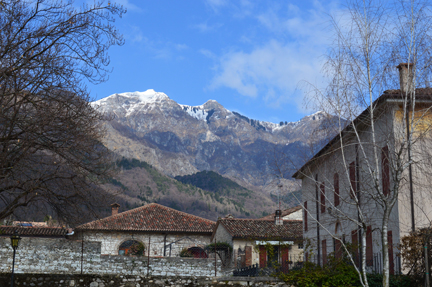
That’s the view, above, that greets us every morning when we leave our apartment at the Villa Marcello Marinelli in Cison di Valmarino (province of Treviso).
In the shadow of such rich natural beauty, I can’t help but be reminded of the following lines from Canzone 128 of Petrarch’s songbook, Italia mia, ben che’l parlar sia indarno a le piaghe mortali (My Italy, although speech does not aid those immortal wounds):
Nature provided well for our safety when she put the shield of the Alps between us and the Teutonic rage; but our blind desire, strong against our own good, has contrived to make this healthy body sick.
(Translation by Robert Durling.)

We’ve been having a great time here at the villa and the band has begun to arrive (we’ll be performing on Friday and Saturday nights).
But my old and very good friend Renato Dal Piva, the villa’s manager, and I have also had some heavy heart-to-heart chats about what it’s like to live and work in Italy these days.
Yesterday, The New York Times reported that “Unemployment in Euro Zone Reaches a Record 12%” (in October 2012, the paper reported that “Unemployment in Euro Zone at Record High” [at 11.4 percent]).
Petrarch’s verses were composed in the mid-fourteenth century. They scan as though they, too, were written yesterday…
HAPPY NEW YEAR, EVERYONE! :)

For lo, the winter is past,
The rain is over and gone.
The flowers appear on the earth;
The time of singing has come,
And the voice of the turtledove
Is heard in our land.
The fig tree puts forth her green figs,
And the vines with the tender grapes
Give a good smell.
Rise up, my love, my fair one,
And come away!
O my dove, in the clefts of the rock,
In the secret places of the cliff,
Let me see your face,
Let me hear your voice;
For your voice is sweet,
And your face is lovely.”
Catch us the foxes,
The little foxes that spoil the vines,
For our vines have tender grapes.
Song of Solomon

We’ll be bringing little Georgia P home today. She’s passed all her tests with flying colors and she and Tracie P are doing great. We loved how the last page of her birth certificate form welcomed our “new little Texan.” :)

I know that every new father thinks that his little girl is the most beautiful of all and I’m no exception. I’ll have two gorgeous girls at home now… I’m the luckiest guy ever…

We are so lucky to have the support of our family: it’s been a joy to have Rev. and Mrs. B here with us and they’re staying at the house all week to help us get settled.

What a joy to watch Rev. B. rocking his new granddaughter! He’s so big and she’s so little! :)
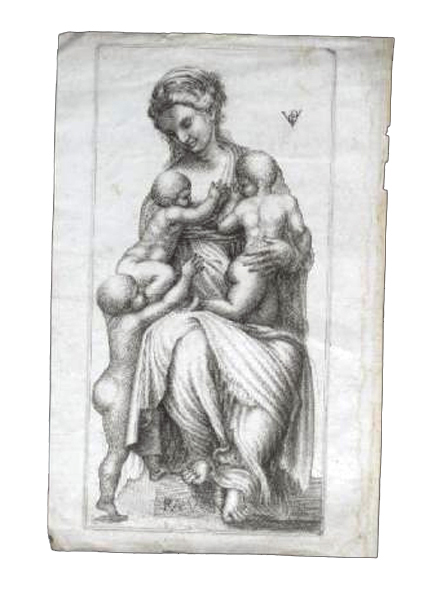
Modesty won’t allow me to reveal a photo of Tracie and Georgia P nursing. But to see Georgia “latching” just minutes after she came into this world was like viewing a living and breathing allegory of maternity. This drawing by Raffaello will have to suffice: words cannot express the emotion we both felt in that precious, precious, unforgettable moment. We’re happy to report that nursing is going great.
The staff at the Seton maternity ward was fantastic. Maybe it’s Texas: everyone was so friendly and sweet and all the nurses shared their own personal experiences. Dr. Abikhaled, our ob/gyn, was awesome. And our anesthesiologist — the only male health care provider in the crew — wore cowboy boots.
And what did we drink to celebrate our joy? As if you have to ask…

Georgia P, Tracie P, and I would like to thank all the folks who commented, tweeted, texted, emailed, and posted on Facebook from the bottom of our hearts. Our lives are so rich right now: full of joy, full of happy tears, full of laughter, brimming with love for a newborn child, overflowing with love for each other… Our virtual community — spanning the Atlantic ocean and the continental U.S.! — means so much to all of us. G-d bless you all…
After services at Rev. B’s church this morning in Orange, Texas, we headed over to Peggy’s on the Bayou where I met George the Gator (above).
Technically, George is “homeless,” one server told me, but he returns every couple of weeks for the French fries and other food that guests offer him. I’m not sure how they know that George is a he but they recognize him by the hole in his snout that never healed after someone shot him there.
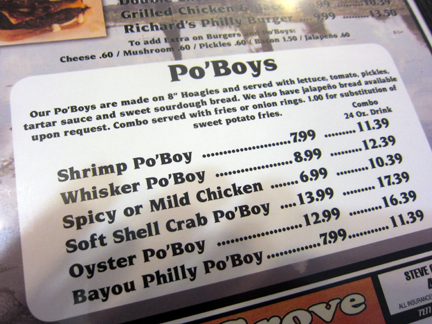
Here in Coonass country, “po’ boy” can be pronounced with the accent on the second syllable: poh-BOY.
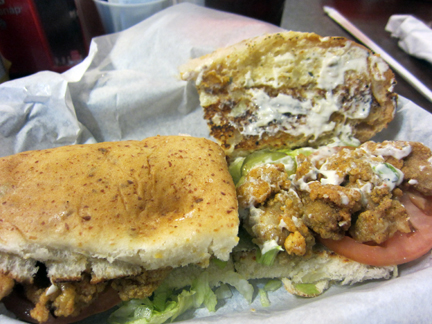
The oyster po’ boy was pretty good.
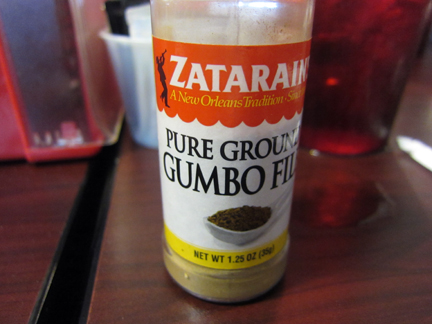
We got there too late for the gumbo (they’d sold it all already)… :(
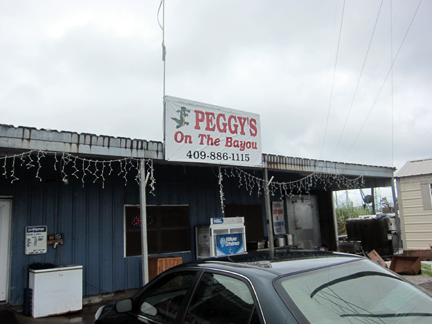
Peggy’s not kidding when she says her place is on the bayou!

In Italian, still life is called natura morta, literally, dead nature, in other words, inanimate nature.

Yesterday, Tracie P and I visited the San Diego home of friends and wine club clients Chrissa and Dan, where we took these photos.

After winning her battle with cancer, the couple decided to devote their lives to homesteading: they grow nearly all the produce that they consume and they slaughter and butcher all the meats that they consume (check out their site and educational program here).
All of the fruits in these photos were grown by them in their garden.

At a time when most of us urbanites place blind faith in the so-called “organic” choices at the specialized super markets, these folks — he a software designer, she an interior designer — have embraced the homesteading approach to self reliance (o that wonderful American ideal!) with a gusto and vibrancy that inspire me.
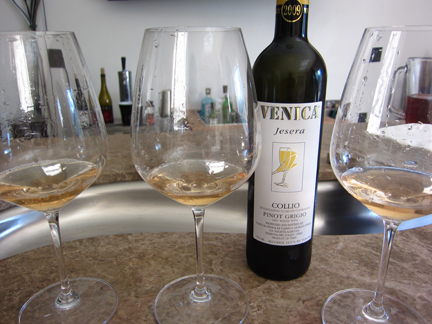
I brought over a bottle of 2009 Pinot Grigio Jesera by my friend Giampaolo Venica. Look at the wonderful ramato (copper) color of this true Pinot Grigio (a red grape, btw). We raised a glass of this delicious salty wine and remembered the grape growers in Collio (Friuli) whose vineyards were devastated over the weekend by a terrible hailstorm.
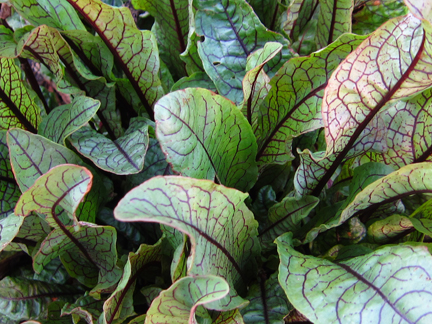
I also took a few shots in the garden — natura viva. I loved the red veined sorrel.

Sage.
Thanks for reading!
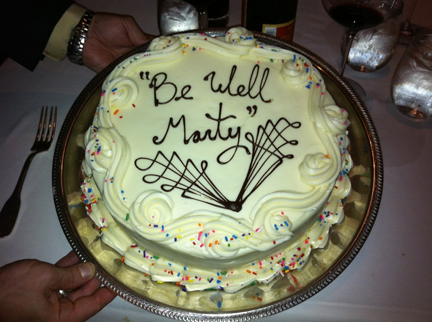
Cousin Marty, whom we love very much, is beginning his cancer treatment today. (Donna Vallone baked him that cake on Saturday, when Marty went to Tony’s for one of his “pre-chemo me” dinners, as he likes to call them.)
In his honor, I’m devoting today’s post to cancer awareness by asking you to check out the “Blue Cure” campaign authored by my colleague and friend Gabe Canales (below).
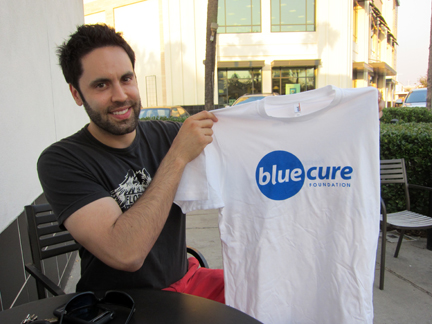
Gabe, one of the top publicists and marketers in the country, was diagnosed with prostate cancer in his mid-thirties and he’s now leading a campaign to raise awareness of the disease among young men. Check out his site here.
Today’s post is also devoted to the victims of the recent tragedy in Japan (I’m currently working on a benefit concert to be held later this month in Austin at Vino Vino — more on that later this week).
@Marty Tracie P and I and the whole family are thinking of you and sending you lots of love today.
Sometimes on the highway of life, there are certain roads you just have to go down…

Driving back from East Texas yesterday, Tracie P and I decided on a whim to find out what lay at the end of Boondocks Road. Yes, Boondocks Road.
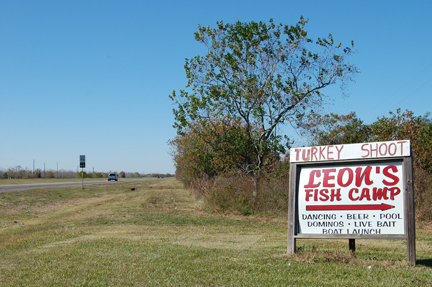
A sign told us about Leon’s Fish Camp. But we knew there had to be more to the story.

What we found was a beautiful bayou and friendly people who waved and smiled at us.

Because of the flooding that hurricane season inevitably brings, the houses are on stilts and many are connected to Boondocks Road by bridges.
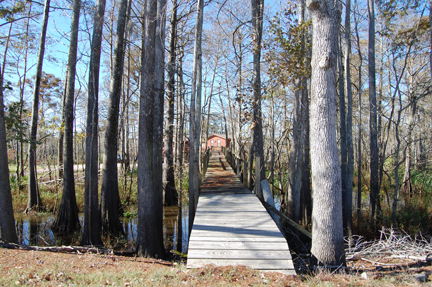
The extreme weather of East Texas will most certainly put the fear of G-d in you.

Of course, everywhere you go in Texas, folks are proud of their state.
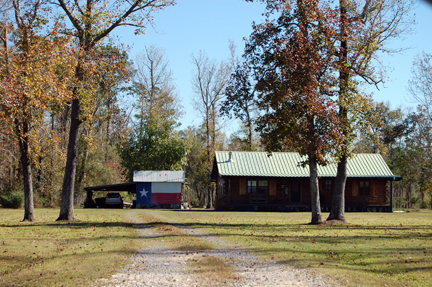
Until recently, as I discovered this morning on the internets, Boondocks Road was called Jap Road. The road had been named to honor early-twentieth century Japanese settlers who had taught their neighbors how to farm rice on the bayou. Today, rice is the predominant agricultural crop of this area. The locals greatly appreciated and recognized Yoshio Mayumi for what he had done for their community. But he and his family were forced to leave between the two world wars when the U.S. government forbade foreigners from owning land in our country (the 1924 Immigration Act; sound familiar?). Jap was not a racial slur at the time and was a commonly accepted abbreviation for Japanese (the historical entries in the Oxford English Dictionary provide hard evidence of this). In 2004, after more than ten years of lobbying, local activists were successful in their campaign to rename the road. The road’s residents chose Boondocks, after a catfish restaurant that had once operated there. (You can find all of this in the Wiki entry, including references to articles in the Christian Science Monitor and on the CNN website.)

Another hour down the highway of life, Tracie P had lox and latkes and I had white fish salad at our favorite Houston deli, Ziggy’s. Cousins Joanne and Marty and Aunt Holly and uncle Terry and cousin Grant joined. The white fish was delicious.
I’m glad they changed the name of Jap Road. But I wish they would have renamed it Mayumi Road, to remember the farm and the people that reshaped the agricultural landscape of East Texas in a more innocent and more earnest time.
But, then again, if it weren’t called Boondocks Road, we probably wouldn’t have felt the irresistible urge to go down it.
BTW, with this post, I’ve added a new category to Do Bianchi: de rebus texanis. Buona domenica ya’ll!

Above: “Anyone who says we can’t feed the world is talking b… s…,” said Glen Boudreaux yesterday. What a great family and what interesting folks! I was fascinated by what he had to say and his take on humane, wholesome farming and “pasture-based” ranching.
There’s so much to tell since the last post… a couple of truly outstanding meals and more than one exceptional bottle of wine. But all that will have to wait.
Yesterday, I had a fascinating conversation with the gentleman above, Glen Boudreaux, who (together with his lovely wife Honi, pronounced honey) has owned and managed a ranch in beautiful Brenham, Texas for more than 20 years — the Jolie Vue Farms. Glen and Honi hosted a farm-to-table dinner last night and I covered the event for one of my clients (one of the underwriters). You can see my post (together with some of my git’ fiddle picking) here.

Above: Mustard greens and blue corn grits, sourced locally and prepared by chef Paul Lewis who came in from Houston for the event.
Glen advocates a no-nonsense approach to farming and is a proponent of humane and wholesome, “pasture-based” ranching. Over the last two decades, he has revived a ranch that had been devastated by cotton farming and left to the weeds. Merely by encouraging and enabling the revival of native grasses, he is literally able to raise twice as many cattle per acre as the Texas department of agriculture believes possible. And he is convinced that his philosophy — if embraced by the world — would allow the global farming community to stamp out hunger. And frankly, when you shake this man’s hand and he looks you in the eye with a warmth and humanity not uncommon in the Texas farmland, you believe him.

Above: More than 200 persons sat down for dinner together at one continuous table last night. The event was organized by artist Jim Denevan and his company Outstanding in the Field.
Among the more fascinating topics of conversation with Glen: the parallels he sees between Jewish dietary law and his approach to ranching and butchering (the butchering, he explains, is as important as the farming and he carefully and “mercilessly” screens his clients, he told me); he loathes anyone who uses the word “natural” or “organic” in their packaging or labeling (see this fantastic post on his blog, What’s it all mean? Natural terminology can be confusing…); his admiration for “sissy” (Joel’s word) and “rebel” (Glen’s word) farmer Joel Salatin (check out this video I found this morning).
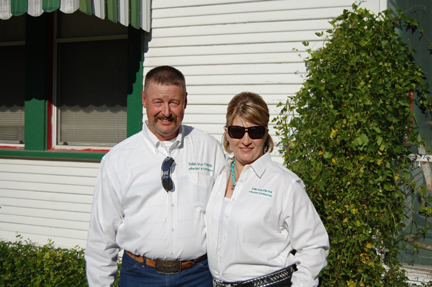
Above: Tracie P and I really loved this couple, Clay and Julia Theeck, who help the Boudreaux family manage their ranch. You wouldn’t think that it’s fascinating to hear someone talk about native grass until you talk to Clay and Julia. Their knowledge of the local plant life is incredible. Clay and Glen haven’t done anything to treat the soil on the Jolie Vue ranch. All they do is help the native grasses flourish.
Glen and Honi sell most of their cattle and pigs to locally based individuals who want to feed their children wholesome food. They also sell to the occasional restaurant, like Cullen’s in Houston, who also underwrote the dinner.
Ultimately, they believe that their livestock should be happy, that happy pigs and cattle make for the healthiest nutrition. Although chef Lewis may have had something to do with the delicious factor yesterday, it was the materia prima that played the starring role.

Above: “Jews may not have believed in the afterlife the way that we do,” said Glen. “But when you read [the dietary laws in] the Old Testament, you can tell that they were doing what they were doing because they knew that it was the right thing to do on earth.”
My life in Texas continues to inspire me on many levels. This state — this Republic! — is home to a wide spectrum of folks, from the love-happy, guitar-strumming, pot-toking hippies of our beloved Austin to the generous-of-spirit, G-d-fearing, gun-toting ranchers of the immensely beautiful plains. Somehow, beyond the stereo- and archetypes, no matter the gulf of difference between them, there seem to be a humanity and a gentleness that pervade their willfully shared ethos.
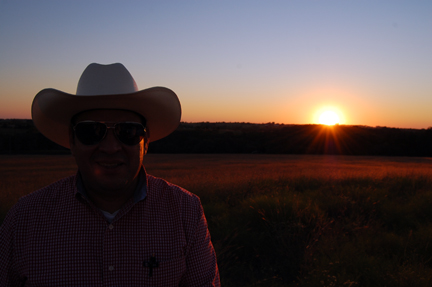
In the words of Gary P. Nunn…
I wanna go home with the armadillo
country music from Amarillo and Abilene
the friendliest people
and the prettiest women you ever seen
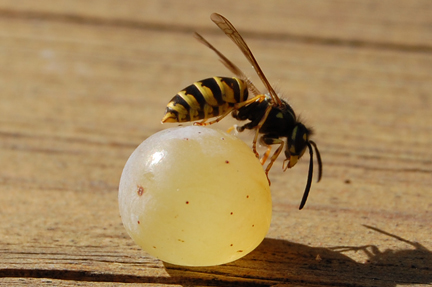
Above: A wasp feasts on newly picked Ribolla at Venica & Venica.
A quick post today, on this autumnal Monday back at my desk in Austin, comprised of photos from my trip, some of the most beautiful things I saw through my lens while in Italy. It was an incredible journey, replete with felicitous confluences, some serendipitous and delightfully unexpected, others grounded in epistemlogic contemplation and convex self-reflection.
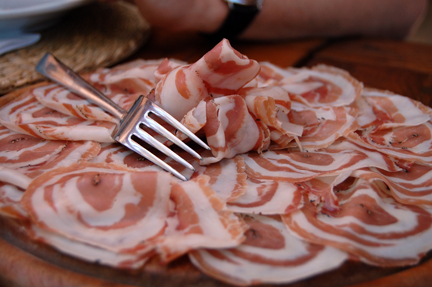
Above: Pancetta offered to weary travelers, also at Venica.
In the days that follow, I’ll begin posting in-depth accounts of my conversations and tastings with winemakers and restaurateurs in Tuscany, the Veneto, and Friuli. I am so grateful for all the comments, emails, Twitter mentions, and Facebook notes encouraging me and sharing insights into what I photographed, smelled, tasted, drank, and masticated over the course of the nearly three-week trip. And I am especially thankful for the incredible hospitality and generosity of spirit of my (literally) myriad hosts and guides.
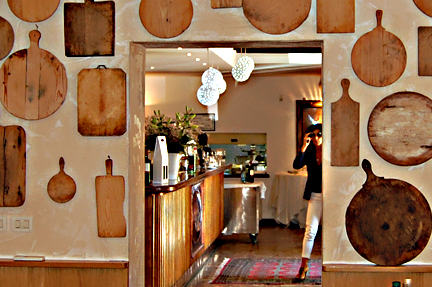
Above: A view from one of the dining rooms at Trattoria al Parco in Buttrio (Udine).
Immense and extreme beauty is offered to the willful traveler of the Italic peninsula: from her generous landscape to her innate and intrinsic humanity (both historical and topical), Italy continues to inspire me (and hopefully you) by revealing some of the mystery and joy of life through her topographic, aesthetic, and sensual pleasures.
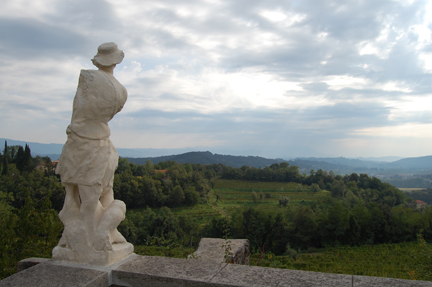
Above: A view from the Abbazia di Rosazzo in the Colli Orientali del Fiuli.
While I thoroughly enjoyed her bountiful intellectual and sensorial gifts, I was however acutely aware of the seemingly insurmountable societal and cultural issues and turmoil faced by the inhabitants (Italian and otherwise) of this profoundly gorgeous land.
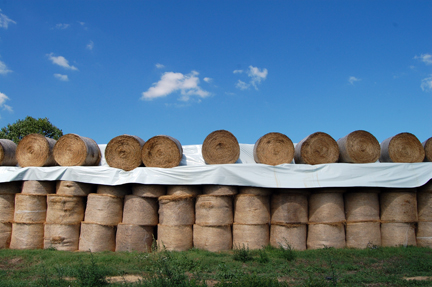
Above: Hay for Chianina cows near Pienza, Tuscany.
Whether it’s Berlusconi patently using one of his media outlets (in this case, Il Giornale, a top national daily) to sling mud at his rival Fini (now embroiled in a sticky familiar real-estate scandal) or the impending expulsion of Roma (following the highly controversial and contested model employed by Sarkozy), Italy and her peoples find themselves in circumstances eerily however distantly reminiscent of the “era between the two wars.” When I commented on the recent changing of the guard in the political regime of the region where she and her family make wine, one winemaker observed wryly but not inronically, “we were better off with the fascists in power than the [newly instated] separatists.”
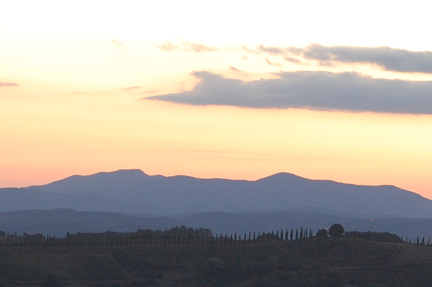
Above: Sunset in Montalcino (Tuscany), viewed from the estate of Il Palazzone.
Perhaps it’s this precarious balance of salt and sweet that makes Italy always taste so great and greatly on our tongues. Thanks for reading…
 Do Bianchi