Champagne, Xerox, and Kleenex

antonomasia [ahn-TAH-noh-MAY-zee’ah], the use of a proper name to express a general idea, as in calling an orator a Cicero, a wise judge a Daniel (OED, online edition).

Above: An unforgettable bottle of 1996 Billecart-Salmon that I shared last year with Jayne and Jon at Spago in Beverly Hills. We weren’t celebrating anything. But we were being treated by a famous winemaker.

In this week’s semiotic treatment of Champagne, we neglected to address one of the most fascinating semiotic implications of the lemma Champagne (at least, one of the most fascinating to me).

The term Champagne is a wonderful example of the literary figure antonomasia, from the Greek ἀντί (anti, meaning instead or against) and ὄνομα (onoma, meaning name), whereby a proper name is used to denote a general idea, in this case, sparkling wine.

Above: A bottle of Bollinger that we popped to celebrate pulling the first mix from Nous Non Plus’s 2009 release Ménagerie. The track? “Bollinger” (click to listen)! A song about our favorite Champagne and official band beverage. (We are a “French” band, after all, n’est pas?)

Other examples that immediately come to mind: Xerox and Kleenex. Both are proper names, in fact, brand names, yet both have come to denote generic items, namely, photocopies and tissue paper.

Let’s face it: even though we wine professionals and enthusiasts strictly use the term (toponym and proper name) Champagne to denote sparkling wines sourced from the place and appellation, Champagne, 99% of the intelligent lifeforms in the world interpret it as any sparkling wine. In his 1953 editio princeps of With a Jug of Wine, for example, food and wine writer Morrison Wood casually and regularly makes reference to California champagne.

Above: A bottle of Initial by Anselme Selosse that Alfonso opened for me and Tracie B last year to celebrate my move to Texas. Perhaps more than any other, Selosse is the most coveted and illustrious brand of Champagne in the U.S. It’s not cheap but it’s worth every penny. Check out this great post, from earlier this year, by McDuff.

Just this weekend, I was reminded of this fact when Melvin C and I visited a Walmart in Orange, Texas in search of some Prosecco for Tracie B, and I was greeted by a “stack” (as we say in the biz) of André California Champagne (“the best selling brand of sparkling wine in the U.S.,” according to the Wiki).

Whatever you plan to drink tonight for your New Year’s celebration, Tracie B and I wish you and yours a happy, healthy, and serene 2010. Thanks for all the support and love in 2009!

Breaking news: this just in from Italy

Thanks are due to reader Elaine from Italy who identified the champagne-method Nerello Mascaelese by Murgo (Sicily).

Also just in from Italy…

According to the Agenzia Giornalistica Italia, when all is said and done, Italians will have spent Euro 2.7 billion on sausage (cotechino and zampone) and Italian sparkling wine (spumante). “Salmon, oysters, and caviar” were no match for the famed boiled sausages of Modena (both delicious, btw). Nor did Champagne, with a “a 66% drop in sales,” rival its Italian counterparts.

On that part, according to a press release issued by the Prosecco di Valdobbiadene e Conegliano Producers Association, Italian agriculture minister Luca Zaia sent 60 “3-liter Jeroboams” of Prosecco to the staff of the “national radio and television stations.”

An early celebration of his upcoming governorship of the Veneto, no doubt.

Happy new year, everyone, everywhere!

Impossible wine pairing? Chicken and dumplings

Above: Did I mention the girl can cook? Tracie B made chicken and dumplings last night for the whole B family. Photo by Rev. B.

In Emilia-Romagna they eat tortellini and cappelletti in brodo (filled pasta in capon broth). In Central Europe they eat knödel served in broth. At the Jewish deli, they serve kreplach in broth. And in the South, they make chicken and dumplings.

Above: Tracie B’s chicken and dumplings. I can only wonder what Dr. V’s user-generated content would have to say about this most impossible impossible wine pairings — chicken and dumplings. But, man, were they good! This and below photos by Tracie B.

By its very nature, broth is an inevitably impossible wine pairing: the temperature alone makes pairing like grabbing the moon with your teeth as the French say.

Heeding the adage by restaurateur giant Danny Meyer, if it grows with it, it goes with it, I should have paired Tracie B’s delectable dumplings with Lambrusco (my top pick would have been a Lambrusco di Sorbara). In Emilia, versatile Lambrusco is served throughout the meal, with the appetizer of affettati (sliced charcuterie), with the first course of tortellini in brodo, with the second course of bollito (boiled meats and sausage), and even with the dessert of Parmgiano Reggiano served in crumbly shards, perhaps topped with a drop of aceto balsamico tradizionale di Modena or di Reggio Emilia (none of that hokey, watery aromatic vinegar). Lambrusco would have been perfect here.

Above: Don’t try this at home. Frankly, the 2004 Barbaresco Pora by Produttori del Barbaresco is going through a nearly undrinkable stage in its evolution.

But as food writer Arthur Schwartz says of pizza, if you can’t be with the one you love, love the one your with.

Before heading to Orange for the Christmas holiday celebration with the B family, I had reached into our cellar and pulled out a bottle of 2004 Barbaresco Pora by Produttori del Barbaresco. Frankly, the wine was too tight, overwhelmingly tannic, and even though it opened up over the course of the evening, it’s going through a nearly undrinkable period in its evolution. But that’s part of my love affair with this winery: experiencing the wine and the different single-vineyard expressions at different points in its life. And there are more bottles of 04 Pora to be had in our cellar. We ended up lingering over wine, sipping it is a meditative wine as we retired to the living room and watched a movie together and munched on oatmeal cookies that Tracie B and Mrs. B had baked that afternoon.

Above: Nephew Tobey wasn’t concerned with wine pairing. But he sure loved him some chicken and dumplings!

Happy Sunday ya’ll and thanks for reading!

Cajun boudin balls and Dolcetto (how’s that for fusion?)

Pam and Melvin Croaker’s fried corn-meal-dusted boudin balls paired superbly with an 2007 Dolcetto d’Alba Monte Aribaldo by Marchesi di Gresy at yesterday’s Christmas day supper. The weather’s been cold and windy here: Dolcetto is such a great wintry grape, with its rich, meaty mouthfeel and nervy acidity pillared by a fulcrum of gentle tannin and meaty flavor. At less than $20 a bottle, the single-vineyard Dolcetto Monte Aribaldo has been my 2009 holiday season standby wine.

Sadly, a bottle of 2004 Rosso di Montepulciano by Sanguineto was corked. It wasn’t corked in the tainted with a corky or wet dog smell, the way “viciously” corked wine can smell (as BrooklynGuy likes to say when he’s disappointed with a much-anticipated bottle like this one). It was just that the fruit had died: as BrooklynGuy might say, it wasn’t “terrible, just dull.”

Boudin balls are made from the filling of boudin sausage — pork, pork liver, rice and Cajun seasoning (spicy). They can be rolled in breadcrumbs or flour but Pam and Melvin used a cornmeal coating (also traditional) for these tasty delights. Soooooo good…

In other news…

Yet another dream came true this Christmas yesterday when Tracie B and I got the 3-quart All-Clad sauté pan we’d been hoping for.

Thanks Mrs. and Rev. B!

Xmas eve gumbo (and they called me “Tex”)

Above: “You’re a cowboy, Je-emy,” said Tobey (left) when I tried on the cowboy hat that Melvin Croaker gave me as a Christmas gift last night. When I was his age, I dreamed of being a cowboy… Don’t all little boys?

According to the Oxford English Dictionary (online version), the word gumbo comes from the Angolan kingombò or quingombo, meaning okra.

Uncle Tim’s gumbo doesn’t have any okra in it, nor does he make it with seafood. But, man, is it delicious: Texas is the only place I’ve lived in the U.S.A. where folks are so passionate about the food they make and eat and where there exists (what I call) idiosyncratic cuisine, where every family (and seemingly every family member) has its own interpretation and expression of traditional dishes and recipes.

Above: You pour the gumbo over boiled short-grain rice (do not used parboiled rice) and then dress with potato salad (made with hard-boiled eggs).

Uncle Tim makes his gumbo as such:

    Prepare 2 gallons chicken stock using chicken thighs (discard the bones if necessary and shred and reserve the chicken meat). Prepare a roux using 2 cups flour and 2 cups vegetable oil (rendered lard was traditionally used), whisking constantly (about 45 minutes) until the flour has browned. Filter the roux using cheesecloth (or paper napkin) and reserve. Combine the roux and stock, add finely chopped yellow onions and green onions, and then add smoked sausage sliced in rounds, including the casing (Tim uses deer sausage, made from deer he hunts himself). Season to taste with Tony Chachere’s Creole seasoning (some use Tony Chachere filé, a powder made from finely ground sassafras leaves). Add the reserved chicken to the pot and simmer for 3 or 4 hours, as necessary, until the desired consistency is obtained. Serve over boiled rice, dressed with potato salad.

Above: Folks in coonass country all have their own idiosyncratic approach to making gumbo but one thing they all seem to agree on is Tony Chachere’s seasonings.

One of the keys to great gumbo, says Uncle Tim, is smoked sausage: the smokey notes, he explains, are what gives his gumbo its distinctive flavor. Be sure not to use Minute Rice (or any other parboiled rice): it will absorb and mask too much of the flavor, he says.

Tracie B and I paired with Luneau-Papin 2006 Muscadet Sèvre & Maine Clos des Allées: the intense aromatic nature of the grape and its bright acidity were great with the spiciness and moreish fattiness of the gumbo dressed with the potatoes, hard-boiled eggs, and mayonnaise in the potato salad.

Above: Uncle Tim and his dog Zsa Zsa. I asked Tim if her nails were painted red for Christmas but that’s her regular color, he said.

Beyond the excellent gumbo, the highlight of the evening for me was a special gift that Melvin and Pam Croaker gave me. You see, they’re very close friends of the B family and so they feel very close to Tracie B. Ever since Melvin got a Facebook, he’s been following my metamorphosis of Calfornian turned Texan (via Italy and New York).

cowboy

Above: That’s me with Melvin. When we left at the end of the night, Aunt Ida Jean said, “we’ll see you tomorrow, Tex!”

At a certain point after dinner was served (they’d been serving gumbo at Tim and Ida Jean’s house since 2 p.m.), Melvin asked for the roughly 20 guests to join him in the living room and he sat me on the one side of him, Tracie B on the other.

“I’ve been following Jeremy’s transformation of becoming a Texan,” he told the room. “He’s found himself a beautiful Texan girl, he’s been learning about barbecue, and he’s even got himself a Texas driver’s license. But he’s still missing a few things.”

He then proceeded to give me a six-pack of Lonestar Beer: “Now, I want you to go analyze this the way you do with your wine,” he said. But most importantly, “you need to start dressing like a Texan. And so I got you this hat.” And then he proceeded to fulfill a childhood wish of mine: he gave me a real cowboy hat, a Justin “cutter straw western.”

Tracie B’s little nephew Tobey jumped up and exclaimed, “you’re a cowboy Je-emy!”

Thanks again, Melvin and Pam, for the generous and thoughtful gift and for welcoming me to Texas and the extended B family: I guess some dreams do come true on Christmas…

Fishes, wishes, and thanks this Christmas

grigliata di mare

Above: “Grigliata di Mare,” Amalfi Coast, photo by friend and colleague Tom Hyland.

“Crisis or no crisis, Italians won’t say no to fish on Christmas eve,” says the daily dose of Italian wine news that finds its way to my inbox this morning. The tradition of eating fish on Christmas eve stretches back to the middle ages and beyond. Its origins lie in a monastic tradition of fasting as part of the holy rite: in a gesture of self-awareness and sacrifice, one “does without” the richness of fatty meat and milk reserved for feast days. Of course, as the bold statement above reveals, the tradition has been turned on its fish head, as it were: across the western world, we consume seafood delicacies on Christmas eve as an expression of luxury. Where I lived in the north of Italy, eel was served on Christmas eve. In the south, where Tracie B lived, a grigliata di mare (as in Tom’s photo above) might be served. (Alfonso posted interesting insight into the myth of the Dinner of Seven Fishes — yes, a myth! — here.)

gumbo

Above: Uncle Tim is an amazing cook and his gumbo is no exception. In Coonass country, where Tracie B grew up, east-Texas style gumbo is served on Christmas eve. When we visit with Tracie B’s family, Uncle Tim and I sit around and talk about food for hours.

Tracie B and I have a lot to be thankful for this Christmas, as we get ready to head east to her family’s place in Orange, Texas (where she and I will be eating Uncle Tim’s excellent gumbo tonight).

It’s been quite a year: I started a new job in the wine business shortly after I moved to Austin only to start over again during the summer when the company I worked for experienced its own financial difficulties. Somehow I managed to land on my feet and things are looking up for 2010 (I think that the loving support and tender words of my sweet and amatissima Tracie B had a little something to do with that).

However much we struggled financially, Tracie B and I are well aware of how lucky we are to be working and we are painfully aware that some in our business continue to struggle.

jeremy parzen

Above: Tracie B and I are getting married next month! Photo by the Nichols.

Crisis or no crisis, our lives have moved forward in wondrous ways I never could have imagined before Tracie B came into my life.

Thank you, everyone, for all the support and well wishes in 2009 and beyond. It’s been some year and as much as I’m glad it’s over, I’ll be sad to see it go: it’s filled with bright memories, even in the darkest times, of the first year of a new beginning and a new life — la vita nova.

Thank you, Mrs. and Rev. B and the entire B family, for welcoming into your lives and hearts. I’ll never forget the first time I met Tracie B’s meemaw and she explained me, “Jeremy, we’re a huggin’ family! Give me a hug…”

And thank you most of all, my beautiful beautiful Tracie B: words cannot begin to express the joy that your love has brought into my life. I love you, I love you with all my heart and soul and every fiber of my body.

Happy holidays to everyone, everywhere…

Best margarita in Texas (and Tex Mex gefilte fish)

bar annie

Above: “The best margarita in Texas,” according to my friend, client, and sommelier extraordinaire Julio Hernández, as served at the legendary RDG Bar Annie in Houston.

Last night after pouring and speaking about Italian wines at my client’s tasting in Houston, my friend Julio treated me to what he calls “best margarita” at the legendary RDG Bar Annie, where there may be a recession going on but there is no shortage of bling and great food.

bar annie

Above: Many believe that owner and master chef Robert del Grande is the founding father of “Southwest American” cuisine. His signature shrimp meatballs were delicious. Raw shrimp is finely chopped and formed into balls and then poached. Tex Mex gefilte fish!

The margarita recipe? Equal parts Herradura Silver Tequila, Cointreau, and lime juice (half Persian lime, half Key lime). “Silver tequila has that stoney minerality,” said Julio, “that we Chablis drinkers like so much.”

bar annie

Above: Fried tortilla strips topped with crab meat and avocado. Soooooo good, especially paired with the cocktail. Also not to be missed, although not as photogenic, are the crab beignets with creamy Tabasco sauce.

I gotta say (and I’m not kidding here, Alfonso!) that this was the best margarita I’ve had since moving to Texas and Julio is right: the dominant minerality balanced the acidity of the lime and the sweetness of the Cointreau, making it more food friendly than any margarita I’ve ever had.

bar annie

Above: Julio, left, with Bar Annie wine director José Perez Montufar.

One of the unique things about Bar Annie is that it combines Houston glamor with truly great food AND a world-class wine list. There were many trophy wines on the list, way beyond my reach, but in every section there was a little gem, like the Inama Carmenere Più, that I can afford on a night on the town.

bar annie

Above: There is no shortage of bling at Bar Annie, as evidenced by the valet parking lot. The trade-in value on my Hyundai Sonata was a Christmas windfall! ;-)

2009 has been a wonderful, wonderful year for me, despite the recession and my own struggles to make a living in this economy. Sometimes it helps to have friends in high places.

Thanks again, Julio and José, for a truly special treat!

And happy Friday ya’ll! I’ve been on the road all week and “moving boxes,” as we say in the biz, and I can’t wait to get home to my super fine lady!

Che bigolo! A sexy pairing with Pierre Péters

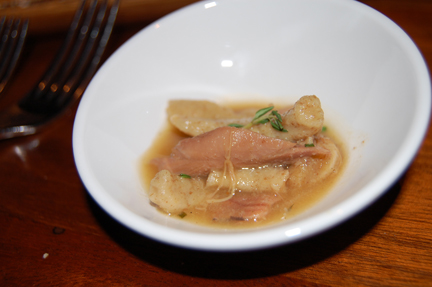
Above: Not exactly traditional but delicious. Buckwheat bigoli with guinea hen last night at Trio in Austin.

My Italian friends will get the joke from last night. When Tracie B and I saw that Trio chef Todd Duplechan was offering buckwheat bigoli on his menu at Trio, I couldn’t resist the pun: I turned and asked sommelier Mark Sayre, “do you think that Todd will let me taste his bigolo?”

Here’s what “Trevisan humanist” Bepo Maffioli had to say about bigoli in his landmark Cucina Veneziana (1982):

    “Brown” bigoli — the buckwheat long noodles of Bassano and Treviso — went through a dark period because Italian law requires that only durum wheat flour be used to make pasta. As a result, bigoli were considered an adulterated product. But then, sentence was passed, and they were found to be a traditional product and thus were permissible for consumption. Since the time of the “vigils,” bigoli a puro oio, in other words, dressed with just extra-virgin olive oil, has been one of the most common dishes for abstinence and fast days. Christmas Eve, Ash Wednesday, and Good Friday have always been holidays for bigoli in salsa (literally, bigoli in sauce) in nearly every city of the Veneto. This dish was almost always made by pairing bigoli and salt-cured sardines but the ingredients could change depending on the city and province and sometimes even the township.

[His thoughts on “adulteration” and culinary law (playful in this case) might seem ironic in the light of the pasta price fixing scandal that surfaced this week in Italy and the Chianti adulteration controversy that first raised its ugly head last week. Ne nuntium necare!]

Like the Tuscan pinci or pici, the Veneto word bigoli is a generic term that denotes long, round artisanal noodles. Most believe it comes from baco or worm. Many Veneto cookery authors use it interchangeably with spaghetti, which simply means little strings (from spago or string). In English, the term spaghetti evokes a particular shape of long noodle. But in Italian, it is a generic term that can be used in certain contexts to denote a wide variety of long, round noodles. The expression bigoli in salsa, literally bigoli in sauce, is used elastically to denote the traditional Venetian dish bigoli with sardines or anchovies as well as other preparations.

For obvious reasons, bigolo, when singular, is a euphemism for the male sex.

Todd served his buckwheat bigoli with guinea hen. They were shorter than traditional bigoli but delicious nonetheless.

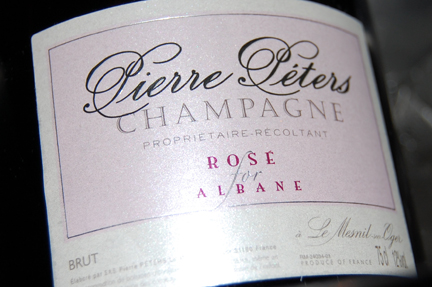
Above: Pierre Péters rosé at Trio. I had never tasted this superb wine before. What a fantastic, exquisite expression of Champagne! There is so much great wine in the world. Anyone who’s really into wine will tell you, the more I learn, the more I realize how little I know.

Our friends April and Craig Collins graciously and generously treated us to a bottle of Pierre Péters rosé to celebrate the holiday season. What an amazing wine! Ubi major minor cessat: for notes on the producer and the wines, I’ll point you to the experts here and here.

As we sipped this delicious and gorgeous pink wine (full of luscious fruit balanced by stern minerality), I couldn’t help but think to myself about how some of my wine blogging colleagues warned me (fruitlessly) that I wouldn’t find good wine to drink in Texas. Well, I’m here to tell ya, they got them some pretty darn good wine down here in this fine state!

Above: Master sommelier candidate Craig Collins and his lovely wife April are the leading man and lady of the Austin wine scene.

Thanks again, April and Craig, for turning us on to (and treating us to) such an amazing wine!

Lowrider Sunday in Dallas

Loriders in the parking lot at the El Pollo Regio on Gaston in Dallas. “Ahh… Que rico pollo!”

That chicken looked might tasty but Alfonso’s on a diet of grilled salmon Jaboulet Hermitage La Chapelle 1985 so we’ll just have to suffer tonight… ;-)

Best airport food? Guess where…

Tracie B and I love to travel. No matter where we’re going, as long as we’re together, the trip to the airport is always a fun one for the two of us.

But the one thing that really sucks about traveling is the awful food options in airports. Even with all of today’s fancy concessions, the food is nearly always a smorgasbord of Sysco-kissed processed foods. Well, friends, I am here to tell ya that there is at least one airport in our country where there’s a local and very tasty food option. It may not look pretty but, man, I was so hungry yesterday by the time my lady and I got to the airport!

Salt Lick BBQ at the Austin airport:

bbq

The real thing (when I took Mama Judy there the other day while she was visiting us in Texas):

bbq

Hungry?

Amphora-aged Primitivo, pozoles and old Rioja, and a Texas wine I liked

Above: This week, Tracie B and I attended our first holiday party of the year at the home of Texas “natural treasure,” author, radio personality, blogger and all-around delightful host, Mary Gordon Spence.

Man, has it been a crazy week — between work, Tignanello triage, the new Amarone DOCG, and the holidays upon us!

Above: Everyone who knows me knows that I rarely eat sweets. But homemade flan? Mary Gordon found my weakness!

Tracie B and I are headed to La Jolla for the weekend, a good thing since snow is expected today in Central Texas!

I’m working on my “interesting wines coming out of Tuscany these days” post and I received a lot of great recommendations from a bunch of Italian wine professionals and bloggers. Thank you, all. I’ll post them next week.

Above: George O brought this bottle of what I’m guessing is a dried-grape red wine from the Texas Hill Country made by Tony Coturri at the La Cruz de Comal winery. It was a great pairing for the flan.

If you haven’t seen it already, please check out this wonderful post authored by Franco (and translated by yours truly) on the amphora wines made by Vittorio Pichierri in Sava (Manduria, Apulia). Amphora wine is all the rage these days. Gravner started making wine in amphora in the late 1990s? Pichierri has been aging his wines in interred amphora since the 1970s and beyond (he uses an ancient format called capasone).

Above: We were joined by the inimitable Bill Head, whose tall Texas tales alone are worth the price of admission (seated next to Tracie B), his lovely SO Patricia, and George O. Jackson (right), photographer and author of a photo collection I am dying to see, Essence of Mexico 1990-2002, images of folklore he captured traveling through rural Mexico.

Dinner at Mary Gordon’s was just the excuse I’d been waiting for to open some older López de Heredia that a client gave me. The 1990 Tondonia white was stunning, as was the 1991 Bosconia. We opened both bottles as we sat in Mary Gordon’s living room and munched on jícama and chips and salsa: I couldn’t help but think about how great these oxidative wines are with food. The 2000 Bosconia Reserva was great with Mary Gordon’s excellent pozoles.

The conversation turned from tales of larger-than-life Charlie Wilson from Bill’s years in Washington to Mary Gordon’s memories of working for President Lyndon B. Johnson, to George O’s adventures in rural Mexico. I spent the whole evening on the edge of my seat. Maybe it’s because I live here now but it always impresses me how Texas often finds itself at the center of the American collective consciousness and American iconography.

Thanks again, Mary Gordon, for such a wonderful evening! And happy holidays to all ya’ll!