spaghetti con crema di melanzane (spaghetti with Listada de Gandia eggplant sauce)

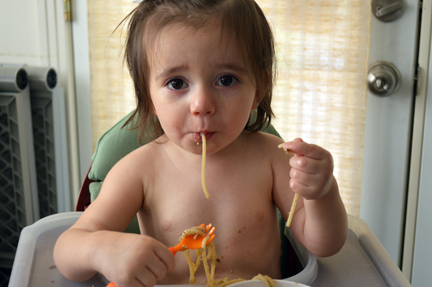
baby eating spaghetti

For this dish, I washed Listada de Gandia eggplant and sliced into rounds.

Then I tossed them in a light dust of kosher salt and let them purge their liquid for about 30 minutes in a colander.

Then I grilled them on our cast-iron stove-top grill with a brush of olive oil and a sprinkling of salt.

After they had cooled, I tossed them with extra-virgin olive oil, a pinch of freshly cracked black pepper and chili flakes, and a “kiss” of vinegar.

After the eggplant had marinated overnight in the refrigerator, I puréed them, adding a thin drizzle of olive oil.

Before folding in the slightly undercooked spaghetti, I added about 3 tablespoons of the pasta’s well-salted cooking water to the sauce.

After folding in the spaghetti and allowing them to absorb the flavor of the sauce as they finished cooking through, I folded in a generous handful of freshly grated Parmigiano Reggiano.

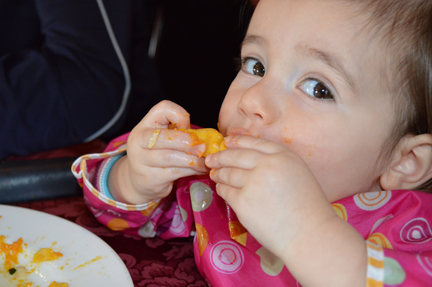
Georgia P’s has been insisting on eating with her fork these days. She still has a little bit of trouble getting the food to her mouth.

But what a thrill to watch her eat spaghetti with a fork for the first time!

Carbonara & more thoughts on its origins, a pairing inspired by Brooklyn Guy

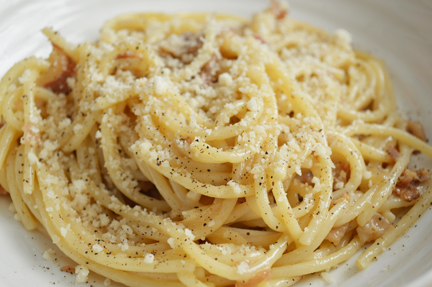
best carbonara recipe

Above: Tracie P’s Carbonara last night. To borrow an expression from Charles Scicolone, “I am blessed.”

“One of the things that is endlessly appealing about New York, for anyone with more than a passive interest in food,” wrote Craig Claiborne in the New York Times in 1965, “is a continual sense of discovery either in products or the environment in which they are sold. It may be a spice or a bread or a cheese in Brooklyn, Greenwich Village, the Lower East Side, but there is always the prospect of the unexpected.”

His words ring as true as if they were written yesterday, don’t they?

In this instance, he was writing about the pancetta at the “Salumeria Italiana, known in the neighborhood as Frank’s Pork Store, at 26 Carmine Street (near Bleecker Street and the Avenue of the Americas).”

Pancetta “is designed to be sliced paper thin and eaten as part of an antipasto or scrambled with eggs. The closest thing it may be said to resemble is prosciutto, and like prosciutto, it is delicious when draped over melon or figs and served as a first course. Mrs. Bocassi, the owner’s wife, commented recently that many Italians used pancetta to make spaghetti carbonara.”
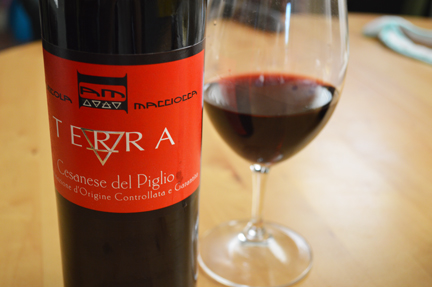
cesanese del piglio

Above: We paired with this Cesanese del Piglio by Cantina Macciocca, sent to us as a sample by importer Katell Pleven of the Vine Collective. In my experience, the Cesanese grape has the right spice to stand up to the intense flavors of Carbonara. I loved this wine by organic farmer and native yeaster Macciocca. Although a little hot with alcohol, it was fresh and meaty and its peppery notes sang with the Carbonara.

Carbonara has been on my mind after reading Brooklyn Guy’s recent and superb post and reflections on wine pairings and recipes.

(Here’s a link to my last post on Carbonara and its origins.)

The Claiborne passage above is significant not only because “Mrs. Bocassi, the owner’s wife, commented recently [in 1965] that many Italians used pancetta to make spaghetti carbonara,” but also for his observation that pancetta “is designed to be sliced paper thin and eaten as part of an antipasto or scrambled with eggs” (italics mine).

By the time he wrote this piece, Carbonara was already an immensely popular dish in the U.S., in part thanks to opera singers who mentioned it as their one of their favorite Italian dishes.

In an article published in 1962 entitled, “A Diva’s Proper Interest in Pleasures of the Table,” Claiborne wrote of soprano Eileen Farrell that “Miss Farrell speaks with warmth, however, of spaghetti carbonara.” It’s one of the earliest mentions of Carbonara, the dish, that I can find in the Times.

I’ve also found an instance where soprano Birgit Nilsson mentions it as a favorite Italian dish.
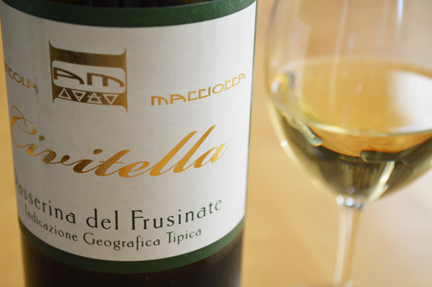
passerina frusinate

Above: Most Passerina comes from Abruzzo but this one, a 2011 by Macciocca, is raised in Latium (Lazio) in the township of Frosinone (Frusinate in dialect). It’s an example of the viticultural connection between Abruzzo and Latium, a relationship that’s even more evident in the regions’ gastronomic ties. This wine took a moment to open up and show its true colors but we both thought it was delicious once it did. Great acidity, balanced fruit, and a nice minerality that you don’t expect in Passerina.

I’ve never met an Italian who scrambles eggs with pancetta. And I was surprised by Claiborne’s observation.

Is it possible that Carbonara could be the child of American influence not via American soldiers (as some have speculated) but via opera singers who wanted eggs and bacon when they traveled to Rome to perform?

(Pancetta is Italian for cured pork belly, the equivalent of bacon.)

Browsing the Times archive for the word carbonara, I also came across a number of obituaries for persons named Carbonara.

It occurred to me that Carbonara, while not among the most common, is a relatively common surname, probably originating in Apulia (Puglia).

Then I started thinking about the wave of Apulian immigrants who came to New York in the 1950s and 60s (hence the prevalence of the surname in New York during those decades).

Could this be one of the elements that will help us to unfold the mystery of the origins of Carbonara?

One thing is for certain, the dish Spaghetti [alla] Carbonara appears for the first time in the post-war era (see my research here), when dried pasta became a popular dish in Rome and later throughout Italy (yes, it’s that recent).

Could the dish be the result of migratory influence and contamination coupled with the influx of American celebrities in the years after the second world war?

Either way, I’m glad that Brooklyn Guy got us thinking about it because Tracie P’s Carbonara is always delicious.

This is what we do at our house after Georgia P goes to bed: we make food, we open wine, and then we spend the better part of the evening talking about it. I am truly blessed.

Dulcis in fundo: yesterday, Italian wine maven Charles Scicolone posted about his recent trip to Italy, calling the Carbonara at Roscioli “the best in Rome.” His post includes a photo.

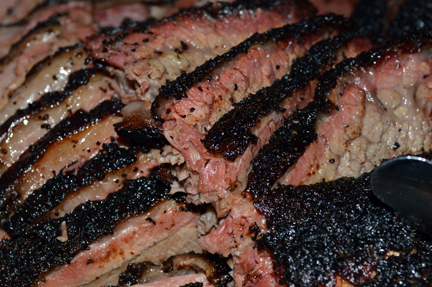
bbq brisket porn @StilesSwitchBBQ

bbq porn

Just had to share this image, snapped the other night at Stiles Switch BBQ in Austin, where my client Vino Vino organized a wine dinner, pairing the Piedmontese wines of Incisa della Rocchetta and classic Texas bbq.

Note the “smoke ring,” the pink ring on the edge of each slice of brisket. It is one of the top criteria by which bbq is judged in competition.

It’s an indication of the evenness applied in “low [temperature] and slow” smoking.

At the dinner, I sat next to winemaker Filiberto Massone, who asked me why Texans like their meat burnt.

In fact, the black outer ring is not burnt meat but rather the smoked dry rub, the sine qua non of Texas bbq.

I thought the brisket at Stiles Switch was outstanding on Saturday night. Highly recommended…

And btw, Stiles Switch is located in one of Austin’s oldest shopping malls, the Violet Crown, built in the 1950s, and then later the backdrop for the movie Dazed and Confused.

I once asked owner Shane Stiles, a handsome and affable guy, if I could take his photo.

He said, “sure,” and stood there behind the counter expressionless.

I said, “hey, you need to smile!”

He looked over at his pit master, with his sweat-stained baseball cap and t-shirt covered in soot.

“There are no smiles in bbq,” he told me with a grimace worthy of Jack Palance.

Grignolino & bbq tomorrow @StilesSwitchBBQ @VinoVinoWine & please read @EricAsimov

stiles switch

Above: Barbecue from Stiles Switch in Austin. Image via Fed Man Walking, a blog authored by former Austin American-Statesman folklore and food columnist Mike Sutter. Click here for his review of the restaurant.

When I first moved to Austin at the end of 2008, there really weren’t a lot of great bbq options in town. You had to drive out to Driftwood (Salt Lick), down to Lockhart (Kreutz et alia), or up to Llano (the original Cooper’s) for the real deal (although Sam’s on East 12th was always good in a pinch).

Then, in 2011, the Austin bbq war happened. A number of new and highly competitive places opened, including the highly praised Franklin’s. The not-so-collegial conflict was punctuated by thieves stealing raw brisket from the local supermarket chain H-E-B by stuffing them in their pants.

Although Franklin’s remains the darling of the national media, Stiles Switch (on the north side of town) emerged as one of the winners of the conflagration and was recently voted one of the top 50 bbq destinations in Texas by Texas Monthly.

It’s where Tracie P and I get our bbq and it’s also where my client Vino Vino will be hosting a dinner tomorrow night with the wines of Marchesi Incisa della Rocchetta — Grignolino and Barbera. $35 for bbq and Grignolino sounds pretty good to me

Tomorrow afternoon, Vino Vino will also be hosting its annual rosé wine festival, Pink Fest, one of the best wine events in town.

I’ll be at both happenings. Come out and taste with me if you’re in town!

In other news…

Please read Eric the Red’s EXCELLENT article today in the Times, “If Only the Grapes Were the Whole Story.”

“Think of wine as food,” he writes. “Concerns about where food comes from and how it’s grown, processed or raised ought to be extended to wine. If we ourselves don’t set standards for quality and authenticity, who will?”

Buon weekend e buona lettura, yall!

the world’s most gooey grilled cheese sandwich

best grilled cheese sandwich

Tracie P and I are always trying to come up with ways to include more and more vegetables in Georgia P’s diet.

The number-one strategy is to incorporate them in dishes she already likes (pasta, quesadillas, etc.).

For her dinner last night, I sautéed diced, unpeeled green zucchine in butter with a garlic clove and pinch of kosher salt.

After deglazing with white wine and allowing the alcohol to evaporate, I added a finger of chicken stock and simmered for about 5 minutes. I strained the zucchine and then finely chopped until I achieved a light paste.

Then I assembled the sandwich on whole wheat bread, with a delicate schmear of mayonnaise, two slices of white cheddar cheese, and an even spread of the zucchine paste.

I fired the sandwich in our cast iron skilled, greased with extra-virgin olive oil, over high heat.

Georgia P was SO excited when I served it to her. I think it’s safe to say that it was the best and most gooey grilled cheese sandwich she’s ever had.

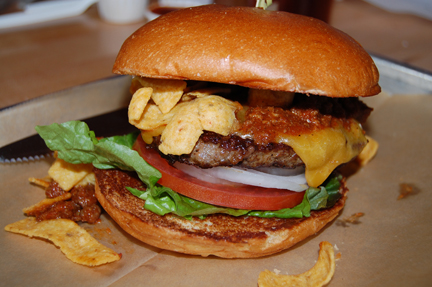
frito pie burger @HopDoddy #ATX #PregnancyCravings

From the department of “daddy is allowed to have pregnancy cravings too”…

frito pie hamburger

The frito pie burger at HopDoddy “burger bar” in Austin, Texas. Super fun stuff…

how American girls eat spaghetti al pomodoro

Tracie P, Georgia P, and I had a blast over the last two weeks in Italy.

But we sure are glad to be at home in Texas with all its comforts (and high speed internet).

Thanks for following along and buon weekend, yall! Lots more fun posts on what we ate and drank (and my notes from the wine fairs) to come…

american girl in italy

Continue reading

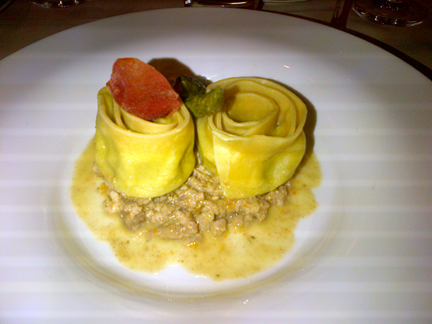
Pappardelle in forma di rosa

pappardelle veneto

Great lunch today at Gigetto in Miane (Proseccoland, province of Treviso), amazing wine cellar, and great conversation with sommelier Roberto Pieri.

The pappardelle sat atop a light “white” ragù and where garnished with asparagus.

Luciano Benetton was sitting at the table next to us.

Proseccoland, our favorite restaurant: Osteria al Cacciatore

baby girl italy

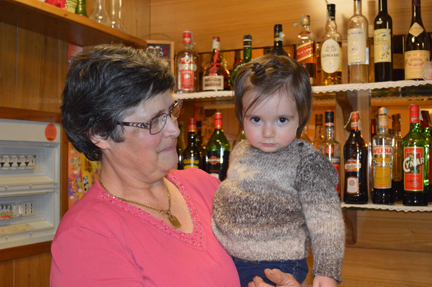
Above: Georgia P was the star of the dining room last night at the Osteria al Cacciatore.

The Italian expression alla cacciatora is actually a relatively ancient one.

Many would have you believe that it denotes as per the hunter’s custom.

wine caraffe

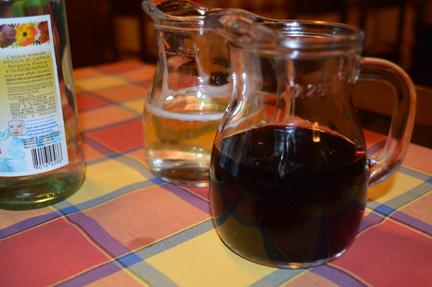
Above: 1/4 liter of gently sparkling white, most likely Verdiso; 1/4 liter of red, mostly likely Raboso, traditional table wines in the province of Treviso.

In fact, it means roughly or coarsely [dressed] (it begins to appear in Italian as an adverbial phrase by the mid-eighteenth century).

There’s no doubt that it comes from the word caccia meaning hunt (from the Latin capere, to seize), akin to the English chase.

antipasti affettati

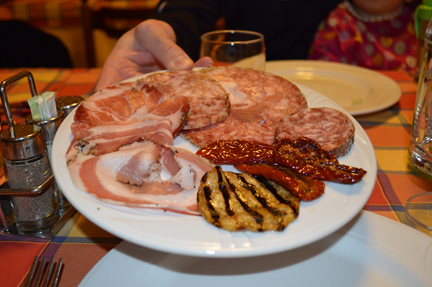
Above: Housemade salumi, so rich in flavor (and fat) but not overbearing on the palate.

But when Artusi canonized the recipe pollo alla cacciatora (chicken stewed with red wine and tomatoes) toward the end of the nineteenth century, he surely perceived the meaning of its designation as roughly dressed (and not in the style of the hunter; like a hunter is a more apt translation).

pasticcio

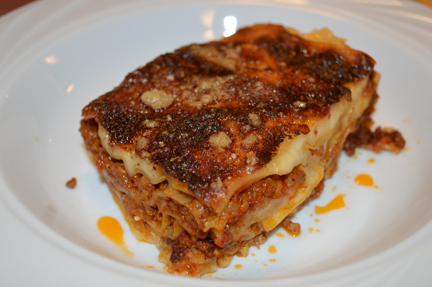
Above: The pasticcio (layered pasta and ragù pie) was one of the dishes I most looked forward to. It didn’t disappoint.

When you make your way to the Osteria al Cacciatore in the village of Zuel di Qua (literally, the hill over here, as opposed to the Zuel di Là, the hill over there, in the township of Cison di Valmarino in the heart of Proseccoland), there’s just a small sign to alert you the presence of a restaurant in the house on the side of the wine country road. You’d think it were just a private home if not for the cars parked outside.

best steak italy

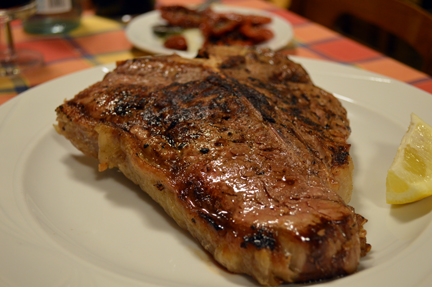
Above: Tracie P craved steak last night. Beef in the Veneto is excellent and the meat had a wonderful sweetness that balanced its savory char.

There’s no menu. And there’s no wine list.

Owner Maria Gusatto’s daughter simply comes over to the table and asks what would you like tonight?

skewered rabbit

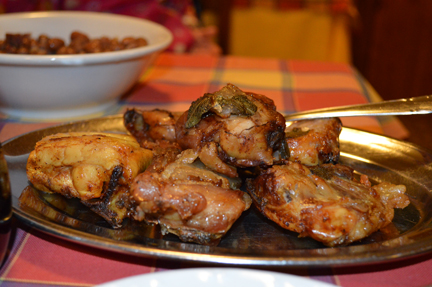
Above: Spit-roasted rabbit and chicken. This was my splurge meal of the trip. The sage leaves were seared into the skin of the rabbit and the bones were so juicy you could crunch them between your teeth.

Georgia P put on quite a floor show: she’s just begun walking and insisted on marching around the restaurant like a drunken sailor.

When I apologized to one lovely older couple for the nuisance, the lady said, non sono i piccoli che danno fastidio… sono i grandi (it’s not the little ones that are bothersome… it’s the big ones).

white polenta

Above: The white polenta was so tender and light but firm to the bite.

The chef added: when they’re little you wish you could eat them up… when they grow up, you regret not having eaten them.

Osteria al Cacciatore is the type of place where people speak in proverbs.

beans veneto

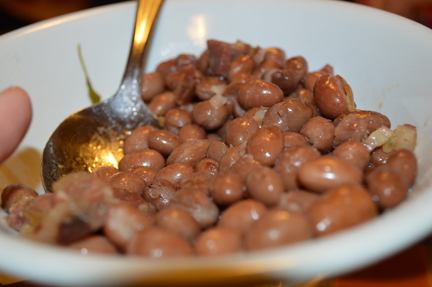
Above: The beans are cooked gently with white onions. We had to take them away from Georgia P… she couldn’t stop eating them and neither could we.

Our bill? €51.

I handed Mrs. Gusatto a 50-Euro bill and a 1-Euro coin. She said, “50 Euros are plenty. May I offer you a coffee or a digestif?”

Thanks, again, to Riccardo Zanotto, who first brought us here. I can’t recommend it highly enough…