Bloody Mary Morning (a lil’ Tex Mex porn)

tex mex

Last weekend’s 3-day bachelor party… well, let’s just say it left me and brothers Tad and Micah a little hazy. By the time it was over, it was most definitely time for a “Blood Mary morning” and so, to make their culinary Trifecta complete (they’d already had some great Texas steak some great Texas bbq), it was time for Tex Mex at one of Austin’s classics, Chuys. My morning started with a Michelada — essentially a bloody Mary made with beer. Chuy’s features $3 margaritas and bloody Marys on Sunday, btw, I wonder why?)

tex mex

The Wild Burrito, above, is a “wet” burrito made with slowly braised tender stringy beef and Hatch chiles. Some might argue that the inclusion of Hatch chiles and the Sonora-style “wet” presentation would betray New Mexico and Arizona roots of this dish. But who needs dogmatism on a bloody Mary morning? Needless to say, I did my best “James Brown” imitation, as Tracie B likes to tease me, consuming this dish.

tex mex

Deluxe chicken enchiladas, above, are essentially, enchiladas verdes, with sour cream added to the salsa verde. An Austin original, Chuys has become a Texas franchise chain restaurant. But it’s everything Tex Mex should be: cheap, colorful, delicious, fun, and a perfect cure for a hangover!

tex mex

Fajitas are an undisputed signature of Tex Mex cuisine. Some will argue that they originated in Austin while others will claim Houston. No one will deny that they have become a calling card of Tex Mex cuisine from sea to shining sea.

Thanks, again, to brothers Micah and Tad (below), for coming out and giving me a great “lost bachelor weekend” here in Austin. I can’t think of better way to end it than with a blood Mary morning!

tex mex

Check out this amazing video of Willie doing “Blood Mary Morning” way back when before he was even playing his signature guitar. If that ain’t Texan, I don’t know what is!

Holiday cheer starts with Campari and blood oranges

garibaldi

When Tracie B told me she had a yen for Campari the other night, I headed to our neighborhood market and picked up some oranges, soda, and ice (she grabbed a bottle of Campari at our favorite local wine store).

garibaldi

Now, mind you, our California blood oranges are nowhere nearly as tasty as the Sicilian blood oranges that Franco loves to brag about. And he’s right: the tenderness and flavor of the Sicilian blood mesocarp are unmatched. But our California blood oranges (I believe the Tarocco cultivar) are still pretty darn good.

I sliced and strained a half of an orange into each glass over ice (we were joined by good friend Amy, who happened to be in the neighborhood, and so three was company, too).

garibaldi

Earlier this year, JT pointed out to me that my preferred formula for drinking Campari is called a “Garibaldi,” I’m assuming because it is a blend of products from Piedmont and Sicily.

Whatever it’s called, it’s delicious!

Tracie B and I still haven’t decided what sparkler we’re popping for New Year’s Eve but it’s that time of year again…

In other news…

sabato napolitano

I’m in Dallas this morning: Alfonso, who’s going to be the best man at our wedding (he introduced us, after all!), took me to get my suit fitted this morning by “SABATO the TAILOR” (that’s him, left). It seems like a long way to travel for a fitting but Neapolitan tailors — everyone knows — are the best in the world and considering the moment of the occasion, it was well worth the trip.

Thanks, Ace!

And in case you haven’t seen it, Tracie B did this adorable post on our wedding invites. I’m just crazy about her and it’s been so much fun getting ready for our wedding… the date is around the corner!

Best margarita in Texas (and Tex Mex gefilte fish)

bar annie

Above: “The best margarita in Texas,” according to my friend, client, and sommelier extraordinaire Julio Hernández, as served at the legendary RDG Bar Annie in Houston.

Last night after pouring and speaking about Italian wines at my client’s tasting in Houston, my friend Julio treated me to what he calls “best margarita” at the legendary RDG Bar Annie, where there may be a recession going on but there is no shortage of bling and great food.

bar annie

Above: Many believe that owner and master chef Robert del Grande is the founding father of “Southwest American” cuisine. His signature shrimp meatballs were delicious. Raw shrimp is finely chopped and formed into balls and then poached. Tex Mex gefilte fish!

The margarita recipe? Equal parts Herradura Silver Tequila, Cointreau, and lime juice (half Persian lime, half Key lime). “Silver tequila has that stoney minerality,” said Julio, “that we Chablis drinkers like so much.”

bar annie

Above: Fried tortilla strips topped with crab meat and avocado. Soooooo good, especially paired with the cocktail. Also not to be missed, although not as photogenic, are the crab beignets with creamy Tabasco sauce.

I gotta say (and I’m not kidding here, Alfonso!) that this was the best margarita I’ve had since moving to Texas and Julio is right: the dominant minerality balanced the acidity of the lime and the sweetness of the Cointreau, making it more food friendly than any margarita I’ve ever had.

bar annie

Above: Julio, left, with Bar Annie wine director José Perez Montufar.

One of the unique things about Bar Annie is that it combines Houston glamor with truly great food AND a world-class wine list. There were many trophy wines on the list, way beyond my reach, but in every section there was a little gem, like the Inama Carmenere Più, that I can afford on a night on the town.

bar annie

Above: There is no shortage of bling at Bar Annie, as evidenced by the valet parking lot. The trade-in value on my Hyundai Sonata was a Christmas windfall! ;-)

2009 has been a wonderful, wonderful year for me, despite the recession and my own struggles to make a living in this economy. Sometimes it helps to have friends in high places.

Thanks again, Julio and José, for a truly special treat!

And happy Friday ya’ll! I’ve been on the road all week and “moving boxes,” as we say in the biz, and I can’t wait to get home to my super fine lady!

RN74’s house-made Pimm’s at TexSom

Above: Dallas native D’Lynn Proctor is one of the top sommeliers in the state of Texas.

Yesterday found me and Italian Wine Guy attending seminars at the excellent TexSom conference (held this year in Dallas). In its fifth year, the conference draws some of the country’s best and brightest wine personalities and features seminars and guided tastings with leading celebrity Master Sommeliers. MS Brian Conin led a lively aperitif tasting that included a sip of the house-made Pimm’s produced by RN74 in San Francisco.

Above: Brian served the RN74 Pimm’s mixed with ginger beer yesterday but explained that Prosecco is mixed, together with the ginger beer, in the RN74 “Pimm’s Cup” in San Francisco.

During the spirited (pun intended) exchange from the floor during the question-and-answer period, the ever-affable Bartholomew Broadbent chimed in with an ad hoc lecture on the traditional Pimm’s Cup and its significance in British culture.

A taste of genuine collegiality among wine professionals, some downright fun, and a Pimm’s cup (however experimental) sure can do a body good!

My new favorite cocktail, an aperitivo for a Manic Monday

Above: Lately, I’ve been drinking my Campari and Soda with a splash of orange juice. I’m sure this recipe has a name: does anyone know it? Photo by Tracie B.

It’s already been one helluva Monday morning and I’m still working on getting to the bottom of what happened over at Decanter.com on Friday.

I sure wish it were Sunday: yesterday Tracie B and I found ourselves in Houston where we had dined Saturday night at the newly opened winebar Block 7 (look for a post later this week) and we stayed overnight at the St. Regis (thanks to my nimble hand at Priceline).

Above: Tracie B and I love to photograph everything we eat and drink. The bartender at the St. Regis had fun with us and took this photo. She mixed our drinks perfectly to order.

It was fun to wake up to room service and swimming and we had great Mexican food for lunch with Tracie B’s childhood friend Talina at La Mexicana (highly recommended, super family friendly and just all around delicious).

Above: My eyes weren’t bigger than my stomach at La Mexicana. I couldn’t help but order à la carte: from 12 o’clock clockwise, 1 taco al pastor, 1 taco de carnitas (available only on weekends), 1 flauta (which I dipped liberally in creamy guacamole), and 1 cheese enchilada drowning in ranchero sauce.

Man, I wish it were Sunday. That was my fun day…

I have seen the Futurism: the Negroni

Above: A Negroni at Annies in Austin, the latest addition to the restaurant and nightlife scene here. Not bad for a snap taken with my Blackberry Curve, eh?

No one needs me to retell the story of the Negroni: the tale of Count Camillo Negroni and the cocktail named after him has been retold countless times (however apocryphal those chestnuts may be).

But what few remember these days is that the Negroni was one of the favorite cocktails of the Futurists, the avant-garde movement founded in 1913 by F.T. Marinetti (often called the father of the historical avante-garde). The Negroni — made with Campari, the quintessential Futurist bitters — was one of their polibibite or polybeverages, each intended to stimulate the idealized Futurist (in one way or another).

Yesterday evening, when I tasted a Negroni at the newly opened Annies Café and Bar on Congress in downtown Austin, I couldn’t help but think of the Futurist banquet I attended in 1993 at the Getty Villa in Malibu. (A few years later, I worked as one of the bibliographers of the Marinetti archive at the Getty’s Special Collections.)

I’ve been thinking a lot lately about how Futurism and the historical avante-garde were essentially self-destructive movements, like much of twentieth-century critical theory: by destroying its fathers (and mothers, for that matter), the historical avante-garde presupposed its own destruction by future generations.

But the cocktails sure were good…

The Negroni at Annies wasn’t bad (although it should have served with an orange wedge or orange zest). The Lousiana-style gumbo I sampled wasn’t bad either. Seems like they have a few kinks to iron out there but I’ll be back: I liked the feel of the place, the hipster mixology, and the old-time music they had going.

It’s sgroppino time (I wish it were)

Man, it’s been a long week… and it’s only Thursday. I’m on the road again today and am looking forward to some relaxing (and gastronomic-literary pursuits) this weekend. I sure wish it were sgroppino time!

A sgroppino is made from sherbet (usually lemon) and Prosecco (and sometimes a shot of vodka). It is served at the end of the meal to aid in digestion. The word itself, from the Italian groppo or knot (akin to the English crop; see below), means “a little helper in pushing out a knot in the — ahem — digestion.”

A sgroppino was mandatory after our horse meat dinner (left) last April in Legnaro (Padua, Veneto).

And a sgroppino (below) really hit the spot after dinner at the osteria of the famous restaurant and inn on the Slovenian border La Subida (Cormons, Friuli), also last April after NN+ played at Movia.

Be sure to check out the Miller Time commercial below. That’s just about how I feel right now!

From the Oxford English Dictionary Online Edition:

[OE. crop(p = OLG. *crop(p, MDu. crop(p, MLG., LG. and Du. krop, OHG. chropf, MHG., Ger. kropf, ‘swelling in the neck, wen, craw of a bird’, in ON. kroppr hump or bunch on the body, Sw. kropp the body, Da. krop swelling under the throat. These various applications indicate a primitive sense of ‘swollen protuberance or excrescence, bunch’. The word has passed from German into Romanic as F. croupe, and It. groppo, F. groupe: see CROUP, GROUP. OE. had only sense 1, ‘craw of a bird’, and 3, ‘rounded head or top of a herb’; the latter is found also in High German dialects (Grimm, Kropf 4c); the further developments of ‘head or top’ generally, and of ‘produce of the field, etc.’, appear to be exclusively English. The senses under IV are new formations from the verb, and might be treated as a distinct word.]

I. A round protuberance or swelling, the craw.

1. a. A pouch-like enlargement of the {oe}sophagus or gullet in many birds, in which the food undergoes a partial preparation for digestion before passing on to the true stomach; the craw.

2. transf. and fig. The stomach or maw; also the throat. Now Sc. and dial. Cf. GIZZARD.

If you’ve got the time, we’ve got the sgroppino:

Is Mascarello the new Che Guevara?

Above: waiter Lindsay Smith was wearing the Bartolo Mascarello t-shirt at Terroir Thursday.

During my junior year of college at the Università di Padova in 1987, dorm life (at Casa dello Studente Monte Cengio) required: 1) drinking sangria from a trash can; 2) knowing the words to Bob Marley’s “Stir It Up”; and owning at least one Che Guevara t-shirt (there were also certain skills that proved useful but we won’t go into those now).

I was blown away when I spotted a camouflage-green Bartolo Mascarello t-shirt reminiscent of the Che t’s we used to wear way back when (and still favored by college students across the world) at Terroir — a new, radical, and vehemently anti-Parkerization wine bar in the East Village (click through the website to read the owners’ manifesto).

One of Italy’s greatest winemakers, Bartolo Mascarello remained a steadfast defender of traditional winemaking and the concept of terroir as others in Barolo and Barbaresco moved toward a more modern style. He was a colorful character, beloved on both sides of the Atlantic, and he never shied from blending traditionalist winemaking, leftist ideology, and charged political views. One of his most famous labels read “No Berlusconi, no barrique” — an apt, poignant, and pungent analogy between the use of barrique aging (and those who favored it) and Italy’s richest man and then prime minister, Silvio Berlusconi (who once famously told journalist Enzo Biagi, “If I don’t enter politics, I will go to jail and become bankrupt.”). Check out Eric’s obituary of the great Bartolo.

My childhood friend and electronic performer extraordinaire Irwin (left) was in New York last week for a recording session and so we connected last Thursday at Terroir.

I asked chef and co-owner Marco Canora to talk to us about the restaurant’s concept and he launched into a zealous diatribe against Robert Parker balanced by a passionate elegiac on Mascarello. One thing that struck me about his harangue was that we, the lovers and defenders of terroir-driven and natural wines, are quick to rail against Parker, but we often neglect to champion and lionize our heroes.

The Che Guevara t-shirt phenomenon may be wrinkle free but it’s not free of irony: the ideals for which Guevara fought and died aren’t exactly embodied by the Andy Wahrolian reproduction of his likeness on t-shirts mass-marketed to naïve college students. But if a locally printed Mascarello t-shirt campaign can help to spread awareness of one of natural wine’s champions, then I’m all for it.

The wine list at neonate Terroir is short and young (Mark and waiter Lindsay Smith told me that it will soon be growing). I ordered the oldest bottle on the list, the 2001 Olek-Mery Chinon Cuvée Des Tireaux. It was fantastic: light in the mouth with earthly Chinon flavors. I also enjoyed a glass of Cicala’s 2005 Asprinio, a citrusy grape from Campania that you don’t see a lot in America.

Irwin and I were both really hungry and we ordered a bunch of stuff: the baccalà (above) had just the right amount of garlic in it and the meatballs were among the best I’ve ever had (Marco’s mother’s recipe) although its tomato coulis was too watery.

Now, if they could just get some older vintages of Mascarello on that list, I’d be sold.

Southwestern Mexican Culinary Adventures

Indulge me with my indulgences: a photo reportage of my trip out west and what I ate…

Grilled yellow peppers at Mexicali Taco in El Centro, California (no link, sorry; see location info below).

Tacos al carbon are wrapped in butcher paper at Mexicali. The slow-roasted pork was tangy and delicate. So good…

The fresh salsa bar at Mexicali. When I stopped there at lunch, they were replenishing the condiments and the grilled peppers were still warm.

Mexicali Taco catapulted itself to the top of my “best Mexican restaurants ever” list. Definitely worth a trip to El Centro. Mexicali Tacos, 2003 S 4th St, El Centro, CA 92243, (760) 353-4505.

A hot dog “estilo sonoro” (Sonoran style) at El Güero Canelo, Tucson, AZ (“The Blond Redhead,” not to be confused with one of my favorite bands, Blonde Redhead). The Sonoran-style hot dog (perrito caliente) is wrapped in bacon, cooked on a griddle, and then topped with pinto beans, finely diced tomatoes, yellow mustard, relish, and mayonnaise.

The griddle for El Güero Canelo’s awesome Sonoran dogs.

The garnish at El Güero Canelo includes grilled spring onions, sliced cucumber, sliced radish, pickled onions, and roast peppers.

El Güero Canelo now has a second location in North Tucson but I went to the original in South Tucson, near the airport, where his old taco stand is still used to make the Sonoran dogs (above).

A visit to a bar — somewhere in the Sonoran desert — was rewarded with a “Michelada,” made with Clamato, Corona, Worchestershire Sauce, and lime juice. I am not a fan of Corona, which tastes more like water than beer to me, but it was great in the Michelada. Tasty and refreshing…

Saguaro cactus (Carnegiea gigantea) in the Ironwood Forest National Monument.

I had a late-night snack of homemade menudo (tripe and hominy soup, topped with freshly dished onion and chopped cilantro, not to be confused with my not-so-favorite band). It was leftover from a New Year’s day celebration (Mexican families traditionally eat menudo for breakfast on New Year’s day).

A bowl of homemade posoles, a traditional Mexican soup, made with pork and hominy, topped with shredded lettuce, sliced radish, and a small dollop of homemade salsa, and garnished with a crispy tortilla.

Traditional pan dulce (literally “sweet bread”) which I didn’t get to taste but I photographed nonetheless (it’s usually served for breakfast with coffee).

Back in La Jolla, I had a classic “wet” carne asada burrito at Alfonso’s, one of the old-school Mexican restaurants (probably inspired by El Cholo in Los Angeles, founded 1923) where the comfort food will cure even the most dogged hangover and the margaritas are always great. Alfonso’s, 1251, Prospect St, La Jolla, CA 92037, (858) 454-2232.

They don’t kid around at La Valencia where the huevos rancheros truly “drown” in ranchero sauce. La Valencia is a 1920s, silent-movie era luxury hotel. I wouldn’t exactly call the cuisine “cutting-edge” but it’s always dependable and the views and décor are fantastic. When in town, I can often be found at the hotel’s Whaling Bar at the end of the night.

Sunset in La Jolla. Thanks for indulging me by reading this post (if you’ve made it this far!).

Style Wins over Substance: Downtown Cocktails

pdt1.jpg

Last Thursday I joined a wine-and-cocktail-savvy crew (including my new friend Jordan Mackay, who is possibly the funniest wine writer I know) for a crawl through the East Village and the Lower East Side.

First stop was PDT (Please Don’t Tell), a speakeasy style, super-affected, reservations-only bar connected and related to Crif Dogs on St. Marks (Crif Dogs’ website doesn’t seem to be working but maybe they’ll get that together one of these days). You have to go through the hot dog joint to a faux phone both where you then call and they let you in.

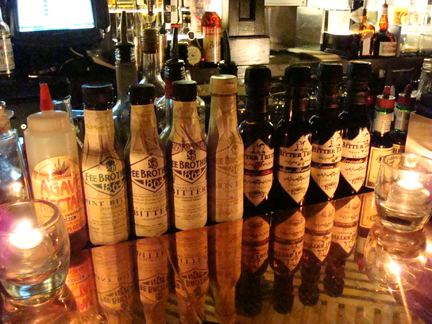
The bartenders at PDT are very creative and the shelves are stocked with unusual bottlings, like the bitters collection above. Our bartender poured us a taste of Lucid, which is purported to be the first legal American-made absinthe.

pdt2.jpg

Frankly, the drinks weren’t that good (mostly sugary to my palate) and the chili dog tasted like a whatever NYC street vendor dog with bland tomato sauce on it.

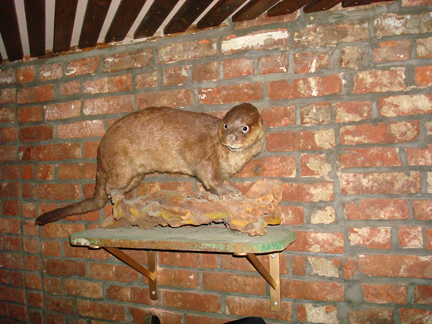
Flash photography is not allowed and I got kicked out after I took the above photo of the weasel (?). Evidently, PDT’s decorator is really into taxidermy.

death_co.jpg

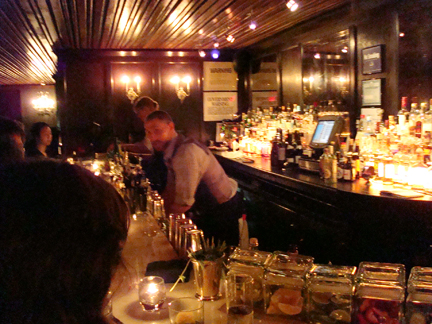
Next stop was Death & Co. (above), which is also a super-stylized and affected place. I really liked the look and feel of this 1920s tavern and its quasi-Edward-Gorey feel. I genuinely enjoyed my cocktail, a Company Buck, which is made with dark rum and housemade ginger beer. Our waiter was glib and professional and really knew her stuff.

little_giant.jpg

The end of the night found us at Little Giant where I was very impressed by the wine list but underwhelmed by the yes-I-hate-to-say-it way too affected food (panzanella with steak in it? oy…).

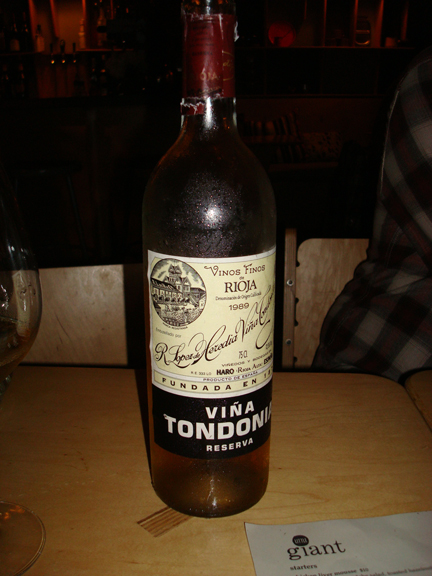
I made the mistake of ordering a 2003 Sassella by Sandro Fay, which was too modern (for me and my dining companions). I had never tasted the wine and, hey, you win some and you lose some. But the 1989 white Rioja by Lopez de Heredia (above), which we ordered upon being seated, was stellar. I had only tasted the winery’s whites back to 1994 and this was, by far, the best I’d experienced.

After so many cocktails and bottles of wines, our crew had achieved a certain brio and the confluence of a lot of style and some substance seemed to have blurred the lines between aesthetic experience and downright, pure-and-simple fun.