Our street:
 Our house:
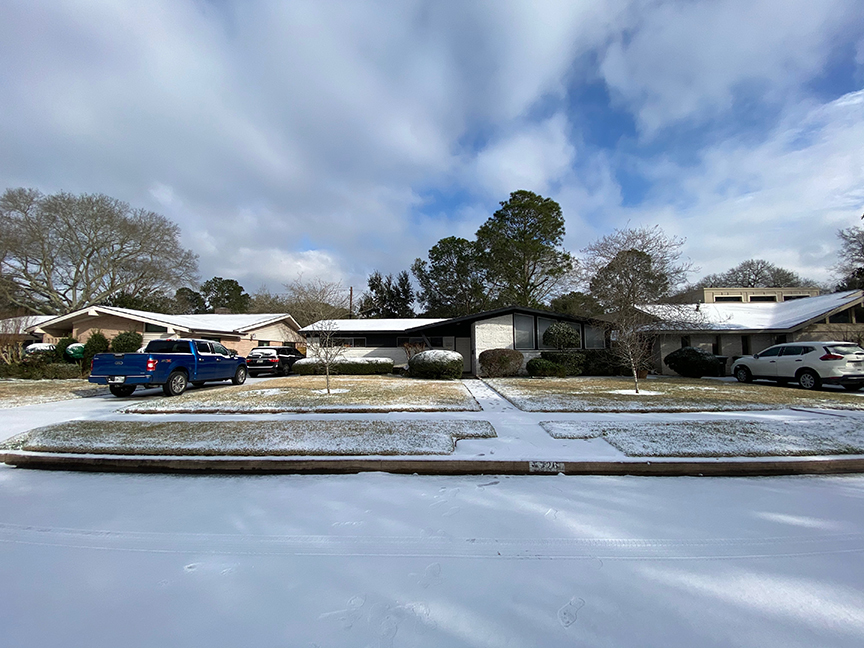 Incredible! Houston, Texas!

Our street:
Our house:
Incredible! Houston, Texas!
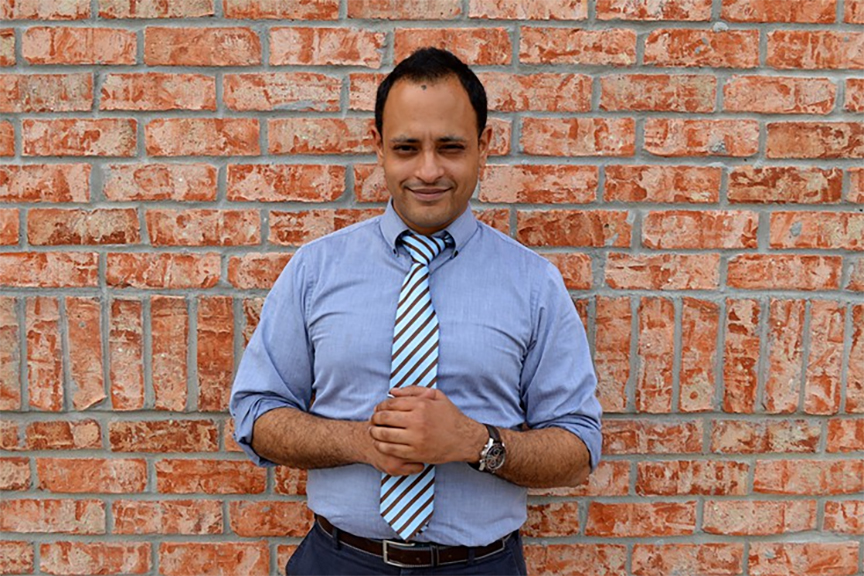 The Houston wine community mourns the loss of one of its most beloved members this week, sommelier Thomas Moësse. He passed away earlier this month in New York City where he had been living for the last few years.
Thomas was a world traveler, polyglot, and a top wine wine professional, equally admired by his peers and his guests alike.
Born in the United Kingdom, Thomas moved to Houston as a teenager but spent his summers in the Loire Valley where his family had roots and where he first learned to love wine. After attending college in New York, he returned to Texas and began working in Houston restaurants. His wine appreciation ultimately led to multiple certifications as a professional sommelier and wine educator.
In 2018 he returned to New York and the following year he became the wine director at one of America’s most celebrated Italian restaurants, Felidia in Manhattan, where he oversaw one of the city’s best wine lists and led seminars and tastings for its who’s-who list of guests.
Before moving to the east coast, he was the wine director and one of the founders of Vinology, the popular wine bar and wine shop in city’s West University district. He was also the wine director at one of city’s temples of Italian gastronomy, Divino, a long-time favorite destination for food and wine lovers.
I knew Thomas well and had the wonderful opportunity to taste with him in Houston and in Italy on many occasions. He was one of the best tasters I’ve ever shared a bottle with. And his passion, devotion to his craft, and knowledge of wine were were world class — an inspiration for all around him, including me.
He was also a man full of joy for life, for great food and wine, for great music, and — most importantly — for his friends. He was always ready to lend a hand at tastings and events, always ready to speak on a panel or offer advice and share his insights and dining recommendations.
Sit tibi terra levis Thoma. You will be sorely missed by your friends and community here in Texas. Our small world of wine won’t be the same without you.
Click here to learn how you can support the American Foundation for Suicide Prevention.
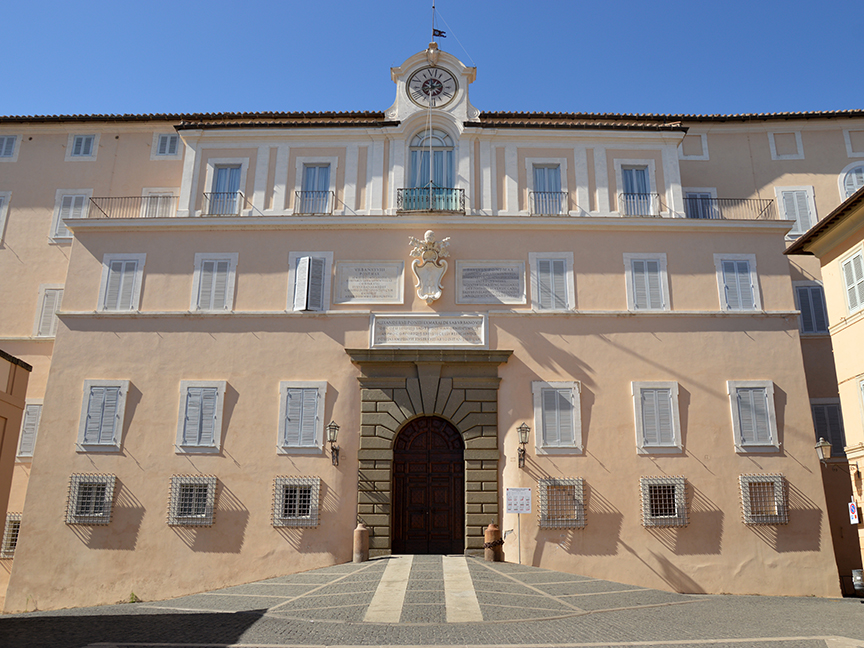 Above: the Apostolic Palace of Castel Gandolfo in Castel Gandolfo township outside of Rome (image via Adobe Stock).
According to a post published Friday by the Italian wine industry news portal WineNews.it, the Vatican will plant two hectares to vine this spring on its Castel Gandolfo estate outside Rome, the Pope’s official summer residence.
Although the grape varieties remain unknown, the project will be overseen by top Italian enologist Riccardo Cotarella, one of Italy’s most prolific winemakers and one of the country’s earliest “flying winemakers.”
This is the first time that the Vatican will grow grapes on one of its estates for the production of its own wine, write the authors of the report. The wine won’t be available for sale, they note, but it will be used for sacramental purposes and will be given as gifts.
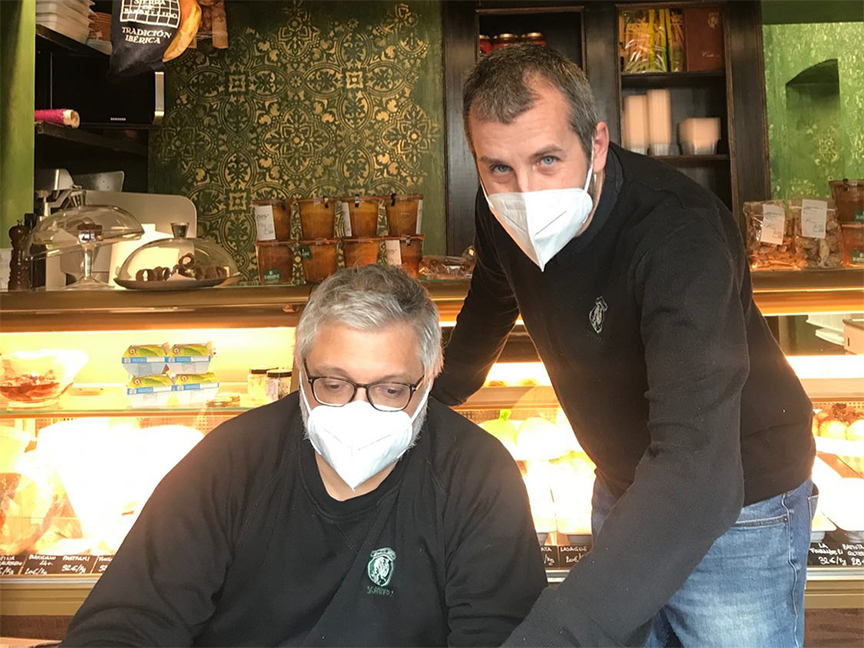 Above, from left: Scannabue’s co-owner and chef Paolo Fantini and co-owner and front-of-the-house Gianluigi Desana (image via the Scannabue Facebook).
In a brilliant video shared on social media last week, a pair of Torinese restaurateurs imagine a world where restaurants are just a figment of the past.
In the short film directed by Stefano Cravero and produced by chef Paolo Fantini and Gianluigi Desana, owners of Scannabue Caffè, Restaurant, e Gastronomia, a museum docent (with lanyard and all, played wonderfully by Italian actor Francesca Bracchino) leads a group of Italian and foreign tourists on a tour of the “restaurant museum.”
“Just think,” she says to her tour group, “they used to all sit around the same table and share the bread in the middle!”
“That’s disgusting!” blurts out one of the Italians in the group.
“Yes, I know,” commiserates the docent as she notes that “we need to remember: that was more than a year ago!”
There’s even a quip about American dining.
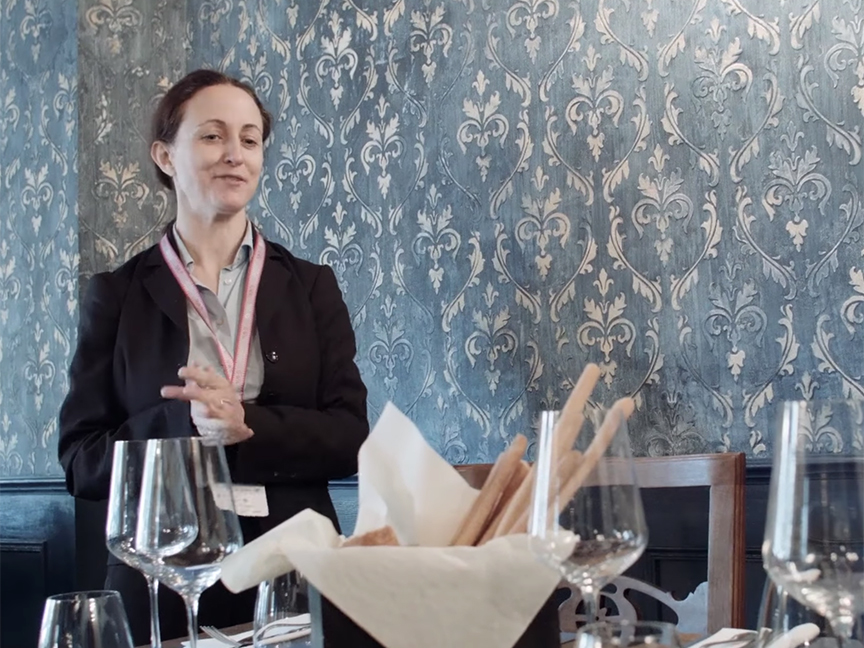 Above: a screenshot from the short film.
After one of the tourists asks the docent whether or not there were restaurants in other parts of the world like America, she doesn’t miss a beat before answering: “Oh, yes, they had restaurants in America as well. But let’s just say they were ‘faster.'”
The cortometraggio has really touched a nerve in Italy.
As of this posting, the video had been shared more than 400 times on Facebook. And it’s been featured in the Italian mainstream media.
The rituals of dining and gastrocentric socializing are key to the Italian identity. So many of my Italian friends have told me about how restaurant closures have weighed on their souls (not to mention winemaker friends who previously depended on independent restaurants like Scannabue for much of their sales).
You don’t need to understand Italian to follow along (although it’s even more funny if you can pick up on some of the nuance of Bracchino’s delivery).
The hilarious yet poignant video came to my attention via one of my favorite food and wine blogs, Sapori del Piemonte, edited by one of the most talented people in the trade and a great friend, Filippo Larganà.
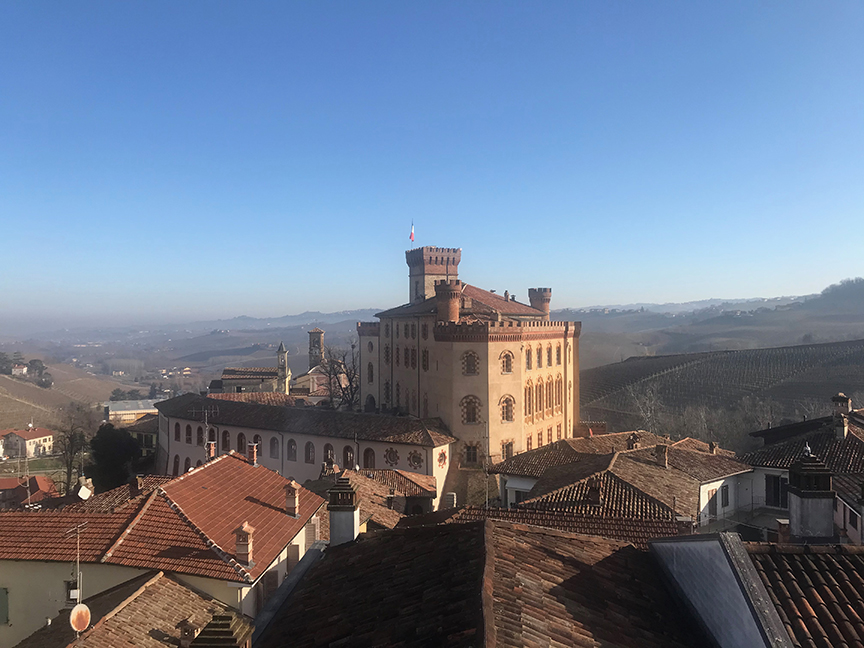 Above: Barolo Castle, photo taken January 17, 2020, on my last trip to Italy before the pandemic shut down global travel.
In an era when truth and fact seem to have become relative terms, it was remarkable to read the breathtakingly candid assessment of the 2017 vintage in Barolo circulated last week by legacy grower and winemaker Alberto Cordero, the current generation of the historic Cordero di Montezemolo winery in La Morra (disclosure: I contribute to his importer’s blog).
An “intense frost… hit not only Piedmont but practically all of Europe,” in April of that year, he wrote, “causing extensive damage in every wine-growing area from Tuscany upwards [northward]. One of the largest and most devastating frosts ever recorded.”
He includes in his a report a photograph showing one of the affected vineyards on his family’s historic estate.
In its entire history, he writes, his family had never seen “damage so huge from spring frosts.”
His notes hardly jibe with the notes issued by the Barolo, Barbaresco, Alba, Langhe, and Dogliani consortium.
“The 2017 vintage growing year will be remembered,” wrote the authors of the report, “for its hot climate, and in particular sparse rainfall.”
There was “some frost damage,” they added, “though in the Langhe only the bottoms of the valleys and cooler slopes were affected.”
Alternate facts?
Italian wine trade observers generally concur that the 2017 vintage represents a climatic anomaly, even for a decade when climate change delivered a string of extraordinarily extreme weather events.
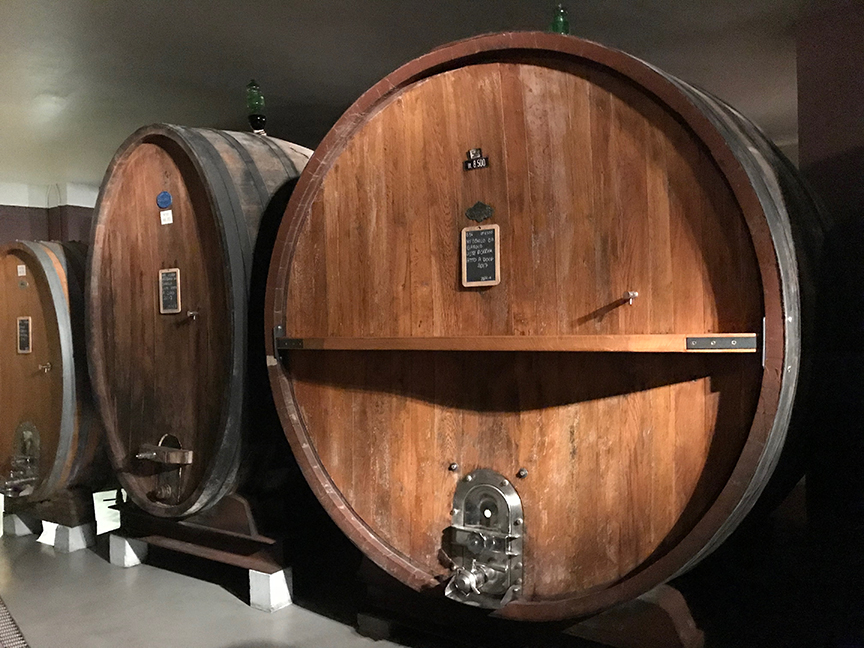 Above: 2017 Barolo in cask at the Cordero di Montezemolo winery.
“2017 – Hail, Frost & Heat…,” wrote Antonio Galloni on Vinous: “Whereas 2016 was an extraordinarily benign year, pretty much anything that could happen did happen in 2017.”
The editors of Jancis Robinson’s site have called the vintage “fairly dismal.”
“The 2017 vintage for Piedmont was difficult, to say the least,” wrote the editors of WineSearcher.com.
In November 2017, shortly after harvest had been completed, one of the consortium’s most prominent and politically active members wrote that the Piedmontese hadn’t seen such an extreme frost in half a century (I don’t want to name the winemaker, whose report still appears on their blog, for the sake of not pitting them against the growers and bottlers assocation).
Many years ago, I had the remarkable opportunity to ask one of Piedmont most celebrated growers about their impressions of Langhe vintages stretching back to the 1950s (again, for the sake of comity, I don’t want to name names).
They talked about how market concerns have often compromised vintage assessments. This was especially true, they said, in the 1970s and 80s, before the time of global warming, when Piedmont vignaioli were lucky to have one great vintage per decade, let alone a string of good if not exceptional harvests (a trend that began in the 1990s).
It wasn’t so long ago that a celebrated Langhe cooperative created a stir when it reclassified its 2006 cru-designate wines. The vintage was called “promising” at the time. But the release of the wines coincided with the peak of the financial crisis. The episode, controversial in some quarters, was the inverse of what typically happens: the bottler talked down the vintage because they wanted to justify the decrease in price.
Traditionally, February is the month when Italian wine pundits begin publishing their vintage notes for the year’s releases. And we should start seeing the 2017s from Langhe in the U.S. by May or so.
Some of the wines will be good, others very good, and some even exceptional. These days, it’s rare that a winery releases wines it doesn’t like (and given the technology available to those who choose to use it, it’s challenging to make bad wine).
In the case of the Langhe 2017 releases, there will just be less wine. As a famous Tuscan grower once noted, there are no bad vintages; there are just vintages when we make less wine.
It’s inspiring to read the brutally honest words of a grower like Alberto. Maybe it’s because he has a longer-term perspective that allows him to see this anomalous vintage as just one piece in a much larger puzzle.
Or maybe it’s because he knows that honesty is a key element in authenticity. This is especially true at a time when nearly everything in the world’s “constitution of knowledge” has come into question.
I applaud Alberto (who’s a really nice and extremely thoughtful guy, btw) for the candor and the earnestness. His report kind of reminds me of a “rare menu that tells the truth.” Please pass the orange beef.
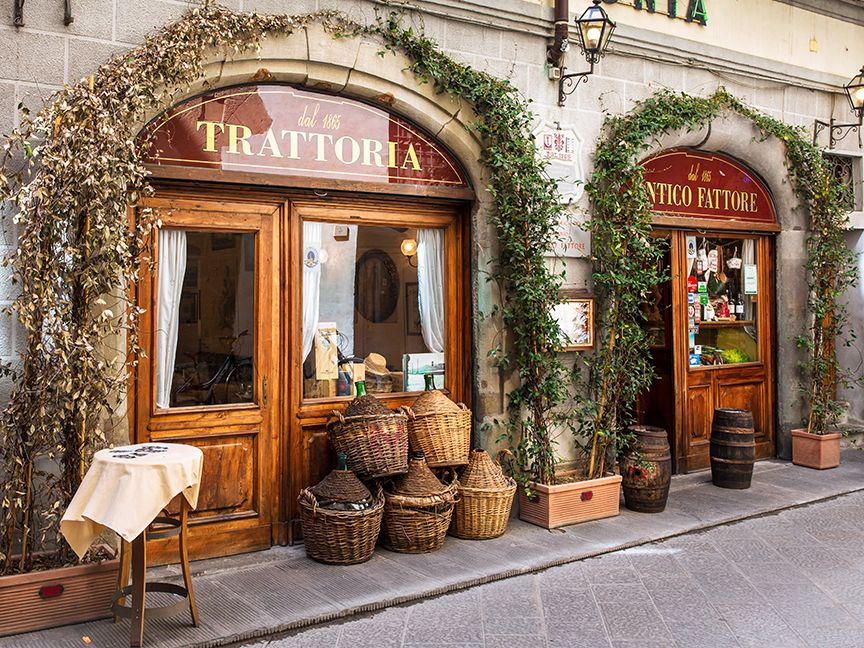
Above: a classic Italian trattoria in Florence (image via Adobe Stock).
“Let me call you later,” wrote an Italian winemaker in a text message around 1:30 p.m. Italian time today. “I’m eating lunch in a restaurant for the first time since dining rooms were closed three months ago.”
In all but five Italian regions, restaurants were allowed to open again today, Monday, February 1. In some cases, like Lombardy in Northern Italy where said winemaker lives, dine-in service has been prohibited (intermittently depending on the city and/or province) for the last there months and beyond. And take-away service was only allowed until 6 p.m.
Restaurateurs and café owners will still be required to close their dining rooms at 6 p.m. nightly, although they will be able to continue take-away until 10 p.m. and home delivery service is allowed 24 hours a day where available.
The re-openings are welcome news to restaurant owners, winemakers and grape growers, and brewers alike. Especially in the case of small-scale wineries, independent regional restaurants are a primary outlet for sales. The lifting of restrictions will undoubtedly lead to a much-needed boost in orders. Restrictions on tasting rooms and independent wine shops, some of which are still in place, have also slowed recovery for winemakers.
With most of Italy now under “yellow zone” restrictions,
– customers can consume food and beverages inside from 5 a.m. until 6 p.m.;
– take-away food and beverages may be sold from 5 a.m. until 6 p.m.;
– restaurants may still fulfill take-away orders from 6 p.m. until 10 p.m.;
– but beverage take-away from cafés (without restaurant service) and wine shops is prohibited after 6 p.m;
– delivery service is allowed 24 hours a day.
“I walked into the restaurant,” said the winemaker, who was seated in a dining room together with the family of his business partner, “and I told them to make me whatever they wanted. Anything. I just wanted to sit down and enjoy my meal without thinking about anything else.”
 Credit owed where credit is due: I developed my approach to naturally lit wine bottle product photography using this educational video by photographer Karl Taylor.
After a business partner of mine recently asked me lend a hand in creating wine bottle photographs for a new website they are launching, I set about watching instructional videos on how images like that are created.
With the skill set of an amateur photographer (emphasis on amateur), some low-cost tools of the trade, and my iPhone 11 Pro Max, I was able to shoot the bottles successfully without the use of professional lighting.
That’s my rig, above, in our kitchen dining room. See the video in the link for how it works.
The white poster board (purchased from a local arts supply store) was ideal for creating my “light box.” But the key to getting the “clean” shots was a used Lastolite 33″ Tri-Grip Diffuser that I picked up curbside from a local camera and photograph shop. You can see the diffuser to the right.
 Another key element was eliminating any light from behind the camera. I did that by covering the window in our kitchen door with a blanket.
As per the video, I changed the aperture on my iPhone camera and used my Apple Watch to trigger the shot (that made a huge difference in the final product). In the video, Taylor uses a professional-grade trigger. I found that my Apple Watch, “paired” with my phone, worked great for this.
As Taylor writes in his blog post: “No studio lights? No problem!”
One last crucial element was creating the right “table” for the shots. I did that using a smaller piece of poster board (luckily my library, the possession I’m most proud of, offered an ample selection of books for setting up my rig and mounting the table).
Ever since online platforms and digital media became a sine qua non tool for wine marketing and sales, bottle photography has been one of the field’s greatest challenges for wine professionals. The lack of professional training (as in my case) and the high cost of professional lighting and the skills needed to implement said lighting have been seemingly insurmountable obstacles in my quest to obtain clean, professional-looking “product” photography. Until now… I hope others will find this post helpful.
Be sure to check out Taylor’s blog post and video.
 Above: Palazzo Montecitorio in Rome, seat of the Italian Chamber of Deputies (counterpart to the U.S. House of Representatives). Image via Adobe Stock.
Although it wasn’t entirely unexpected, Italian prime minister Giuseppe Conte’s announcement yesterday that he would resign set into motion what the Italian media have called a grave “crisis in the dark” (a reference to the political turmoil of the 1970s when the country faced a complete economic meltdown).
The collapse of the Italian government comes as the country faces cascading health and economic challenges.
(See the links above for the New York Times coverage.)
For Italian winemakers, many of whom are relying on domestic sales to keep their businesses afloat as exports have dropped precipitously, the political infighting couldn’t come at a worse moment. With nearly all of the country under lockdown, Italian restaurants and wine shops are required to shutter their doors at 6 p.m. every evening. As a result, major supermarket chains and other national retail outlets, which are allowed remain open in the evening, are seeing a boost in sales. But because the chain retailers source their wines primarily from larger wineries, this shift leaves smaller estates, who depend on boutique shops and independent restaurants, without a means to sell their products.
Earlier this month, Andrea Terraneo, president of the Italian association of wineshop owners (Vinarius), sent an open letter to prime minister Conte and his health and economic ministers asking him to amend the restrictions crippling the independent wine retailer industry. The “discriminatory” 6 p.m. cut-off, he wrote, has led to a 30 percent drop in sales in a sector already decimated by the pandemic fallout.
The restrictions add to the woes of a hospitality industry already besieged by the pandemic.
For small-scale growers, the government collapse only exacerbates the economic pain felt across the nation. Tasting room closures and restrictions had already shut off one of their main sales channels. And now, with the government on hold, there is little hope that the restrictions will be lifted in the near future.
If Conte or one of his rivals (namely, the self-described “Machiavellian” Matteo Renzi), are unable to form a new coalition, it’s possible a technical government will be installed to oversee the country’s current covid response and the management of forthcoming financial aid from the European Union — another crucial element in the wine industry’s recovery. Although unlikely, snap elections would take months to be implemented.
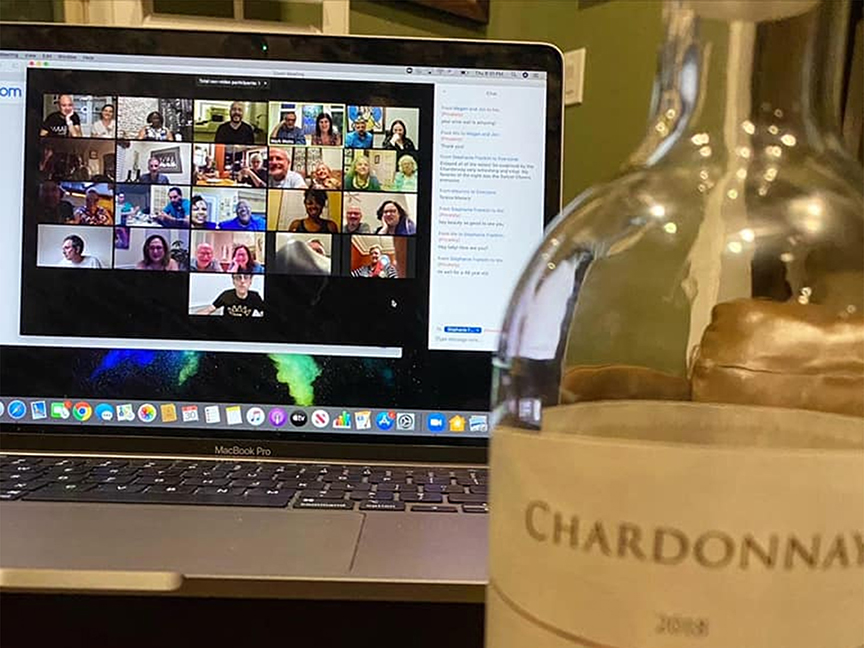 Image by the Corkscrew Concierge, a regular attendee at Roma’s virtual wine dinners.
Like many independent concept restaurants across the U.S., the barely four-year-old Roma in Houston was eager to shift to virtual events as soon as the shutdowns began to be enforced across Texas in the early days of the growing pandemic.
At the time, prospects for the restaurant’s survival were dim. As for tens of thousands of American restaurateurs (and for hundreds of thousands across the world), business had ground to a halt. Regulars, mostly middle-aged professionals, were reluctant even to order take-out in those early days of the health crisis. And for a “neighborhood,” “date night,” and “special occasion” restaurant like Roma, the world of plastic containers and utensils was as distant as Mars. The expression curbside available, now a workaday locution in the American restaurant lexicon, was as exotic as H.G. Wells’ “Martian herbs and trees.”
When the owner was approached by an energetic supplier/sales rep (a salesperson for a locally based importer and distributor), he gladly accepted her offer to organize a virtual wine dinner and tasting. Her idea — as brilliant as it was simple — was to have a winery representative in Italy on the other line, as it were, while the guests tasted through a three-bottle flight of wine paired with regional dishes. Yes, it would be 2:30 in the morning for the estate ambassador, but the sacrifice of a little sleep was well compensated by the potential sales and brand building — especially considering how business had declined precipitously in the early days of the new normal.
The initial virtual gatherings were unsurprisingly (at least in retrospect) clumsy. Zoom links that didn’t work. Guests who didn’t know how to mute their microphones and the subsequent TMI intimacy. Seafood dishes that were cold and rubbery by the time the guests opened their containers at home.
But the turning point came when the featured guest, the enologist son of a legacy Italian winemaker, began to insult the restaurateur over the pairings — in Italian. It didn’t occur to the dim-witted nimrod (excuse the pleonasm, merited in this case) that one of the guests, who happened to work as the restaurant’s media manager, was fluent in Italian.
The disconnect issue was only compounded when another microcephalic brand ambassador joked to the guests that the proprietary name of one of the estate’s wines could be loosely translated as “end of the world.” Appropriate, he quipped, for the times (despite the fact that he was employed by the estate, he didn’t realize the name was actually a reference to the nec plus ultra of Homer’s Odyssey).
And that’s when it dawned on Roma’s owner: the dinner’s “content” was being driven by the supplier rep and the brand ambassadors on the other side of the Atlantic; and the brand ambassadors, often export directors with poor English skills, were treating the events as if they were “supplier meetings,” as they are called in the trade, educational affairs where the brand ambassadors share insights with sales reps from regional distributors.
It was mid-July and the restaurant was still struggling, literally teetering on the brink of failure, when the owner made a radical shift: he would only host virtual wine events, he decided, with “principals” from the wineries, the winemaker or an immediate family member, and the featured guests had to speak English well. He also brought on a moderator, a wine professional with experience in public-facing wine education and public speaking, a veteran events organizer.
And that was what turned out to be the key: instead of letting commercial interests shape the events, his team would choose the wines, the pairings, and — most importantly — the winemakers who would represent the wines. The idea was to deliver a media “product” that was as entertaining and engaging as it was delicious.
He also made sure to keep the cost moderate. By negotiating aggressively with the distributors, whom he approached as opposed to them reaching out to him, he made sure the price per person remained palatable. What he found was that distributors were so keen to “move boxes,” as they say in the trade, that there was ample flexibility in pricing, “sampling,” and other strategies to offset the wine cost.
Almost as if by magic, the attendance at the dinners grew rapidly from 10-20 guests to 40, 50, and 60. By the fall even though the events were held on a weekly basis, he was regularly fielding 70-80 diners every Thursday evening. By the time the restaurant hosted its last event of 2020, it counted 90+ guests including some of the city’s leading wine mavens.
The secret, says the owner, is that he gives the guests what they want and not what the distributors want. And dulcis in fundo, the distributor reps aren’t complaining (anymore) either.
I’ll be joined by three other leading Italian-focused food and wine professionals a week from Friday as we discuss the mechanics of running a successful virtual tasting event for a webinar hosted by the Italy-America Chamber of Commerce South Central. See this link for registration details. All are welcome.
 Image via WhiteHouse.gov (Creative Commons license).
Please join us as we celebrate the life, teachings, and legacy of the great Dr. Martin Luther King, Jr. in Orange, Texas.
Continue reading
 Do Bianchi