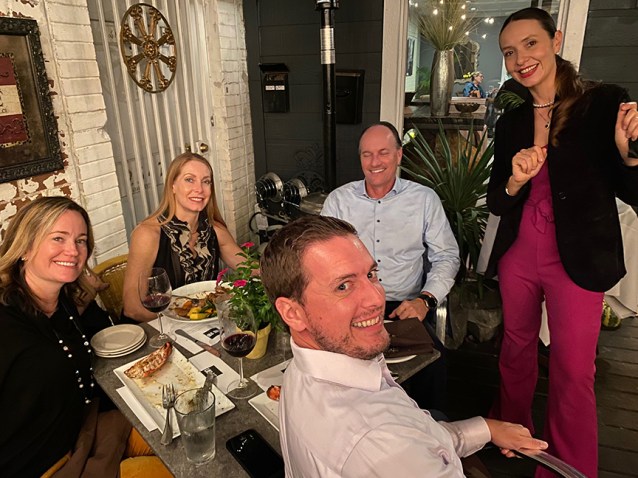
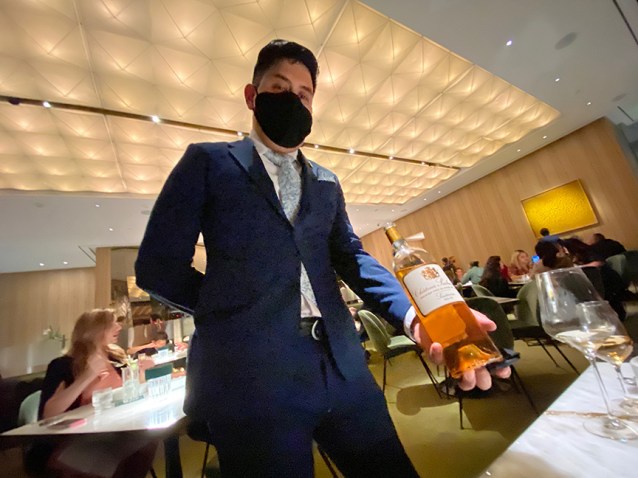
The wine bar of our dreams in Sonoma: Valley Bar and Bottle.

Please consider giving to Unicef’s Ukraine child refugee fund. This link takes you straight to the donation page. G-d bless our Ukrainian sisters and brothers. Thank you.
The sun shone through the trees on an unusually warm Sonoma valley early evening as kids played in the park and tourists milled about the shops and tasting rooms.

And it felt like a dream as I walked through the threshold of Valley Bar and Bottle in downtown Sonoma right on the main square.

Continue reading

Where homage to tradition is transcendent: Cotogna in San Francisco, one of my best meals this year.

Wines for Peace: Brunello Consortium auction benefitting Ukraine, Monday, April 11, at Vinitaly. Click here to learn more.

Since the late 1980s, Italian cuisine in the U.S. has been shaped by a tension between traditional- and creative-leaning forces.

Remember the wave of “northern Italian cuisine” that came around in the Reagan years? “Sunday gravy” was out and polenta was in.

The problem was that culinary interpreters often didn’t see these dishes in historical or cultural context. The rich meat- and jus-driven sauces we ate as kids in this country were a derivative of haute Neapolitan cuisine (vis-à-vis Ippolito Cavalcanti).

Polenta, on the other hand, so popular “rustic” and “peasant” (ugh, I can’t stomach that term) movements of the late 1990s, was a dish that many older people in Italy refused to eat at the time because it reminded them of a time when there wasn’t enough to eat (the 19th-century pellagra crisis in Italy was caused in part because polenta had become a staple for economically marginalized families; in the years following WWII, many older Italians in the north will tell you, polenta was all they had to eat).

Making my way over to Cotogna from my hotel in San Francisco the other night, I couldn’t help but remember a chilly winter evening in the late 80s when I stopped a man on the street and asked him if he knew the way to a certain “trattoria,” a name for pseudo-Italian restaurants that had become popular in the second half of the decade.

He did, he responded, but he would only tell me — and I’m not kidding about this — if I pronounced it correctly.

It wasn’t traht-toh-REE-ah, as I had enunciated it. It was traht-TOH-ree’ah, with the emphasis on the second syllable, not the second to last.

It kinda says it all, right there.

In my view and experience, the greatest Italian restaurants in the U.S. have always found a precarious however brilliant balance between the traditional and creative. And my meal at Cotogna was a fantastic example of how respectful homage to tradition can be transcendent.

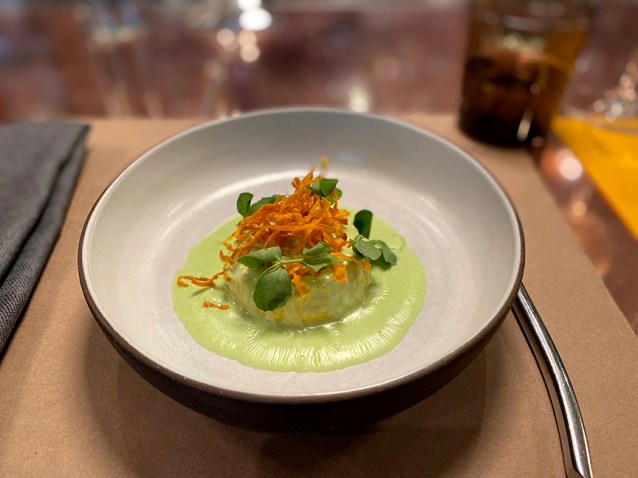
The carrot sformato (first photo) blew me away with its ethereal texture and subtle dance of bold but elegant flavors. Sformato — properly called a savory custard in English — is all about the texture. It should be firm but light, rich but buoyant. I know already from my Instagram that people agree with me: this dish was nothing short of show-stopping. I loved it.

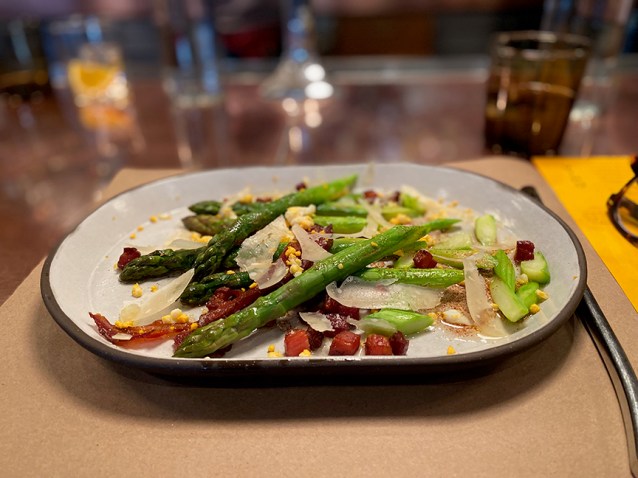
The asparagus alla fiorentina (second photo) brought to mind trips to San Francisco with my parents when I was a child in the 70s. They would slurp coffee as they inhaled “eggs Florentine” at a swank hotel restaurant on Union Square.

This truly Florentine-inspired dish sang out to me. The flavor — the bontà or goodness as we say in Italian — of the materia prima was nothing short of spectacular. And I loved the play in texture — again, texture! — between the lardons and American-style bacon (which btw is extremely popular in Italy today).

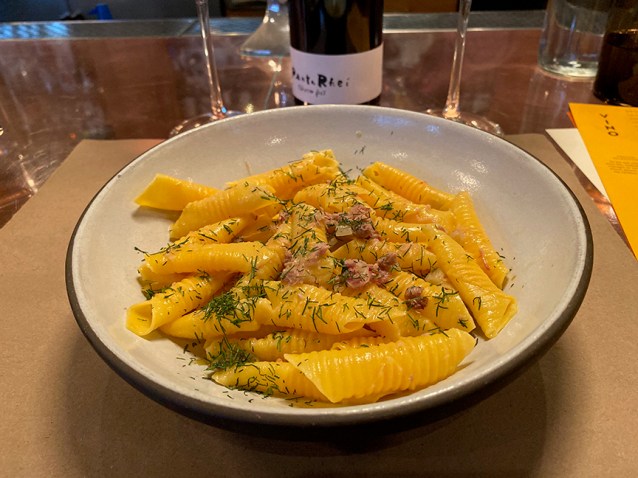
The finale, garganelli with rabbit, also played on its balance of textures and subtle flavors. I loved that the rabbit was ground, not stringy, and the richly flavored pasta was the focus of this dish, not the rabbit. I couldn’t agree or have enjoyed it more.

Paired with the delicious, spicy Ruché Panta Rhei by Valdisole (thank you, Ceri Smith!), this dish became the synecdoche for the entire dinner. For a generation who grew up complaining that there wasn’t enough sauce on the soggy over-cooked and rinsed pasta, it made me feel like we might finally have adolesced.

Thank you wine director Joseph Di Grigoli and team for taking such good care of me. Your work is as inspiring as it is delicious.

Wines for Peace: Brunello Consortium auction benefitting Ukraine, Monday, April 11, at Vinitaly.

Image via Caritas.it.

On Monday, April 11, on the occasion of the Vinitaly wine trade fair in Verona, the Brunello Consortium, in partnership with the Chianti Classico and Bolgheri consortia, will be holding an auction of large formats and prized vintages to benefit Ukrainian refugees in Italy. The event, “Vini per la Pace” (“Wines for Peace”), will include 30 rare lots.

Proceeds will be donated to the Siena province chapter of Caritas Italiana (Caritas Diocesana di Siena-Colle di Val d’Elsa-Montalcino) whose administrators will direct the money to refugee services.

The auction is scheduled to begin at 4 p.m. local time and is being coordinated by Sotheby’s. Online bidding will be available via Bid Inside.

Visit viniperlapace.bidinside.com to learn more.

Caritas Italiana is part of Caritas Internationalis, “a confederation of 162 Catholic relief, development and social service organizations operating in over 200 countries and territories worldwide” (Wikipedia).

Vinitaly, don’t have too much fun without me!

Every year at my Vinitaly, there’s a first-day toast organized by a loosely knit group of Italian wine bloggers and social media users at the Abruzzo region stand.

It’s been an honor and a joy for me to be included over the years. That’s our group in 2019, above, at the last Vinitaly before the closures began in early 2020.

As my social feeds are being flooded with images posted by my American colleagues, some of them already in Italy as they gear up for the fair, my heart is teeming with bittersweetness.

Because I have to be in Italy next month to teach at the Slow Food University of Gastronomic Sciences, I wasn’t able to make the trip this year to the trade fair. Now that Tracie is working full-time, we need to budget our time parsimoniously and a trip to the fair would mean missing a weekend in Houston when Tracie will be showing houses and I’ll be taking care of the girls. (When I go in May to teach, I’m literally going to be on the ground for five days while I teach four seminars.)

One of the most compelling experiences in my post-2020 era has been reconnecting in person and in real time with wine people and friends in Italy and the U.S. I’m so bummed that I won’t be in Verona next week.

But less travel, especially less travel to Europe, is part of our family’s new normal. It’s not a sacrifice, by any means. But it’s part of our new life rhythm. And that’s a good thing. As Tracie has been working, I’ve been spending more time with the girls working on music and doing schoolwork. They both play a stringed instrument, they both take piano, they both perform with the school choir, and they are both girls scouts. So please call me Mr. Mom. I love every single minute of it.

What I wouldn’t give to look for a parking place for an hour!

What I wouldn’t give to stand inline for a stinky bathroom at Veronafiere (the fairgrounds where the event is held), my shoes sopping from the centimeter of liquid on the floor! (Don’t ask.)

And what I wouldn’t do to fight the crowds, the throngs of drunken laypeople, the cigarette smoke (which I really don’t mind but…), the wifi and cell coverage that never work, and the long lines to buy a bottle of water or a sandwich!

Seriously, what I wouldn’t give to see my many friends I’ll be missing next week.

To everyone going to the fair, have a great one! Buona fiera! Buon Vinitaly! But don’t have too much fun without me!

Ashtin Berry is one of the greatest wine writers of our generation.

Please consider giving to Unicef’s Ukraine child refugee fund. This link takes you straight to the donation page. G-d bless our Ukrainian sisters and brothers. Thank you.

Read. Ashtin. Berry. Now.

“There is nothing inherently wrong with minimalism,” she writes in a recent post on Instagram, “but it’s essential to understand how aesthetic trends are always in discussion with social structures. and also note when aesthetics are being used to push harmful biases. Minimalism is an aesthetic and it is also a lifestyle and if you aren’t careful you can end up perpetuating biases about poor and racialized people.”

In my view, there is no eno-focused writer today who is addressing the epistemological implications of wine culture with such unbridled perspicacity and clarity of voice.

Her post yesterday (above) is one in a series where she parses some of the thornier nuances of the contemporary natural wine world. Along the way, she draws from a broad spectrum of critical theorists, some of whom will surely surprise even the informed student of 20th century thought.

I’m certainly not the first to note the power of her voice. She’s been featured in countless who’s who lists by prominent wine-centered mastheads.

Those publications, at least as far as I can find, tend to focus on her utterly vital inner- and extra-industry activism. There is no question that her community work has had an outsized and welcomed impact.

But what intrigues me most about her writing is that she approaches the subject as a critical theorist. She is a Roland Barthes of our wine time, a writer who dissects the aesthetics — the ars poetica — of contemporary wine culture with acumen and deep insight. She is also a Noam Chomsky in her ability to see behind what Nietzsche would have called the “sacred texts” of wine, the cultural hegemony (to borrow from Gramsci) that continues to drive what she calls the “moralized consumption” of wine (and other lifestyle products).

I know those are big shoes to fill but fill them she does… and then some.

She also possesses a preternatural ability to ferment her observations into approachable, highly drinkable language. In a wine writing world where the register of language and the hermetic argot are often used in an exclusionary capacity (she address this trend as well), she seamlessly renders her thought into palatable demotic language digestible by all. It’s a glorious, beautiful balancing act that delivers spectacular results in widening the horizons of lay people and trade members alike.

Can you tell that I am entirely absorbed by her writing? I’m a little late to the game but am glad to be here. And thanks to Tracie for hipping me to her feed.

Ashtin Berry is one of the greatest wine writers of our generation. Read her.

Addio Roma. You really broke my heart.

Please consider giving to Unicef’s Ukraine child refugee fund. This link takes you straight to the donation page. G-d bless our Ukrainian sisters and brothers. Thank you.

Above: in November of last year, I presented a sold-out dinner at Roma in Houston featuring the wines of Alicia Lini (standing).

It’s with deep sadness that I share the news: Roma, the Houston restaurant where I ran the website, e-letter, and social media for nearly five years; where I helped the owner rebrand his business; where I ran weekly virtual wine dinners during the lockdowns; and where I wrote the wine list since May of last year, is no longer my client.

The reason? The new chef, Kevin Bryant, doesn’t believe my marketing skills are up to snuff. Evidently he and his wife are marketing geniuses. Five years down the drain. Just like that. All because of a pig-headed chef who thinks that chicken liver mousse passes for a bona fide topping on crostini toscani.

It was clear from the start that he wanted me out and he wanted his wife in. She’s a high-powered publicist with a who’s who of leading Houston restaurateurs in her portfolio. At least that’s what she and her husband think.

Honestly, I wasn’t really interested in working with a chef who believes “steak tartare” is an Italian dish. (All the previous chefs I worked with there were Italian and had cooked and trained in Italy.)

The thing I’ll miss is the incredible community we built through the weekly virtual wine dinners I ran for nearly two years. It’s hard to believe now but we must have presented roughly 100 Zoom events, often with an Italian winemaker participating on the other side of the Atlantic. It was one of the most compelling and rewarding experiences in my career in wine. So many of my now ex-guests have told me that those events were what kept them sane during isolation. It was a virtual supper club where people forged connections and friendships. I’ll never forget the night that a prominent Houston doctor, the wife of a noted Houston wine blogger, began helping people get vaccine appointments in the early days of availability.

No regrets, coyote. The restaurant business is always full of drama and microcephalic players like “the Kevin,” our family’s apt nickname for him. And this wasn’t my first rodeo, as we say in Texas.

Addio Roma. You really broke my heart.

Orange was the most highly prized wine in the Italian Renaissance. I can prove it.

Please consider giving to Unicef’s Ukraine child refugee fund. This link takes you straight to the donation page. G-d bless our Ukrainian sisters and brothers. Thank you.

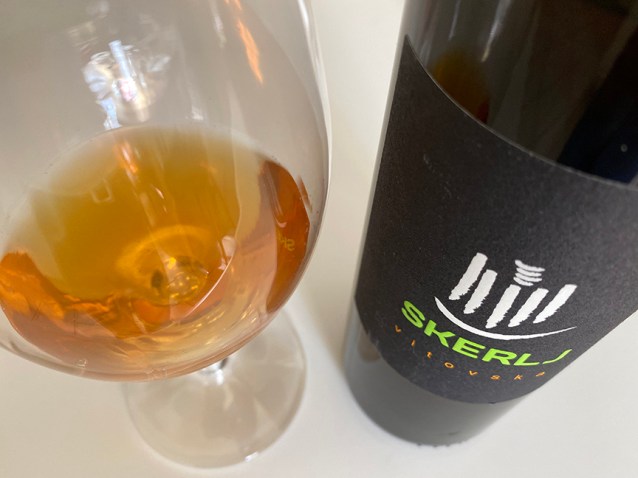
Above: last night, Tracie and I treated ourselves to one of our favorite macerated white wines from Friuli, the Vitovska by Skerlj. I’m now more convinced than ever that the most highly prized wines in the Italian Renaissance were “orange” like this one.

It hit me like a brick of bio char: vin greco (Greek wine) in the Renaissance was neither red or white according to a then best-selling author. It was golden brown, like a lion’s mane noted Cesare Crivellati, a medical doctor and wine writer from Viterbo whose Trattato dell’uso et modo di dare il vino nelle malattie acute, contra il costume de nostri tempi (Treatise on the Use and Mode of Treating Acute Illness with Wine, [a Guide] Counter to the Customs of our Time) was published in Rome in the second half of the 1500s.

On white wines that are not quite “white” but definitely not “red” he writes, “si deve intendere di colore fulvo o flavo come è quello della malvasia, del greco, e simili.”

“They should be considered fulvous or flavous in color, as is the case with Malvasia and Greco and similar [wines].”

The descriptor fulvo is from the Latin fulvus (fulvous in English), a term generally translated as “deep yellow, reddish yellow, gold-colored, tawny” (Lewis and Short).

Similarly, flavo from the Latin flavus meaning “golden yellow, reddish yellow, flaxen-colored” (Lewis and Short).

The word fulvus was used in antiquity to denote the color of a lion’s mane, to put it in context.

The discovery was part of my ongoing research on wines in Italian literature from 1300-1600. In and of itself, the quote is highly significant in our contemporary understanding of wine during the late Italian Middle Ages and Renaissance.

But there’s also an extremely important observation to be made here based on my extensive readings of primary texts from that era.

At the time, the term vin greco (Greek wine) referred not to the modern-era grape variety Greco or family of white grapes known as Greco, Grechetto, Grecanico, etc. Instead, it denoted a style of wine that often arrived by ship via Greece but was also produced in significant quantities, particularly in Naples where it was famously grown and vinified on the slopes of Mt. Vesuvius.
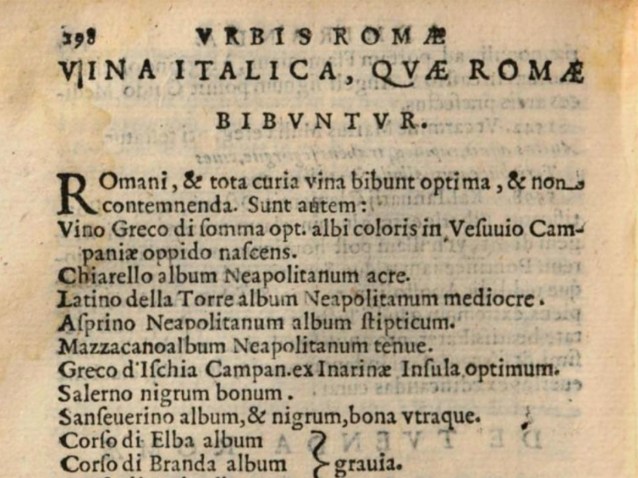
Above: a folio from Itinerarium regionum urbium et oppidum nobiliorum Italiae (Itineraries Through the Noble Regions, Cities, and Towns of Italy), a travel log published by Flemish jurist Franz Schott on the occasion of the 1600 Jubilee declared by Pope Clement VIII.

By 1600, when Franz Schott (1548-1622) published his travel guide to Italy (above), Rome was already an important “wine destination,” as we would call it today. And the number-one wine in Rome, as Schott notes, was vino greco (see the image above):

“The Romans and the entire [Papal] court,” he writes, “indisputably drink the best wines [in Italy]. They are as follows. The best is white in color, Vino Greco from Somma, which is grown in the town of Vesuvius in Campania…”

He calls it white. But as noted in the Crivellati quote above, it was common to call tawny-colored wines “white” at the time. The confusion about tawny wines like Malvasia (a style, not a grape) and Vin greco (again, a style, not a grape) was such that Crivellati felt compelled to address it.

So the fact that Schott calls it albus doesn’t mean it wasn’t fulvus.

A few decades later, Francesco Redi, the Italian scientist and poet, would refer to the “amber” color of wines made in Crete (in Greece) and the Neapolitan coast and islands, not far from Vesuvius.

In his poem “Bacco in Toscana” (“Bacchus in Tuscany”), he refers to the “preziosa… ambra liquida cretense” (“precious amber liquid from Crete”) and in another instance, to the “noble wines” of [the island of] Ischia and the town of Posilippo on the Gulf of Naples.

The last however extremely important piece of evidence that leads me to believe that vin greco was an orange wine comes from the Trattato della coltivazione delle viti (Treatise on the Cultivation of Vines) composed at the end of the 1500s by Giovanvettorio Soderini (see one of my posts on Soderini here). In his work, he describes a practice of vinifying wines on the solids from previously vinified vin greco. This would seem to indicate that vin greco was made by fermenting the must on its skins. As any observer of the contemporary Italian wine scene knows, orange wine gets its amber color through the fermentation of white grapes on their skins.

My research is part of a bigger project slated for academic publication on the literary implications of wine in Boccaccio. As I publish more of my work, it will become clear that vin greco and wine in general play a greater role in the Decameron than previous scholars have imagined.

I hope you enjoy reading about it as much as I enjoyed putting it together! More to come… Thanks for being here.

 

Time to reimagine the Oxford English Dictionary definition for “sommelier”? @OED

Please consider giving to Unicef’s Ukraine child refugee fund. This link takes you straight to the donation page. G-d bless our Ukrainian sisters and brothers. Thank you.

This just in from the department of lexicography…

Anyone who owns or runs a website is familiar with the tide of unsolicited emails from would-be web designers and SEO “experts” who want to sell their services. One such email arrived in my inbox last week. But it had an unusual message.

The sender’s services, the email’s author wrote, would help me to correct myriad spelling errors on my site. And they provided an example of an egregious orthographic error on my site — the word somm.

It struck me as odd because as a rule, the word sommelier always appears in its unabridged form on my blog.

Curiosity killed the cat. Is somm not considered an acceptable rendering? The urge to look up the entry for the lemma in the Oxford English Dictionary was too much to bear (btw look for the OED “draft addition” entry for lemma and you will find the acceptation used here).

The first thing that struck me is that somm is not included as an accepted abbreviation or alternate spelling.
At this point, somm the truncated form has nearly eclipsed the use of sommelier. And especially after the release of the “Somm” films, it has prevailed in winespeak, both professional and laical.

It has also been verbified or denominalized, depending on how you like your grammar.

Tonight Andres will be somming is understood in professional circles to denote that tonight Andres will be working as a sommelier on the floor of the restaurant. (That’s Andres Blanco in the photo above btw).

It’s surprising that the OED hasn’t yet included a definition for to somm.

It’s also dumbfounding to note that the last example reported by the editors is dated 1974. If you’re, say, 30 years old and working as a sommelier, you weren’t even born when the London Times reported that “an awe-inspiringly stately sommelier and long wine lists… can often discourage the sale of wine” (see above).

Wow, how the world of wine has changed since the year when the U.S. had two presidents in the same term (Nixon and Ford)! It’s also the year that the Stones released “It’s Only Rock ‘n Roll.” Just think what the wine world was like back then and who populated it.

It’s also no short of nonplussing that the only bona fide meaning the editors give is “wine waiter.” Today, the sommelier is so much more than just an arbiter of good wine and keeper of the cellar. Modern-day sommeliers are hosts, educators, tastemakers, entertainers, performers, human resources managers, entrepreneurs, authors, and even activists. Some would go as far to call the work of a sommelier “art.” None of this spirit is present in the OED entry.

But the thing that made the deepest impression on me is that in all the usage examples offered by the OED editors, each one includes a hint of negativity, a note of condescension, or, at worst, a downright insult to the sommelier profession.

The sommelier is actually a “butler.”

The sommelier jumps at the snap of fingers to fetch a cocktail.

The “fastidious wine-bibber” terrorizes the sommelier.

Standards are high even though there are “some cooks to shoot and many sommeliers to educate.”

And the irony in the “stately sommelier” who “discourages” wine sales is hard not to suppress.

Isn’t it time for the editors to reimagine the definition?

Once we get that taken care of, we can start working on an update of their entry for puttanesca.

Such is the fate of hapless lexicography that not only darkness, but light, impedes and distresses it; things may be not only too little, but too much known, to be happily illustrated.

Samuel Johnson
1755

Parenting in the wine industry, a wonderful piece by Rachel Tepper Paley for Wine Enthusiast.

Please consider giving to Unicef’s Ukraine child refugee fund. This link takes you straight to the donation page. G-d bless our Ukrainian sisters and brothers. Thank you.

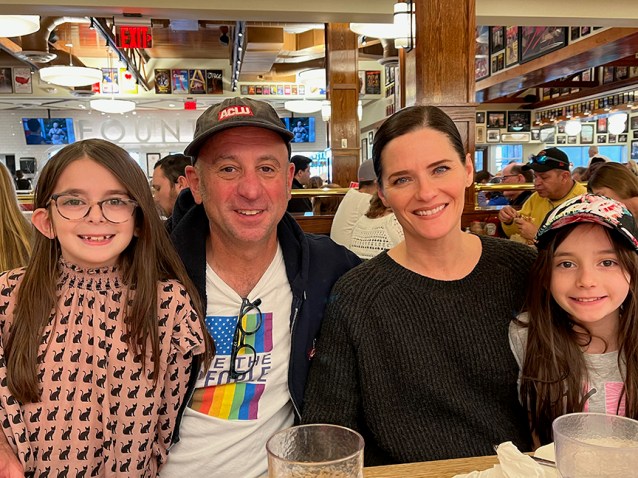
Above, our family, from left: Lila Jane (age 8), me, Tracie, and Georgia (age 10). Photo by Bruce Schoenfeld.
What a thrill for our family to be included in Rachel Tepper Paley’s wonderful piece about “Raising Kids Around Wine” for Wine Enthusiast this month!

The funniest thing was that I happened to be on a work call yesterday with Kristi Devlin Delovitch whose family was also featured in the article. You can imagine our delighted surprise when we all made the connection.

Her husband got the best line in the story. Working in wine, he said, has “brought Italy, it’s brought France — people from those countries and their culture into our house. It’s allowed us as a family to see the world and to experience it from the comfort of our own home.”

In my view, that’s what it’s all about: culture and experiencing wine as a cultural expression. After all, there is no culture without agriculture.

The following are excerpts from the answers I sent to Rachel for her piece. I love that writers like her are expanding the horizons of wine writing. Families matter in wine, too.

Check out her excellent article on the Wine Enthusiast website here.

*****

The greatest benefit of our “wine-positive” household is that our children understand that wine is an expression of human culture. They regularly meet Italian winemakers (many of whom don’t speak English; my wife and I are both fluent speakers of Italian). They have visited Italy with me and have toured wineries and wine country. It’s given them a sense of the fundamental role that agriculture plays in all of our lives. Without trying to sound cliché, it helps them understand the connection between the land and what we consume.

It’s also given them an understanding of how wine is something that can give us both aesthetic and intellectual pleasure. They know that wine isn’t just something to drink. It’s also something to think about, something that can open new worlds to the thoughtful consumer.

The only real drawback for our family is that my work requires me to travel a lot.

We don’t make wine a taboo subject. We drink wine nearly every night at dinner and often enjoy more than one glass after dinner as well. But we never conceal our consumption from the girls. We talk about how wine is a type of food, how it aids digestion, and how it can be a healthy part of your diet. We consciously model our culinary life after the Italian diet, where wine is a food to be served with food. I believe that they will have healthier attitudes about wine as a result.

I grew up in a household where alcohol was always taboo. That made it all the more alluring to me as a teenager. We are working to give our kids an understanding of wine and alcohol in a cultural context.

We have so many close friends in Italy who work in wine. It’s never an issue there. As a matter of fact, I have occasionally had to explain to my Italian clients that we don’t allow children to appear in any marketing materials for wine here in the U.S. (because it’s illegal). My wife and I both lived in Italy for years. Based on our experiences there, I believe we knew what to expect.

We are concerned, like all parents, that our kids won’t have a healthy relationship with alcohol when they get older. But our hope is that when they become old enough to drink, their experiences growing up with a parent working in the wine business will help them have a positive and respectful relationship with alcohol.

Wine and alcohol in general were taboo in my family. There’s no doubt in my mind that I would have had a safer experience with alcohol had my parents talked more openly about it with us. It was a generational thing, of course. But it led to some excess and abuse of alcohol when I was a kid.

Our kids don’t have any desire to try wine but they LOVE pouring it for Tracie and me. They still can’t use a wine key but we have taught them how to serve wine. They often scold me for not holding my glass correctly!

They watched the recent 60 Minutes show on “weather and wine” (the producers had contacted me because they wanted to use images from my blog; so we watched the show together). Georgia, our 10-year-old, said, “daddy, it’s weird that you only drink Italian wine. You should drink English wine, too!” I’m sure that her obsession with the Beatles and her growing Anglophilia might have something to do with that.

Coravin-Prosecco experiment delivered a surprising result.

Please consider giving to Unicef’s Ukraine child refugee fund. This link takes you straight to the donation page. G-d bless our Ukrainian sisters and brothers. Thank you.

Back in the fall of 2021, attendees at the Boulder Burgundy Festival were blown away by a Champagne tasting organized by the marketing team at Coravin, the event’s title sponsor.

Guests were invited to taste top-tier Champagne that had been accessed weeks, even a month, before the gathering. The freshness of the wines and their vibrance on the nose and palate were nothing short of stunning — no need for apologists. Had they tasted them blind, even some of the world’s top experts on sparkling wine — and there were more than a few in attendance — would have been hard-pressed (excuse the pun) to nail the access date. The wines sparkled (pun intended) as if they had been opened on the spot.

Many of the sommeliers present that day commented how the new Coravin sparkling closure, which officially launched the week of Boulder Burgundy Festival, could be a game-changer for by-the-glass programs.

What happens, one could posit, when a guest arrives not long before closing and asks for one glass of Champagne? Maybe the sommelier is lucky and there is just one glass left in a bottle they have been pouring throughout the evening. But more likely than not, they will have to reach for an unopened bottle, only to pour one glass of the six it contains. What guest is going to want to taste that same wine, opened the night before, the next day? And by next day, that means a whole day before service begins again.

Gauging from my experience in Boulder, the Coravin sparkling closure is going to change all that. If my tasting were indicative of the device’s potential, no guests — not even the experienced sparkling wine lover — would perceive the difference between a newly opened bottle and another accessed the night before.

But would the closure work with other types of sparkling wine? In particular, at least one blogger wondered, would it work with tank-method wines like Prosecco.

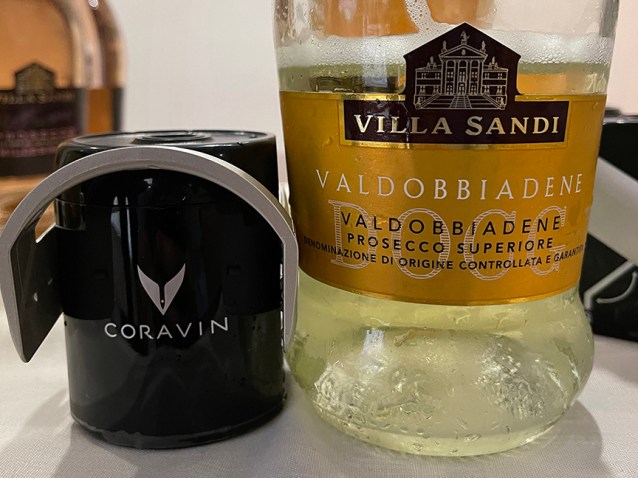
Two weeks before the Taste of Italy trade fair and festival, on February 27 (see the time stamp in the video), I had our older daughter film me as I opened four bottles of Villa Sandi Prosecco — two bottles each of classic Prosecco Valdobbiadene and Prosecco Rosé. Then, on Monday, March 14 (the day of the walk-around tasting at the fair), I poured them side-by-side with four bottles of the same wine that I had opened on the spot.

Villa Sandi is known for their signature freshness and their one-tank fermentation method (whereby they never rack the wine during production, thus eliminating nearly all contact with wine’s enemy: oxygen). It was the perfect guinea pig for this experiment.

The wines, which were consumed liberally by candidates in the Villa Sandi Houston Sommelier Competition and by Italian winemakers attending the event, were fantastic, fresh as if they had just been opened. All agreed that the closure had worked brilliantly.

But something surprising happened as well. There was no question in anyone’s mind that both sets of wine were perfectly fresh and vibrant. But the wines that were accessed two weeks prior were actually more vibrant in their fruit flavors. All agreed that you couldn’t tell the difference, in terms of freshness, between the two sets of wines (all the wines, the accessed wines and the wines opened the day of the event, had been shipped to me on the same day in February btw). But there was definitely a subtle however perceptible difference between them.

It was an extremely nuanced and subtle divergence. But the more experienced tasters in our group all picked up on it.

The Coravin closure worked exactly as predicted. But I also have to give a shout-out to winemaker Stefano Gava, one of the top people working in Prosecco today imho, for creating these wines with such wonderful freshness and shelf life.

My advice to on-premise buyers: be sure to ask for the professional Coravin sparkling closure model with its larger gas capsules, ideal for a sparkling btg program.