At Allegra Angelo’s wonderful Vinya in Miami, the hegemony of the tasting note is disrupted.

From my colleague Nicola Perullo at the Slow Food University of Gastronomic Sciences in Piedmont to leading sommelier and author Pascaline Lepeltier in New York City, wine thinkers across the world are trying to forge a new language — a new dialectic — to describe the tasting experience.

If ever the twain were to meet, I doubt they would agree on much — except for one thing: the hegemony of the 20th-century tasting note (and score) must be disrupted for Westerners to continue to evolve as tasters.

For an international and youthful wine community where wine and wine culture have long moved past the idols of the last quarter of the 1900s, it’s hard to believe that the tasting descriptor canon created nearly 50 years ago continues to be the predominant medium for wine communications.

In the light of these highfalutin and literally epistemological issues being faced by the current wine intelligentsia, I drew a deep breath of fresh air when I walked into Allegra Angelo’s extraordinary wine shop and wine bar last night in Key Biscayne (Miami), Florida.

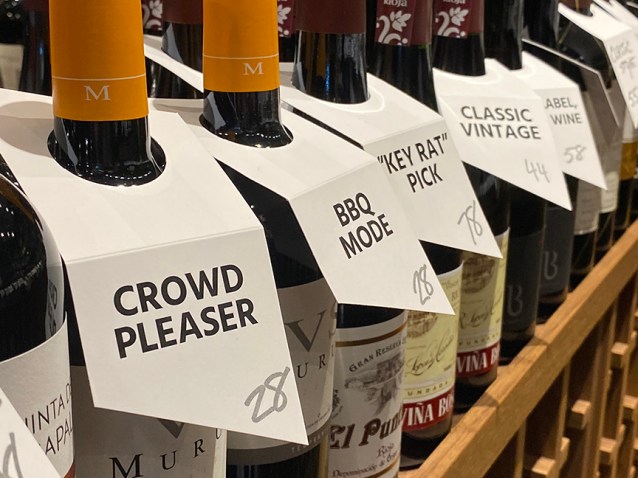
Allegra, one of the most brilliant wine communicators I’ve ever met, has dispensed with nearly every one of the stodgy conventions of wine retail that have dominated our industry for far too long.

Just take a look at her shelf talkers, above!

It was amazing to watch her customers browse her shelves and confidently purchase and select wines using her unique and innovative system.

When I commented that she had devised an entirely new way of thinking about and communicating wine, with a user-friendliness that imbues the whole shop with her exhilaration for the wines she loves, she wondered out loud whether her approach was too “whimsical” at times.

No, I said, it’s just what our world of wine needs: fresh, energetic, creative thinking to an age-old problem. She an original and an inspiration and I can’t recommend her lovely shop to you highly enough (check out the link to get a taste of her aesthetic and approach to wine retail).

Happy Juneteenth! Here’s a book that totally changed my perspective on the holiday and its meaning in Texas and beyond.

Above: one of the earliest celebrations of Juneteenth at Emancipation Park in Houston in 1880. The park was created especially by local business leaders to serve as a gathering place for future Juneteenth celebrations. That tradition continues today in Houston. Image via the John Marshall Center (Creative Commons).

Happy Juneteenth, everyone!

It’s so awesome to see people celebrating this year, two years after it became an official U.S. holiday.

Houston has a deep connection to the holiday because it was first observed here in our city not long after the earliest celebrations in Galveston.

For anyone who wants to learn more about the holiday, I highly recommend Annette Gordon-Reed’s wonderful book, On Juneteenth, a memoir of her growing up in Texas (not far from where we live), published a few years ago. It’s a great read and it totally changed my perspective on the holiday and its meaning in Texas and beyond.

Happy Juneteenth! Enjoy the holiday!

Houston wine folks: I need you! And so does Abruzzo. Dinner Monday, June 26 at Davanti.

Houston wine trade and media folks, I need you to join me on Monday, June 26 for a classic Abruzzo menu paired with Abruzzo wines at Davanti, Chef Roberto Crescini’s casual Italian on Wesleyan.

It’s my first event for the consortium of Abruzzo wines and we’ve just got a couple of spots to fill to knock this one out of the park.

Chef Roberto is closing the restaurant just for our party that night. It’s going to be a great one! And I PROMISE: no boring speeches to sit through or videos to watch. Just great food and wines.

The flight of wine is forthcoming. But in the meantime, here’s the menu that Chef Roberto has created especially for our group.

antipasto
pizza rustica abruzzese

primo piatto
ravioli alla teramana

secondo piatto
agnello alla neretese

dolce
parrozzo abruzzese

The dish agnello alla neretese is lamb braised with tomato, sweet and hot peppers. Sound good?

This event is open only to trade and media and again, we just have a few spots to fill at this point.

Please DM me via jparzen [at] gmail.com to RSVP. There is no cost to guests and only a business card is required to attend.

Please feel free to share with any members of trade or food and wine-focused media.

Thank you for the support and solidarity and hope to see you on Monday, June 26! Buon weekend a tutti!

Wine writing as ekphrasis.

For many years now, I’ve pondered the notion of “wine writing” as a self-referential exercise.

Whenever you describe a wine, you’re not actually describing the wine but rather your experience tasting the wine (or experiencing the wine). Even when you tell the “story” of a wine, you are ultimately describing your own story.

Students of 20th-century critical theory will remember Gertrude Stein’s 1933 book The Autobiography of Alice B. Toklas. It is an “autobiography” not written by the subject but rather by her partner.

Many before me have called the work a “new paradigm” in Western narrative where the author (in this case, Stein) explores her own perceptions and experiences by purporting to be the subject and author. In doing so, she presaged one of the great conundra of the post-war Deconstruction movement where critical theorists like Barthes and Derrida declared that the “author was dead” (until Eco decided the author was actually still alive).

Stein’s book is one that comes up in my seminars on wine communications in the grad program at the Slow Food University of Gastronomic Sciences in Piedmont.

Reading through the examples of the “tyranny of the tasting note” in Eric Asimov’s “memoir and manifesto” How to Love Wine (2012), it’s abundantly clear that the writers in question are not describing wine but rather their experience tasting the wine in a given sitting. And my analogy here is that Stein is not describing the life of Alice B. Toklas but rather her perception of that life.

In writing a tasting note for a given wine, instead of saying “this is what the wine tastes like,” it would be more precise to say “this is what the wine tasted like to me when I tasted it that day.” The infamous case of Matt Kramer a wine writer from the 2000s saying [updated March 4, 2024] that Bartolo Mascarello tasted like “wet dog” “a warm room with two dogs in it” comes to mind in this context [updated March 4, 2024]. Instead of saying “this is what the wine tastes like,” he should have said, “this is what the wine tasted like to me on the day that I tasted it.”

[As Mr. Kramer recently pointed out to me, it was not him but rather a colleague of his at the time that wrote the note. For more on the episode of the wine that tasted like “a warm room with two dogs in it,” see this post by Craig Camp.]

But it wasn’t until recently that I realized that wine writing isn’t just an exercise in Deconstruction. It finally occurred to me that wine writing is actually ekphrastic in nature. The Greek term ekphrasis denotes the art of describing a work of art. And that is exactly what happens when we describe a wine.

Not only do we not tell our own story — our own experience as opposed to an empirical evaluation of the wine — but we perform that story. Along the way, we can’t help but compete against our peers and even ourselves as we try to excel as wine communicators.

Or do we?

I’m still working it out. Thanks for following along as I do…

Is AI going to put wine communicators out of a job? My Slow Food U students and I put Bard to the test.

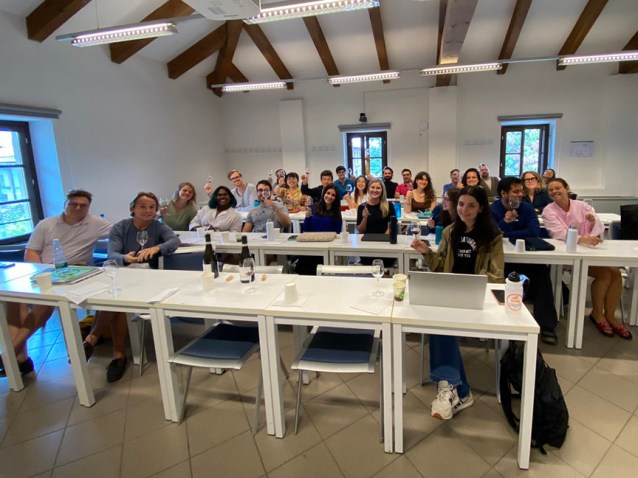
Above: some of my students in the graduate program at the Slow Food University of Gastronomic Sciences in Pollenzo, a hamlet of Bra commune in the Roero subregion of Piedmont.

During their seminars on digital wine communications, the wine and spirits grad students and their instructor decided to take artificial intelligence “out for a drive,” so to speak. Their goal was to determine whether or not Bard, Google’s generative artificial intelligence chatbot, could create humanlike content about wine and viticulture.

The group started by lobbing Bard a soft ball.

“Please write a blog post, with title, about the Slow Food University of Gastronomic Sciences.” This was to be the “control” entry, a relatively easy pitch that the students could swiftly verify (given that they are students at the university).

As expected, Bard regurgitated and even quoted passages from the densely populated UniSG website:

    The Slow Food University of Gastronomic Sciences (UNISG) is a unique institution that offers a multidisciplinary approach to food studies. Founded in 2004 by Carlo Petrini, the founder of Slow Food, UNISG is located in Pollenzo, Italy, a small town in the Piedmont region.
    UNISG’s mission is to “educate gastronomes, people equipped with knowledge and skills in the agricultural and food sector, capable of driving food production, distribution and consumption towards proper, viable choices and helping to create a sustainable future for the planet.”

But students and instructor alike were surprised that there was absolutely no mention of wine, viticulture, and spirits studies — all core subjects.

But even more startling was that toward the end of the post, Bard shifted from a descriptive tone to an optative mode.

“If you are looking for a challenging and rewarding educational experience,” wrote Bard using language seemingly lifted from a 1970s ad campaign, “UNISG is the perfect place for you.”

All the more unexpected since the group had not asked it to recruit new students. But the content was solid.

Then, they asked Bard to write a post about a winery with attenuated but lyrical web presence. Beyond fact sheets about the wine, the estate’s website’s primary content is a poetical discourse on the winemaker’s philosophy.

And here things started to get strange.

“The winery is certified organic and biodynamic.” Not true.

It’s “a popular destination for wine lovers, and the winery offers a variety of wine tastings and tours. The winery also has a restaurant, which serves traditional Piedmontese cuisine.” Not true, not true. In fact, entirely made up!

Then came the tasting notes.

“The wine is full-bodied and flavorful, with notes of red fruit, spice, and tobacco.”

One member of the group had recently tasted at said winery. They found it unusual that “tobacco” was used as a tasting descriptor for wine in question. The tasting notes, in general, seemed odd. The winery’s fact sheets don’t include any mention of tobacco.

In conclusion, wrote Bard, “I hope this blog post has inspired you to visit [the] winery in Roero. The winery is a great place to learn about sustainable winemaking practices, taste award-winning wines, and enjoy a traditional Piedmontese meal.”

As my daughters, ages 10 and 11 would say, “CRINGE!”

Two things became clear with subsequent queries:

    1) when Bard was tasked with creating content about subjects where ample information was available on the internet, it produced a generic but honest blog post;
    2) when tasked with create content where scant info is available, it created misinformation.

The group’s conclusions were that:

    1) AI still cannot be relied on for useful, factual information when it comes to wine and viticulture;
    2) AI’s wine-focused copy still comes across as wooden and overly generalized; it lacks the verve and originality of human-generated content.

My personal thought is that wine writing remains an entirely idiosyncratic enterprise and lacks the kind of overarching standards and conventions that would facilitate the creation of AI-generated content.

When we asked Bard to write about Google authority, a subject we discussed at length, it did a great job. When asked to describe a groovy winery in Roero, it came across as a phony and fake.

But how long is that going to last?

The bunga bunga party is over. Berlusconi, Italy’s long-time buffoon prime minister and political huckster, has died.

Image via Wikipedia Creative Commons.

By the time a wide-eyed U.C.L.A. undergrad made their way to Italy in 1987, the country’s socialist government was thriving, the economy was booming, a year of university studies, even at a top school, cost around $300, and “there was a Benetton on every corner in Manhattan,” as one of their professor’s put it.

But by the early 1990s, that had all collapsed as the government led by socialist leader Bettino Craxi went down in flames and scandal.

That power vacuum led to the rise of the first post-modern politician, as many have called him, Silvio Berlusconi. As he himself openly put it, he got into politics so that he could change laws in order to make himself richer, pay fewer taxes, and avoid legal jeopardy. As he achieved all three of those personal goals, he drove the country’s economy into the toilet with bloated borrowing and destroyed Italy’s image as a progressive nation who protected its vulnerable and cherished its cultural legacy.

He also became the first, in his own words, to legitimize the far and fringe right. Today, the roots of Italy’s first post-fascist (in other words, its first post-war bona fide fascist) government can be traced to his tenure.

Back in the early 2000s, when Italy was the president of the European Union, I was recruited to be an interpreter at the Italian Mission to the United Nations. Because Berlusconi, prime minister at the time, was tasked to address the General Assembly as the president of the EU, the mission needed an extra full-time interpreter. I was assigned to foreign minister Franco Frattini, who represented Italy at the gathering, while the senior interpreter was assigned to Berlusconi.

I never met him but I did attend a meeting where he spoke — and I held my nose.

After his notorious sexual predation parties became well documented by the media, my bandmates and I wrote and produced a song about his bunga bunga. We recorded it in Austin, Texas for our 2011 album “Freudian Slip” (Aeronaut Records). You may have heard it on season 1 (episode 2) of “Emily in Paris” (listen below).

Many have said that Berlusconi created the paradigm, the road map for our country’s own post-fascist, post-supremacist political monster.

But let us not mention the name of that Devil… lest he appear.

Read the Times obit here.

Not a Nebbiolo by a lesser god. Extraordinary tasting at Hilberg Pasquero in Roero.

The mantra that I share with my students at the Slow Food University of Gastronomic Sciences in Piedmont where I’m teaching this week:
taste, taste, taste
read, read, read
write, write, write

Whenever I’m in Italy, I try to taste as much as possible. After yesterday’s afternoon seminar on digital wine communications with the students in the wine-focused grad program, it took me about 25 minutes to get the Hilberg Pasquero winery in Priocca village on the edge of the Roero DOCG. Man, it’s been literally 20 years since I first visited this lovely family! Now their son Nicola has returned from a successful career in corporate marketing to take over the family farm.

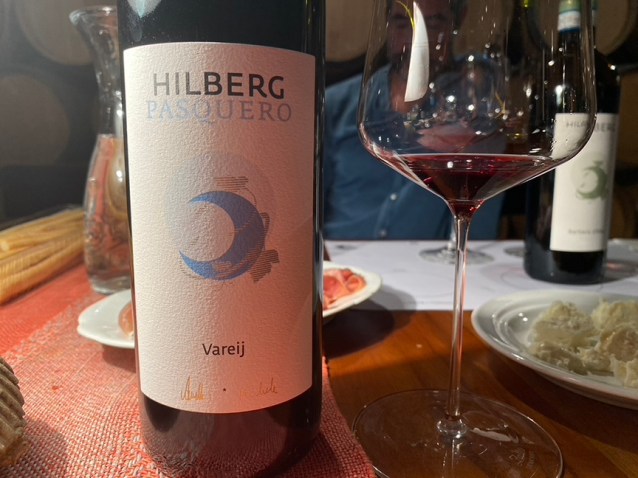
That’s their still blend of Brachetto and Barbera, above. The fruit in this wine is so vibrant, but delicate and nuanced at the same time. When’s the last time you tasted a Brachetto that wasn’t sparkling? I have always loved this wine and was so happy to revisit it with them in situ.

Whenever we talk about Roero in generalities, we tend to emphasize that Roero’s subsoils are mostly sandy. That’s why, the conventional wisdom goes, Roero’s Nebbiolo doesn’t have the depth of its neighbor in Barolo with its mix of limestone, clay, and marl soils.

But what many don’t realize is that Roero is actually just a stone’s throw from Barbaresco to the east. They are divided by the Tanaro river. Villages in the eastern part of the Roero DOCG share soil types with their neighbors.

Nicola was keen to show me a vineyard they had recently re-planted (below). Do you notice the color and texture of the soil? That’s the classic limestone terreno bianco (the “white soil”) that you also find in Barbaresco and Barolo!
It was fantastic to stand atop that hill and have Nicola point out some of his neighbors who also farm on the same white soils.

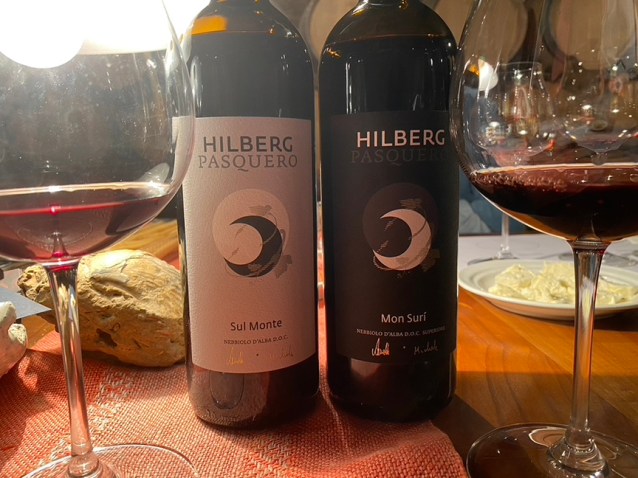
And man, let me tell you, those two expressions of Nebbiolo d’Alba (above) that we tasted are no Nebbiolo by a lesser god!

Hilberg Pasquero is currently imported in the U.S. by wonderful friend Dino Tantawi in New York. But they are looking for representation in other states now, too. If I were an importer, I’d jump on it.

Thank you again Annette, Michele, and Nicola for an awesome tasting! Looking forward to seeing you guys again soon so we can break out those guitars!

Why are Italians so fascinated with American-style food?

If memory serves correctly, it all began with hamburgers in the 2010s.
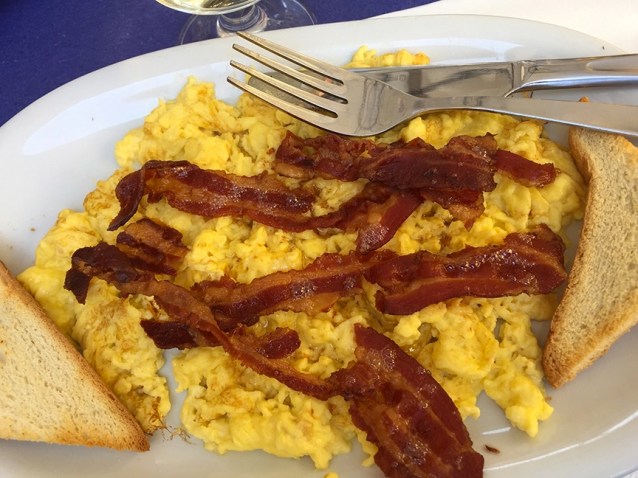
That was followed by bacon and (scrambled) eggs.
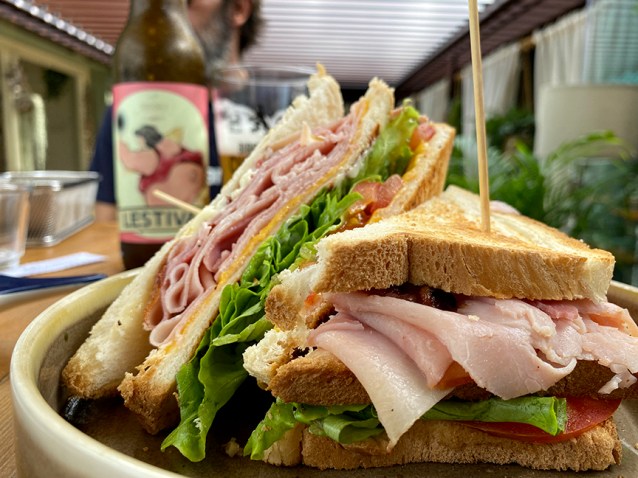
It didn’t take long before club sandwiches started to appear everywhere as well.
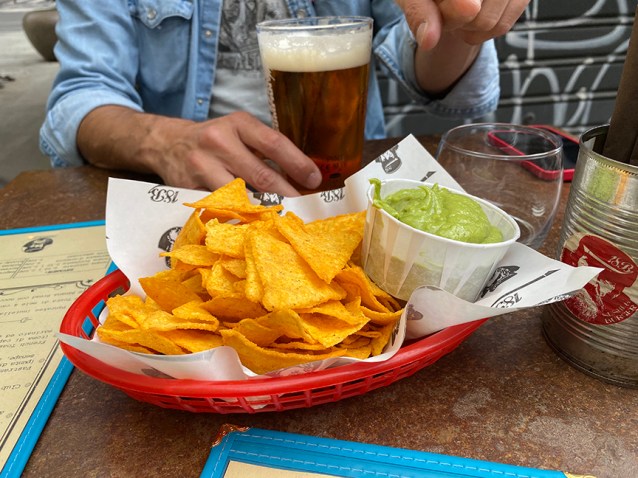
Today, it seems like there’s no end to the continuously growing list of classic American dishes that Italians are making and consuming.

Over on the Facebook, there was a lot of chatter after I posted a picture of chips and guacamole that I was served earlier this week in Brescia. The restaurant actually calls the dish “nachos” (although that’s not what we would call it).
Honestly, I had never even seen guacamole in Italy until this week. On Saturday, I was served guacamole at lunch and then later that evening, when I was invited to a swank spot in the heart of downtown Turin, chips and guacamole appeared again at our table!

And let’s not forget the preponderance and ubiquity of “sushi” in Italy today! That cuisine is from Japan, of course, but nearly everywhere I see it here, it’s served in the American style that we grew up with.
I’ve seen more than my share of “Caesar salad” as well in recent years. Texas-style BBQ has also become extremely popular here.

When it came to the initial wave of hamburgers, the Italians swiftly surpassed us in terms of the quality of ingredients. Where I grew up, the cheapest beef was used for burgers. Italians use top heirloom beef for theirs and they are also expert at mixing pork and beef for their patties. The quality of the bread is also an important factor.

I’m not exaggerating or kidding in any way when I say wholeheartedly that some of the best hamburgers I’ve ever had have been in Italy.

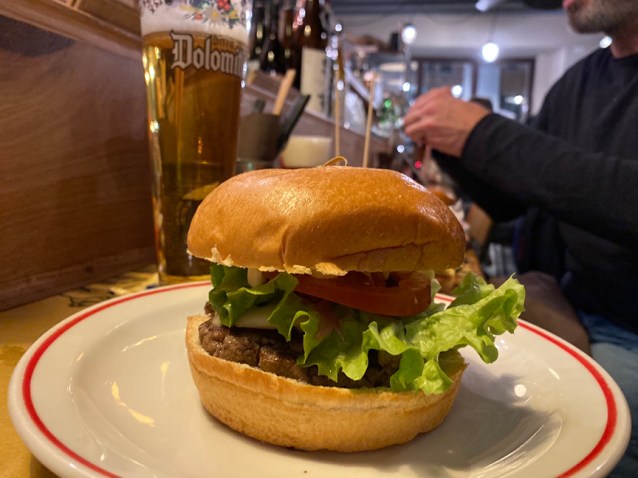
The burger above is from a wonderful, homey spot called 18B in Brescia. It was fantastic! Check out their Instagram here.

The joint is run by a lovely young couple. And even though the focus is burgers and their now famous “pulled rabbit” sandwich (a riff on pulled pork), they also have an extensive sushi menu. Incredible!

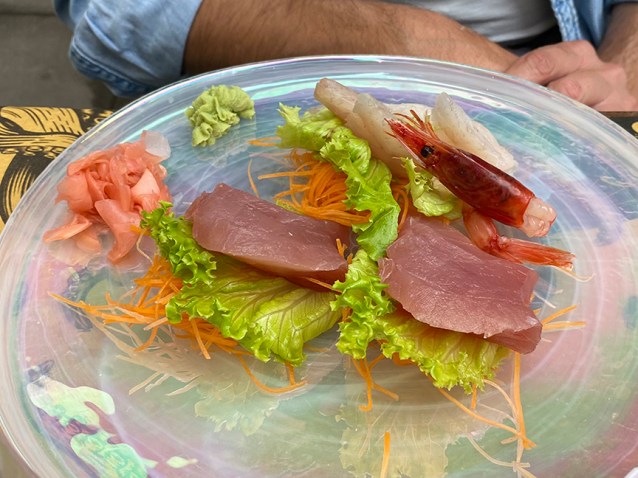
I’ve loved the burgers there. I still haven’t tried the sushi (that’s Giovanni’s sashimi above). The avocado was perfectly ripe and delicious but it was more like an avocado purée (like Americans have been spreading on toast).

I’m not really sure why Italians love American food so much. In many cases, they do it WAY better than we do (again, because of the ingredients).

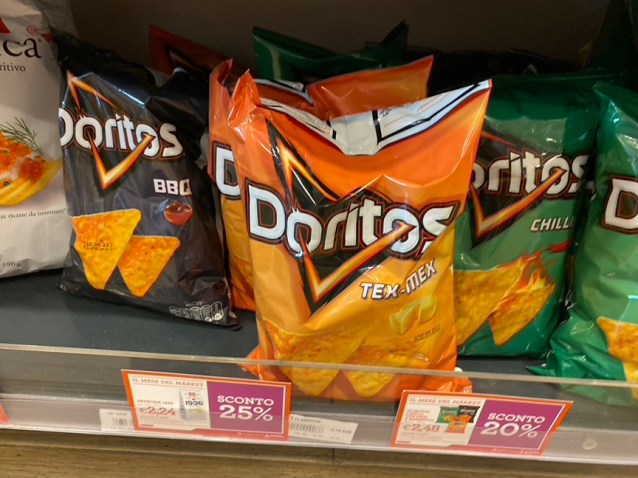
But “Tex Mex” Doritos is where I draw the line! Spotted in an Autogrill the other day.

All the photos are from Italy. The burger, sushi, and chips from 18B. The bacon and eggs are from a lunch many years ago in Milan. The club sandwich is from a place on Lake Iseo from a few years ago. Today’s my first day back teaching at Slow Food U. Looking forward to meeting the students this afternoon!

Italy’s been amazing (but crowded) so far. And UPCOMING JUNE TASTINGS where I’ll be presenting in the U.S.

Italy’s seemingly unending chamber of wonders never ceases to amaze me.
From running along the farmland banks of the Tiber river outside Rome to devouring castraure artichokes of Venice paired with some natty macerated white wine… Italy always gives of herself effortlessly and tirelessly.

It’s no wonder that there are so many tourists here this summer — from all over. In Rome they were saying that they are expecting three times the number of people who actually live there. Out of the way hotels have been key to keeping cost down. But man, don’t ask about the rental car!

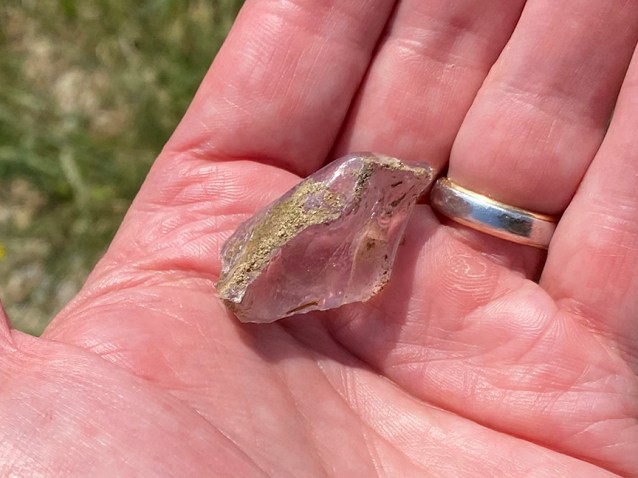
That’s a chunk of quartz, above, that I found in a vineyard high atop the Valpolicella valley. The soil types in Valpolicella are so variegated and distinctive. I had the most amazing day there yesterday.

Today is Festa della Repubblica, a national holiday that celebrates the founding of the Republic of Italy in 1946. But I still managed to get a winery visit in. Tasted some amazing Cabernet Franc in Piave this morning.

After I finish my week of teaching at Slow Food U next week, I’ll be sharing tales of my trips to Italian wine country at three events in the U.S. later this month.

Long Beach
Friday, June 16
register

On Friday, June 16, I’ll be in Long Beach, California with the Dugans, America’s grooviest wine family (I’m so not exaggerating about that either!). Jeremy and I will be pouring some favorite Italian naturals as we try not to one up each other with Mel Brooks quotes. Seriously, we’ll be pouring some super compelling wines and the crowd and community at their shop is super lovely.

Miami
Wedsnesday, June 21
register

On Wednesday, June 21, in Miami I’ll be pouring and speaking about Barbera and Nizza, including two wines by my client and friends at Amistà. I’ll be hosted by the amazing and inimitable Allegra Angelo at her super fun store Vinya in Key Biscayne. The vibe of her store is so cool and we’re going to be opening some truly benchmark wines that night.

Houston
Monday, June 26
DM me

I’m super psyched about a dinner I’m hosting at Davanti in Houston where chef Roberto Crescini is creating an Abruzzo menu especially for us. It’s part of a new gig I’m doing with super sweet folks at the Abruzzo consortium. It’s only open to trade and media. But I might be able to snag a spot or two for you if we have space. Please email me if you’d like to attend.

Thank you for the support and solidarity! Hope to see you later this month!

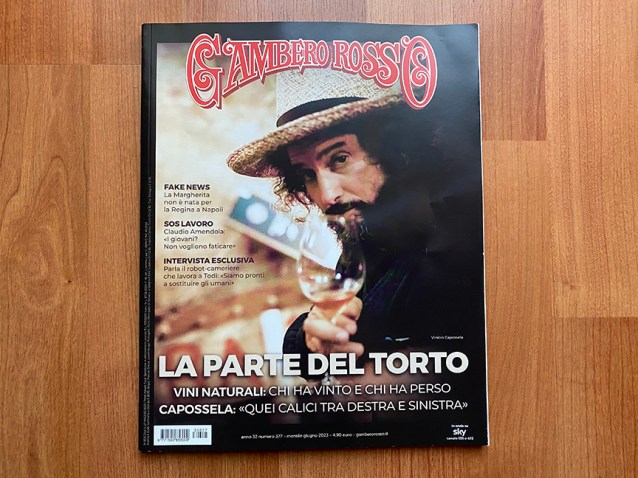
Gambero Rosso goes Natural? A new editor-in-chief and a controversial new cover story.

Vanity Fair Italia, Corriere della Sera (one of the country’s leading national dailies), and some of Italy’s highest-profile food and wine blogs like Dissapore are all talking about it: the first issue of the Gambero Rosso magazine under its new leadership and the masthead’s June 2023 cover story on natural wine.

Natural wine in the Gambero Rosso, you ask?

Longtime reporter for La Repubblica (another one of Italy’s leading dailies), Marco Mensurati, shocked the media community earlier this year when he left his new position as the editor of the paper’s Rome desk and became the editor-in-chief of the Gambero Rosso monthly magazine, now in its 32nd year.

For its first issue with Mensurati at the helm, he asked editor and writer Lorenzo Ruggeri, who’s been with the outfit for more than a decade, to write a cover story (June 2023) on natural wine and to interview the popular singer-songwriter Vincio Caposella about his new album where he makes some highly controversial declarations on the world of natural wine in Italy today.

“I have seen the best minds of my generation,” says Caposella (quoting the American Beat poet), “lose themselves in natural wine while the extreme right has taken over the electorate and [our] country.”

On his new album, “Il Bene Rifugio” (“Safe Haven”; the title is a riff on the finance term “safe haven investment”), Caposella sings, you natural wines… are on the wrong side…” (from the track, “Il Lato del torto,” “The Wrong Side”).

In his long interview with Ruggeri, the artist makes his case that natural wine is a “cliché” of the “radical chic.” It’s the same hypocrisy, he says, as that embraced by the “populist right.”

Wow.

Caposella, whose style is heavily influenced by Tom Waits, is a well known lover of natural wine. He cites Gravner as one of his favorite producers, to give you an idea.

“Vinicio Capossela exploits the pretext of natural wine in an effort to criticize a Left that has lost touch with the people — just like him,” wrote one commentator.

The interview is accompanied by a truly fantastic piece by Ruggeri (a good friend, for the record) where he writes about “The Lesson of Natural Wine” (not yet available online for non-subscribers). Not only does he profile some of the leading producers in the natural wine movement. But he also speaks to top Italian enologists like Luca D’Attoma, who talks about the highly positive influence the radical natural wine movement has had on conventional winemaking.

Historically, the Gambero Rosso has been known for its generalized disdain for the natural wine scene. Ruggeri even quotes a scathing editorial on the expression “natural wine” written for the masthead in 2013 (“If there’s anything that’s really natural,” wrote the editor, “it can’t be wine.”)

If this month’s issue is a taste of what’s to come under Mensurati’s leadership, then I’ll take a double please!

Super congrats to my friend Lorenzo on his wonderful cover story.