Angelo Gaja’s State of the Union Address: “the winery next door isn’t an enemy”

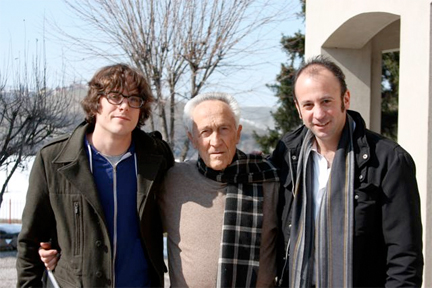
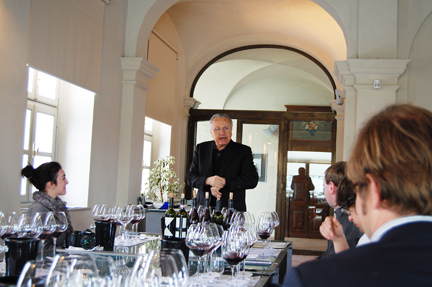
Above: The last time I tasted with Angelo Gaja was in March 2010 at his winery in Barbaresco.

Earlier this week Angelo Gaja sent out one of what I call his “papal bulls.” As an elder statesman of Italian wine, he often issues these statements via email — on the state of the Italian wine industry, on the Brunello controversy, on the distillation crisis in Piedmont etc. And a number of Italian bloggers repost them.

As I prepare to leave for Italy to attend the Italian wine trade fair Vinitaly (and to lead a group of bloggers to Friuli the following week), I decided to translate his most recent “state of the union” address.

Whether you agree with him or not, I think that you’ll find his insights and observations as interesting as I did.

For the record, I am the author of the translation below and while you can find the piece on many Italian-language sites, I read it on I Numeri del Vino (an Italian wine industry blog that I highly recommend).

I also highly recommend checking out this post by Alfonso on the DOC(G) to DOP migration (part of the same EEC Common Market Organization Reforms that Gaja references in his statement).

Europe’s Winds of Change

by Angelo Gaja

The Italian wine market is going through a phase of profound change that offers contrasting clues for interpretation.

Domestic consumption is dropping while exports are growing. There are producers who are finding it hard to sell their wines and their cellars are still full of wine. Others take advantage of market opportunities and they empty their cellars with ease.

The current trend of pessimism contrasts with the rhetoric of optimism. Where does the truth lie? The numbers don’t tell the whole story but they help us to understand the current situation.

Nearly twenty-five million hectoliters of Italian wine are exported annually and domestic consumption is just over twenty million hectoliters. Together, these numbers constitute a demand of forty-five million hectoliters, to which we need to add the demand for wine by vinegar producers and users of industrial alcohol. The annual average production of wine in Italy in recent years has strained to meet demand. Will Italian wine fail to rise to the occasion?

Causes that Contribute to a Balancing of the Market

Global warming has contributed to this stress, as has the advanced state of obsolescence of 50 percent of the vineyards in Italy today. But it has also been accelerated by the effects of the European market reforms that were called for, imposed, and implemented by Brussels on August 1, 2009.

These reforms were inspired by common sense — a rare commodity these days. And they were intended to put an end to the waste perpetuated by more than thirty years of public subsidies devoted to the elimination of surplus. And they were implemented by the introduction of measures aimed at re-balancing the wine market.

Once squandered, [European Economic] Community contributions are now devoted to the co-financing of promotion of European wineries beyond Europe’s borders and they have helped exports take off despite the current crisis.

In a short period of time, the number of wineries exporting their products has grown more than 30 percent. A significant number of artisanal producers has begun to ship wines abroad and their success has encouraged to them to combine their resources and to travel beyond Italy’s borders to tell their stories and share their passion, traditions, and innovations. And in doing so, they have helped to contribute to the greater respect that Italian wine now commands throughout the world. As a result, there are many who now believe that the Italian wine market is undergoing a profound and unprecedented structural change that requires them to adopt a new and different cultural approach.

Think Differently

More must be done to monitor and prevent the production of counterfeit wine.

We must stop thinking that we need to compete with one another and that the winery next door is an enemy.

It’s inconceivable that the windfall of European Economic Community contributions for the co-financing of exports beyond Europe’s borders continue uninterrupted: why should European citizens be taxes to achieve this goal?

We must learn how to build business networks using only our own funds.

The domestic market continues to be the most challenging. But its value is undiminished because it’s what shapes and builds business: it’s a mistake to dismiss and neglect it.

The producers whose wines enjoy a healthy presence in the Italian market are often the same producers who reap the rewards of foreign markets.

The balance between supply and demand puts the greatest responsibility on all of our shoulders. And it should impel producers to grow and to become more capable businessmen who are better prepared to rise up to meet the challenges of the market.

Angelo Gaja, March 19, 2012
The many “inos” of New York, a visit to Maialino (New York Stories II)

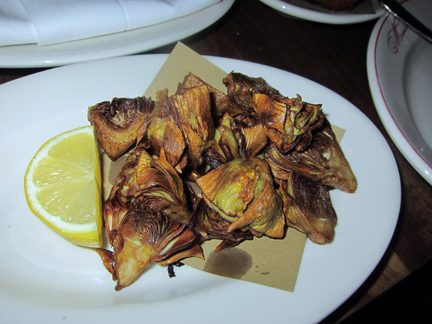
Above: I loved the fried artichokes at Danny Meyer’s Maialino.

It’s amazing to think that restaurant maven Jason Denton opened his Italian sandwich shop ‘Ino back in 1998 — the same year that Batali-Bastianich launched Babbo. Strolling around the West Village last week, I spotted two new (at least to me) “inos”: Gottino and Corsino.

It occurred to me that the Molto Mario paradigm is like al-Qaeda: it’s not just a working method or brand anymore; it’s a concept. And the rash of “inos” that have appeared across the City in the last fourteen years are akin to the self-appointed “cells” of the Jihad (perhaps modeled more after Lupa and Otto than his earlier successes).

I’m embarrassed to say that I still hadn’t been to Maialino (which opened in 2010), Danny Meyer’s Rome-inspired “ino”. And when Alice and I arrived there at 8 p.m. on Friday, the place was slamming packed.

I was geeked to reconnect with my good friend Nicolas, who works there. And we ended up having a nosh at the bar (including the awesome fried artichokes, above).

Nicolas treated us to a delicious bottle of Perella, one of Bruno De Conciliis’s expressions of Fiano. And I was psyched to see 2006 Produttori di Carema by the glass (!) and a truly courageous selection for the Pinot Grigio by the glass: Vie di Romans Pinot Grigio Dessimis — a vineyard designated, skin-contact, tannic expression of lees-aged Pinot Grigio. That’s a pretty gutsy choice for someone expecting Santa Margherita…

I tasted a 1997 Dessimis a few years ago in Friuli and was blown away by the elegance and power of the wine. And although I thought the 2009 offered at Maialino isn’t fully developed (the wood still resided atop the wine), I loved the fact that the wine director Liz Nicholson (whom I haven’t met) is prompting her guests to question the Pinot Grigio status quo in our nation.

OBut no matter how hard courageous and well informed wine directors like Liz try, you still can’t take the “ino” out of Pinot Grigio…

Up next: New York Stories III, Alice and I pay a visit to the “Wine Seer” uptown and “everything is beautiful at the ballet”…

Call for emergency irrigation in Brunello by Fabrizio Bindocci @BrunelloMaker

“Let us debunk the common misconception that irrigation serves solely to increase production,” wrote my friend and Brunello producer Fabrizio Bindocci (above) on his son Alessandro’s blog Montalcino Report this morning. “Today, the appellation rules establish low yields and monitoring is implemented in the vineyard to see if these yields are real. For this reason, we would be opening a practice that can only help to raise the quality when there is need because of climatic capriciousness. But until today, not having this possibility, the growers of Montalcino will use the agronomic techniques that they possess to manage their vineyard the best that they can.”

If you’ve been following their blog (as I have), you know that the weather in Montalcino has been very strange this year and there are already forecasts and fears of drought in the 2012 vintage.

Drought isn’t as great of a threat for Fabrizio, his son, and the estate they manage as it may be for other growers: thanks to the age of their vines, their roots reach deeper and have greater success in finding the water table, even in lean years.

But as one of the members of the technical advisory board of the Brunello growers association, Fabrizio is speaking to and for the more than 250 bottlers in the appellation.

Fabrizio has taken a lot of flak for serving on the advisory board under Ezio Rivella, the maligned septuagenarian who continues to lobby for the inclusion of international grape varieties in Brunello.

The way I see it, Fabrizio — a friend of mine and a winemaker I greatly admire — is serving Montalcino’s best interests by working within the current political framework and climate. I can’t think of a more noble and more Tuscan attitude…

And should Montalcino be stricken with another 2003, emergency irrigation would make the blending of Merlot in Brunello much less appealing…

Click here to read his “open letter” calling for emergency irrigation in Montalcino.

Barolo Villero by Brovia (New York Stories I; @saignee wish you were here)

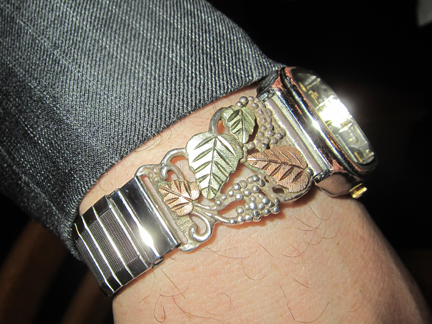
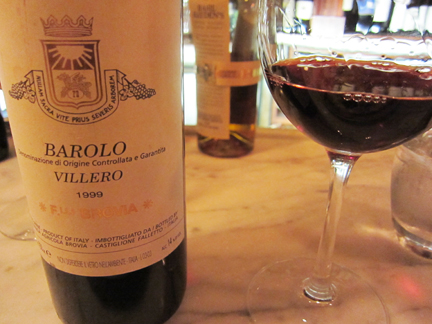
“My mother was disappointed that I didn’t become an architect,” said Victor Pinkston as he opened and poured me and my good friend Jeff a bottle of 1999 Barolo Villero by Brovia on Thursday night in Manhattan at Otto. “But then I showed her the watch that she gave me [above] when I was a kid and told her that ‘it was meant to be.'”

Victor’s done pretty well for himself: after five years as a company man in the Bastianich-Batali dynasty, he’s landed the job as wine buyer and head sommelier at the empire’s pizza joint.

And while he and I may disagree on the finer points of the modern vs. traditional dialectic, the dude definitely knows his shit.

When I lived in the City, Otto was one of my best-kept secrets: although not a fan of the university and tourist crowd that hangs there (Otto is, after all, “Molto Mario Light,” if such a thing can exist in the rational and sensual world), I knew I could always find some older Nebbiolo there at reasonable prices. Back in the day, I practically depleted an allocation of 1993 Barbaresco Nervo by Pertinace at $75 a pop (there are still some bottles left although at a higher price). And when I asked Victor what trick he had up his sleeve, he suggested no fewer than five labels from the 90s under $150, including an Oddero Barolo (classic) 1996 (wow!).

But it was the 1999 Barolo Villero by Brovia at $140 that spoke to me. (Remember this post by Saignée on our visit to Brovia a few years ago?)

I am no fetishizer of old wine and you’ll never hear me cry infanticide when a great one is opened before its time. But I must admit that this bottling was going through an extremely tight phase.

It was dense and deliciously chewy, with mushroom and earth dominating the fruit. But as Jeff and I slowly nursed this spectacular bottle, the berry fruit began to emerge, as did a delicate eucalyptus note, with the zinging acidity — the nervy backbone, as the Italians say — plucking on the strings of fruit and earth like Jimi Hendrix playing the first notes of “Little Wing.”

That’s me and Cory aka Saignée (left) with Giacinto Brovia back in March 2009 (photo by Brunellos Have More Fun). And here’s what Saignée had to say about our visit there.

Let’s just hope that Victor saves a bottle of this truly thrilling wine for us to taste next year.

Stay tuned for New York Stories II: Alice and I visit Maialino… or “two Jews walk into a Jew-owned bar named ‘suckling pig'”…

Cumin in my pants Brussels sprouts @Tertulia_NYC

Not a lot of time to post today… slammed with meetings in NYC…

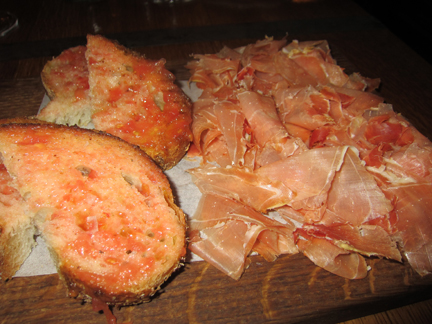
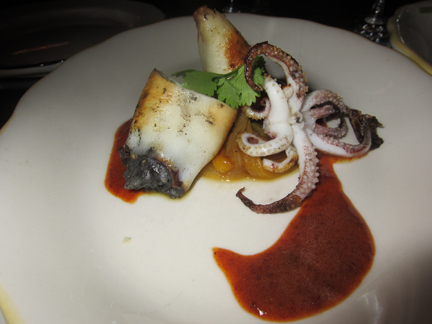
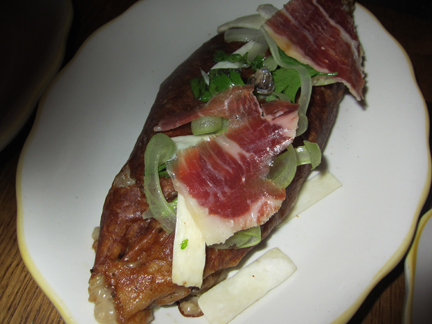
Here’s what I ate last night at Tertulia, an awesome new Spanish joint in Manhattan…

I didn’t get a picture of the FANTASTIC Brussels sprouts, roasted with a generous dash of cumim. They had me cumin in my…

Stay tuned for my notes on the 1999 Barolo Villero by Brovia that we drank later in the evening…

Cuttlefish risotto and the “last taboo” of Italian gastronomy @TonyVallone @AldoFiordelli

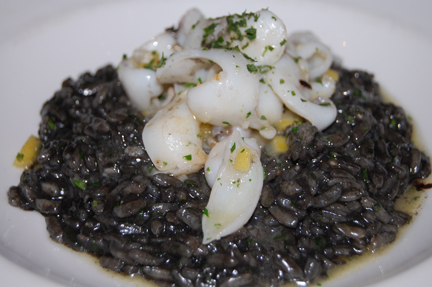
The Cuttlefish risotto at Ciao Bello in Houston the other night was so good that it nearly made me cry.

And it inspired a conversation about the “last taboo” of Italian gastronomy: the pairing of dairy and seafood.

I was at the restaurant doing a media dinner for my friend and client Tony Vallone, who shared the following anecdote about a luncheon in Naples a few years ago.

One of the guests, he said, an Italian-American, asked for grated Parimigiano Reggiano with his seafood pasta. The waiter politely responded that the restaurant didn’t serve cheese with seafood dishes. When the guest insisted, the waiter acquiesced, telling the patron that he would bring him the cheese. He disappeared, only to return after the gentleman had finished eating his pasta. “You see,” he said, “the dish didn’t need the cheese,” adding “in Italia si fa così,” this is how we do things in Italy.

The Italian taboo of mixing dairy and seafood stretches back to the Renaissance, when widely embraced Catholic customs required abstinence from dairy and meat on the numerous Lenten — di magro — days in the religious calendar. The bottom line: when seafood was consumed, dairy and meat were not. (I don’t have time to post about this today but this element of Renaissance cookery came to mind when I read Mark Bittman’s recent NY Times editorial on faux chicken; Renaissance cooks were obsessed with creating faux food, a gastronomic phenomenon that I called “culinary anamorphism” in a piece I wrote for Gastronomica some years ago.)

Of course, Tony’s cuttlefish risotto was made without the use of cheese (even though so many chefs in Italy and the U.S. discreetly fold some grated Parmigiano Reggiano into their seafood dishes). The secret to its creaminess? Tony had his chef caramelize and emulsify onions and then add them a few moments before the rice (Carnaroli) had cooked through. The viscous liquid gave the dish the all’onda texture that Tony likes in his risotto (whether sea- or landfood).

And it seems that we weren’t the only ones thinking about the “last taboo” of Italian gastronomy this week.

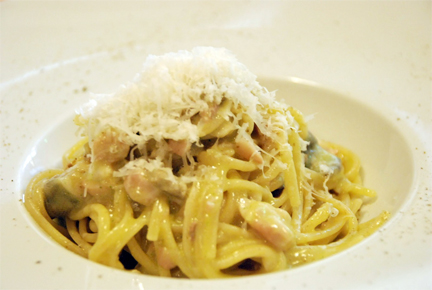
Today, Aldo Fiordelli, one of my favorite Italian-language food and wine bloggers and writers, posted this photo of “Linguine limone sgombro capperi essicati e parmigiano vacche rosse di Cristiano Tomei dell’Imbuto di Viareggio” (linguine tossed with lemon, mackerel, dried capers, and Red Cow Parmigiano Reggiano by Cristiano Tomei at the restaurant Imbuto in Viareggio).

Aldo notes that more and more Italian chefs are taking the bold step of using cheese in their seafood dishes, calling it their “last prejudice.”

Tony always says that for Italian cuisine to be authentic, it must also be creative. But I don’t think he would ever serve a dish like the one described by Aldo.

But hey, when in Viareggio, why not take a walk on the wildside?