The best thing I ate in Napa (is not what you think)

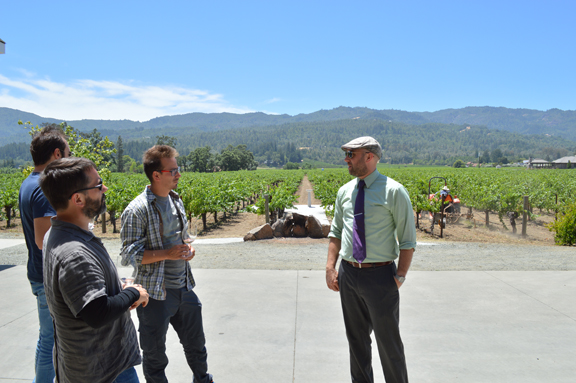
best sandwich napaStill catching my breath after a whirlwind trip to Santa Cruz, Napa, and Sonoma to talk to some favorite winemakers there.

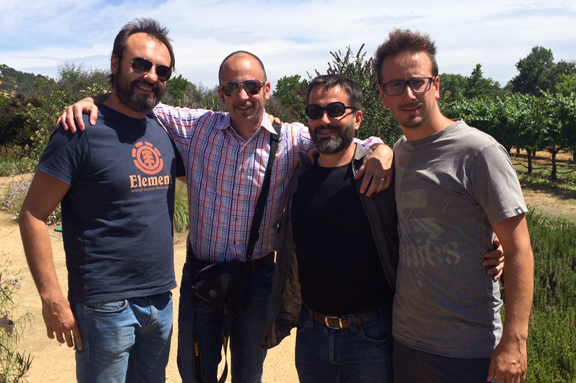
The Italian crew and I tasted some great wines, including many that surprised us and reshaped our perception of California winemaking.

I’ll be posting my “Napa dispatch” this week on the blog.

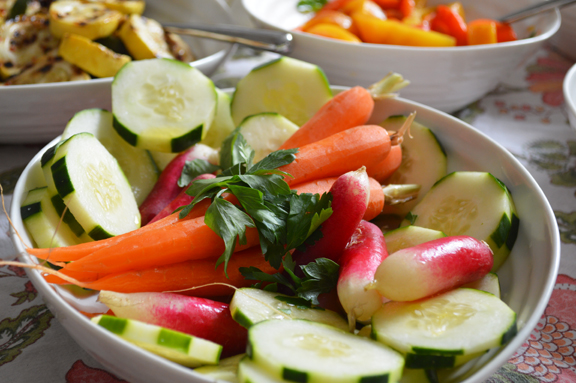
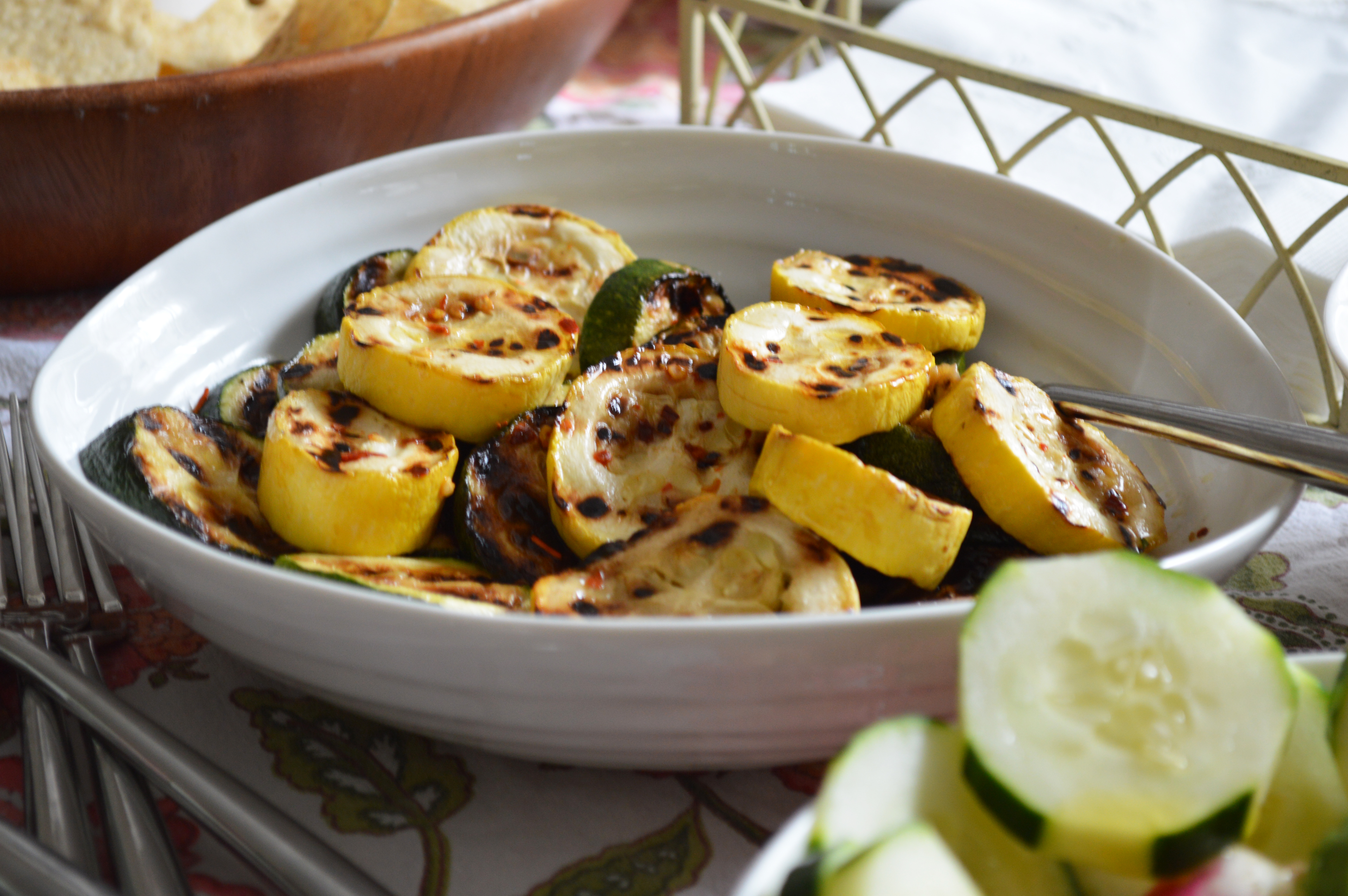
But in the meantime, as I get my feet back on the ground, I just wanted to share the best thing I ate in Napa: a [California] Veggie Sandwich at the Yountville Deli (above).

It’s was everything a [California] Veggie Sandwich should be (I write California in brackets because back in my native California, they just call it a “Veggie Sandwich”).

It was served on ciabatta from Bouchon bakery (delicious) and note the mandatory sprouts.

Of all the good things to eat there (and there are countless restaurants, from refined to homey, where the food is phenomenal), this is the one thing I’m still thinking about: it’s one of those simple pleasures of life that’s so satisfying and so easy to find in my home state.

I have so much to tell about our trip: the wines and the people were truly compelling. So stay tuned…

And wow, as we sat at the bar at the Oakland airport yesterday (below), it was amazing to see travelers cheer the U.S. on in the World Cup.

Soccer started early for kids growing up in Southern California like me. But I don’t ever remember seeing so much interest and passion for the game.

Thanks for reading and stay tuned…

best place watch world cup houston

Prosecco supply-demand crisis & Italians eating breakfast tacos in Austin

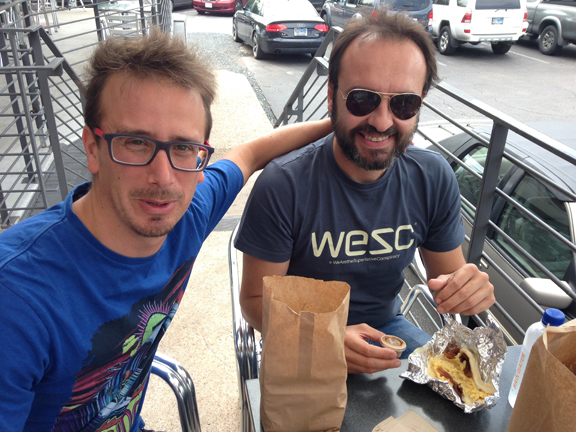
italian wine austinYesterday, I took “team sparkling wine” for classic Texas breakfast tacos at Taco Deli in Austin. After all, no trip to the Groover’s Paradise is complete without them.

I’m posting in hurry this morning as I head out the door to the airport to jump on a flight for Los Angeles (I’ll be at Sotto tonight, btw, pouring and talking about wine).

best breakfast tacos austinSomewhere between changing a diaper and kissing a booboo this morning, I did manage to translate this post for my client Bele Casel. It’s about the absurdity of the Prosecco consortium’s restrictions on sales. I’m always impressed by grape grower Luca Ferraro’s earnestness in writing about his appellation and his wines.

And I highly recommend the post to you: I believe that Luca’s insights can help us to understand how Prosecco is changing.

“I’m just a simple farmer,” he writes. “But I would have preferred lower maximum yields over the current policy” of blocking sales.

Lastly, Houstonians, if it’s not on your radar, Tony will be pouring Massolino 2009 Barolo next Tuesday at Ciao Bello for his “Evening in Piedmont” dinner. I’ll be there to talk about the wines.

Thanks for reading and I’ll see you on the other side!

jeremy parzen italian wine

A new & revolutionary Franciacorta: Solo Uva, made exclusively with grape sugar

best natural franciacortaThey’re not the only ones in the world to be working with frozen grape must as a means to make sparkling wine. But they are the first to do it in Franciacorta.

Andrea Rudelli, Domenico “Nico” Danesi, and Giovanni Arcari (my bromance) call it Solo Uva (just grapes): they freeze and reserve some of the grape must after pressing and then they use it as the sugar in both the tirage (i.e., the addition of sugar and yeast to the base wine in order to provoke the second fermentation) and the dosage (i.e., the addition of sugar before bottling to achieve the desired balance of acidity and sweetness).

The resulting wines have no cane sugar added to them (the traditional practice for classic method and Champagne method wines).

But the thing that really sets the wine apart as a new category of classic method Franciacorta is the fact that they allow the grapes to achieve full phenolic ripeness before harvesting. Where some sparkling winemakers pick early in order to obtain higher acidity (notably in Champagne and also in Franciacorta), this trio of winemakers lets the grapes ripen fully. As a result, the wines have a markedly rich (and arguably richer) fruit profile and a more vinous quality.

It’s a new and perhaps revolutionary approach to Franciacorta and sparkling wine.

And one of the coolest things about what they’re doing is that they have shared their technique openly with their peers and colleagues at home. They believe that this new method represents the future for their appellation and they liberally reveal the process to anyone who’s interested to find out more.

At Vinitaly in April, I tasted another Franciacorta made using this method (by Vezzoli) and a Barbera rosé (by Barolo producer Principiano). Both were wonderful.

Because they don’t adjust for sweetness using an extraneous sweetener, the wines have unusual depth and character. Not better, but different from conventional classic and Champagne method wines.

I’ve found the wines to be truly compelling.

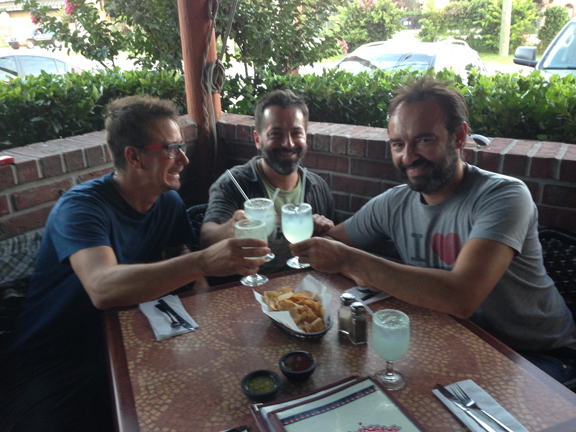
italians in houstonTracie P and I thoroughly enjoyed a bottle of Solo Uva on Saturday night in anticipation of the trio’s arrival in Texas (that’s them above, from left, Andrea, Nico, and Giovanni).

They landed last night at Bush and I took them directly for margaritas and Tex Mex at one of our favorite Houston restaurants, La Mexicana.

Today, I’m taking them to see some Texas sights and hear some Texas music before we head to California for a short business trip in wine country and a stop in LA at Sotto on Thursday night.

I’ll be posting on our adventures as time permits. Stay tuned!

tex mex houston best

When will Texas bottlers come clean? Deceptive marketing practices should be stopped

lewis dickson wine texasAbove: grape grower and winemaker Lewis Dickson is one of just a handful of Texas winemakers who produce wines using Texas-grown fruit exclusively.

Last week, the Texas Department of Agriculture released proposed changes in how its “Go Texan” licensing will be regulated.

Currently, Texas bottlers can print the “Go Texan” logo on their labels even if the wine in the bottle is not made from Texas-grown grapes. Yes, even a bottle that contains no Texan grapes whatsoever can sport the logo.

If approved, the proposed changes would require that at least 75 percent of the fruit must be from Texas.

But the proposal doesn’t address the fact that up to 80-90 percent of wine sold as “Texan” is actually sourced from out-of-state growers. Much of it is vinified beyond the Texas border and is simply bottled here.

Today, the Houston Press published my editorial on deceptive marketing practices in the Texas wine industry.

Here’s the link. Thanks for reading.

And here’s a link to Alfonso’s post on the Duchman Vermentino, a Texan-grown wine that caused a ruckus at the California State Fair wine competition last week.

happy father’s day

It’s my first father’s day as the dad to two happy, healthy, beautiful little girls. And it feels great.

Tracie P and I have so much to be thankful for…

Our girls have the best mommy ever. She takes such good care of them and works so hard to make sure that they have everything they need to grow up in a wholesome environment.

And we are so blessed to have the support of our loving family here in southeast Texas.

I love our girls and their mommy so much. Thanks for sharing our joy and happy father’s day!

Coravin controversy: don’t malign this revolutionary device

My post today for the Boulder Wine Merchant follows.

Thanks for reading and buon weekend!

dave fass wineAbove: a sommelier using the Coravin. The device is wildly popular among wine professionals today in the U.S.

In case you’re not familiar with the Coravin, it’s a tool that allows wine professionals to extract wine from a bottle without breaking its seal or removing the cork. The device itself is a high-tech syringe that’s inserted into the bottle through the cork. Because it doesn’t allow any air to enter the bottle, the fitness of the remaining wine is not compromised.

The Coravin was launched in July 2013 (click here for the company’s press release announcing the launch) and since that time, it’s become immensely popular among wine professionals across the U.S.

On June 3, subscribers to the Coravin email newsletter received the following message:

“Dear Coravin Customers… it has come to our attention that, in certain circumstances, wine bottles can burst when used with the Coravin System, presenting a risk of lacerations. We believe the likelihood of this occurrence is very rare since wine bottles are designed to withstand significantly greater pressure than the low pressure the Coravin System places into the bottle. Nevertheless, Coravin has now received seven reports of bottles bursting including one report of a laceration.”

The story was immediately reported by myriad English-language and foreign blogs, notably by the popular wine search engine, WineSearcher.

In the title of the post, “Safety Warning Over Coravin’s ‘Killer Device’,” the editors of WineSearcher quote the noted wine writer, Robert Parker, Jr., out of context.

In his July, 2013 review, he wrote in praise of the new device: “Coravin is the most transformational and exciting new product for wine lovers that has been developed/invented in the last 30+ years, this is a killer device.”

The Coravin June 3 announcement has polarized the trade.

“Always hated these stupid things,” wrote a prominent sommelier in a message e-list subscribers.

Please click here to continue reading my post today for the Boulder Wine Merchant.

My favorite interview & my top 10 wine destinations in Houston

jeremy parzen wine blog bloggerAbove: friend and colleague Alfonso took this photo of me.

I feel so fortunate to be part of the national dialog on wine.

One of the fun things about belonging to the U.S. wine community is that wine writing colleagues will occasionally reach out and ask me to share my insights into Italian wine and trends in fine wine.

But I rarely get to talk about my other interests, like Italian cinema and indy music.

Until today…

Jameson Fink, author of one of my favorite wine blogs, Wine Without Worry, and contributor to Grape Collective, just posted an interview that we did via email.

In it, he gave me the opportunity to talk about some of my favorite Italian filmmakers, my music, and about the city that I have come to love and where I live with Tracie P and our girls, Houston. It includes my top 10 spots for wine in the Bayou City, where the scene is bustling like never before.

Jameson, thank you so much for this. I thoroughly enjoyed it and it really means the world to me… thank you, friend!

Palmento, latest entry in Italian Winery Designations Explained glossary TY @GiacomoBrunelli

PLEASE CLICK HERE FOR THE UPDATED GLOSSARY (April 2018).

ancient winemaking italyAbove: outside a mid-twentieth-century palmento in Alliste, Lecce province (image via Wiki Commons).

“The closer you look at a word,” wrote the twentieth-century Austrian essayist Karl Kraus, “the more distantly it looks back” (see this note on a word’s “aura”).

That’s what happened when I started to examine the word palmento this morning. It was suggested to me by Italian artist and photographer Giacomo Brunelli for inclusion in my Italian Winery Designations Explained glossary.

palmento, literally a place where grapes are pressed or where wheat is milled, an ancient term that appears as early as the thirteenth century in Italian, possibly from paumentum, spoken Latin for floor (akin to the Italian pavimento), possibly from the late Latin (?) palamentum meaning [mill] paddle, akin to the Italian pala meaning paddle or blade (N.B. neither etymology is certain).

In antiquity, the palmento was a de facto cooperative, the so-called torcular (Latin, press) where grapes were pressed before being transferred to other vessels for fermentation. Today, there are still working palmenti in Campania and Sicily, while in other parts of Italy, you can find palmenti that have been transformed for other uses.

palmento siciliaAbove: a palmento in Buscemi, Siracusa province (image via Wiki Commons).

The Italian expression mangiare a quattro palmenti (literally, to eat like four millstones, akin to the expression macinare a quattro palmenti, i.e., to grind like four millstones) means to eat voraciously or to eat like a horse. See this note on the expression by leading English- and Italian-language food blogger Briciole.

Thanks again to Giacomo for suggesting this fascinating term!

In other news…

A tweet this morning from the nice folks at Hearth and Terroir in New York reminded me that I had neglected to update the Italian Grape Name and Appellation Pronunciation Project with the most recent entries (Ribolla Gialla, Friulano, and Verduzzo).

It’s now up-to-date and you can view it here.

In other other news…

Yesterday, I posted on a superb meal that I shared with my friends and clients Silvia Loschi and Alessandro Fenino in the Marches in April. It was one of the highlights of my trip and I’ll never forget the excellent vincisgrassi that I ate that magical night.

Thanks for reading and for speaking Italian wines!

amaro varnelli best marche

Wine culture stymied by Pennsylvania monopoly, a sommelier speaks out

steven wildy wine list vetriAbove: Steve Wildy (left), wine director for the Vetri restaurant group in Philadelphia. The group’s flagship restaurant, Vetri, is considered one of the best Italian restaurants in the U.S. Steve has to pay retail prices (not wholesale) to maintain its superb wine list (image via McDuff’s Food & Wine Trail).

The following Facebook note, by my friend and colleague Steve Wildy, one of our country’s leading wine professionals, appeared week before last. I’m reposting it here in its entirety.

Others (notably Joe Roberts, author of 1WineDude) have written about the dismal situation in Pennsylvania, where the state monopoly on wine and spirits requires restaurant wine buyers to pay retail prices for their wines.

After reading Steve’s note, I felt it was important to share it here. (See also “The PA State Monopoly on Wine & Spirits: A Systemic Failure” by Joseph M. Norton, professor of history, SUNY Dutchess, Poughkeepsie.)

If we are to grow as a nation of fine wine lovers, we need to fight arcane, anachronistic, fascist-era regulation of wine sales in states like Pennsylvania, where young wine professionals are stymied by egregiously restrictive and counterproductive oversight (Texas is another major offender).

*****

I recently received wind of online comments made by Jason Malumed, a wine distributor, in response to Philly Mag food writer Trey Popp’s review of Petruce et al. These comments elicited a response from the critic called “A Second Look At Petruce et al: The State of the Markup.” (You should read it – http://www.phillymag.com/foobooz/2014/05/27/second-look-petruce-et-al-state-markup/#comment-1410210035) Malumed’s comments sought to point out many factual inaccuracies and outright untruths. Unfortunately, Popp’s second look doesn’t apologize to Petruce co-owner and wine director Tim Kweeder for misquoting his average markups as 3x instead of 2.6x as much as it takes the opportunity to further rail against restaurant wine pricing in general.

Popp may not be alone in his opinions on the matter, but as a journalist whose readers regard him as an authority on the subject, I’d like him to take another look. There are several serious issues with his critique that show a fundamental lack of understanding of the wine business, and in fact how restaurants operate in general.

It’s this lack of knowledge—given Popp’s wide platform and long reach—that has the potential to irrevocably harm a slew of honest and hardworking small businesses. Why? Because his misinformation, even if it’s un-willful, potentially discourages a large swath of people from dining at a restaurant for fear they’re being ripped off.
Continue reading