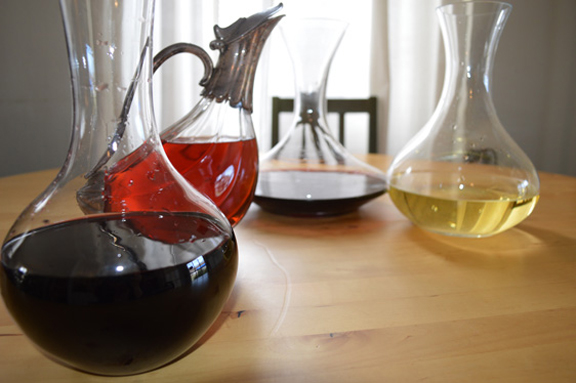
My post today for the Houston Press on my evolving views of decanting: “I am an American and I am an Anti-Decanter.”

My post today for the Houston Press on my evolving views of decanting: “I am an American and I am an Anti-Decanter.”

Above: a bottle of Mastroberardino 1968 Taurasi, considered by many one of the appellation’s greatest vintages, tasted in May 2013.
Today, the world of wine mourns the loss of Antonio Mastroberardino, who died yesterday in Campania at age 86.
He was widely considered the father of fine winemaking in Campania and his decision to replant indigenous grapes after the second world war redefined the fine wine movement in his own region and beyond.
“In 1945,” wrote Neapolitan journalist and wine writer Luciano Pignataro on his blog today, “Irpinia’s great viticultural district, which quenched Italy’s thirst in the 1920s, was practically non-existent [destroyed by the arrival of phylloxera in the 1930s]. Together with his brothers Angelo and Walter, he began again to make wine. But it was he who decided the contents: Fiano, Greco, and Aglianico.
“His decision to remain faithful to the grapes of his forbearers was a stubborn one, rooted in his Irpinian mountain origins. It seemed out of fashion in the 1960s, when agricultural inspectors were pushing growers to plant more prolific Italian grapes: Trebbiano, Montepulciano, Sangiovese, and even Barbera.”
In the 1990s, Mastroberardino launched the Villa dei Misteri project, a viticultural and archeological quest to grow grapes in Pompeii using DNA culled from ancient artifacts and techniques described by the ancient agronomist Columella.
It was just one of the many initiatives that helped to reshape and revitalize Campania winemaking as we know it today.
The many fine wines now produced there — and in particular, the myriad expressions of Aglianico — are inexorably linked to his legacy and passion as a grape grower and winemaker.
Antoni sit tibi terra levis.

When Tracie P and I sat down for dinner at Bufalina in Austin on Friday night, it was as if we communicated telepathically: without uttering a word, we both knew that we were going to order the 2010 Slatnik by Radikon, a wine by Stanko Radikon’s son, Saša.
A lot of Italian wine bloggers have talked about how Saša’s wines are more “easy going” and perhaps more approachable — less tannic and more affordable — than his father’s wines.
But I found this wine to be one of the most elegant and thoughtful that I’ve ever tasted from this farm — a winery and winemakers for whom I have a quasi religious reverence.
Its stone fruit flavor was brilliant, its acidity popping, and its tannin laid back. But ensemble, all of these elements sang together to convey a gorgeous balance. In some ways, I thought, it represents the evolution of macerated wine, which can tend to be austere and aggressively tannic in its youth.
We really, really loved it. And we were thrilled to share a glass with another couple who were nonplussed by its color.

We ordered three pizzas: the classic Margherita, the creative Taleggio (below), and the whacky Brussels Sprouts (above), which was topped with surprisingly subtle serrano-scallion pesto, ham, and Brussels sprouts.
Many pizza purists can’t see beyond the Margherita cannon. And they don’t know what they’re missing.
Pizza, by its very nature, should also be creative. As my friend Tony always says, “to be authentic, Italian cooking must also be creative.” We loved all three dressings.

Like so many things in the U.S., most gauge a pizza’s quality by the toppings. But pizza is the crust, the pie, the dough…
I taste so much pizza across the U.S. and have eaten in many of the cutting-edge Neapolitan pizzerias in the country.
Bufalina owner Steven Dilley’s pizza is in my top five: perfectly soggy in the middle and with an outer crust that never becomes too chewy or heavy, always in perfect balance with the center (this last element, the cohesiveness — the “oneness” of the crust — is so important imho).
And Steven’s list continues to stand apart as my number-one wine list in Austin.
I wrote about his wine revolution when we visited about six months ago (the night before Lila Jane was born!). And more recently, when I visited with one of the most famous wine writers in the world, said wine writer noted approvingly that he had reviewed every one of Steven’s by-the-glasses in his column (we drank Foradori Manzoni Bianco that night).
Has Steven’s groovy wine list caught on in Austin? From what he told me, some of his go-to distributors have been gravitating toward Houston where they find buyers more receptive to their “esoteric” labels. The Slatnik had been on the list for a few months, he said, and we were the first to order it.
After dinner, we headed to the über cool Violet Crowne theater where we saw American Hustle paired with cocktails.
I sure am going to miss this town once we make our move eastward…
Thanks again to Mrs. and Rev. B for babysitting and for letting us sleep in the next day!

One of the things that New York wine maven Charles Scicolone and I have in common is that we are both “blessed,” as he puts it, to have spouses who excel in the kitchen.
My wife Tracie P may not be a celebrated cookery book author like Michele Scicolone, but, man, can she cook.
Last night she served the family her delicious ragù alla bolognese and we paired with a bottle of 2008 Gaja Sperss that a client had given me for Christmas 2013.
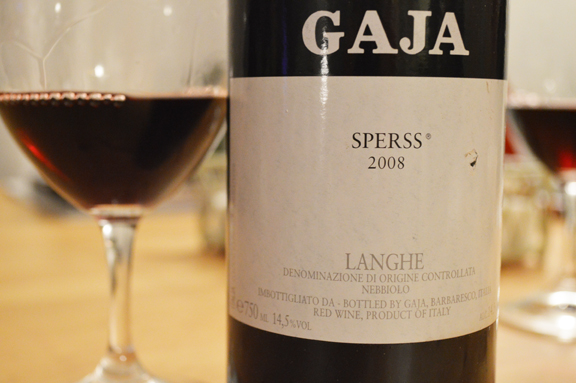
Perhaps because of my love of romance philology and my keen interest in Italian language and its history, one of the questions that I get asked more than any other is what does the designation “Sperss” mean?
Over the years, Angelo Gaja has been generous in spending time with me and it must have been five years ago or so that he explained the origin of the term.
In 1961, the winery decided to end its practice of buying grapes from outside growers. Because the family did not own land in the Barolo appellation, they were no longer able to produce a Barolo.
It was a bold move: at the time Barolo was the only “brand” that carried any weight outside the Langa hills. And ultimately, it was Angelo Gaja who would single-handedly create awareness of Barbaresco among foreign wine lovers through his tireless marketing efforts and travels.
It wasn’t until 1988, when the family purchased vineyards in the Serralunga township, that it would once again produce a Barolo.
“Sperss means nostalgia,” he told me.
It’s a Piedmontese dialectal term akin to the Italian perso (lost) from perdere (to lose). Its etymon reaches back to the Latin [dis]perdo meaning to squander or to waste.
“When we first released this wine,” he explained, “we called it Sperss to remember that time” when the winery still produced Barolo using grapes from other growers.
In 2000, with release of the 1996 vintage, Gaja “reclassified” the wine, as Angelo’s daughter Gaia likes to say, from “Barolo Sperss” to “Langhe Nebbiolo Sperss.”
Many Langa wines from the 2008 vintage are going through a phase of openness right now and the fruit of this wine emerged confidently despite its tannic nature. The more and more I taste from this harvest, the more I believe that 2008 is going to be the standout from the 06-08 harvests.
The wine was elegant in the glass, with Gaja’s signature nuanced, understated savory character and earthiness. A stunning wine that I was thrilled to share with my father-in-law, the Rev. B, who’s visiting with Mrs. B. right now.
It was an unforgettable meal on a wintry, snowy night in central Texas.
Please stay warm and safe wherever you are… Buon weekend…

Above: the view from our kitchen window this morning.
I never thought I’d live to see the day: snow in Austin, Texas!
Across the state, from Central Texas to East Texas, bridges and overpasses are closed and scores of motorists are stranded. Unbelievable…
Texans aren’t accustomed to wintry driving conditions and the Texas police don’t mess around when it comes to enforcing road closures.

I’ve been writing a fun “how-to wine” series for the Houston Press this year.
Today’s post deals with the sticky subject of the “overpour.”
Is the glass half full or half empty? The age-old conundrum…

Above: is Mario Zanusso Italy’s sexiest winemaker? (image via Brunellos Have More Fun).
Mario Zanusso (above) of I Clivi is giving Francesco De Franco (pronouncer of Gaglioppo) a run for his money as the sexiest contributor to the Italian Grape Name and Appellation Pronunciation Project, my personal quest to capture native speakers on video as they pronounce their region’s enonyms and designations.
Today’s contribution comes via Marie Tyler, who works with I Clivi’s U.S. importer, Oliver McCrum.
See Oliver’s excellent page on I Clivi here and see also Hawk Wakawaka’s superb post on a tasting that she and I attended with Mario a few years ago.
I’m always looking for new entries: just be sure that I don’t already have the grape name or appellation covered and note the format that I use (the grape name or appellation, pronounced three times, clearly, in a normal speaking voice).

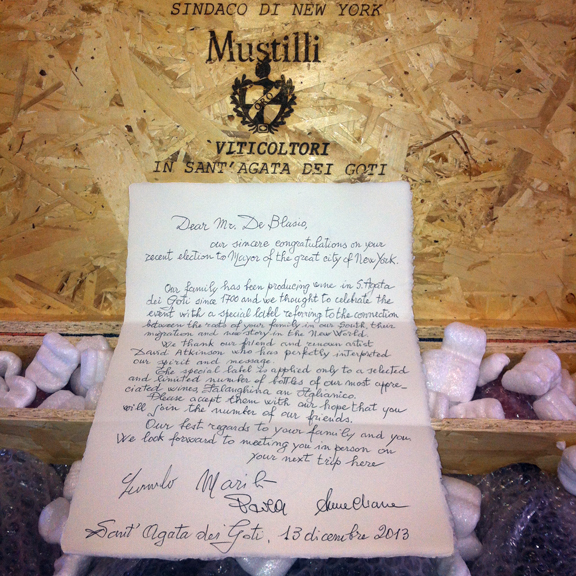
Above: British mapmaker and illustrator David Atkinson’s label for Mustilli’s “Bill de Blasio” Falanghina.
The tiny, picturesque medieval hamlet of Sant’Agata dei Goti, in the heart of Campania’s wine country in Benevento province, has gone a little Bill-de-Blasio crazy since he was elected mayor of New York in November of last year. (See this piece in the New York Times; the slideshow is priceless.)
De Blasio’s grandparents lived in Sant’Agata before they immigrated to the U.S. in the early twentieth century.
Across Italy, De Blasio’s election has been a source of great pride and Forkgate has been closely followed by Italians and Italian food and wine writers (although the Italians were a bit baffled by the episode that launched the scandal).
Honestly, I can’t remember the Italians getting so excited about Rudy Giuliani (whose grandparents came from Montecatini, Tuscany). But then again, Giuliani was a republican.
A few days ago, I received the following note and a few images from Paola Mustilli, whose family makes some of my favorite expressions of native Campania grapes. She’s dedicated two labels to the new mayor.
*****
The idea for a wine dedicated to Bill de Blasio came about when he was elected mayor [of New York] and we decided to commission a label that represented the connection between Little Italy and Sant’Agata [dei Goti], the town where his grandparents lived before they immigrated to America in the 1920s.
We produced a limited edition of these labels, 50 each for two of our wines that we bottle in magnum, Falanghina and Aglianico. We sent him a wooden case with 4 magnums.
The artist who designed the label is Londoner David Atkinson, who has worked and continues to work with Château Latour, Decanter, Grants of St. James’s, the Wine Society, etc.
—Paola Mustilli
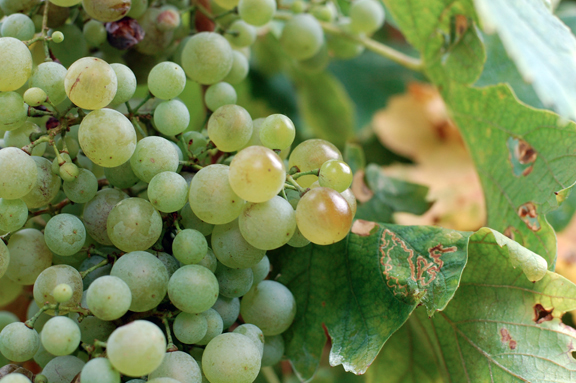
Above: the Glera grape, mighty mighty and letting it all hang out.
When I started out in this business in 1998, Prosecco was a wine known by few outside of northeastern Italy.
Back then, when someone handed party guests a glass of Prosecco in the U.S., it wasn’t uncommon that they would respond gleefully, “Champagne!”
Today, it’s not uncommon for the exact opposite to occur. And in many corners, Prosecco — in part thanks to its price-quality ratio and in part thanks to its ubiquity — has become the sparkling wine by antonomasia.
According to data published on Friday by the Italian wine trade publication Corriere Vinicolo and ISTAT (Italy’s national institute of statistics), Prosecco sales grew by 30% in 2013 and led Italian sparkling wine sales to a record high.
While Italian sparkling wine sales fell in Germany, a historically reliable market for the category, U.S. and U.K. sales were so strong that winemakers still managed to set new records. 2013 also saw nearly 80% growth in Italian sparkling wine sales in China.
It’s incredible to think that none of this was even conceivable fifteen years ago when a handful of Prosecco négociants set out to conquer the world.
I’ve posted an excerpted translation of the report on the Bele Casel blog. I hope you’ll find it as interesting as I did.
Mighty, mighty Prosecco, the little wine that could.

Above: Hans Wirsching 2009 Sylvaner is what we drank to get us started. Put enough Master Sommeliers under one roof together and something delicious and geeky is bound to be opened.
Saturday night “happened” to find me at Mark Sayre’s newly renovated bar at Trio in the Four Seasons in downtown Austin, where the board of the Court of Master Sommeliers “happened” to be staying for a Court meeting.
I wasn’t exactly invited to the party that ensued. But some how I ended up in a hotel room where I was the only lay person, so to speak. Having five Master Sommeliers and one Master of Wine offering to pour me wine was — how can I put it? — a unique experience.
It was really interesting to meet MS Geoff Kruth, director of operations for the Guild of Sommeliers, and learn that he speaks Italian fluently and is an unabashed fan of the often forgotten Italian region of Molise. He had recently returned from a visit there and was raving about the venues where stayed and ate. His Italian and his knowledge of Italy are impressive, to say the least.
My conversation with MS Shayn Bjornholm, the court’s examination director, was also intriguing. He had a lot to say about the legacy of the 2012 film Somm (in which he appears) and how it has reshaped awareness of the court and its mission. Dialog was candid and he spoke of his personal investment in making hospitality, rather than wine connoisseurship, the primary focus of the court’s evolving curriculum.
It was also great to catch up with MS Bret Zimmerman, whom I know from my years in New York. He affirmed my conviction that Boulder, Colorado, where he runs the excellent Boulder Wine Merchant, is one of the (not so) new epicenters of North American enogastronomy.
And it was equally rewarding to hear MS (and Austinite) Craig Collins, wine director for the ELM Restaurant Group, talk about plans to develop a new Italian concept restaurant in Austin. He’s on his way to Rome, Chiantishire, and Montalcino for research.
The next morning, when Tracie P gently roused me from bed (after generously letting me sleep in), we couldn’t help but laugh about a comment a good friend and high-profile wine writer made when I told her I was moving to Austin five years ago.
“What will you drink?” she asked, deeply and genuinely concerned for my enogastronomic health.
Looking back now, “What won’t you drink?” would have been more to the point.
 Do Bianchi