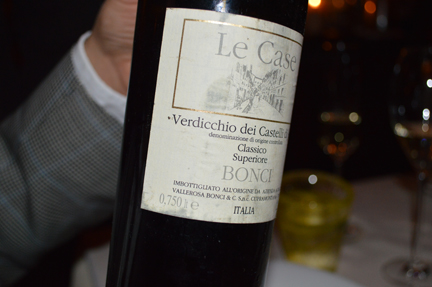
Above: in November of last year, Steven Wildy poured this 1998 Bonci Verdicchio dei Castelli di Jesi for Paolo Cantele, 1WineDude, and me. Here’s what 1WineDude had to say about it: “This was a stupidly good bottle of wine; earthy, oily, unctuous, citric, spicy, alive, piquant. ‘Tired’ is not a word that seems to have entered its vocabulary at any point in the last fifteen years. As impressive as how well it wore its age was the fact that its round, toasty, nutty finish felt like it was going to last another fifteen years…”
Last week, the editor of the SlowWine guide, Giancarlo Gariglio, posted an editorial entitled, “The destiny of Italian whites? Pessimist! The sink, according to Wine Enthusiast” (“Il destino dei bianchi italici? Pessimist! Per Wine Enthusiast il lavandino”).
“It wasn’t easy to keep our comments in check after we read a special edition like the one that appeared in the February issue of Wine Enthusiast,” writes Gariglio. “It included ‘The World’s Greatest Vintage Chart’: the list of the best vintages across the world. Well, if it were a joke, they could have told us on the cover, which trumpets the chart in block capitals. We purchased a copy at the San Francisco airport and we began laughing and didn’t stop until we reached Chicago, after four hours in the air.”
Gariglio goes on to lament the fact wines like Soave (“one of Italy’s greatest whites”) are broadly dismissed by the magazine’s editors as “undrinkable” beyond six years of age: “How can they write that the whites of the Veneto — as if the were all the same — are ‘in decline, maybe undrinkable’ from 2008 and beyond? This is terrible!”
The only explanation, he posits, noting that “it’s not an excuse,” is that the editors have not tasted a sufficient number of aged Italian whites.
(Click here for the Wine Enthusiast post where the editors present the list.)
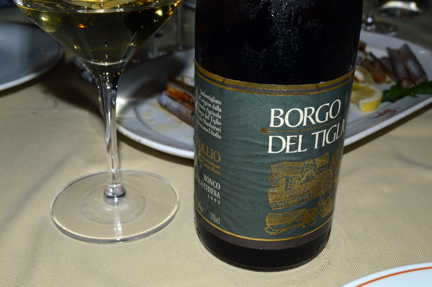
Above: I drank this 1999 Borgo del Tiglio Ronco della Chiesa back in October of 2013. It was one of the best wines I’ve ever had in my life.
“All those over-the-hill whites?” asks Avellino producer Lello Tornatore of Tenuta Montelaura in a comment. “Tell me where they are and I’ll go fetch them!”
It’s hard not to share Gariglio’s disbelief and frustration.
Think of all the incredible Italian whites with immense aging potential like those from Friuli, Veneto, Campania, and Marche, not to mention wines like Fiorano from Lazio or Valentini from Abruzzo.
How could I forget a bottle of 1988 Bucci Verdicchio dei Castelli Jesi Riserva that I drank back in 2007 in New York? It was stunning.
1999 Borgo del Tiglio Ronco della Chiesa (above)? 1994 Gaia e Rey that I tasted with Angelo and Gaia in Barbaresco in 2010? I’ll never forget how Angelo was so thrilled with the results of that terribly difficult, rainy vintage, “a surprise,” he said.
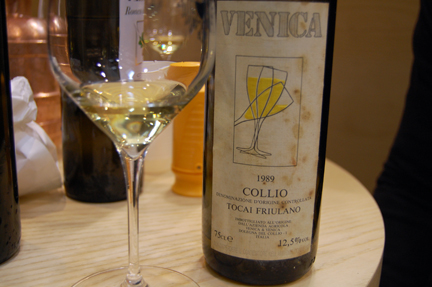
Above: 1989 was a superb year in northern Italy, as this gorgeous bottle of Venica Tocai demonstrated a few years ago when Tracie P and visited our good friends Giampaolo and Chiara Venica.
For the most part, the Wine Enthusiast vintage chart aligns with conventional wisdom and experience — even in regard to Italy.
But the sweeping brushstrokes that elide the great Italian whites represent a lacuna — I can’t think of a better word to describe it — in the editors’ attention to Italian viticulture.
In all fairness to them, the Italians’ marketing focus in the 1990s and 2000s was on big, American-friendly red wines.
As one (very high-profile) commenter to Gariglio’s post notes, Italians haven’t done the greatest job of marketing their white wines to English-language media.
France is uniquely positioned when it comes to its dominance in the realm of white wine. And historically, Italy has always played the part of the white step-child, even as its reds have begun to compete on an international level with the best of the French.
In his 1980 Vino, Burton Anderson compared the wines of Valentini to some of the greatest expressions of Montrachet.
But therein lies the rub: many English-language writers feel obliged to compare Italian wines to French when it comes to describing their greatness.
It’s time for English-language media to cast off the stereotypes and bias of past generations.
Thanks for reading…


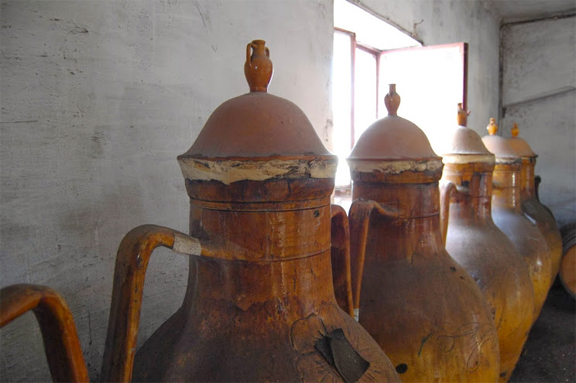




 Do Bianchi