little drummer girls

 Above: one of my Austin restaurant clients had his contractor board up our front door after the burglar broke it down.
The date was October 9, 2013, two days before Tracie P’s birthday, when two men burglarized our home in Austin in broad daylight.
I had left earlier in the morning for my weekly commute to Houston (where we now live) and Tracie had taken our daughters to the grocery store.
One of the men broke down our front door and searched through our belonging for valuables (here’s my post from the week of the burglary). The other waited outside with their getaway car.
The police were able to identify one of the burglars because he took a selfie with our family iPhone and we saw it in our iCloud. He also took a photo of a brand new pair of tennis shoes.
Both men left Texas and went to California. The driver had been pulled over by police in Austin and fled. He was ultimately apprehended in California.
From what we were told by the Austin detective who handled our case, the man who entered our home was killed in Los Angeles in June in a gangland shooting. He was twenty-four years old.
On Friday of last week, the driver accepted a plea bargain. He will spend the next ten years in jail.
In the end, the news of the one’s passing and the other’s guilty plea made me feel terribly sad.
 The news has been so doleful this summer that I wanted to share this video, which was debuted last night at my favorite wine bar in Houston, Camerata.
It’s dopey, it’s silly… and it’s just what I needed to cure my summertime blues.
The puns are irresistible and I wrote it up today for the Houston Press.
 Friulian grape grower, winemaker, and founder of the Ronchi di Cialla winery, Paolo Rapuzzi (above, center) has died.
He passed away in his sleep on August 13, said his son Ivan.
Rapuzzi was a much beloved figure in Friuli, where his legacy as a pioneer in reviving indigenous grape varieties continues to shape local viticulture.
He was among the first in a wave of growers who embraced native grapes in the late 1970s.
And his superb wines — especially his coveted Picolit — are treasured by Italian wine insiders.
Please see this profile of Rapuzzi that I wrote for the Colli Orientali del Friuli consortium a few years back.
Google him and you will find that many of my peers and colleagues were inspired by him as well. He was a sweet and gentle man and he shared a little bit of his magic with everyone he touched.
His contribution to Friulian — and Italian — viticulture played a fundamental role in the current Italian wine renaissance.
 On more than one occasion, I’ve heard Angelo Gaja say that white wine is a category with immense potential for growth in Italy.
There are a handful of whites from Piedmont that have captivated the imagination and palates of Italian wine lovers: Gaja’s Gaia e Rey (I remember tasting 1994 with him at the winery a few years ago), Aldo Vajra’s Riesling (he likes to call it “a wife for Barolo”), Ettore Germano’s Riesling (such a focused, brilliant wine), and Walter Massa’s Timorasso (we all remember when this wine hit the U.S. scene and knocked everyone’s socks off) are some of the more memorable.
But they remain just a handful. Unlike Friuli, Campania, and Jesi/Matelica, where white wine is a long established category with myriad standouts and impressive expressions of longevity, Piedmont has yet to make its mark as one of the greater producers of vini a bacca bianca.
I was a little skeptical when my good buddy Nathan hooked me up with a bottle of 2004 Tre Uve by Roero producer Malvirà. I know the winery but, with spotty distribution, you don’t see much of its in wine in the U.S. today.
It’s a blend of Chardonnay, Sauvignon Blanc, and Arneis. According to WineSearcher (and what Nathan told me), 2005 is the current vintage available.
This wine had all the right stuff: freshness, acidity, clarity of fruit (stone and white fruit), and wonderful vibrancy. Ten years out from its harvest, it had depth and nuance and it danced on the palate. Great wine.
It aromatic breadth rivaled some of the great white blends that you see from Collio’s top wineries.
A truly original and exciting wine imho. Could Chardonnay blended with aromatic varieties be the future for Piedmont whites? If this is any indication of their potential, I think the winemaker at Malvirà is on to something great.
In other news…
I continue to receive tragic reports from northern Italy, where seemingly incessant rains have seriously threatened the vintage.
I hate to bear bad news but today I heard about a Lambrusco producer who has virtually lost his entire crop. And a friend from Friuli (Colli Orientali) wrote that some growers are fearful that they will not have any fruit to vinify.
In Tuscany, things are looking up. The vegetative cycle — which started extremely early — is now moving very slowly. The cool weather has helped to balance out the accelerated start (caused by a very mild winter).
If sunny days arrive, one producer told me today via Facetime, they could have a great vintage. It’s all a matter of how much sun they get between now and harvest. She’s in Chianti Classico where they expected to harvest as late as mid- to late-October.
That’s all the news that’s fit to post. Thanks for reading.
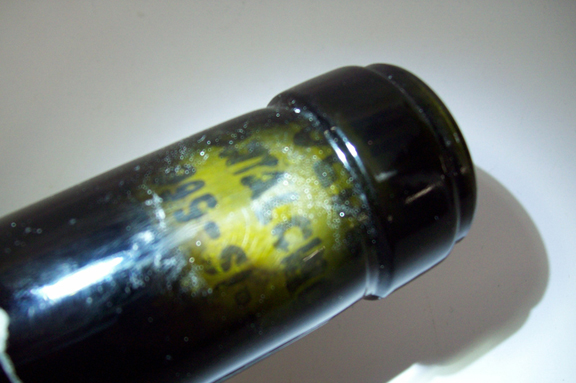 Above: a friend at a major wine auction house once asked me to help out with the authentication of a lot purportedly from one of Italy’s most exclusive producers. In the end, she established the wine’s authenticity by verifying that the corks were branded and not printed (branded with an iron as opposed to printed with ink). The winery began using printed corks after the vintage in question.
Thanks for reading and buon weekend.
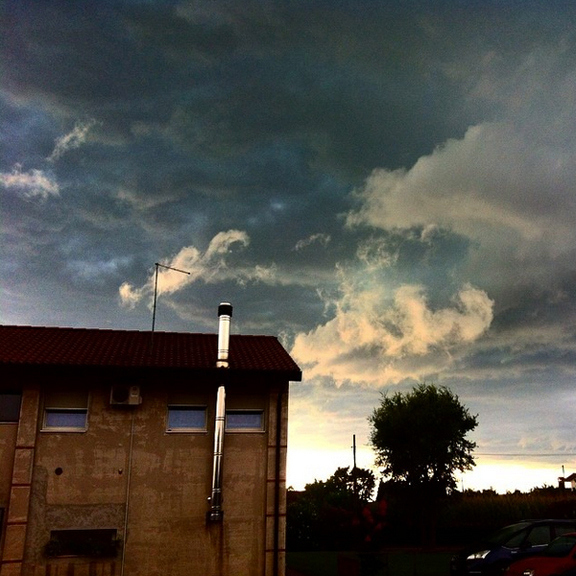 Above: my friend and client Luca Ferraro, grape grower and winemaker in the Prosecco DOCG, posted this photo on his Instagram this morning, noting that the 2014 is a “disaster… I’m losing hope,” he wrote.
As some northern growers have already begun to pick (Franciacorta) and some are preparing to harvest in roughly two weeks (Asolo-Conegliano-Valdobbiadene), incessant rains continue to plague embattled winemakers in northern Italy this week.
Scattered hailstorms have already caused widespread damage this year, particularly in Piedmont and to a lesser extent in Franciacorta and Prosecco country.
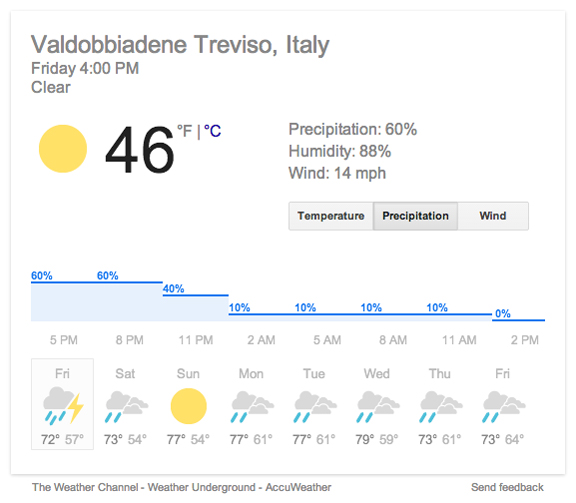
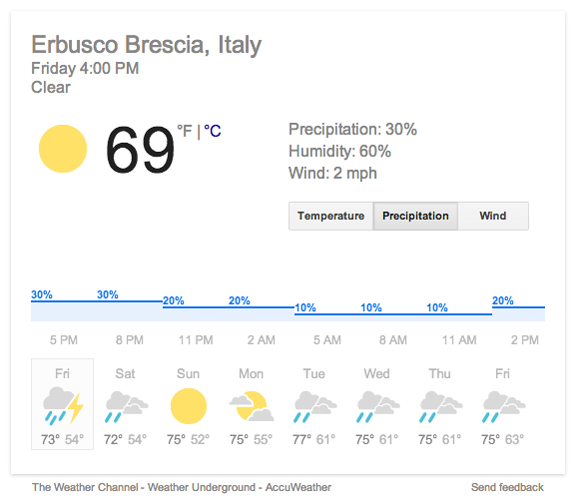
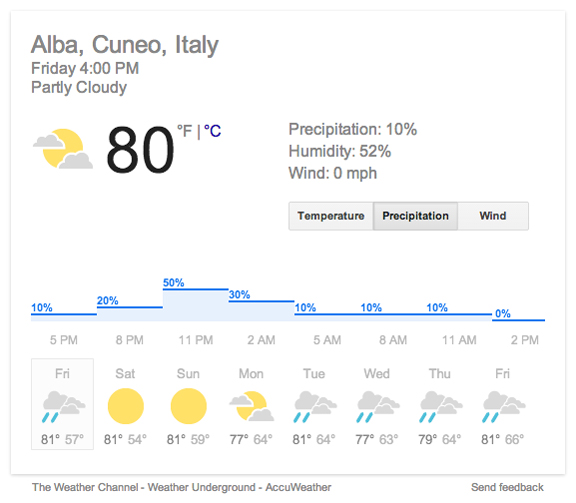
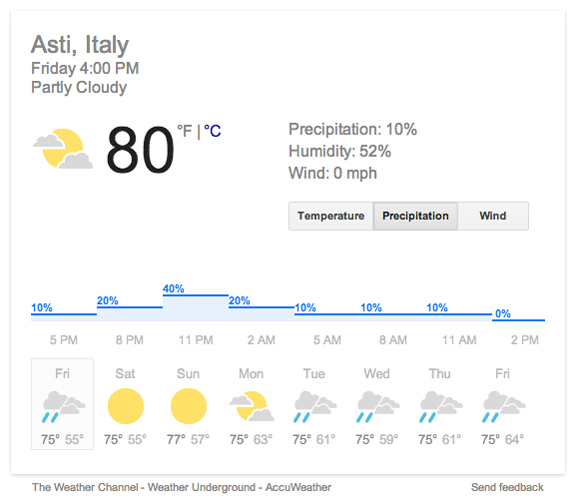
The following screen captures show weather forecasts for Valdobbiadene, Erbusco (Franciacorta, where they are already harvesting), Alba (Barolo and Barbaresco, the appellations hardest hit by hail this year), and Asti (Barbera and Moscato d’Asti).
The relentless precipitation is making it increasingly challenging for growers to combat rot and mildew in the vineyards.
My friend and client Luca Ferraro, a Prosecco producer, wrote last week that he’s abandoning in growing sites in the flats this year so that he can focus his already herculean efforts to save his hillside vines.
Piedmont is getting the warmth that it needs but note the cool temperature today in Valdobbiadene just two weeks from expected harvest.
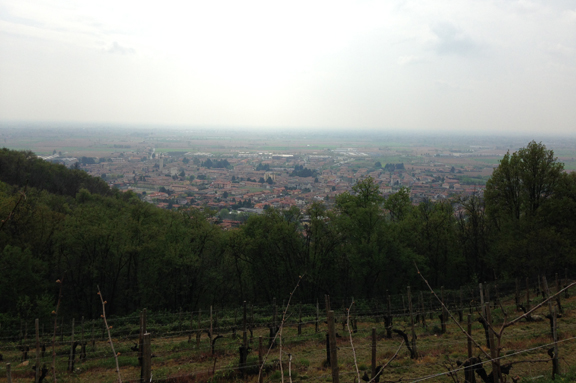 Above: the village of Coccaglio as seen from a vineyard owned by Franciacorta producer Arcari-Danesi; photo taken in April 2014.
According to a press release issued this week by the Franciacorta consortium, growers in Coccaglio (Brescia province) began picking Chardonnay, Pinot Bianco, and Pinot Nero grapes on Monday.
They are among the first in Italy to harvest in one of the most challenging vintages in recent memory.
According to Coldiretti, Italy’s national farmers union, the month of July saw a roughly 74 percent spike in average rainfall with respect to 2013.
As Corriere della Sera wine writer Luciano Ferraro noted this week on his blog, 1,000 mm of rain fell in the region of Trentino (northern Italy) during the first seven months of 2014 — the average amount of rainfall for a normal year.
Across northern and central Italy, a rainy and cool July has slowed the growing cycle. As Ferraro put it, citing the song by the Doors, winemakers are literally waiting for the sun. The arrival of warmer weather will be crucial: without it, the grapes will take too long to ripen fully and rot and mildew — already an issue for many growers in this wet, chilly summer — will go unchecked.
In Proseccoland, where nearly daily rainfall continues to plague the vineyards, producers expect to start picking in early September.
In central Italy, most are expecting harvest to begin around the middle of September. They cool weather, some have noted, has brought 2014 in line with the growing cycles of the 70s and 80s — the era before climate change delivered extremely warm summers and accelerated harvests.
In southern Italy, where winemakers have experienced a more “classic” growing cycle, many will begin picking their grapes next week.
 Above: a screen capture taken at 3 p.m. Italian time.
 A Texas-sized lightening storm took out my modem and wifi last night (and scarred the crap out of us when lightening struck a few doors down from our house).
But that didn’t stop our dinner guests, Tracie P, and me from thoroughly enjoying a bottle of 2000 Franciacorta Dosage Zero by Ca’ del Bosco.
This still youthful wine was vibrant and fresh with remarkable depth and character. Its fruit was rich and its acidity was perfectly integrated throughout its body.
A truly extraordinary, supreme expression of an often misunderstood and misrepresented appellation. One of the best bottles I’ve had all year…
I’m still recovering from a morning’s work lost (when I got to my cable provider’s office this morning, I discovered I wasn’t the only Houstonian with a fried modem).
But I just had to take a moment to share Alfonso’s excellent post on “Franciacorta’s ‘Little’ Problem.” It’s a great read…
 I recently received an exuberant e-blast from a respected colleague, a top wine professional in Los Angeles (for whom I have the utmost admiration). In it, he sang the praises of one of my favorite Valtellina producers.
It’s only available in a handful of New York restaurants, he wrote, and he was thrilled to be pouring it at an upcoming wine dinner at the super hip LA restaurant where he works as wine director.
He even made a very self-aware and bold statement: although it’s virtually unknown to American wine lovers, he wrote, it’s one of the best wineries in Italy.
Italian wine insiders know the wine he was talking about.
But few remember that ArPePe is the current incarnation of the historic Pelizzatti winery. If you leaf through Italian wine monographs from the 1990s, it’s often referred to as the “second label” of Nino Negri (see this 2007 post by Alfonso). Since that time, the new generations (Pelizzatti and Perego) have converted to chemical-free farming and have begun making some of the best Valtellina available today.
I love ArPePe and have written about it here on numerous occasions (the wine is actually available in a lot of states beyond New York, including Texas; and btw, locals pronounce it ahr-peh-peh and not ahr-peh-PEH with a false and hypercorrective stress on the last syllable).
But when I read my colleague’s email it occurred to me: most Americans simply haven’t tasted a lot of Valtellina. And unless they collect Italian wine tomes from the 1950s and 60s (like me), most Americans aren’t aware that Valtellina was the top expression of Nebbiolo before Langa wines — Barolo and Barbaresco — rose to prominence beginning in the 1970s.
On Saturday night, I opened a bottle that was sent to me by one of my clients (an importer for whom I compose tasting and background notes; he likes to keep a low profile and so I am not going to name him here). It was the 2006 Balgera Valtellina Inferno (above) and man, this wine knocked our socks off.
It was lithe and nimble in the glass and its confident eastern spice notes and elegant tannin were perfect for the griddle-fired medium-rare cheeseburgers that we served on toasty wholewheat buns.
We only drank half the bottle: the next night, it was even better paired with some fontina and crusty bread.
Our tasting note: WOW! The freshness of this wine and its depth and nuance of flavor just blew us away.
I don’t want this post to sound like too much of a plug for my client. But if you love Nebbiolo, you need to taste this wine. And it weighs in at less than $30 retail (if I’m not mistaken).
Sadly, it’s not available in Texas and I’m not seeing any availability on WineSearcher.com beyond an older vintage of their rosso at Chambers (one of the best wineshops in the U.S., btw) in New York. But I’m going to try to get my hands on some this fall when my wine club becomes active again.
 Do Bianchi