spaghetti con crema di melanzane (spaghetti with Listada de Gandia eggplant sauce)

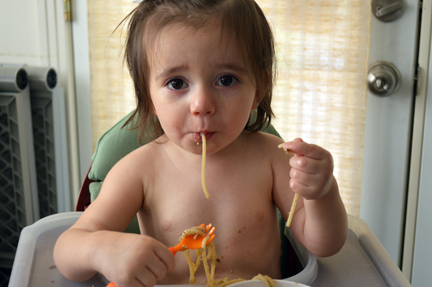
baby eating spaghetti

For this dish, I washed Listada de Gandia eggplant and sliced into rounds.

Then I tossed them in a light dust of kosher salt and let them purge their liquid for about 30 minutes in a colander.

Then I grilled them on our cast-iron stove-top grill with a brush of olive oil and a sprinkling of salt.

After they had cooled, I tossed them with extra-virgin olive oil, a pinch of freshly cracked black pepper and chili flakes, and a “kiss” of vinegar.

After the eggplant had marinated overnight in the refrigerator, I puréed them, adding a thin drizzle of olive oil.

Before folding in the slightly undercooked spaghetti, I added about 3 tablespoons of the pasta’s well-salted cooking water to the sauce.

After folding in the spaghetti and allowing them to absorb the flavor of the sauce as they finished cooking through, I folded in a generous handful of freshly grated Parmigiano Reggiano.

Georgia P’s has been insisting on eating with her fork these days. She still has a little bit of trouble getting the food to her mouth.

But what a thrill to watch her eat spaghetti with a fork for the first time!

Mothers aided by @WWF in pesticide battle in Proseccoland cc @Bele_Casel @ZanottoColfondo

baby in the vineyards

Above: We took Georgia P to Proseccoland for the first time in September 2012 when she was about nine months old. The grapes were still on the vines and about to be harvested. She loved playing in the vineyards and Tracie P and I felt good about it because the two vineyards we visted — Bele Casel and Zanotto — are both organically farmed.

On Friday of last week, a friend of ours from mainland Venice, Paola, alerted me to a report in Oggi Treviso (Treviso Today) about daycare mothers protesting the use of pesticides and herbicides in Proseccoland.

According to the author of the article, the local chapter of the WWF has helped them to organize an assembly (this coming Friday) to address their concerns about chemicals being sprayed in vineyards that lie adjacent to a preschool daycare center.

Yesterday, I wrote about the event for the Bele Casel blog, a site devoted to the Veneto and viticulture in Proseccoland.

pesticide protest

Above: During the “Prosecchissima” festival in the village of Miane in April of this year, the WWF Altamarca displayed signs calling for the abolition of chemical-based farming in the Prosecco DOCG appellation (source: PDQNews.it). The signs were removed by thieves.

But this morning, as I poked around the internets looking for more info about the situation “on the ground” in Proseccoland, I learned that similar protests, assemblies, and impassioned calls for a chemical-free Prosecco DOCG have been going on since 2011 when the WWF opened a local chapter, WWF Altamarca (no website).

I also discovered a video feed by European parliament deputy Andrea Zanoni, a Treviso resident and native, who has been documenting his battle with “big Prosecco” to curb the use of chemicals and to stop the deforesting of woods in the appellation.

Here’s a video from his YouTube page:

The video was shot in the township of Tarzo, not far from the preschool where mothers first raised concerns about pesticides being sprayed.

Like the WWF Altamarca, Zanoni has also called for a halt to helicopter spraying.

In another of his videos, he notes that restaurant-diners were recently affected by pesticide-spraying aircraft. Such spraying, he says, is only allowed in extreme cases and he believes that recent airborne spraying is in direct violation of EU regulation.

Before his passing, even the great Veneto poet Andrea Zanzotto lent his gravitas to the cause, publicly aligning himself with the WWF mission.

I first traveled to Proseccoland in 1989 (playing music) and I think it’s safe to say that no other Italian appellation has been transformed so radically by “big wine.”

The Prosecco boom of the last two and half decades and the ever growing demand for grapes are so enticing that chemical-farming and the clearing of land has become a way of life there.

I’ll be following these stories and will continue to report on them here and on the Bele Casel blog.

Please tweet or share this on Facebook if you feel so inclined.

Carbonara & more thoughts on its origins, a pairing inspired by Brooklyn Guy

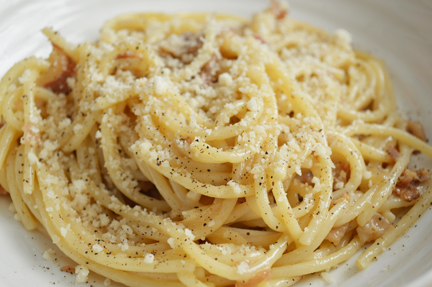
best carbonara recipe

Above: Tracie P’s Carbonara last night. To borrow an expression from Charles Scicolone, “I am blessed.”

“One of the things that is endlessly appealing about New York, for anyone with more than a passive interest in food,” wrote Craig Claiborne in the New York Times in 1965, “is a continual sense of discovery either in products or the environment in which they are sold. It may be a spice or a bread or a cheese in Brooklyn, Greenwich Village, the Lower East Side, but there is always the prospect of the unexpected.”

His words ring as true as if they were written yesterday, don’t they?

In this instance, he was writing about the pancetta at the “Salumeria Italiana, known in the neighborhood as Frank’s Pork Store, at 26 Carmine Street (near Bleecker Street and the Avenue of the Americas).”

Pancetta “is designed to be sliced paper thin and eaten as part of an antipasto or scrambled with eggs. The closest thing it may be said to resemble is prosciutto, and like prosciutto, it is delicious when draped over melon or figs and served as a first course. Mrs. Bocassi, the owner’s wife, commented recently that many Italians used pancetta to make spaghetti carbonara.”
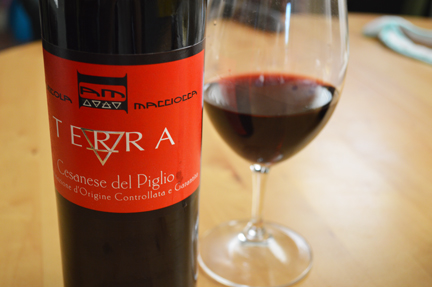
cesanese del piglio

Above: We paired with this Cesanese del Piglio by Cantina Macciocca, sent to us as a sample by importer Katell Pleven of the Vine Collective. In my experience, the Cesanese grape has the right spice to stand up to the intense flavors of Carbonara. I loved this wine by organic farmer and native yeaster Macciocca. Although a little hot with alcohol, it was fresh and meaty and its peppery notes sang with the Carbonara.

Carbonara has been on my mind after reading Brooklyn Guy’s recent and superb post and reflections on wine pairings and recipes.

(Here’s a link to my last post on Carbonara and its origins.)

The Claiborne passage above is significant not only because “Mrs. Bocassi, the owner’s wife, commented recently [in 1965] that many Italians used pancetta to make spaghetti carbonara,” but also for his observation that pancetta “is designed to be sliced paper thin and eaten as part of an antipasto or scrambled with eggs” (italics mine).

By the time he wrote this piece, Carbonara was already an immensely popular dish in the U.S., in part thanks to opera singers who mentioned it as their one of their favorite Italian dishes.

In an article published in 1962 entitled, “A Diva’s Proper Interest in Pleasures of the Table,” Claiborne wrote of soprano Eileen Farrell that “Miss Farrell speaks with warmth, however, of spaghetti carbonara.” It’s one of the earliest mentions of Carbonara, the dish, that I can find in the Times.

I’ve also found an instance where soprano Birgit Nilsson mentions it as a favorite Italian dish.
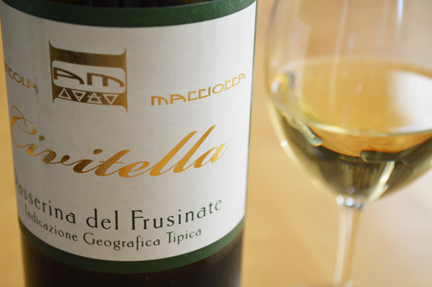
passerina frusinate

Above: Most Passerina comes from Abruzzo but this one, a 2011 by Macciocca, is raised in Latium (Lazio) in the township of Frosinone (Frusinate in dialect). It’s an example of the viticultural connection between Abruzzo and Latium, a relationship that’s even more evident in the regions’ gastronomic ties. This wine took a moment to open up and show its true colors but we both thought it was delicious once it did. Great acidity, balanced fruit, and a nice minerality that you don’t expect in Passerina.

I’ve never met an Italian who scrambles eggs with pancetta. And I was surprised by Claiborne’s observation.

Is it possible that Carbonara could be the child of American influence not via American soldiers (as some have speculated) but via opera singers who wanted eggs and bacon when they traveled to Rome to perform?

(Pancetta is Italian for cured pork belly, the equivalent of bacon.)

Browsing the Times archive for the word carbonara, I also came across a number of obituaries for persons named Carbonara.

It occurred to me that Carbonara, while not among the most common, is a relatively common surname, probably originating in Apulia (Puglia).

Then I started thinking about the wave of Apulian immigrants who came to New York in the 1950s and 60s (hence the prevalence of the surname in New York during those decades).

Could this be one of the elements that will help us to unfold the mystery of the origins of Carbonara?

One thing is for certain, the dish Spaghetti [alla] Carbonara appears for the first time in the post-war era (see my research here), when dried pasta became a popular dish in Rome and later throughout Italy (yes, it’s that recent).

Could the dish be the result of migratory influence and contamination coupled with the influx of American celebrities in the years after the second world war?

Either way, I’m glad that Brooklyn Guy got us thinking about it because Tracie P’s Carbonara is always delicious.

This is what we do at our house after Georgia P goes to bed: we make food, we open wine, and then we spend the better part of the evening talking about it. I am truly blessed.

Dulcis in fundo: yesterday, Italian wine maven Charles Scicolone posted about his recent trip to Italy, calling the Carbonara at Roscioli “the best in Rome.” His post includes a photo.

bbq brisket porn @StilesSwitchBBQ

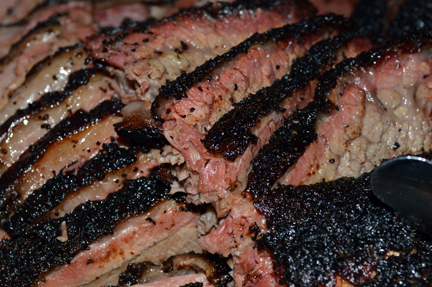
bbq porn

Just had to share this image, snapped the other night at Stiles Switch BBQ in Austin, where my client Vino Vino organized a wine dinner, pairing the Piedmontese wines of Incisa della Rocchetta and classic Texas bbq.

Note the “smoke ring,” the pink ring on the edge of each slice of brisket. It is one of the top criteria by which bbq is judged in competition.

It’s an indication of the evenness applied in “low [temperature] and slow” smoking.

At the dinner, I sat next to winemaker Filiberto Massone, who asked me why Texans like their meat burnt.

In fact, the black outer ring is not burnt meat but rather the smoked dry rub, the sine qua non of Texas bbq.

I thought the brisket at Stiles Switch was outstanding on Saturday night. Highly recommended…

And btw, Stiles Switch is located in one of Austin’s oldest shopping malls, the Violet Crown, built in the 1950s, and then later the backdrop for the movie Dazed and Confused.

I once asked owner Shane Stiles, a handsome and affable guy, if I could take his photo.

He said, “sure,” and stood there behind the counter expressionless.

I said, “hey, you need to smile!”

He looked over at his pit master, with his sweat-stained baseball cap and t-shirt covered in soot.

“There are no smiles in bbq,” he told me with a grimace worthy of Jack Palance.

@SottoLA wine list named one of “best in LA” by @SIreneVirbila @LATimes #DreamComeTrue

sotto los angeles

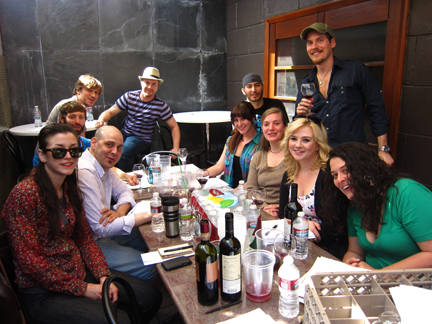
Above: Our very first staff wine training at Sotto in Los Angeles when the restaurant opened more than two years ago.

What a thrill for me and Tracie P to learn that S. Irene Virbila has named the wine program at Sotto, where I co-curate the list, one of the “best” in Los Angeles!

It means even more to me because I grew up in Southern California and went to U.C.L.A. for both undergrad and grad: like it was yesterday, I remember my first starry-eyed meals at Valentino and Spago, two restaurants also named in this shortlist of top wine programs in Los Angeles. And now my name is up there with theirs! Wow…

fatalone primitivo

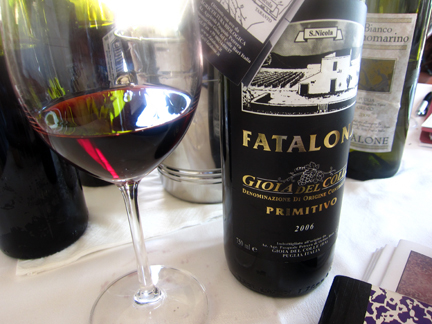
From day one, my co-curator and bromance Rory Harrington and I have taken a very radical approach to the list at Sotto and we’ve never strayed from that course. We have always featured food-friendly wines that truly reflect the grapes with which they are made, the place where those grapes are grown, and the people who grow them.

But like a tree that falls in the forest when no one is there to hear it thump, our wine list wouldn’t have any meaning if guests didn’t enjoy our selections. More than two years into this project, I never stop being thrilled by watching someone taste an old Taurasi, Gaglioppo, or Gioia del Colle Primitivo for the first time. Of all the rewards that this experience has delivered, this has been the greatest by far.

I’m currently on paternity leave from my monthly visits to the restaurant. But I’ll be back again in September and we already have some interesting wine events lined up for the fall.

Thanks SO much to everyone for supporting me and the restaurant in this adventure. And thanks from the heart to Ms. Virbila for taking the time to enjoy the wines that we love so much…