Michel Bettane’s diatribe against Natural wine (translation) cc @AliceFeiring

michel bettane

Michel Bettane’s diatribe against Natural wine in the current print-version issue of the Gambero Rosso monthly came to my attention this morning via the popular Italian wine blog Intravino (where I also grabbed the above image of the French wine writer).

The issue also includes an op-ed by editor Eleonora Guerini in which she writes, “every time that I hear someone talk about natural wine, I begin instinctively to laugh.”

I didn’t bother translating her piece (for obvious reasons) but, in the interest of transatlantic dialog, I have rendered excerpts from Bettane’s harangue in English below.

The image of the page comes from the Facebook of Jonathan Nossiter (via @AliceFeiring). Click the image for PDF version.

*****

We sincerely hope that Italian wine lovers will not be subjected to what has been happening in France: an invasion of so-called “natural” wines — in other words, so called “zero sulfur” wines — with the complicity of numerous sommeliers, wine merchants, and irresponsible journalists…

[These winemakers] insist on making wine without sulfur and they peddle their “beverage” as if it were true terroir.

Their products are easily recognizable: the red wines stink and all of their grape varieties and terroirs end up resembling one another because the nasty native yeasts with which they are made — yeasts that greedily cannibalize the good yeasts if the vinifier allows them to do so — are the same yeasts that you find all over the planet. The wines are cloudy and unstable and they show an excessive presence of carbonic gas, giving the impression that the wine is incomplete.

The white wines — when possible — are even worse: more or less oxidized from the moment of birth and therefore stillborn. Their decomposition is then “managed” posthumously! We are amazed by the ingenuousness of the many excellent chefs who now only include such wines on their lists. They are so careful about their food: they should be the first to be ashamed of such rotten wines!

It’s up to their clients to point out that what they believe is a wine closer to “nature” is actually nothing more than a bad wine whose only intention is to give you a headache.

With some luck and perseverance, it’s possible to make wines without the addition of suflur. These are simple and very pleasant fruity wines that should be consumed where they are produced. But they need to be stored in a cool cellar and — most importantly — they mustn’t travel!

For every cuvée that turns out well, there will be two or three that are completely wrong.

But who has the means to not sell them and accept responsibility for one’s own errors?

—Michel Bettane and Thierry Desseauve
Gambero Rosso
January 2013

bettane gambero rosso

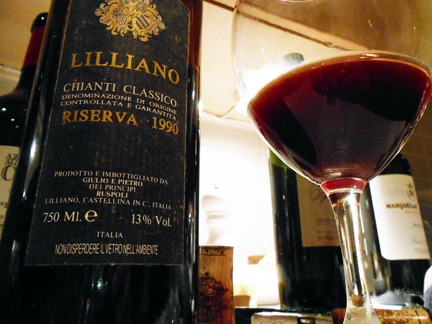
1990 Lilliano Chianti Classico Riserva, the Gambelli touch

From the department of “still catching up on remarkable wines that I tasted in 2012″…

old chianti sangiovese

This extraordinary bottle was the gift of an overly generous friend who sent it to me from Italy, where the bottle once resided in his cellar.

After it had rested in my San Diego cellar for a few weeks in November-early December, I picked it up from my locker and took it to the Jaynes Gastropub staff party on my last visit to California for the year.

There were many incredible wines opened that night, including a 2000 Amarone della Valpolicella from my cellar (always a thrill and always a joy to share).

But the wine of the night was this otherwise unassuming 1990 Chianti Classico Riserva by Lilliano, a venerated but quiet and often overlooked estate in Castellina (one of the core townships of historic Chianti).

It was unbelievably fresh and the fruit wonderfully vibrant and bright. And its singing acidity and judiciously balanced alcohol gave it that gentle zing that makes Chianti — when done right — so food friendly and moreish (we paired with a spread of California charcuterie, cheese, and crusty bread).

One of the most delightful surprises and best wines of my year.

I’ve been thinking about this wine because it was around this time last year that Giulio Gambelli — the legendary “taster” of Sangiovese — passed away (see also this collection of remembrances that I culled from the internets). Gambelli made his mark on so many iconic expressions of Sangiovese of our generation — Soldera, Poggio di Sotto, Monte Vertine, and so many others. But he also continued to consult for taste the wines of many of the historic Chianti estates, like Lilliano (Bibbiano is another one that comes to mind).

There are lightyears between a wine like this earthy and earthly Chianti and ethereal wines like Soldera’s or Poggio di Sotto’s. But there is also unmistakable red thread that unites them: it’s that gentle electricity (I don’t know how else to describe it) that makes traditional Sangiovese so unique in the world of fine red wine.

Many who have followed and observed Tuscan winemaking over the last generation would attribute that signature to Gambelli.

Thank you, FB, for this truly splendid bottle of wine, shared with a group of people I care about deeply.

It reminded me that great Sangiovese was, is, and can always be…

Anti-racist pizza & a studly view of Proseccoland (required reading) cc @Bele_Casel

racist pizza

This “kebab” pizza, prepared by pizzaiolo and restaurateur Alberto Barban of Pizzeria La Torre in Caerano di San Marco (province of Treviso) almost made it into my “best meals of 2012” series.

However delicious, this pizza just couldn’t compete with the many memorables meals of the year.

But it was unforgettable nonetheless: in a part of Italy where xenophobia and separatism sometimes trump human dignity and common sense, the notion of a pizza topped with kebab stands defiantly in the face of often unbridled racism.

Remember: in at least one Italian city, kebab (and kebab purveyors) has been banned from a historic city center. And in many urban areas, kebab and other Middle Eastern street food has been subject to de facto marginalization (you’ll find no kebab stands in the village of Caerano). While young Italians enjoy kebab as much as young people anywhere do in the West (Paris, London, New York, Los Angeles…), the dish has become synecdoche for the north Africans and Arabs who reside in Europe.

When Georgia P, Tracie P, and I stayed in Caerano di San Marco last September, we ate at the pizzeria on three different occasions. And after becoming friendly with Alberto, I asked him to make me his favorite pizza.

We didn’t speak of its underlying social commentary. But I couldn’t help reflect and remark on the fact that it makes perfect gastronomic sense: after all, pizza’s origins fall somewhere in a shared Mediterranean culinary legacy that includes pita and myriad expressions of flatbread.

Chapeau bas, Alberto!

The pizzeria was recommend to us by our friend and client Luca Ferraro, Prosecco producer in Asolo (a short drive from Caerano).

On Luca’s blog today, we posted amazing photos of his mountain bike ascent to a pre-Alpine pass.

italy alps mountain bike

The images are impressive as they are picturesque. But, beyond the studly ascent, I can’t think of a better way to illustrate the unique combination of topography, altitude, and marittime influence that define Proseccoland.

I highly recommend the post to anyone trying to wrap her/his mind around what makes Prosecco, Proseccoland, and the Veneto so special (at least to me).

Buona lettura, yall…

Neb[b]iolo and Politics in 1950s Italy

luigi einaudi vignetta large

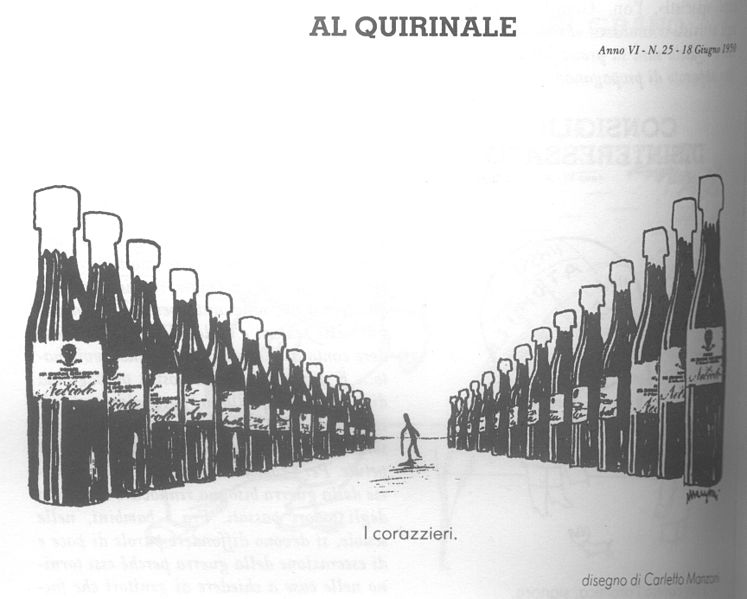
Above: This caricature of the second president of the Italian republic Luigi Einaudi, farm owner and producer of Dolcetto and Nebbiolo, was published in 1950 in Italy. The monarchist publisher was convicted of libel. Click on the image for a larger version and note that Nebbiolo is spelled with one b.

The often workaday nature of my professional life is balanced by my insatiable curiosity and the unmitigated access to all kinds of information via the internets.

Yesterday, as I was roaming around the web and trolling for nuggets about the Einaudi winery in Dogliani (for one of the many restaurant sites that I curate), I came across this wonderful caricature of Italy’s second president (and winemaker), Luigi Einaudi, a figure whom I admire immensely for his opposition to historic fascism.

The Einaudi family has played impressive roles in Italian contemporary history, society, and culture, including Luigi’s son Giulio’s legacy as a publisher (the bookshelves of our home are line with works of literature and critical essays published by Einaudi, including collections of Pasolini’s writings), his son Ludovico’s legacy as a musician, and son Mario’s strident anti-fascism.

In 1950, when Luigi Einaudi became the second president of the Italian Republic, the monarchist review Candido parodied him in the caricature above.

Einaudi is the figure in the center, guarded by corazzieri (a presidential guard of Neb[b]iolo) at the Quirinale, Italy’s presidential palazzo.

The episode reveals how fine wine, and Nebbiolo in particular, was viewed as an elitist indulgence at the time. It also gives us an indication of how wine visionaries like Einaudi (he was among the first to modernize his winery and he was a pioneer in his vision of building the wine export industry in Italy) were seen as misguided.

The satirical message of the vignette is this is how our new president expects to rebuild our country… with wine.

Einaudi sued the publisher for libel and won.

An Einaudi Dolcetto was Eric and Levi’s top pick this week in their The New York Times tasting panel. I’m a big fan myself… for the wine’s traditional and classic style… and for the family’s legacy as anti-fascists and intellectual celebrities…

My band hits the road: Austin, NYC, LA, & SF @NousNonPlus

jeremy parzen nous non plus wine

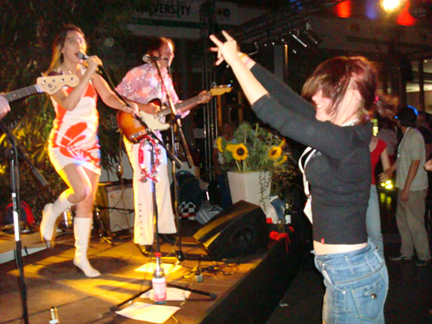
Above: That’s Céline Dijon and me (stage left) at a 2008 show we played in East Germany.

One of the nicest compliments that anyone ever made about our band, Nous Nous Plus, came from my friend and composer extraordinaire Mike Andrews (who produced our 2003 album Fixatione Orale and has played on a number of our tracks).

“Jar, you know what’s cool about your shows?” he said to me a few years ago (all of my rock-n-roll friends call me Jar), “you’re never embarrassed to laugh when your band plays. You totally rock it out but your shows are also super fun.”

Our shows are super fun and if you’ve never had a chance to see us in San Francisco at the Bardot a Go Go party, it’s one of my highlights every time we hit the road: it’s a dance party where they play 60s yéyé, everyone dresses in yéyé style, and Godard films are projected on the wall… It’s a blast… and it’s San Francisco

Tour dates and club info below…

*****

Bonne année 2013!

Nous Non Plus returns with a new album and tour dates in NYC, AUSTIN, LA and SF!

Le sex et la politique is now available on iTunes, Amazon and CDBaby.

NYC
Jan 26
Fontana’s – 105 Eldridge Street

AUSTIN
Feb 9
The Parish – 214 E. 6th Street

LOS ANGELES
Fête de St-Valentin
Feb 14
Bootleg Theater – 2220 Beverly Boulevard
TICKETS

SAN FRANCISCO
Feb 15
Bardot a go go
Rickshaw Stop – 155 Fell Street
PARTY INFO
TICKETS

french indy rock sexy