Ubi Raveneau, ibi beati

In case your Latin is rusty, the title of this post means where there is Raveneau, there are happy, blessed folks.

I certainly feel blessed to have met and to know so many cool interesting folks through blogging, like la dérive, who also posted on the outstanding flight of wines we tasted together the other night in Chicago.

I thought the Raveneau was stunning, however tight and in need of aeration. And I loved how la dérive called the Zanna “pure bottled sunshine with deep, earthy, dark fruit notes; but not heavy in anyway, just comfortable in it’s own skin.”

Check out his super cool post here.

And in Friulian news…

I think it was love at first sight for Swedish wine blogger Billigt Vin when he met Rosa Bosco (above) in the Colli Orientali del Friuli last year.

Billigt Vin is another friend I’ve made (virtually) through wine-related social media and although I can’t really read his blog, we often trade notes on tastings and impressions of Italian wines and wineries.

Check out his post here.

My favorite line was: “Rosa Bosco might be a fan of Bach but this aroma is pure Mozart.” Great writing, great wine blogging.

The wonders of Montepulciano d’Abruzzo: 1998 Illuminati Zanna

In these heady days of single-vineyard Barolo and Barbaresco with designer labels, lieu-dit Brunello with astronomically impossible scores, and the coveted-by-conservative-elites and dreaded-by-liberal-populists Super Tuscans (if, in the course of my research for my upcoming Friuli trip, I come across the expression “Super Whites” one more time, I’m going to heave), we often forget an earlier chapter in the renaissance of Italian wines when grapes like Aglianico (ever tasted a 1968 Mastroberardino Taurasi?) and Montepulciano d’Abruzzo or Montepulciano Nero (1979 Pepe, anyone?) stood proudly side-by-side with their Tuscan and Piedmontese counterparts.

“Montepulciano d’Abruzzo,” wrote Burton Anderson in 1980 (Vino, p. 368), “ranks among the ten most prominent DOC wines of Italy.” (The appellation was among the earliest to receive DOC status, long before the DOCG-system was implemented, in 1967.) Two years later, in Italy’s Noble Red Wines, Sheldon and Pauline Wasserman infer (erroneously) that Montepulciano d’Abruzzo is a clone of Sangiovese Grosso and classify it as one of Italy’s three noble red grapes, together with Nebbiolo and Sangiovese (see the opening lines of chapters 13 and 14).

Last week, on a freezing night in the Goose Island neighborhood of Chicago, at a dingy BYOB Cuban joint called Habana Libre, I met up with three men I’d met over the internet, each bearing fantastic bottles of wine (mamas, don’t let your sons grow up to be wine bloggers!).

Phil, Nathan, and Lars and I got to know each other through wine-related social media (and Lars actually saw my French band play back in Detroit way too many moons ago). And this was the second time the de facto tasting group convened when I was in town. Many fantastic bottles were opened that night, including a brilliant Vouette et Sorbée NV Champagne Extra Brut Fidèle, an incredibly savory Willi Schaefer 2007 Graacher Himmelreich Riesling Kabinett, and a Raveneau 2000 Chablis Vaillons (!!!) — all thanks to my hosts.

But the wine that I can’t stop thinking about is the Illuminati 1998 Montepulicano d’Abruzzo DOC Zanna (above).

Phil had found a small and forgotten allocation of 98 Zanna at a local wine retailer and he wisely picked up as much as he could (at an obscenely low price). I’ve tasted a lot of Zanna in recent years and Alfonso made a point of taking me to meet and taste with his good friend winemaker Stefano Illuminati a few years ago at Vinitaly — great guys, both of them.

But, man, I’d never had the chance to taste a Zanna at 12 years out! This wine showed bright, youthful acidity (the secret to its longevity, no doubt) and rich layers of red stone fruit and crunchy, salty red earth. As I munched on my delicious stewed pork and my lightly breaded and fried flattened chicken breast, the aromas and flavors of this wine danced like wild beasts on my tongue, with sweaty horse and bramble notes, evoking, in my mind, an era when Abruzzo was one of the centers of the intellectual outdoorsman’s universe (did you know that King Frederick II of Swabia, emperor of the Holy Roman empire, named the the region’s capital “L’Aquila,” meaning the eagle, because of his love of the art of falconry?).

An unforgettable bottle of wine, thanks to these dudes. But then again, that’s what you get for making friends on the internet!

Phil, Nathan, and Lars: THANK YOU, THANK YOU! Alla prossima… (and ya’ll know what I’m talking about)…

Meatballs and Primitivo with my father Zane

The best advice anyone ever gave about blogging was “remember that all blogs are vanity blogs and always write what you feel.” Well, here goes…

“Everybody had their hands out. Everything was for the taking. And now it’s all over. And that’s the hardest part. Today, everything is different. There’s no action. I have to wait around like everyone else. Can’t even get decent food. Right after I got here, I ordered some spaghetti with marinara sauce and I got egg noodles and ketchup. I’m an average nobody. I get to live the rest of my life like a schnook.”

—Henry Hill, Good Fellas, 1990

Last Wednesday’s dinner with my father Zane at Giovanni’s in Munster, Indiana brought to mind the above passage uttered by Henry Hill in Scorsese’s Good Fellas (he had the Veal Piccata, I had the Spaghetti with Meatballs).

Those of you who have followed along here at Do Bianchi haven’t heard much about my father, Zane. In fact, you haven’t heard anything at all. He left the fold of our family when I was a teenager and, truth be told, none of us — my mother and my brothers — have ever entirely recovered from that fissure. The circumstances of that schism began to unfold when I was 11 years old (1978) and in many ways, my Italophilia was borne out of the fact that my closest Italian friends (most of whom were musicians that I met when I was around 19) helped me to see the “transgressions of the father” in a light (Pasolinian?) disparate from that which shines down from Mt. Soledad onto the sun-filled spelunks of the La Jolla Cove where I grew up.

Today, he lives in Highland, Indiana (not far from Munster), a “bedroom” community (as he likes to call it) of Chicago. After leaving our family, he lived in Phoenix, Arizona for many years, and then Israel, where he made the aliyah and continued to work in the defense industry (his second career). About twelve years ago, when he was convinced that he wouldn’t be arrested by the FBI for espionage (as he tells the story), he decided to return to the U.S. for his retirement.

In Italian new wave cinema of the 1960s and early 70s, directors like Antonioni created landscapes that reflected their characters’s stato d’anima (state of soul). The cold temperatures and intonations of grey that greeted me there (above) felt like they came from within me rather than from the environment around me.

Ultimately, Highland, Munster, Hammond, and Gary, Indiana are towns that could have been depicted in Bruce Springsteen’s Darkness on the Edge of Town (have you seen the recent documentary?). The main employers here are the steel mills and Giovanni’s is arguably the best place around.

Zane doesn’t care much for red wine but he did share a bottle of Primitivo by Cantele with me. It was one of the two bottles that spoke to me, together with Araldica’s Gavi by the glass (Giovanni’s has an impressive website, with its wine list available online).

A friend once wrote: as “the son of a psychiatrist, Dr. J. is capable of finessing virtually any situation with seamless ease.”

I don’t know if that’s true but like every other human being on this planet, I have one father. It wasn’t and never is an easy trip. It had been too long since I’d gone to visit him… but I’m glad that I did.

As I look back and reflect on my visit and use my blog — my web log, my journal, my diary — as a therapeutical tool, there’s one thing that has come into sharp focus in my psyche: sometimes a meatball is just a meatball.

The best hot dog I ever had happened at Hot Doug’s

Family matters took me to Chicago and northwestern Indiana this week (more on that later).

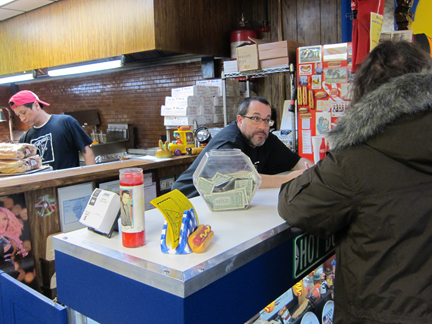
Even though my traveling roadshow of social media was keeping me busy (all a dude needs is a camera, a laptop, and wifi), I did manage to take time out to make it to Hot Doug’s, the much hyped and highly touted “encased meats emporium” on the north side of the Windy City.

Everything you’ve read about this place is true: at Wednesday lunch time, with light snow falling and temperatures below 20° F. (no kidding), there was a line around the block. As a devoted lover of encased meats in general, I’d been wanting to get out to Hot Doug’s for sometime and my moment of truth had arrived. I’m here to tell you: it was worth the 20 minute wait I spent in the cold for that dog (I arrived around 11:45 a.m. and by the time I left the wait had increased to probably 45 minutes).

Hot Doug’s is probably most famous for having topped wieners with foie gras. (And owner Doug Sohn, below, gained notoriety when he was among the first to challenge Chicago’s ban, later repealed, on foie gras.) Being a traditionalist in Nebbiolo and hotodoggery, I went with the classic Chicago dog and a Polish sausage (with sauer kraut and mustard), plus cheese fries and a coke (my bill was less than $8 and, btw, when I ordered a large soda, Doug — who waits on everyone — pointed out that refills are free and recommended that I get a small, thus saving me about a dollar).

Hot Doug’s simply does it right. Dogs can be charbroiled, steamed, deep-fried, or fried and grilled, and the classic toppings applied on the Chicago-style dog are impeccably and impeachably aligned with the North American hot dog canon: “Mustard (yellow, spicy brown, honey or Dijon), Caramelized Onions, Relish, Tomatoes, Pickle [wedge not slice], Celery Salt [the sine qua non IMHO].”

I also really dug the Ramones-heavy mix that was playing the day I was there. Forget all the hype and all the paraphernalia (however fun) that surround Doug Sohn’s “emporium”: I highly recommend this joint.

Stay tuned for my harrowing escape from clutches of insipidness in the culinary wasteland of Bruce Springsteen’s America, on deck for tomorrow.

Friuli, here you come again…

Friuli, here you come again
Lookin’ better than a body has a right to
And shakin’ me up so that all I really know
Is here you come again …
And here I go…

The Colli Orientali del Friuli producers association has asked me to lead a group of bloggers to visit their appellation, taste, blog, eat, and taste some more.

Read all about how it came together and the bloggers we’ve selected here.

We arrive in Friuli a month from today, but we’ve already begun posting about COF, its grapes and wines, and its foods and folks.

Do you have a story about COF that you’d like me to repost at the #cof2011 blog? Just drop me a line by clicking here.

Buona lettura, ya’ll!

Here you come again
Just when I’ve begun to get myself together
You waltz right in the door
Just like you’ve done before
And wrap my heart ’round your little finger

Here you come again
Just when I’m about to make it work without you
You look into my eyes
And lie those pretty lies
And pretty soon I’m wonderin’ how I came to doubt you

All you have to do is smile that smile
And there go all my defenses
Just leave it up to you and in a little while
You’re messin’ up my mind and fillin’ up my senses

Here you come again
Lookin’ better than a body has a right to
And shakin’ me up so that all I really know
Is here you come again …
And here I go

Black-eyed peas and Champagne for New Year’s day

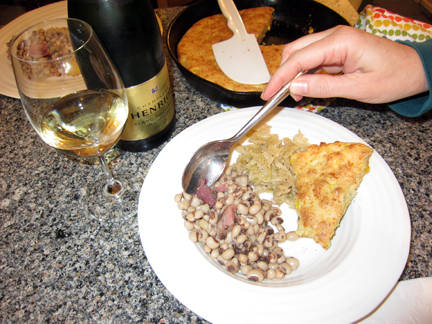
On New Year’s day, Tracie P cooked up some black-eyed peas with the ham bone reserved from the spiral ham Mrs. B had served on Christmas day. Her buttermilk cornbread (baked in her grandmother’s cast-iron skillet) was unbelievably delicious, especially when used to sop up the bean liquor (as it is called in the south, i.e., the beans’s cooking liquid). Neapolitan-style cabbage braised with onions gave the combined flavors just the right twang of sweet and sour.

And the perfect pairing for those creamy beans? Henriot NV Blanc Souverain, 100% Chardonnay. Ubi major, minor cessat: I am always one to agree with Ed McCarthy when notes that Chardonnay finds one of its greatest expressions in Champagne. This wine was an ideal pairing for the flavors of our New Year’s day meal: its acidity and white stone fruit flavors combined with its elegant fizziness were wonderfully refreshing against the richness of the cornbread, the dolce amaro of the cabbage, and the texture of the legumes.

Black-eyed peas for New Year’s is now a three-year-old tradition at our house and de rigueur in the south. I loved Jessica Harris’s NY Times op-ed on its origins as a New Year’s dish.

What did ya’ll eat on New Year’s day?

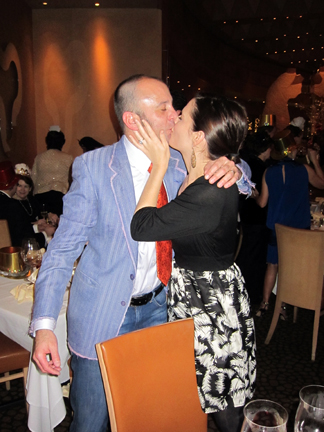
First kiss: Tracie P. First sip: Brovia 04 Barolo.

I dream of your first kiss… And then I feel upon my lips again…

The first kiss of 2011 tasted just as sweet as that very first kiss of 2008. A taste of honey, tasting much sweeter than wine…

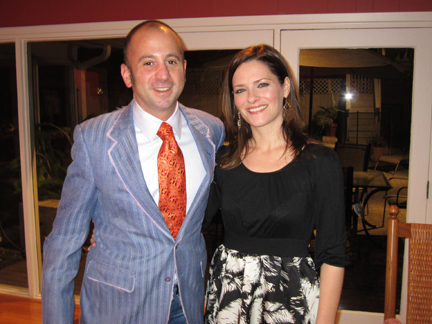
Tracie P and I had wonderful New Year’s eve at Tony’s with cousins Joanne and Marty, Dana and Neil, Mary Kelly (Neil’s mother), and prof Jonathan, who took the photos above. Don’t I look like I just won the jackpot? ;-)

That first kiss was followed by a first sip of 2011: Brovia 2004 Barolo.

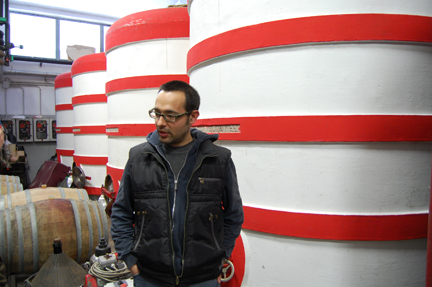
I have long been a fan of traditionalist Brovia and I finally got to taste at the winery in March 2010 when I was visiting Piedmont with a group of wine bloggers. That’s Brovia son-in-law Alex in front of the winery’s cement vats. (Check out Saignée’s excellent post on Brovia here.)

No pharmaceutical yeast here: Brovia’s wines always captivate with their balance of freshness, purity of fruit, and their power, and this wine drank surprisingly well as young as it was, with not overly generous fruit tempered by mushroom and earth. It was a fantastic way to start our 2011.

I posted some of the food shots from that night over at Tony’s blog, btw: Chef de Cuisine Grant’s risotto is always stellar IMHO, and his rich beef stock carnaroli topped with fried sweet breads were served perfectly al dente that night.

All in all it was an unforgettable night, our first New Year’s as a married couple and a celebration of all the wonderful things that happened for us in 2010. We have lots of adventures (and challenges) ahead of us in 2011 and we’re looking forward to our upcoming trip to Italy (more on that shortly).

But in the meantime, I’m gonna keep on dreaming about that first kiss, tasting much sweeter than wine… Happy new year, everyone!

Tracie P and Tony V

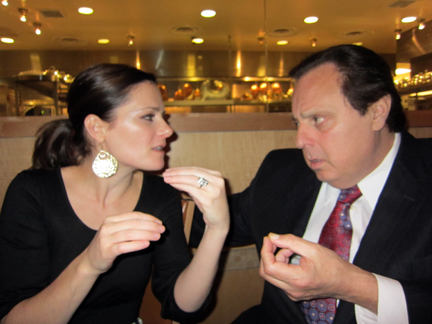
There’s more to come… but first I just had to share this photo I snapped of Tracie P and Tony V, who was our host for the New Year’s eve holiday.

In our family as in his, we love to talk about food and when Tony V and Tracie P get together, I can guarantee that they will engage in finely calibrated discussions of how and when onion and garlic may be applied (never in tandem!) and how al dente al dente should be. The above photo is clear evidence of this phenomenon!

More on what we ate and drank later…

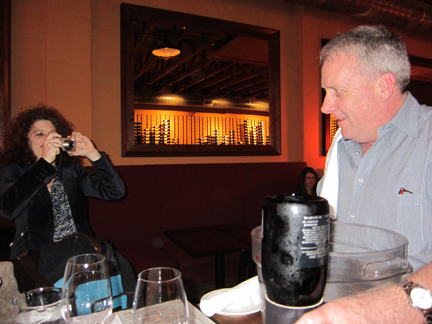
Our night on the town with Lettie

One of the more remarkable things that happened between Christmas and New Year’s was our night on the town in Austin with Lettie Teague. Lettie was in Dallas celebrating the holiday with family when Nature, by means of the east coast blizzard, decided not to let her fly back to New York. So, she decided to hit the road and come visit us in Austin, where we took her to some of our favorite spots, like Fonda San Miguel, where we had some huitlacoche tamales (de rigueur). Oddly enough, they were out of our fav Tondonia Rosado by López de Heridia and so Lettie proposed that we drink Gimmonet Champagne instead. The pairing was BRILLIANT!

Later, we took her to another one of our favorite nightspots, Vino Vino, where Jeff disgorged some Puro for her.

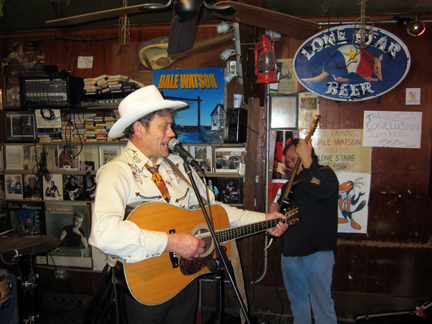
And, of course, no night on the town with Tracie P and me is complete without some late-night honkytonking at Ginny’s Little Longhorn Saloon.

Lettie wrote about our evening here. And I don’t care how much ya’ll holler: I ain’t givin’ you the number to the speakeasy we visited! Ya’ll will just have to come down and pay us a proper visit if you want to check it out!

06 Barolo Ravera by Cogno INSANE! (06: so far so good)

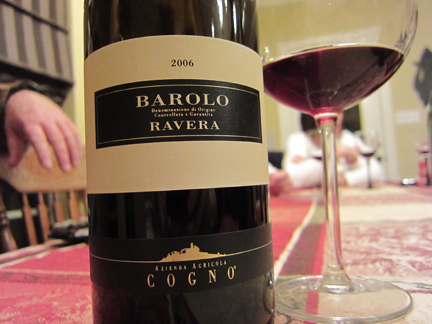
For our Christmas day meal in Orange, Texas (at sister and brother Misty and Ricky’s house), we opened this bottle of 2006 Barolo Ravera by Cogno (sent to us by winemaker Valter Fissore).

While I’ve tasted a lot of 2006 Barbaresco at this point, this was one of the first expressions of 06 Barolo that I got to spend some time with. The more and more 06 I taste, the more I’m convinced that this is going to be a fantastic vintage for Langa wines, despite the controversy stirred in 2008 when B. Giacosa decided not to bottle his 2006).

06 may not be as great as 01 and 04, but it’s an indisputably balanced, classic vintage, where people who make and made honest wine are going to be rewarded for their faith and integrity.

I was stunned by how good Valter’s 05 Ravera was: beautiful nose, bright acidity, and a great balance of earth and fruit. Chapeau bas, Valter!

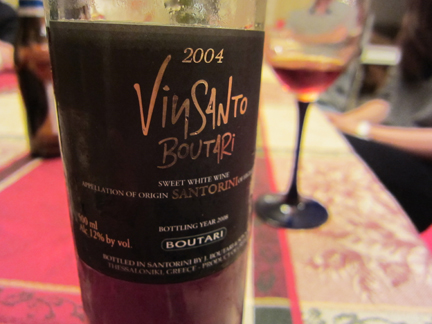
The other star of the Christmas day meal was this 2004 Vinsanto by Boutari, also sent to me as a sample (for the Boutari Social Media Project, which continues in 2011). At a youthful 6 years out, this wine showed the depth and complexity that the appellation in known for, with a gorgeous balance of candied white stone fruit and saltiness. The Assyrtiko grape and its unique expressions, whether vinified as a dry or dried-grape wine, continue to fascinate me and the Boutari Vinsanto is one of my favorites (for the record, it’s actually a blend of Assyrtiko and Aidani, which imparts a wonderful aromatic character to this wine). Tracie P and I have been blown away by how well new oak and small cask aging works with Assyrtiko and in this case, the wood gives a nutty counterpart to the fruit and salt (the label reports that the wine was bottled in 2008, leading me to believe that it spent nearly 4 years in wood). I also love how this wine clocks in with a judicious 12% alcohol, remarkable for the dried-grape category but in line with overarching attitudes among Greek winemakers. Great stuff…