Reactions to the Suckling & Gambero Rosso marriage

There were a lot of interesting reactions to yesterday’s news that James Suckling will join the editorial staff at Gambero Rosso. Some were… ahem, how can I say this? Mmmmm… visceral.

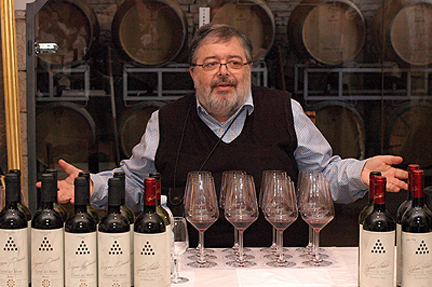
One of the more interesting observations came from Italy’s top wine blogger and a long-time critic of the Suckling approach to scoring, Mr. Franco Ziliani (above).

Franco pointed out, with a relative measure of irony, that:

    ‘Giacomino’ Suckling is the right man for the post-Cernilli era at Gambero Rosso.

    I also think that Mr. Cernilli (some years ago I invented a nickname for him: Robert Parker der Tufello – Tufello is a very popular area in the outskirts of Rome) could be the right man for Wine Spectator in the post-Suckling era.

    Why not? Suckling for Gambero Rosso and Cernilli for Wine Spectator and things will never change, absolute continuity in the mainstream (establishment) flow of information about Italian wines.

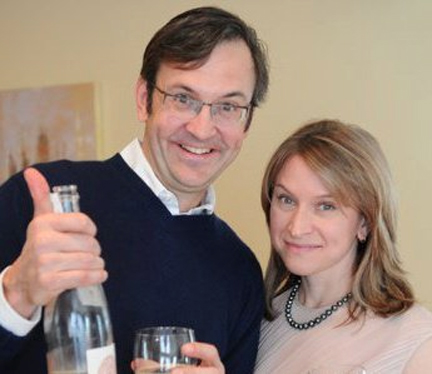
I also really liked what my virtual friend Andy Pasternak (above, with his wife JoAnn) had to say:

    We actually had a long discussion about this at dinner tonight and my lovely wife brought up a great point. Ten or twenty years ago, when wine drinkers had far fewer resources to learn about wine, magazines like Gambero Rosso and WS were way more important. With the advent of the interweb, and great [wine] blogs […], people have more resources to learn, read and figure out where to get wines that they like.

I think that both make excellent points.

A Sicilian prince once said: In order for everything to stay the same, everything must change.

Click here to read all the comments (warning: CONTAINS ADULT LANGUAGE).

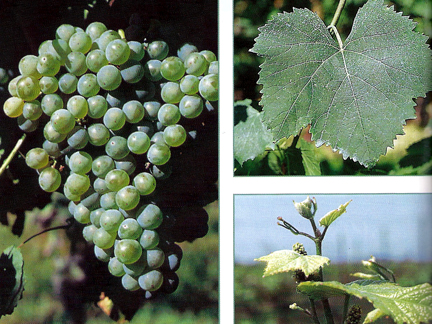
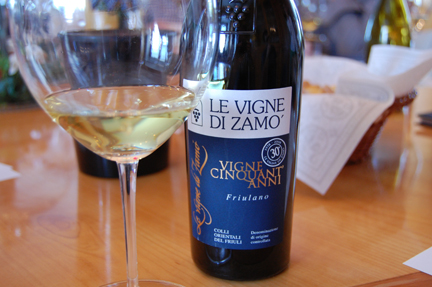
Verduzzo Friulano Bianco: the basics

The following post is my abridged translation of the entry on “Verduzzo Friulano Bianco” in Vitigni d’Italia, le varietà tradizionali per la produzione di vini moderni (Grape Varieties of Italy, the traditional varieties for the production of modern wines) by Antonio Calò et alia, Bologna, Calderini, 2006. This is the second in an educational series on the grape varieties of the Colli Orientali del Friuli, posted in conjunction with the COF 2011 aggregate blog.

Synonyms (documented and/or otherwise plausible): Verduz, Verduzz, Verduzo, Verduza, Ramandolo.

Erroneous: Verdisio, Verduzzo trevigiano, Verduzzo di Motta.

Origins (Historical Notes): An ancient grape variety of Friuli, cited by Acerbi (1825) who notes that a grape called Verduz had been cultivated in Friuli in the province of Udine for more than 100 years. It is mentioned in the 1879 Bolletino Ampelografico (Ampelographic Bulletin) as one of the white grape varieties of Friuli. In 1939, Poggi noted a distinction between two types of Verduzzo, a “green” clone which has all but disappeared and a “yellow” clone which was probably derived from the former. Besides these two clones, there is another found in the Ramandolo area (province of Udine) called Verduzzo “raçsie” with semi-loose [semi spargolo] clusters.

Environment and cultivation: Verduzzo is not particularly difficult to grow. It likes hillside vineyards with good exposure, low fertility, and dry climate. Production for this grape is high and constant. Medium-open training systems and medium-long pruning are ideal for this grape variety. It tolerates hail better than most.

Sensitivity to Disease and Other Issues: light sensitivity to powdery mildew, sensitivity to moths, high tolerance to botrytis thanks to its thick skin.

Alcohol Content: 9-15%
pH: 2.5-3.5
Acidity: 5-10 grams per liter

Verduzzo Friulano Bianco produces a wine that is rich golden yellow with a pleasant vinous aroma, relatively tannic, full-bodied, sweet, fruity, with honey notes. Two types of wine can be obtained using this grape: a dry white wine and a sweet semi-viscous dessert wine (Ramandolo) following exposed drying on the vine or drying in an enclosure.

The variety is used exclusively for vinification. It is commonly blended with other grapes to obtain a finer, drier, and more delicate wine. It is grown primarily in the province of Udine but also in the provinces of Pordenone and Gorizia. It can be used in the production of the following DOCs: Colli Orientali del Friuli, Friuli Annia, Friuli Aquileia, Friuli Isonzo, Friuli Latisana, Lison-Pramaggiore, and Piave, and it can be utilized in a variety of ways.

We were better off when things were worse: James Suckling joins forces with Gambero Rosso

Above: James Suckling via his Facebook.

“We were better off when things were worse.” That’s what Italian wine blogger Antonio Tomacelli wrote today on Intravino describing his feelings about the news that James Suckling will be joining the editorial staff of the Gambero Rosso brand. (!!!)

Si stava meglio quando si stava peggio is one of those perennial Italian sayings, expressing the nostalgia (and consequent irony) for a time before the hegemony of capitalist consumerism fatally grasped the Italian people in its merciless grip (in the wake of the “economic miracle” of the 1960s when American culture and mores began to dominate the ethos of the Italian people).

There’s another expression in Italy that describes precisely my reaction to the news of Suckling’s new gig: non ho parole.

NE NUNTIUM NECARE!

Signor Tannino vi sono obbligato (two deceptively tannic wines)

Saturday night found Tracie P and me on a double-date at one of our favorite dinner spots in Austin, Trio at the Four Seasons, where Austin’s very own celeb sommelier Mark Sayre generously allows MOT (that’s members of the trade not members of the tribe for the Hebraically inclined among you) to bring their own wines.

I always point to Lettie’s article, “Corkage for Dummies,” as a great rule-of-thumb guide to the etiquette of corkage. I’d only add to it, that beyond bringing a bottle that’s not on the sommelier’s wine list, I always try to bring something that I think the sommelier will enjoy tasting — a bottle or label that might just surprise her/him.

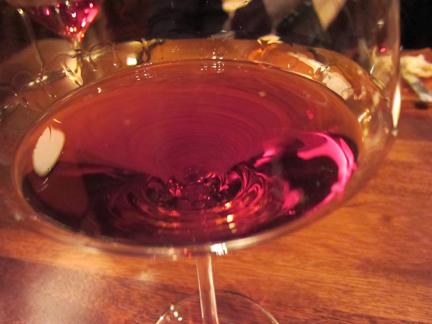
On this occasion, we brought along two deceptively tannic wines: the 2006 Romangia Bianco by Dettori (Sardinia) and the 2009 Grignolino del Monferrato (above) by La Casaccia (Piedmont), two of our favorite wines from two of our favorite producers.

Thanks to what must be significant maceration time for the Vermentino (I’m still trying to get Dettori to send me some tech notes on this wine and will post as soon as they arrive), this wine is TANNIC with a capital T. In fact, it was MORE tannic than it was on at least two other occasions when we tasted it between the fall of 2010 and last Saturday. Crunchy and salty, with layers and layers of white and pitted fruit (dried, cooked, and gloriously ripe), it’s time IMHO to put the rest of my allocation down in the cellar to be revisited in a year or so. It’s such a great value for people like us who like to age white wine.

The Vermentino was FANTASTIC with the caramelized and dolce amaro flavors of chef Todd Duplechan’s pork belly, which he seasons with the same ingredients used to make Coke. (I know I’ve said it before but I’ll say it gladly again: in Texas, where pork belly is de rigueur at nearly any venue that caters to carnivores, I’ve found no one so far who does it as well as Todd does, with seasonal pickled vegetables and a flair that takes it from A to A+. Be sure to eat it when it’s still hot and the unctuous character of the fat sings like Tammi Terrell to the crispy crust of Marvin Gaye.)

Even chef Todd was surprised by how tannic the Grignolino was: “It’s so light in color,” he said when he came out from the kitchen to chat with our table, “I wasn’t expecting so much tannin.”

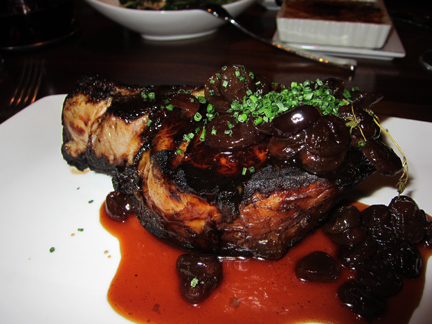
Very little Grignolino makes it to this country and honestly, I didn’t fully grasp what an amazing and powerfully tannic wine this grape could deliver until I visited the folks at La Casaccia. The first time Tracie P tasted it late last year, she looked up at me from the dinner table and asked plaintively, as if she were a Texan Oliver Twist, “can there be more Grignolino in our future?” The wine was sumptuous (not something you would expect from a wine so light in color) and delicious, with that characteristic rhubarb note that you find in classically vinified Grignolino. The wine was stunning with my Brooklyn-cut pork chop.

O Signor Tannino, vi sono obbligato!

Fat cat Cernilli leaves Gambero Rosso marking end (?) of an era

Above: Soon-to-be ex-editor of the Gambero Rosso Guide to the wines of Italy, Daniele Cernilli, as photographed by Christian Callec, who quotes Cernilli as asking “what is wrong with the use of new oak?”

Italy’s top wine blogger Mr. Franco Ziliani and I have posted the news over at VinoWire: Daniele Cernilli is stepping down as the editor-in-chief of the Gambero Rosso Guide to the Wines of Italy, the most influential rubric of Italian wines today (pun intended for the Italophone among you).

Rumors of his departure have circulated wildly in the Italian enoblogsphere for more than four weeks and while no one expects the editorial direction and ethos of the Gambero Rosso Guide to change for the better (actually, it will probably only get worse), the omega of his tenure there does mark the end of an era that saw the “international style” and international grape varieties dominate the worlds of commercial and fine winemaking in Italy.

I interviewed Daniele Cernilli in San Diego in 2008 when he came there to speak at the Gambero Rosso Road Show, traveling event. The event, originally scheduled for Las Vegas, was hastily detoured to San Diego that year. An insider told me that the sudden change of venue was due to the insistence of behemoth distributor Southern Wine and Spirits that Cernilli and his wife Marina Thompson present only wines distributed by Southern. Whether or not this is true (and I believe that it is), it does give you a sense of how Cernilli, his wife and publicist Thompson, and the Gambero Rosso Guide are perceived by observers of the Italian wine industry as a purely “pay-to-play” operation.

Here’s the video, directed by my childhood friend Charlie George and with music from Nous Non Plus:

Gnocchi and Barbera, a virtual pairing for someone we love

Anyone who follows along here at Do Bianchi knows how much we love cousin Marty (above) and what an important part of our lives he has become since I moved to Texas two years ago.

Marty and family have been facing some health issues lately and so it was a great thrill for me when he emailed late Saturday afternoon asking me to recommend a wine for dinner at Tony’s in Houston.

As I do often for many of my friends and family (who often ask us for virtual pairings; remember this very early one here?), I jumped online and took a look at the PDF version of Tony’s list: not knowing what Marty and co. would be eating, my “best bet” was a 2006 Barbara d’Alba by Prunotto.

I’m not such a fan of Prunotto and their modern-style bottlings of Nebbiolo (not exactly “my speed,” I like to say euphemistically), but when it comes to the winery’s entry-level labels like its Barbera d’Alba, you can almost always count on an honest wine, bright, with real acidity, balanced alcohol, and approachable prices. Barbera, the ultimate food-friendly grape in our book…

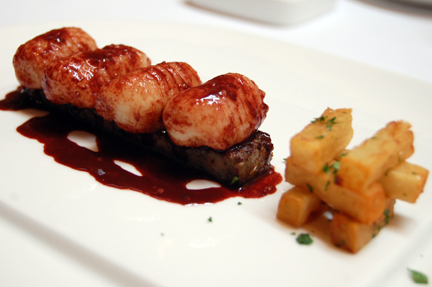
Marty paired with Tony’s Gnocchi over Foie Gras-Guinea Hen Sausage and Crispy Potatoes (which I happened to taste, thoroughly enjoy, and photograph on Friday when I was in town for my weekly chat with Tony).

Reports this morning reveal that the gnocchi were followed by a rib-eye! I guess he is feeling better! :-)

We’re just glad to hear that Marty — our family’s favorite bon vivant, gourmand, and fresser — is back on his feet and back at Tony’s, his favorite hang in the HTX. (HTX denotes Houston for all ya’ll who don’t speak Texan, btw.)

A Bialystock to our Bloom, we just don’t know what we’d do without him.

Buona domenica ya’ll!

Trainspotting a trend: British gastropub franchise in Austin? A culinary double-take at Haddington’s

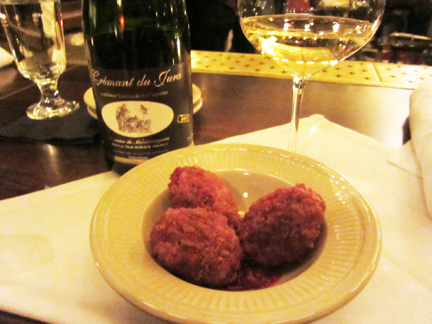
Above: The kitchen at the newly opened British gastropub Haddington’s in Austin still needs to work out the Kinks, Beatles, and Stones, but we really dug their more than reasonably priced sparkling wine list, including this Crémant du Jura by Montbourgeau (delicious) and a Gaston Chiquet Champagne Special Club (that will surely lure me back when in the mood/occasion for celebrating).

One of my magazine editors (for a food and wine pub I contribute to) likes to remind me that it “takes three examples” to constitute a bona fide trend. Between the Spotted Pig (technically and self-consciously “British and Italian”) in NYC, Jaynes Gastropub in San Diego (familiar to regular visitors here), and now Haddington’s in Austin, I think it’s safe to say that the second (third?) British wave has begun.

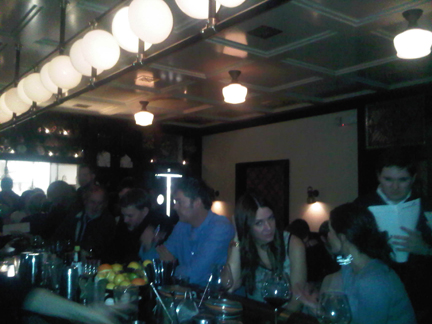
I did a culinary double-take when Tracie P and I arrived chez Haddington last night, not knowing — frankly — what to expect aside from the fact that the place is brand-spanking new and that Tracie P and I needed a great glass of wine after a Friday that was too long for both of us.

Tiled floor? Check. French windows? Check. Open kitchen (replete with stressed-out chefs)? Check. Monty Python-worthy relics and paraphernalia of the fallen British empire? Check. Hipster play list with emphasis on retro? Check. Gourmet-aspirant pub (read comfort) food? Checkmate (I had the Bibb Salad with blue cheese and pickled watermelon rind and the “Blue Burger”; Tracie P had a turkey and stuffing sandwich with cranberry relish).

Haddington’s was packed to the gills last night and although I think the kitchen is still working out some of the kinks that any new (and immediately popular) restaurant has to unravel, the impressive sparkling wine list will certainly bring us back. A stiff glass of Gérard Mugneret 08 Bourgogne Rouge was also nice with my main course.

2010 saw so many new restaurants open in Austin (which, according to most reports and eyeball witnesses continues to lead the country in its growth as a tourism destination) and the Austin food blogger community is thrilled (clearly) by this new edition (pun intended for Sam). I’m sure we’ll revisit Haddington’s but there’s only room for one British gastropub in our hearts… and her name is Jaynes…

Tocai Friulano: the story behind the EU decision to change the name

In her 1913 poem “Sacred Emily,” Gertrude Stein wrote famously that a rose is a rose is a rose.

The best English-language account (that I could find) of the EU litigation that led to Tocai’s name change was posted by DiWineTaste here.

The bullet points are as follows:

In 1993, Hungary filed a complaint with the EU, petitioning the legislative branch of the European government to block Italy from labeling wines as “Tocai.” The Hungarians’s complaint was based on a common precept of trademark law: the Hungarians were the first to use the name Tokaji (a toponym and enonym and homonym of the Friulians’s Tocai) in commerce.

A protracted legal battle ended with a 2005 EU decision that the Italians could use the designation “Tocai” only on bottles sold in Italy (and not abroad).

The decision went into effect in March 2007, so technically the 2007 vintage was the first to fall under the restrictions created by the ruling.

Surprisingly, as Mr. Franco Ziliani and I reported at VinoWire, sales of bottles labeled with the new designation “Friulano” increased in Germany and the U.S. after the new labeling restrictions went into effect.

Maybe Stein and Shakespeare were both wrong: What’s in a name? that which we call a rose Tocai / By any other name would smell as sweet sweeter!

Tocai Friulano Bianco: the basics

Above: “This is a 45-year-old Tocai Friulano vine that I have kept so that I could try to make a late harvest wine. We picked this vineyard in October. As you can see, there is some botrytis.” Sent to me this morning by my friend and Friulian winemaker Giampaolo Venica (Collio).

The following post is my abridged translation of the entry on “Tocai Friulano Bianco” in Vitigni d’Italia, le varietà tradizionali per la produzione di vini moderni (Grape Varieties of Italy, the traditional varieties for the production of modern wines) by Antonio Calò et alia, Bologna, Calderini, 2006. This is the first in an educational series on the grape varieties of the Colli Orientali del Friuli, posted in conjunction with the COF 2011 aggregate blog. Tomorrow, I’ll post an appendix to the present post on the EU litigation and resolution that led to the grape variety’s official name change (today, it can only be labeled as “Friulano” when shipped outside Italy’s borders).

Synonyms (documented and/or otherwise plausible): Cinquien, Malaga, Tocai bianco, Tocai italiano, Trebbianello, Blanc doux, Sauvignon à gros grains, Sauvignon de la Corrèze, Sauvignon vert, Sauvingonasse.

Erroneous: Sauvignon, Tocai, Tokai, Tokay, Tokaj, Furmint, Pinot grigio.

Origins (Historical Notes): grape variety cultivated in the Veneto and Friuli, principally in the provinces of Gorizia, Udine, and Venice. Professor Dalmasso was the first to propose the attributive Friulano to distinguish it from other possible synonyms. How it arrived in the Veneto is not known for certain. It’s possible that it was imported from Hungary (Perusini, 1935), although it bears no resemblance to the grape varieties of that region. According to documents cited by Dalmasso (1937), a grape called Tocai was cultivated in the Veneto as early as 1771. Tocai Friulano Bianco has recently been identified as Sauvignonasse, a variety that has all but disappeared in France but is widely cultivated in Chile (see Calò et alia, 1992).

Environment and cultivation: variety with high and constant production levels, susceptible to humidity but relatively tolerant of lack of water. It thrives in calcareous subsoils with median fertility and with training systems that offer greater exposure (Guyot, Casarsa, Cordone Speronato [i.e., cordon-trained, spur-pruned]).

Sensitivity to Disease and Other Issues: the bunches are particularly susceptible to rot, Esca, Peronospora, and powdery mildew. While the vines are not particularly sensitive to leafhoppers, they are sensitive to mites and moths.

Alcohol Content: 9.5-14.5%
pH: 2.8-3.8
Acidity: 4.30-7.40 grams per liter

Tocai Friulano Bianco produces a wine that is yellow and straw-yellow in color with greenish hints. Delicate, pleasant aroma, dry, fresh, softy, and velvety, typically with a slightly bitter note of almond and hay. It can be low in acidity and therefore is often blended with Ribolla.

The variety is used exclusively for vinification, for the production of wines intended for consumption within one year or with short aging times. The principal appellation for which Tocai Friulano Bianco is used are as follows: Bagnoli Bianco, Rosato e Spumante, Bianco di Custoza, Breganze Bianco, Colli Berini-Tocai Friulano, Colli Euganei Bianco, Colli Euganei-Tocai Friulano, Colli Euganie Fior d’Arancio, Gambellara, Garda Orientale Trebbianello, Lison Promaggiore-Tocai Friulano, Lugana, Piave-Tocai Friulano, Valdadige, Corti Benedettine del Padovano, Riviera del Brenta.

Translator’s Note: Oddly, Calò et alia omit the Colli Orientali del Friuli as one of the principal appellations where Tocai Friulano is used (an oversight?).


Merlot di Montalcino is almost here! Hurray! Not!

Nearly 3 years after the story of the Brunello controversy broke in the mainstream media, after millions of liters of wine have been declassified, after guilty pleas and plea agreements and guilty verdicts and fines and sentences that included jail time for some… tomorrow the Brunello producers association is expected to approve new verbiage that will allow for up to 15% of grapes other than Sangiovese to be used in Rosso di Montalcino.

Italy’s top wine blogger Mr. Franco Ziliani and I reported the new language today over at the English-language blog we co-edit VinoWire.

Is the change a lesser of two evils? Yes.

Is it a shame? Yes, it’s a shame. It’s a pity and it causes me sorrow.

The fact of the matter is that when you add an alpha grape like Cabernet Sauvignon or Merlot to a lighter-bodied grape like Sangiovese, the Cabernet Sauvignon or Merlot will mask the nature of the Sangiovese — even when the former are added in small quantities. Most of the Chianti Classico that makes it to the U.S. these days is made in this manner.

Remember the other day when I was talking about paesaggio come stato d’anima (landscape as state of soul/mind) in Italian new wave cinema?

Antonioni’s 1957 Il grido (The Outcry) is a great example of this and it’s how I feel right now. Buona visione