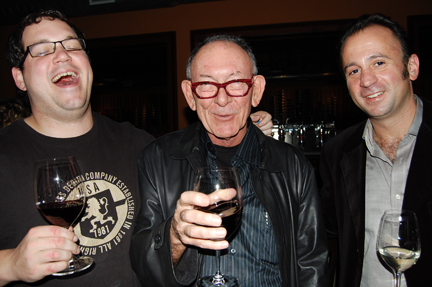
Thor, a wine writer and blogger whom I greatly admire and an all-around mensch, wrote the other day to winemaker Aldo Vacca (left) inquiring about his decision not to bottle his 2006 crus. Thor was kind enough to share Aldo’s response and Aldo was kind enough to allow me to post it here.
Technical reason: 2006 is a very good vintage, but warm and ripe, lacking a little bit of the finesse and complexity to make a truly great S[ingle]V[ineyard wine] and yet preserve excellent quality in the regular bottling. We think 2005, lighter in body, has more fruit and balance, at least in Barbaresco and at least for Produttori.
Marketing: with the current economy we thought it more appropriate to produce a larger quantity of solid, extremely good 2006 Barbaresco avoiding a flooding of the market with too many SV wines, since 2007, 2008, 2009 will all be produced. Had 2007 or 2008 been bad vintages, we would have released 2006 SV, but since we have so many great ones, we felt we could skip one and stay on the safe side of the fence.
Above: I snapped this photo when I visited what may be my favorite winery of all time, Produttori del Barbaresco, in March of this year. Are the 09s destined to be bottled as crus?
Aldo’s been traveling in the U.S. and while I haven’t spoken to him directly about this, various emails and links thrown about led me to a thread in the unforgiving landscape of WineDisorder.com, where a kind gentleman named Bob wrote the following:
Attended a Produttori event last night. Asked Sr. Vacca about the 2006 standard. He mentioned a couple of items that went into the decision re: no riservas. One was the concern that the standard bottle would be be too unbalanced with not enough fruit to match the structure. Too lean for the style that they try to produce. They take the standard bottling very seriously at the co-op. Also, given the embarrassment of riches in recent vintages, he felt that the co-op could go a vintage without the range of riservas for one year. He mentioned experience with previous vintages like 1995 (riservas made because none since 1990, but standard was perhaps too lean) and 1998 (standard might have been too lean, so riservas not produced after a few vintages in a row that were) that informed their thinking in 2006. Also, there was first lot of standard released locally in Albese before the potential riserva juice was blended in. All lots since then have been blended, including what’s in international markets now. Co-op’s current plans include riservas in 2007 and 2008.
And so the saga of 2006 Nebbiolo from Langa continues…
In other news… that’s what friends are for…
Got to drink the above last night thanks to my friend Tom. Wow… Did I mention that I love Il Poggione? Both wines were simply stunning. Thanks, Tom! You R O C K!
And in aesthetic news…
Chicago is such an interesting city to look at. Whenever I visit the city, I can’t help but think of how it represents an encyclopedia of and monument to America’s industrialization and its twentieth-century pre-imperial glory. It was a beautiful day in the city yesterday when I arrived. Snapped the above walking from the L Train to my hotel.
Gotta run now… Meetings, meetings, meetings… Thanks for reading, ya’ll!
Above: The 1989 Produttori del Barbaresco Barbaresco was truly brilliant yesterday afternoon. We paired with roast leg of lamb and sat outside in the gorgeous weather. Ubi major minor cessat: check out Tom’s excellent profile of Produttori del Barbaresco here. I visited the winery during my March trip to Piedmont and will post on my tasting there in the next few weeks.
Posting in a hurry this afternoon because slammed with work and getting ready for tonight’s Orange Wine dinner at Vino Vino, where I’ll be pouring and talking about some amazing wines. We posted the wines and the menu earlier today. (There are still a few spots open: the wines are great, chef Esteban is pulling all the stops, and in true Austinite fashion, the dinner will be followed by Gary Clark Jr.’s first performance at Vino Vino.)
We shared our Easter feast with another couple, close friends of ours. I roasted a leg of lamb yesterday afternoon, seasoned with rosemary from our garden. My beautiful Tracie P made all the fixins. :-)
Tracie P had also dyed some Easter eggs. Our new home is so wonderful. Words just cannot say how much I love her…
In other news…
Alfonso aka Italian Wine Guy has been making his way from Bordeaux down to Italy. I’ve really be enjoying his posts and his travels… Definitely worth checking out…
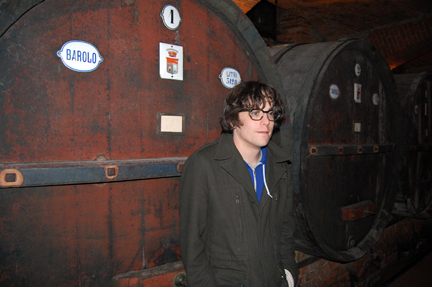
Above: Cory posed for me in front of an old large-format chestnut wood cask, once used to age Barolo at the historic Fontanafredda winery in Serralunga d’Alba. I highly recommend a visit there. The winery represents an important piece in the historical puzzle of the first Italian wine renaissance that began in 19th-century Italy.
One of the more interesting elements to emerge from my recent trip to Piedmont was one enologist’s observation that Italy did not undergo a “barrique revolution” in the 1980s but rather a “stainless steel revolution.” One of the results of the new trend of stainless steel aging introduced in Italy in the 1980s, he claimed, was that small-cask, French-oak aging soon followed as a natural and necessary corollary. Made from an impenetrable and inert substance, stainless steel vats do not allow for oxygenation of the wine. As a result, he claimed, the use of barrique aging expanded in Italy. The smaller cask size oxygenates the wine more rapidly and the more manageable format helps to maximize cellar space (among other efficacious aspects of the now overwhelming popular French format).
Above: Owner and winemaker Giovanni Rava at La Casaccia in Monferrato showed us this “vat,” carved into the tufaceous subsoil, once lined with glass tiles and used for vinification of Barbera (in the 18th century), now used to store barriques.
The day we visited the Marcarino winery and spoke with enologist Mauro de Paola, I was interpreting and so wasn’t able to take notes and photographs. And I will agree with colleague Fredric that beyond Thor’s account of the visit there couldn’t be “a more fair or thorough explication of our visit to this puzzling property.” (I will say, for the record, that I loved Paolo Marcarino’s wines, however manipulated the process to achieve no-sulfite-added expressions of Barbera and Cortese.)
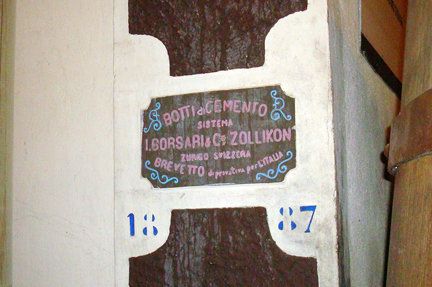
Above: This patent, for “botti di cemento [cement casks],” dated 1887, is believed to be evidence that Fontanafredda was the first to use concrete vats to age wine in Italy.
A 1982 visit to Napa by Giacomo Bologna, Maurizio Zanella, and Luigi Veronelli is widely considered the “eureka” moment that led many of Italy’s foremost producers to begin fermenting in barrique (Zanella) and aging in barrique (Bologna). (I have written about in one of my favorite posts here, and Eric wrote about it here.)
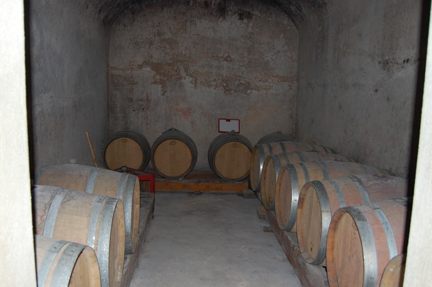
Above: Cement vats used to make one of my favorite wines in the world, Produttori del Barbaresco. Stainless steel is also used today at the winery, even for some of its top wines. In the 1980s, a lot of Italian winemakers shifted from glass-lined and varnish-lined cement aging and large cask aging to barrique aging (not at Produttori del Barbaresco, however).
I had always assumed that Angelo Gaja had begun using barrique aging around the same time as Bologna (whom many credit as the first to use new cask aging in Italy). But when we visited and tasted with Gaja on our recent trip, he told me that his winery began experimenting with new, small cask aging in 1978. (I have a long backlog of posts but I’ll get to our Gaja visit, which was, as you can imagine, immensely interesting.)
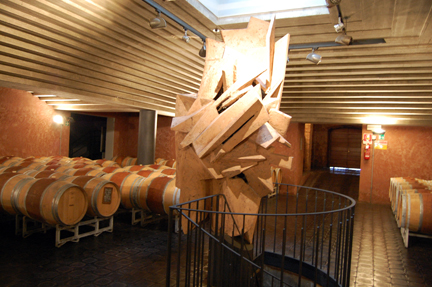
Above: One of Gaja’s barrique aging rooms is dominated by this fantastic Giovanni Bo sculpture, an extension of the well, no longer in use, in the courtyard of the winery.
Honestly, I can’t say that I wholeheartedly agree with De Paola’s assessment that the advent of stainless steel is what made barrique aging necessary in Italy. But I do think that the introduction of stainless steel and barrique, together with a California-inspired approach to cellar management (prompted by the emergence of the Napa Valley fine wine industry) are all elements in the current renaissance of Italian wine (whether you prefer traditional- or modern-style wine). His observation that “stainless steel was the true revolution,” in my opinion, is a fair if atypical assessment: it’s not that Italian producers decided one day that they should age their wines in barrique.
Barrique and stainless steel were both part of the new and contemporary era of Italian wine.
So much (too much, really) of the wine we tasted during Barbera Meeting was dominated by new oak but we also tasted some fantastic stainless-steel aged and large-cask aged Barbera that really turned me on.
In other news… Man and husband cannot live by Barbera alone…
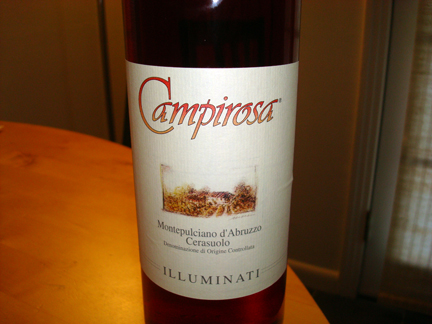
Last night we paired this wonderful Montepulciano d’Abruzzo Cerasuolo with Tracie P’s excellent slow-cooker braised pork chops smothered in cabbage. Check out the recipe and tasting notes here…
Above: While in Los Angeles in early December, I had lunch at Mozza with my friends Howard Rodman and Lou Amdur. Owner of my favorite natural wine bar, Lou has a wonderful food and wine blog (not so new), where he writes about his wine selection and whatever else makes him culinarily curious. Comrade Howard is my number 1 candidate for “someone who outta have a food and wine blog.”
The oughts are noughts and 2010 has arrived and at least a couple of friends of mine took time during the December wind-down to launch new food and wine blogs.
Above: For desert, Howard, Lou, and I shared olive oil ice cream. Penelope and Javier sat at the table next to us. I had no idea who they were (as I was hoping to run into Mel and Carl, who purportedly dine there and are a much more sexy couple!).
This month saw the launch of a food and wine (and music) blog by my friend Anthony Wilson (click on “blog” in the left-hand nav bar). You see, Anthony’s primary mission in life is not to be one of the greatest jazz guitar players of our time. His true calling is “to seek out — every day — fresh, delicious, typical food, prepared with love by like-minded obsessives, along with real, authentic, natural wine, served whenever possible in non-aristocratic, sometimes downright quirky, environments where it’s possible to roll up one’s sleeves and really get down to the business of eating and drinking.”
Above: While in LA, I also dined at Palate (in Glendale), which, despite the swagger, is my favorite restaurant in the U.S. right now. I really dig their vintage decanters (we decanted a bottle of Domaine de Montille 2006 Pommard Les Rugiens, thank you very much).
I’m also excited about a new blog, Gourmale, authored by my bandmate and air guitar superstar, Dan Crane (aka Jean-Luc Retard, aka Björn Türoque). Dan’s well-earned nickname on the road is “Snackboy Jr.” or “Snack,” and the Nous Non Plus tour bus has often been forced to stop abruptly for “snack attacks.” Enough said… (now, if we could just get Dan to add a blogroll!).
Above: At Palate, chef Octavio Becerra treated us to an amazing roast side of goat.
I’ve also been recently hipped to two very cool wine blogs by Los Angeles-based wine professionals, My Daily Wine by Amy Atwood, now at the top of my Google reader feed for news from the world of natural wine, and Brunellos Have More Fun, by Whitney Adams, whose mostly Italocentric blog I would read if only for the title! And lastly, but by no means least, my new guide to Bay Area restaurants is called Wine Book Girl, by my colleague UC Press publicist Amy Cleary.
In other news…
Above: A collaborative NYE meal, dill and chive roast potatoes (by Tracie B) and pan-roasted, boneless rib-eyes (by me). Langhe Nebbiolo 2008 by Produttori del Barbaresco and Beatles Anthology on DVD. Is this what heaven is like? ;-)
At the last minute, Tracie B and I decided to spend our New Year’s eve at home, alone, just the two of us. :-) We’ll have a lifetime of NYE celebrations ahead of us and so we thought we’d spend this last one, before we get married later this month, by ourselves.
Our bubbly beverage? A champagne of Champagnes (ha!): a bottle of Pierre Gimmonet Cuis 1er Cru Sans Année. We opened it at the beginning of the evening for an apertif and re-corked it. By the end of the night, it had opened up into a wonderful toastiness complemented by fresh white fruit and bright acidity. The perfect wine to pair with my true love’s sweet first kiss of the new year…
Above: Did I mention the girl can cook? Tracie B made chicken and dumplings last night for the whole B family. Photo by Rev. B.
In Emilia-Romagna they eat tortellini and cappelletti in brodo (filled pasta in capon broth). In Central Europe they eat knödel served in broth. At the Jewish deli, they serve kreplach in broth. And in the South, they make chicken and dumplings.
Above: Tracie B’s chicken and dumplings. I can only wonder what Dr. V’s user-generated content would have to say about this most impossible impossible wine pairings — chicken and dumplings. But, man, were they good! This and below photos by Tracie B.
By its very nature, broth is an inevitably impossible wine pairing: the temperature alone makes pairing like grabbing the moon with your teeth as the French say.
Heeding the adage by restaurateur giant Danny Meyer, if it grows with it, it goes with it, I should have paired Tracie B’s delectable dumplings with Lambrusco (my top pick would have been a Lambrusco di Sorbara). In Emilia, versatile Lambrusco is served throughout the meal, with the appetizer of affettati (sliced charcuterie), with the first course of tortellini in brodo, with the second course of bollito (boiled meats and sausage), and even with the dessert of Parmgiano Reggiano served in crumbly shards, perhaps topped with a drop of aceto balsamico tradizionale di Modena or di Reggio Emilia (none of that hokey, watery aromatic vinegar). Lambrusco would have been perfect here.
Above: Don’t try this at home. Frankly, the 2004 Barbaresco Pora by Produttori del Barbaresco is going through a nearly undrinkable stage in its evolution.
But as food writer Arthur Schwartz says of pizza, if you can’t be with the one you love, love the one your with.
Before heading to Orange for the Christmas holiday celebration with the B family, I had reached into our cellar and pulled out a bottle of 2004 Barbaresco Pora by Produttori del Barbaresco. Frankly, the wine was too tight, overwhelmingly tannic, and even though it opened up over the course of the evening, it’s going through a nearly undrinkable period in its evolution. But that’s part of my love affair with this winery: experiencing the wine and the different single-vineyard expressions at different points in its life. And there are more bottles of 04 Pora to be had in our cellar. We ended up lingering over wine, sipping it is a meditative wine as we retired to the living room and watched a movie together and munched on oatmeal cookies that Tracie B and Mrs. B had baked that afternoon.
Above: Nephew Tobey wasn’t concerned with wine pairing. But he sure loved him some chicken and dumplings!
Above, from left: my buddy Mark Sayre, Kermit Lynch, and me last night at Vino Vino for the Kermit Lynch listening party. A grand time was had by all. Photos by Tracie B.
Tracie B and I had a blast last night at the Kermit Lynch listening party at Vino Vino here in Austin. It’s been a while since I took the stage with a microphone in my hand and it was great to feel that energy again and the buzz that comes along with playing music (even if I was just cueing it from my Ipod). Click here for highlights from the event.
Above: Kermit’s producer Ricky Fataar, right, with his friend and awesome bass player, Austin-based Sarah Brown, who joined us for dinner. Ricky and the entire band will be fielding questions from the audience tomorrow night in Nashville at the Basement.
We’ve had a great time hanging out with Kermit, his wife Gail Skoff (who is delightful), and Ricky Fataar, who’s played with so many musical greats over the years (the Beach Boys, Bonnie Raitt, Jon Scofield, Boz Scaggs, Crowded House, The Rutles). I could have listened to Ricky tell stories from his years on the road all night long.
Above: What does this country boy pair with his pulled pork? Nebbiolo, of course!
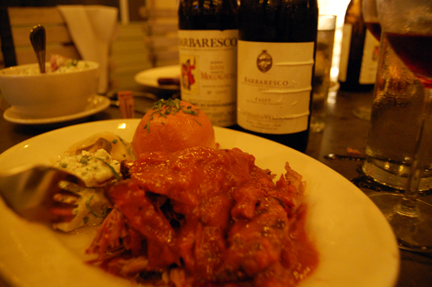
After the event, I swept the entourage away in the Hyundai limo and we hit Lambert’s downtown for dinner (not my favorite barbecue, but solid and open late). Earlier I had raided my Nebbiolo stash and so we BYOBed some 2001 Barbaresco Moccagatta by Produttori del Barbaresco (which was deliciously chewy and tasted like sumptuous mud) and 2001 Barbaresco Faset by Castello di Verduno (wow, this wine was off-the-charts good, almost Baroloesque in its austerity, regal and elegant, and showing nicely with some aeration despite its youth). Some would say that it’s a shame to pair savory, tannic Nebbiolo with the tangy, smokey flavors of Texas barbecue but, man, o man, was it tasty — especially riding on the high and the brio of the evening and the event…
Thanks again to the staff at Vino Vino and to everyone who came out last night for the sold-out event!
Tomorrow night: Nashville! (It’s fun to be “on the road again,” even if for just one night).
One of the frequent questions that we wine folk get is “what’s your favorite wine?” It’s not an easy one to answer. I always tell people, it depends on where I am, whom I’m with, and what I’m eating. A favorite wine could be a humble bottle of grapey Lambrusco with some belt-busting gnocco fritto and rendered lard or it could be a 40-year-old Giacomo Conterno Barolo Monfortino and a blood-rare porterhouse steak, the genteel noble tannin of the Nebbiolo waltzing with the marbled meat.
But if there ever were ONE wine, one winery that I could point to and say that’s my favorite, it would have to be Produttori del Barbaresco. I love the wines, I have deep respect for the people who grow it and make it, and the ideology and winemaking philosophy that stand behind it. I also love it because I can afford it and because I can afford to “follow” each vintage. And more than anything else, I love how the style of the winery has remained so consistent: whether tasting a ’67, an ’89, or the current release ’05, the style of the “house” steadfastly represents the terroir and the vintage.
And so it was a thrill yesterday to taste the 2008 Langhe Nebbiolo by Produttori del Barbaresco, the cooperative’s entry-level wine, made from the member growers’s younger vines, and vinified with shorter maceration time and aging.
The 2007 was an anomalous vintage for this wine. The bumper crop of noble fruit resulted in a more tannic and richer expression of Nebbiolo than you usually see in this wine (I think this is what BrooklynGuy found to be off-putting when we exchanged notes about it). When I told winemaker Aldo Vacca that as much as I loath the expression “baby Barbaresco,” the ’07 was the one instance when I thought the Langhe Nebbiolo was “Barbaresco-esque.” “Baby Barberesco?” he said to me with a quizzical look. “Baby Barolo!”
With the ’08, the wine has returned to is more classic style: a Nebbiolo lighter in body, with very approachable berry fruit and sour cherry and already mellow tannin. Great for drinking now. Damn, I love this wine. It should retail for around $20, more or less. A great value.
In other news… boys will be boys…
John Roenigk and I played a little hooky yesterday after tasting and some lunch: we went to one of the most amazing guitar stores I have ever visited, Quincy’s here in Austin. (John’s an amazing musician and I’ve been helping him transfer some of his recordings from the 1980s to digital format, one of the other things that GarageBand is great for. That dude can play him some serious geetar.)
I sure wish I had the dough to afford one of these handmade beauties. It’s hard to convey what it’s like to play guitars of this caliber. Their sounds are warm and round, with the bass notes resonating like a train in the distance and the highs sparkling like stars in the sky. That’s a 1999 Gibson SJ200 Custom (Brazilian) in the foreground.
But when you actually play them, the sensation of feeling the sounds emanate from the warm wood pressed up against your belly is purely transcendental. That’s a ’52 Martin D28 above — one of the few vintage guitars owner Pat Skrovan had in the store yesterday.
Above: I poured an awesome flight of Nebbiolo on Tuesday night at The Austin Wine Merchant for my class “The De Facto Cru System in Piedmont.”
They say that parenting blogs, so-called “mommy blogging,” are the most lucrative: evidently, folks who write about parenting have no troubles finding advertisers. Among wine bloggers, however, the term “mommy blogging” denotes a sub-genre of posts in which bloggers “write home to mom,” telling her all the great bottles that they have opened. Italian Wine Guy often accuses me of this and I must confess that my mom does read my blog (hi mom!).
Since I am about to indulge in some flagrant, unapologetic mommy blogging, I’d like to propose a new sub-genre of enoblogging for your consideration: “Umami Blogging.”
Umami is one of the “the five generally recognized basic tastes sensed by specialized receptor cells present on the human tongue” and in wine writing, we often use it to denote a class of “savory” descriptors.
Umami, meaty, brothy, savory flavors were on everyone’s palates Tuesday night when I poured 7 bottlings of Nebbiolo from Langa at my weekly Italian wine seminar at The Austin Wine Merchant. Man, what a flight of wines! The de facto cru system of Piedmont was the topic and participants tasted bottlings from the east and west sides of the Barolo-Alba road as well as a Barbaresco and a Langhe Nebbiolo sourced in Barbaresco, where many believe the proximity of the Tanaro river adds another dimension to the appellation’s macro-climate.
Highlights were as follows…
Bruno Giacosa 2001 Barolo Falletto
This wine, from a classic Langa vintage, showed stunningly on Tuesday. Still very tannic in its development but as it opened up over the course of the evening, it performed a symphony of earthy, mushroomy flavors. The Austin Wine Merchant is selling this wine at release price (RUN DON’T WALK).
Brovia 2004 Barolo Rocche
My first encounter with this vintage from traditional producer, Brovia, one of my favorites. Here wild berry fruit ultimately gave way to a wonderful eucalyptus note. The wine is still very tannic, of course, but was suprisingly approachable after just an hour of aeration. I loved the way the fruit and savory flavors played together like a meal in a glass. Great value for the quality of wine.
Marcarini 2005 Barolo Brunate
This wine had a bretty, barnyardy note on the nose that was a turn off for a lot of folks but guest sommelier June Rodil (the current top Texas sommelier title holder) and I really dug this wine, which weighs in at less than $60. I love the rough edges of this rustic style of Barolo and only wish that I had some bollito misto and mostarda to pair with its vegetal, sweaty horse flavors.
Produttori del Barbaresco 2005 Barbaresco
Tracie B, who joined at the end of the class, and I agreed that this wine is beginning to close up. It is entering a tannic phase of its development and its savoriness overpowers its fruit right now. That being said, it still represents the greatest value in Langa today, at under $40. If you read Do Bianchi, you know how much I love the wines of Produttori del Barbaresco: I would recommend opening this wine the morning of the dinner where you’d like to serve it. By the end of the night, the tannin had mellowed and the fruit began to emerge.
To reserve for my Wines of the Veneto class (Nov. 3, a seminar dear to my heart because of my personal connection to the Veneto) or my Italian Wine and Civilization Class (Nov. 10, my personal favorite), please call 512-499-0512. On Tuesday, Nov. 10, we’ll all head over to Trio after class for a glass of something great to celebrate. Thanks again, to everyone, for taking part and heartfelt thanks to The Austin Wine Merchant for giving me the opportunity to share my passion for Italian wines with Austin!
In other Nebbiolo news…
My buddy Mark Sayre is pouring Matteo Correggia 2006 Roero Nebbiolo by the glass at the Trio happy hour at the Four Seasons. European wine writers have been paying a lot of attention lately to the red wines of Roero (an appellation better known in this country for its aromatic white Arneis). There isn’t much red Roero available in the U.S. and I was thrilled to see this 100% Nebbiolo in the market. It’s showing beautifully right now and is my new favorite pairing for chef Todd’s fried pork belly — my compulsive obsession — a confit seasoned with the same ingredients used to make Coca Cola.
See, mom? You can sleep peacefully knowing that your son is drinking great Nebbiolo! ;-)
*****
Does anyone remember Tom Lehrer’s “So Long Mom, I’m Off To Drop a Bomb”?
The rain just didn’t want to stop falling as Étienne, John, and I made our way from Austin to Dallas yesterday for business meetings and a tasting of Étienne’s family’s wines. My friends and family know that I am a very cautious, prudent driver, even to the point that some will tease me. It was one of those bad Texas rain storms, a “white-knuckle” tempest as some would say, and so I maintained a pretty steady 60 mph as we headed north on I-35. It wasn’t long after my habitual pit-stop at Italy, Texas, about 30 minutes outside of Dallas, that a gold Mercedes spun out of control about 150 yards ahead of us, bouncing off the median divider and sliding lengthwise across the highway directly in our path. I swear, and John, who was in the front passenger seat, told me that he had the same experience: everything seemed to appear in slow motion, despite the celerity with which events unfolded. I didn’t want to break too hard because the road was wet. We were in the middle of three lanes. My instinct told me to swerve right to avoid the oncoming car but I glanced in my right-side mirror and saw there was an 18-wheeler behind me in the far-right lane. It seemed that we were going to collide with the Mercedes head-on.
In that moment, I thought I was going to die.
But then a miracle happened: the Mercedes seemed to bounce off of the front bumper of my Hyundai, like a billiard ball, and it kept moving, colliding with the truck that had passed me on the right. It then flew back across the freeway in front of us and finally stopped moving when it hit the median divider. By this point, I had managed to stop my car.
We were lucky to be alive. The driver of the Mercedes was alive and conscious and the emergency team arrived swiftly and took him away.
The right side of my bumper had been dislodged but a tap put it back into place. There’s barely a scratch on my car. A miracle.
Beyond the adrenaline rush, Étienne, John, and I were 100% fine.
Later, that night, following long meetings and a tasting, Alfonso hosted us all for dinner at his house. We paired his chipotle-chili-marinated, grill-fired pork and baked potatoes with the Étienne’s Domaine de Montille 2006 Volnay 1er cru Les Mitans and a Produttori del Barbaresco 2001 Barbaresco Pora. Étienne told me with a big smile, “you can write on your blog that I love Barbaresco!”
We were lucky to be alive.
We got back to our hotel around 10 p.m. and retired and I was finally able to call Tracie B, who shared the wonderful news that her childhood friend Jennifer had posted our engagement photos onher blog. (Click the photo above to see them all, if you like.)
I don’t know that everything happens for a reason, and even though I believe in God, I’m not sure there is a divine plan. I do know that I love Tracie B with all my heart and all my soul and the joy that she has brought into my life is the greatest miracle anyone could wish for. To imagine my life without her is to imagine a life without meaning, direction, or purpose. I can’t say that “my life passed before my eyes” in the moment of the crash. All I could think about was how I’ve finally arrived at this moment after a life that has certainly been interesting but never entirely fulfilled: I have the love of the sweetest, most beautiful woman I’ve ever known, I have my health and my mind, both of our families are with us and healthy and soon will share the joy of our union. And there was even one of Tracie B’s savory oatmeal cookies left in my wine bag for breakfast this morning…

 Thor, a wine writer and blogger whom I greatly admire and an all-around mensch, wrote the other day to winemaker Aldo Vacca (left) inquiring about his decision not to bottle his 2006 crus. Thor was kind enough to share Aldo’s response and Aldo was kind enough to allow me to post it here.








 Do Bianchi