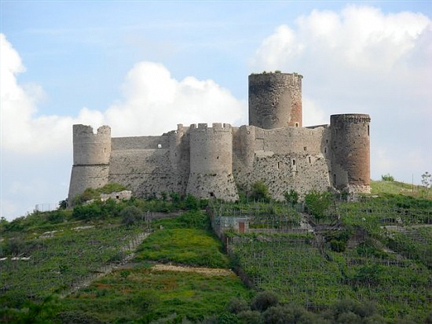
Above: It’s easy to understand why they can make fresh, clean wines in the Commune of Lettere (Naples), where vines are tended atop the peaks of the Lattari mountain chain.
It’s another busy day over here at Do Bianchi Editorial and I really shouldn’t be posting. But when a lovely lady sends me an etymological quaestio, the chivalrous in me trumps my otherwise unflagging work ethic (hah!).
Over at My Life Italian, Tracie B has produced a truly wonderful and thoroughly delightful post on a wine we shared just over a week ago in New York: a sparkling red blend of indigenous grape varieties from the township of Lettere (province of Naples). You’ll have to click through to read about this wine and why it — together with Gragnano — is one of Neapolitans’s favorite pairings for pizza.
But as far as toponomastic matters are concerned, I poked around the web and found an answer to her query as to the origins of the name Lettere.
The most likely etymon I found was that Lettere is a corruption of Lattari (pronounced laht-TAH-ree, if I’m not mistaken), the name of the mountain chain where the township is located. The beautiful (and fruitful) mountains take their name, most believe, from the Latin mons lactarius, literally the suckling mountain (from the Latin lac meaning milk) because the mountain chain was known in antiquity as an excellent site for sheep to pasture.
Tracie B and I will be heading to central and northern Italy in early 2010 but we are hoping to head south next fall. We’ll be sure to take a print out of this listing of pizzerie in Lettere (click on “Dove Alloggiare e Mangiare”)!
And in the meantime, I’ll reiterate Tracie B’s advice: head to Kesté Pizza e Vino in New York and order some Lettere (or Gragnano) with your pizza!
Above: Skewered mozzarella at Dough, wrapped in prosciutto and grilled at Dough. Has the mimetic desire kicked in yet?
I recently took Tracie B to try the pizza at Doug Horn’s Dough in San Antonio. I had eaten there a few times and was consistently and repeatedly impressed by the authenticity of the pies. It was time to call in the expert: after all, Tracie B lived in Ischia outside of Naples for nearly five years. She KNOWS her authentic Neapolitan pizza. She was duly impressed and suffice it say that we will soon be back.
Above: Self-Portrait in a Convex Spoon? I think I just gave myself an idea for this week’s Sunday Poetry. Doug’s panna cotta is as good as it gets. I told Doug that his panna cotta was one of the best I’d tasted outside of Italy and one of the best ever tasted, really. “I know,” he responded dryly. This guy doesn’t kid around.
Above: Doug Horn’s pizza at the aptly named Dough in San Antonio is among the best I’ve ever had — in Italy and the U.S. That’s his margherita: there is a lot of great Stateside pizza but Doug’s is the most authentically Neapolitan I’ve tasted.
The tenor of the debate seemed to have reached fever pitch by the time I weighed in with my post Pizza, pairing, and Pasolini.
A Solomon of pizza lovers, Eric, the sage among us observed rightly that we don’t have to do it the way they do it Rome.
Above: Doug’s mushroom and caramelized red onion pizza is not the most traditional among his offering but, damn, is it good! I have deep respect for Alan Richman (who also happens to be one of the nicest food writers you’ll ever meet) but his omission of Dough in the top 25 pizzas in the U.S. is a glaring oversight.
But now one of our nation’s greatest food writers, Alan Richman, tells us that “Italians are wrong about pizza… Pizza isn’t as fundamental to Italy as it is to America. Over there, it plays a secondary role to pasta, risotto, and polenta. To be candid, I think they could do without it.” (Here’s the link to the GQ article on the top 25 pizzas in the U.S. but it is a major pain in the ass to navigate.)
Above: Doug also does a wonderful, traditional Neapolitan flatbread. This is probably a trace of the origins of pizza as we know it today. I’ve never met anyone as passionate about traditionalism in pizza as Doug.
Alan has impeccable and unquestionable taste and I agree with almost all of his top-25 selections (at least those I have tasted myself). Anyone who reads Do Bianchi knows that I — like most Italophile oenophiles — have an obsession with pizza and that Lucali in Brooklyn is one of my all-time favorites (a preference that Alan shares).
I know that Alan is just having fun when he says that Italians are “wrong about pizza.” And I agree that Americanized pizza is a wonderful and spontaneous mutation of the ingenious simplicity that the Italians have created — like so many things they’ve given the world.
Above: Doug also does some incredible fresh cheese and traditional Neapolitan cheese antipasti that he learned to make while studying to be a pizzaiolo in Naples.
But to say that “Pizza isn’t as fundamental to Italy as it is to America” is egregious hyperbolism. Pizza — like pasta, like the Italian national football team — is one of the few notions that truly binds the Italians together as a nation — nation in the etymological sense, i.e., a shared birth from the Latin natio. (I have a great deal to say on this but I’m literally running out the door to San Antonio as I write this.)
Alan, Eric, and Tyler, please come to San Antonio anytime: we have much to discuss and the pizza (and the Brunello) will be on me. I promise that the trip will be well worth it.
Above: Chef Julian Barsotti’s excellent Margherita at Nonna in Dallas last week, paired with Inama Soave Classico Superiore Foscarino 2006, one of my favorite expressions of Garganega. The bright acidity of this wine and its structure were a great match for the intense flavors of the mozzarella di bufala, tomato, and fresh basil. YES, I paired wine with pizza! Keep reading…
I was glad to see the doc have fun with it and the many colorful comments. One entry, however, merits special attention. Pinotage (“an international cyber-based fan club for wines made from the Pinotage variety”) wrote:
The statement about Italians in Italy not drinking wine with pizza doesn’t match up to the many times I have been in Italy. But maybe the giveaway is ‘pizzeria’, in other words the type of restaurant and their clientele. Pizzas are served in more upper class restaurants and Italians do drink with with them.
I suppose an Italian in the USA might come away with the idea that Americans don’t drink alcohol with chicken if they’d been saving money by eating in KFCs.
Above: Two slices at my favorite old-school, by-the-slice pizzeria in Bensonhurst, Da Vinci (6514 18th Ave at 65th St, Bensonhurst, Brooklyn, NY 11204, 718-232-5855).
Let me set the record straight: in my view, there’s nothing wrong with pairing pizza and wine and I do it all the time. The observation culled from my blog by Dr. V actually referred to a would-be Italian cookbook author whose claim of “authenticity,” in my opinion, was undermined by the fact that he paired pizza with wine. Ask any Italian (I swear: I speak Italian with native-speaker proficiency, I lived in Italy on and off for ten years, I travel there regularly for my work, and I have a Ph.D. in Italian!). They will tell you that pizza is traditionally paired with beer. The fact of the matter is that pizza culture in Italy is a youth-based culture. The number of young enonauts in Italy has been growing steadily but wine consumption is a relatively new phenomenon among Italian young people.
Above: pizzaiolo Mark Iacono at my favorite NYC pizzeria, Lucali (575 Henry St and Carroll, Carroll Gardens, Brooklyn, NY 11231, 718-858-4086). He’s cooler than Nicolas Cage in Moonstruck. Last year I did this post on the best pizza in NYC (worth checking out in my humble opinion, one of my top posts ever).
There are technical reasons for not pairing pizza and wine: the acidity of fresh plastic cheese (i.e., buffalo-milk mozzarella), tomatoes, and the intense flavor of fresh basil can easily overpower the nuance of fine wine. But “rules are rules” and I must confess: I have written many times on my blog about my guilty pleasure of pairing pizza and Nebbiolo.
Above: In San Diego, I have been often known to indulge in Produttori del Barbaresco 2004 Barbaresco and pizza at my top-spot for authentic Italian pizza, Mamma Mia (1932 Balboa Ave, where Balboa and Grand intersect) San Diego, CA 92109, 858-272-2702).
I do take ideological issue with Pinotage’s “upper crust” (forgive the pun) attitude that “Pizzas are served in more upper class restaurants” in Italy. It’s simply not the case (but then again, his blog is called “Pinotage,” so I should slice him some slack… I guess…).
Pizza is a wonderful part of Italian life but in terms of authenticity, it needs to be understood as an element of youth and popular culture. Pizza in the U.S. can be wonderful as well, but it is the result of that great misunderstanding otherwise known as the Atlantic Ocean.
Above: One of my favorite sequences from Pasolini’s 1966 Uccellacci e Uccellini (Hawks and Sparrows). Note the counterpoint between the joyous youth culture and the squalor of suburban Rome.
Aside from alliteration, what does Pasolini have to do with all of this? Nothing really: I currently find myself mired in that hellish experience called “indexing” and today, I happen to be on the letter P.
In his films, Pasolini repeatedly reminded us of the struggles and the beauty of popular culture (and by popular culture, I don’t mean Warholian culture; I mean the workaday culture of the populus).
In the U.S., drink whatever you want with your pizza. Have fun with it. Enjoy yourself. In Italy, try pizza paired with beer in a crusty ol’ pizzeria in Trastevere (Rome).
If you made it this far into the post, thanks for reading! Have a great week.



 Do Bianchi