Ed McCarthy’s insights into Valentini, one of the absolutely best wines I’ve had in 2010

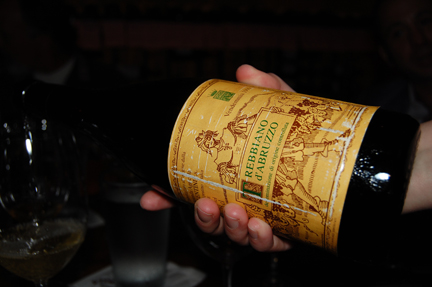
Above: One of the absolutely best wines I had this year was the 1999 Valentini Trebbiano d’Abruzzo, which I drank at the Orange Wine dinner we held at Vino Vino in Austin in April.

Ever since my friend and ex-boss Nicola Marzovilla became an importer of Edoardo Valentini wines earlier this year, this legendary winery has entered into a renaissance in the consciousness of American lovers of fine wine.

Eric did this excellent post on a portfolio tasting of the wines that took place a few weeks ago in NYC and last week, another of the wine writers whom I admire greatly, the inimitable Ed McCarthy, wrote this fantastic profile and remembrance of Valentini, his wines, and the winery (his notes on the different clones of Trebbiano are a must read for anyone interested in Italian wine).

Also worth checking out: this round-up, by my blogging colleague and friend James Taylor, of past literature on Valentini.

When I had dinner with Nicola in NYC last month, I grilled him about his recent visit to the property in Abruzzo. He was reluctant to give up the goods but he ultimately revealed some of the winery’s secrets. But you’ll have to pour me a glass to get them out of me!

Natural wine matters

Above: The wines produced in the Sierra Foothills of California by Hank Beckmeyer and his wife Caroline are among those recommended by Eric in his blog post yesterday on Natural Wine. (I’m offering two bottlings by Hank in my wine club six-pack this month.)

With all the trimmings of a lustful post-modernist dialectic on the semiotic implications of “the other” intrinsically expressed through the exile of “self” in the production of wine, the debate over what is and what is not Natural Wine (with a capital N word) is gearing up like a Hollywood summer box office block buster.

Joking aside, the Solomon of wine blogging, Eric, has opened the flood gates with a torrent of strength equal to a Texas summer flash flood.

We’re all gearing up for Cory’s 32 Days of Natural wines, which begins in a few days (I’ll be posting, as will Jaynes Gastropub, as will Hank above, and a lot of other friends of mine).

In the meantime, I can’t recommend Lou’s posts strongly enough: while Eric is our Solomon, Lou is our Rebi Akiva.

A disturbance in the Pour

I felt a great disturbance in the Pour, as if millions of voices suddenly cried out in terror and were suddenly silenced. I fear something terrible has happened.

The Pour has been folded into the The New York Times aggregate eating and drinking blog.

You were our only hope, Obi-Wan Cannubi.

You are a Jedi Master among wine bloggers: the Pour was what gives a Jedi wine blogger his power. It was an energy field created by all vinous things. It surrounded us and penetrated us. It bound the galaxy together.

The Pour will be with you, always.

Credit where credit is due: I owe the above punny title to Alfonso. In exchange I offered free use of “mishegas impossible.”

Mikey likes it: Brunello 2004 by Il Poggione

From the “on any given Sunday” department…

poggione

Above: Just to be on the safeside, we opened 2004 Brunello di Montalcino by Il Poggione last night at Trio in Austin. Photos by Tracie B.

Tracie B and I were both concerned when, the other day, we read that the 2004 Brunello di Montalcino by Il Poggione had been eliminated from the top-ten wines in The New York Times recent blind tasting panel of 04 Brunello.

Blind tasting can be such a tricky business and in many ways, it removes wine from the terrestrial context in which we consume it (and the way it was intended to be consumed). In blind tasting, our experience becomes metaphysical, in other words, beyond the physical inasmuch as it treats wine as an abstraction. The intention is noble: blind tasting is intended to remove as many “extraneous” variables as possible and force the taster(s) to evaluate the wine purely on its sensorial attributes as an empirical expression of its intrinsic value. But wine, by its very (human) nature, cannot be reduced to pure science.

Even Eric, whose palate I admire greatly, was surprised that Il Poggione didn’t make the top-ten cut. “Some very well-known brunellos,” he wrote, “missed the cut in our blind tasting, including one of my perennial favorites, Il Poggione… A cautionary note about blind tastings: they are snapshots of a wine at a particular moment. I would never say no to a bottle of Il Poggione, even if I did reject it here.”

Never ones to say no to a bottle of Il Poggione, Tracie B and I went to Trio in Austin last night and asked our friend sommelier Mark Sayre to open a bottle of the 2004. Above and beyond our friendship, I turn to Mark when I want the proverbial “second opinion” (and his wine program offers the ideal setting for tasting fine wine in Austin).

Tracie B, Mark, and I all agreed that the wine is going through a very tannic moment in its evolution. We opened the bottle, decanted it immediately, and then tasted it immediately. Then, we put it aside and let it aerate for about 45 minutes.

tocai

Above: We also tasted Scarpetta 2007 Tocai Friuliano (bottled by Master Sommelier Bobby Stuckey) with the shrimp croquettes. This old-school wine is one of those “not-for-everyone” wines but just right for me and Tracie B!

At first sip, the wine was overwhelmed by its tannin, but when we returned to it, it had begun to open up beautifully, showing that magical balance of tannin, fruit, and acidity that makes Montalcino (in my view) one of the greatest appellations in the world.

Not everyone made great wine in 2004. As much as the Tuscan wine industry would like us to believe that 2004 was a 5-star vintage, it simply was not: summer heat spikes plagued growers whose vineyards lie at lower elevations.

But, as father-and-son winemaking team Fabrizio and Alessandro Bindocci will tell you, Il Poggione’s vineyards lie at some of the highest elevations in the entire appellation, reaching 400 meters a.s.l. and thus keeping summer temperatures cooler during warm summer months.

I don’t think 2004 will be remembered as a great vintage in Montalcino but I do think a handful of producers made superb wines and Il Poggione was one of them. The wine has many, many years ahead of it in the bottle and will only get better with age. It’s a young buck right now and just needs some patience and aeration to temper the power of its youth.

The je-ne-sais-quoi moment came when Mark insisted that we pair the fried pork belly with the wine: the classic plum notes of the wine and its tannin attained an ethereal nobility when blended with gelatinous fat and caramelized flavors of the dish.

What happened with the bottle that Eric and the panel tasted in New York? We’ll never know: on any given Sunday, even in a laboratory environment, a bottle of wine can be affected by innumerable variables (including how it was handled by the many actors who “touch” it before it reaches the end user).

Our evaluation? In the words of Tracie B, “Mikey likes it!”

Pasta in bianco and a Calabrian white (and the story behind Pearl lager)

librandi

Above: “Pasta in bianco,” literally “pasta in white,” one of my favorite things to eat. Pasta dressed simply with extra-virgin olive oil, salt and pepper, and chili flakes.

In the wake of holiday feasting and the unusually cold weather here in Texas (making it all the more challenging to head to the gym!), Tracie B and I have been indulging lately in one of our not-so-guilty pleasures: pasta in bianco, literally, pasta [dressed] in white.

Bring a large pot of water to a boil and then add a heaping handful of kosher salt (“enough to make it taste like seawater,” is the way Tracie B likes to put it). Cook a short or long pasta to the desired firmness (some like it more al dente than others). And then toss with extra-virgin olive oil, salt and pepper to taste, and chili flakes (if desired). Sometimes I’ll throw some finely chopped flatleaf parsley in as well.

After bread and wine, pasta in bianco (which can also be made using butter in the place of olive oil), is one of G-d’s true gifts to humankind. And it’s also one of the most healthy things you can eat. South Beach diet? Atkins diet? Hogwash! If you want to slim down or just stay trim, avoid protein and meat. Eat easy-to-digest starches dressed with the “good fat” of olive oil. When I first lived in Italy (more than 20 years ago) and pasta and rice became the central ingredient of my diet, my health (and life) changed radically for the better.

librandi

Above: Librandi is a high-volume winery in Calabria that makes well-priced food-friendly wines. They’re highly affordable, clean, and delicious. Calabrian and Apulian wine represent some of the greatest value in the market today.

I got a lot of feedback from yesterday’s post on the Calabria riots.

Last night, with Calabria on our minds, we opened a beautiful wine from Calabria that we love, Cirò Bianco: Calabrian Greco vinified in stainless-steel by Librandi. Bright (but not tongue-splitting) acidity, balanced minerality, and low alcohol (and a more-than-reasonable price) made this wine an ideal pairing for our pasta in bianco.

In other news (from the “recommended reading” department)…

doug sahm

Eric did a wonderful post yesterday poking fun at the fine art of pairing fine with junk food, The Match Game.

His recommended pairing for Mrs. B’s Chex Mix was Pearl lager.

I imagine Eric knows the famous beer of San Antonio from his days as a grad student at University of Texas at Austin.

That’s San Antonio and Austin music legend Doug Sahm with a can of Pearl in the photo left (courtesy of Pogzilla via IWG). (I’m sure you know Stevie Ray and Jimmie Vaughan as icons of the Texas music scene but locally, Doug Sahm is considered its über-hero.) The Pearl Brewery is in the midst of a veritable renaissance these days: the facility itself and the adjacent retail and restaurant complex has become one of the top food and wine destinations in Central Texas. Definitely worth checking out…

Thanks for reading! Ya’ll come back now!

Champagne by any other name…

From the semiotics department…

champagne

Above: A few weeks ago, Tracie B and I attended a “Champagne Party” in south Austin hosted by wine collectors.

Champagne is a place (a province of eastern France).

Champagne is an adjective, “something exhilarating, excellent” (“It was of the two Lytteltons, Alfred and Edward, that the phrase ‘the champagne of cricket’, was first used,” 1928, OED online edition). Champagne is a color.

Champagne is also a compound attributive adjective: you can have “champagne” tastes; you can be a “champagne” socialist (I, for one, certainly am one, although I prefer Brunello socialist); you can even have a “champagne” cocktail.

Champagne is also a wine — a sparkling wine made in the region of Champagne, twice-fermented in bottle.

champagne

Above: It was like a scene from Man Bites Dog when fellow Austinite blogger Alcoholian and I faced off with our cameras at the Champagne party. Meta-blogging at its best!

Champagne perhaps more than any other wine (with Bordeaux a distant second) evokes an ethos, a zeitgeist, an aura, a sentiment, a sensation, a sensual experience…

On any given day, you will find at least three bottles of wine in my refrigerator: a bottle of Prosecco, a bottle of Moscato d’Asti, and a bottle of Champagne. The Prosecco for celebration and/or a great pairing for a small plates dinner (cicchetti). The Moscato d’Asti, with its low alcohol and bright fruit flavors and residual sugar, a great brunch wine, a great a-friend-just-dropped-in wine, a great wine to pair with fresh fruit. But the Champagne? When it comes to a truly special occasion, I wish for no other wine to grace the palate of my beautiful Tracie B than Champagne. Is there any other wine where refinement and elegance meet power and structure as in Champagne? Is it just the ethos behind the wine that inspires this reverence in me?

Today, I’ll leave the technical discussion of Champagne to Eric and BrooklynGuy (I highly recommend both posts, the one on some great grower-producers, the other on varietal expression in Champagne).

I’ll just invite you to consider the word… say it aloud, roll it around your mouth… think of the imagery and ethos it evokes… Champagne… the very word titillates the senses, no? Champagne by any other name just wouldn’t be the same, would it?

Tracie B and I will be opening a Champagne on New Year’s Eve this year but we haven’t decided which one. What’s your “best Champagne” pick?

More tomorrow…

In other news… There is a G-d!

pastrami

Yesterday, Tracie B and I stopped in Houston on our way back to Austin from Orange, Texas and had lunch at Kenny and Ziggy’s Delicatessen. The day I decided to leave New York City, I had resigned myself to never eating great smoked fish and pastrami again (at least, not on a daily basis). But, man, let me tell you: the pastrami at Kenny and Ziggy’s ranks right up there with Barney Greengrass and Katz’s.

I never thought I’d utter the words, “there IS great deli outside of New York.”

Who knew?

Our date with the City, part 2: the best natural wine bar in the U.S.?

beaujolais

Above: I may be going out on a limb here when I say that Ten Bells seems to have captured the title of the “best natural wine bar in NYC” but I’ll go ahead and say it anyway. The selection of stinky cru Beaujolais was pretty impressive, even after affable owner Fifi Essome had sold out of many of the labels for his Beaujolais festival the Thursday before our Sunday visit. Photos by Tracie B.

Whether it’s Saignée, Wine Digger, Eric, Alice, or McDuff, it seems like all of my fav bloggers are either writing about or hanging out at The Ten Bells on the Lower East Side of New York City (which takes its name from the homonymous and notorious London pub).

So after Tracie B and I finished lunch with Michele at Kesté, we took a stroll over to the east side and picked up Alice in SoHo and walked down the Bowery to Broome and Orchard on the Lower East Side and tasted a few of the by-the-glass Beaujolais selections that were leftover from the wine bar’s Beaujolais festival the previous Thursday — and what an impressive, if picked-over, list it was!

alice feiring

Above: Alice Feiring is one of my dearest friends and one of the persons I have known the longest in New York. Her book The Battle for Wine and Love was recently released in paperback.

Beyond Lou on Vine in Los Angeles, which remains my favorite American winebar, I can’t think of anywhere else you will find a greater selection of natural, stinky wines. And while Lou can trump nearly any joint for the hipster celebrity sitings on any given night, The Ten Bells seems to have become the official backdrop for the natural wine dialectic of our fine nation and seems to be the official satellite office for visiting natural winemakers.

I liked the way McDuff put it best: “The Ten Bells is mysterious… The Ten Bells is dark… The Ten Bells is Dangerous…” Just quickly scanning Fifi’s hand-written chalkboard wine list as Tracie B, Alice, and I caught up after our last meeting in Paris at Racine’s, I eyed at least a score of labels that I wanted to try. The oysters looked fantastic, too.

We had lots to catch up on but the main topic of conversation during our all-too-short visit was Alice’s recent and heated exchange with The Wine Spectator’s James Suckling, who was finally hipped to natural wine by our mutual friend (and jazz guitar great) Anthony Wilson. I’ll be connecting with Anthony early next month and I’ll be sure to get the juice behind the juice he turned Suckling on to!

Our date with the City was too short and there were so many folks and places that we would have loved to have seen. I can’t say that I miss living in New York but you gotta love the buzz of that city, the energy, and the wine. With London, Paris, and Rome, New York is right up there as one of the great wine destinations of the world — whether you’re drinking old Nebbiolo at Manducatis in Queens or stinky, natural Beaujolais on the Lower East Side at The Ten Bells. I sure don’t need it everyday… but a beautiful, crisp, clear fall day in November, with some yummy Beaujolais in our tummies, catching up with some dear friends, felt just right…

Our date with the City, part 1: pizza at Kesté

faicco

Above: It was such a beautiful fall day in Manhattan yesterday, perfect for some noshing, tasting, and strolling. Before we hit Kesté Pizza e Vino, I took Tracie B for some rice balls, prosciutto balls, and potato croquettes at Faicco’s Pork Store on Bleeker (old school, no website). There aren’t many things I miss about living in the City, but Faicco is one of them. (Photos by Tracie B, except for this one, obviously.)

Ever since reading Eric’s post in April, Tracie B and I have been dying to get to Kesté in Manhattan. We both needed to be at work on Monday morning so we only had a few precious hours yesterday to visit the City before we jumped on a plane to head back to Austin. (That would be The City, the apotheosis of cities!)

Above: The Regina Margherita at Kesté. Tracie B also ordered another Neapolitan classic, Broccoli Raab and Sausage (white) Pizza, and pizzaiolo Roberto also sent over his signature Battilocchio, yesterday with figs and gorgonzola.

Who better to eat authentic Neapolitan pizza with than our good friend Michele Scicolone? Charles was otherwise occupied on his way back from Montefalco and the “Experimental Classification of Montefalco Sagrantino DOCG tasting” and conference so it was up to me to accompany these two beautiful ladies to lunch.

Above: Michele is the author of countless tomes on Italian cookery. She and Charles are another thing I miss about living in New York.

I wish I could share with you the joy of dining alla napoletana with Tracie B, who lived for nearly five years in Ischia off the coast of Naples: at Kesté, she was like a kid in a Neapolitan candy store and with her eagle eyes, she swiftly selected a wine that wasn’t on the list and that I had never tasted before, Lettere.

Above: I had never had a wine from Lettere (Penisola Sorrentina) before. It was delicious.

But you’ll have to tune into her blog My Life Italian for a report on that part. As they say in Latin, ubi major minor cessat: I don’t know anyone else in the world who knows more about Campania wines than her and she’s promised us a blog post about this wonderful bottle.

I guess there are a few things (bagels, pastrami, pork stores, friends like Charles and Michele, not necessarily in that order) that I miss about living in Manhattan. But without Tracie B at my side, they just wouldn’t be any fun, would they?

We had a great time on the East Coast but we were both so happy to get back to Austin where we belong. There’s no place like my new home, Dorothy…

Tomorrow, part II: tasting natural Beaujolais with you-know-who (who else?). Stay tuned…

Best Thanksgiving wines (or at least, what me and Tracie B will be drinking)

Above: Tracie B and I held an informal wine tasting last night with our friends CJ and Jen, who made some excellent pulled pork for dinner (photos by CJ).

It’s that time of year again and everyone’s doing their “Best Thanksgiving Wines” posts. So I figured I’d do mine. Seems like there’s more humor and a greater twang of irony this year in the otherwise traditionally Hallmark consumerist spirit. Maybe ’cause everyone is so broke (or at least I am), it feels like you’re reaching beyond the perfunctory when you compile these lists. It does occur to me that we in the U.S. of A are probably the only folks who believe in these “best” and “top” lists. I just can’t imagine Franco writing a “Top Ten Christmas” wine list. Can you?

My favorite top Thanksgiving wine post so far was authored by Saignée, “I Feel Obligated to Do a ‘Thanksgiving Wine Pairing Post'” (it’s worth checking out but it also sports a NC-17 rating).

Above: The only wine that exceeded my $20-or-under-rule for this year’s holiday was the 2007 Bucci Verdicchio dei Castelli di Iesi, which you should be able to find for under $30. Man, I love that wine.

The Solomon of wine writing and blogging, Eric, poked some fun (or at least, I read it that way) at the Grey Lady’s perennial Thanksgiving suggestions (marked this year by the absence of Frank Bruni) in his post “Six Years of Thanksgiving Wisdom.” I love the wine that Eric brought to the paper’s Thanksgiving tasting, a Frappato by Valle dell’Acate (Sicily). I also love the new wine descriptor, coined and used by Eric to describe it, and I love that it made it past the paper’s grammarians: “earthy chuggability.”

And lest he think that I’ve forgotten him, I got a genuine chuckle and chortle out of Strappo’s “THANKSGIVING WINE STUNNER: EXPERTS CLAIM RED OR WHITE OK!”

This year, Tracie B and I will be heading to Orange, Texas, just like last year, but this year, we’ll also be bringing Mamma Judy with us — her first visit to Texas since I moved here last year. Mrs. B and Rev. B are expecting 24 people at this year’s festivities. Since finances are tight for this fiancé (especially in view of our upcoming nuptials), I tried to keep my wines under $20 (and, for the most part, I succeeded on that part, as they say in the south).

Bucci 2007 Verdicchio dei Castelli di Jesi
($22.99 at Jimmy’s in Dallas)

CJ and I really dug the crunchy mouthfeel of this wine and its elegant, lingering finish. The acidity was “tongue splitting,” as Tracie B likes to say.

Domaine Fontsainte 2008 Corbières Gris di Gris
(rosé, $17.50 at The Austin Wine Merchant)

We all agreed that the fruit in this wine was approachable and fun, juicy and tangy. This could go with just about anything at the Thanksgiving table.

Marchesi di Gresy 2007 Dolcetto d’Alba Monte Aribaldo
($18.75 at The Austin Wine Merchant)

I just can’t believe what a value this wine is at under-$20. It’s rich and chewy, surprisingly tannic, and has that noble rusticity that you find in the Marchesi di Gresy.

Mas Lavail 2007 Terre d’Ardoise Carignan
($11.25 at The Austin Wine Merchant)

Tracie B called this “salty” wine “the stand alone” wine of the flight we tasted with Jen and CJ. The price-quality ratio here is stellar (at $11.25? HELL YEAH!) and the wine is chewy, rich, with dark fruit and lots of savory flavors. I can’t wait to pair it with Tracie B’s Meemaw’s deviled eggs and Mrs. B’s sweet potato pie.

AND HERE IT IS, THE MOMENT YA’LL HAVE BEEN WAITING FOR… MY NUMBER 1 THANKSGIVING WINE FOR 2009!!!

Selvapiana 2007 Chianti Rufina
($16.25 at The Austin Wine Merchant)

Selvapiana is one of my all-time favorite producers (one of Franco’s favs, too) and Rufina is one of the greatest expressions of Sangiovese. This wine is tannic and will benefit from a little aeration before serving but once it opens up it’s all about bright acidity and plum fruit flavors. The price range will vary for this wine across the country but it’s always a tremendous value.

Thanks for reading ya’ll! I’m wishing you a great (and safe) holiday with your loved ones.

In other news…

I had a blast pouring and talking about wine and pairing European and domestic wines with Asian food at the Saheli “Discover Asia through Wine” event on Saturday night. The Tandoori chicken (above) was one of the hits of the evening, as was the Selvapiana Chianti Rufina, which I paired with the Chinese roast duck. Donations support battered Asian women and immigrants in the greater Austin area.

In other other news…

I’ll be pouring wines from Piedmont and Tuscany this Thursday at the Galleria Tennis and Athletic Club in Houston. Click here for details.

Best definition of “orange wine” out there?

There really is no exact nor canonical definition of “orange wine” out there. But the best attempt to define the often murky and cloudy stuff was scribed by the inimitable Thor Iverson here.

Eric was at the same dinner described by Thor, as was Alice.

One thing you can say for certain about orange wine is that even though there is no succinct, clear cut definition of what it is, you definitely know when you’re drinking it!