Orange wine awaits at the beach

Above: Not everything we’re going to taste in San Diego on Sunday at Jaynes Natural Wine Summit will be as orange and cloudy as this Picrate (Chenin Blanc from the Loire) that Alice, Tracie B, and I shared last February in Paris.

Seems that everyone who is someone is talking about “orange wine” these days. Last week Eric and Alice attended an “orange wine” dinner in Tudor City (Manhattan) and posted these excellent dispatches respectively, here and here.

Just like the ongoing discussion of what can truly be called “natural wine,” I’m sure some will disagree as to what “orange wine” is exactly but the generally accepted defining element is skin-contact (maceration) during fermentation of otherwise white grapes. Not all the wines included in the “orange” genre undergo maceration but there is most definitely an orange revolution afoot.

Not all the wines Tracie B and I will be tasting on Sunday at the first-ever San Diego Natural Wine Summit at Jaynes Gastropub will be as orange as the Picrate (in the photo above) but there are 29 — yes, count ’em — 29 superbly stinky, natty wines* for your tasting pleasure, paired with Jayne’s “farm to table” menu and DJ Greyboy’s “rare grooves.”

Above: This weekend, Tracie B and I will most definitely be hitting our favorite San Diego taco shack, Bahia Don Bravo. Natural wine and fish tacos, anyone? Yummmmmmm…

If you happen to be in town, please come by to see me, Thursday through Saturday nights at Jaynes and don’t miss the Natural Wine Summit on Sunday!

All of the wines we’ll be tasting on Sunday will be available for purchase at my new snazzy site, 2bianchi.com. Check it out if you have a moment and thanks for reading and for your support! Hope to see you in SD!

And remember, Stay classy, San Diego…

* The expression natty wines was happily coined by my Nous Non Plus bandmate Bonnie Day on our 2009 California mini-tour. I’ve got to be the only wine blogger in the world that uses footnotes, right? ;-)

Barbaresco and Barolo producers respond to negative reports in English-speaking press

Please read my translation of a press release issued just moments ago by the Barbaresco and Barolo producers associations.

I’m running out the door to do an Italian wine seminar in San Antonio (why do these things always get scheduled for the morning???!!!) and I will post more on this later — an issue that commands every Nebbiolophile’s attention!

In other news…

Today is Alice’s birthday. Happy birthday, Alice!

It’s also Randy’s birthday. Happy birthday Rev. B! (We all celebrated with him at his church yesterday in Orange). :-)

I had a great time in Orange for 4th of July weekend. Thanks again!

You can take foxes outta the country but…

From the “just for fun” department…

Johnny OtisLife’s been a little stressful lately and there’s so much negativity going around right now in the world of wine that I thought it was time for some “just for fun.”

It had been a while since Tracie B and me popped any Movia. So Sunday night, we invited our friend and fellow natural wine freak Josh Loving over for Tracie B’s famous fried chicken and mashed potatoes and a bottle of Puro, which Josh — the consummate wine professional — ably disgorged (check out the video I shot below).

Dinner was served accompanied by one of my favorite records: Cold Shot! by the Johnny Otis Show. I love every track on that disk and “The Signifyin’ Monkey” is probably the most famous. But my favorite favorite track is “Country Girl.” Toward the end of the song, Johnny Otis doubles the following aphoristic chiasmus with his guitar: You can take foxes outta the country, but you can’t get the country outta foxes. It’s one of the mysteries of life but that line just kills me every time. Check it out, as Josh disgorges the wine:

You’ve probably seen Puro disgorged at Do Bianchi before but in case you haven’t, it’s really easy to do (as in the vid above). Winemaker Aleš Kristančič makes the wine using the méthode champenoise but he leaves the lees and sediment in the wine (i.e., he doesn’t disgorge before release). You store the wine upside down in your fridge (using a cardboard cylinder that comes with the wine) and then you disgorge it upside down in a basin of water. The wine will be totally clear (as in the photo below).

Although Bollinger remains the indisputable official wine of my band Nous Non Plus, we have been known to disgorge a bottle of Puro… or two.

Life could be worse…

In other news…

Today, “the absolutely fabulous Alice Feiring,” as Tracie B likes to call her, is up to bat at 31 Days of Natural Wine. Alice is a dear friend, a great lady, a mentor, and one of the few things — besides Katz’s pastrami and Barney Greengrass whitefish salad — that we miss about New York City. I love the wine she talks about and I can confirm what Cory writes in his intro, that “very Alice Feiring” has become a canonical wine descriptor. How cool is that?

Giacosa’s 2006 vintage and Decanter’s slopping blogging

As much as I despise the editors of The New York Post, I couldn’t help but laugh out loud when, over a straphanger’s shoulder, I read my favorite example of yellow journalism back in 1999: “The first shiksa wants to be a yenta!” (The article referred to Hillary Clinton’s mention of a Jewish relative.)
I wouldn’t go as far as to call it “yellow” journalism but I was so troubled by a recent post by Decanter.com that I felt compelled to post a few reflections of my own.

On Wednesday, one of Decanter’s writers, a certain Suzannah Ramsdale, wrote that “The renowned Piedmontese wine producer Bruno Giacosa has announced that he will not be bottling his 2006 Barolos and Barbarescos… Company oenologist Giorgio Lavagna says that the wine will be sold on as sfuso (unbottled wine) for use by another bottler.”

First of all, this is not exactly breaking news. Back in April, James Suckling reported in his Wine Spectator blog — with much more restrained and judicious tone — that Giacosa was making a “hard but right” decision:

    It’s a courageous thing to do, and I can’t think of many wine producers who would do the same. I was at the 80th birthday of Bruno Giacosa, the legendary winemaker of Piedmont, about a week ago and he told me that he wasn’t going to bottle his 2006 Barolos or Barbarescos.

    “I just don’t like the quality of the wines,” he said, as we ate lunch and drank some of his fabulous Barolo Le Rocche del Falletto including the 100-point 2000. “I just don’t like the way they are. They are not good enough for me. So I am not going to bottle them.”

Secondly, what really happened was that the British importer of Giacosa announced that it was going to be releasing Giacosa’s 2007 bottlings in February of next year (since the 2006 will not be available). Here’s the release, which was sent to me today by the importer Armit:

    2006 was a difficult year for Bruno Giacosa. He suffered a serious stroke which resulted in him being absent from both the vineyards and cellar for most of the year and into the beginning of 2007.

    Although 2006 was overall a fine vintage in Piedmont, now that Bruno is in a position to judge the quality of the wines personally, he is not satisfied that the Barolo’s and Barbaresco’s [sic] produced at Giacosa meet his exacting standards.

    He has taken the brave and we think highly honourable decision not to bottle these wines, which is clearly a considerable financial sacrifice.

    Bruno’s decision underlines the remarkable recovery he has made. He is now back fully involved, alongside new winemaker Giorgio Lavagna, and after a clearly difficult period, the focus on quality remains as strong as ever at Giacosa.

    As a result of the decision with the 2006s, we now plan to release the 2007 Barbaresco wines in February/March 2010.

I hope this helps to clarify Decanter’s sloppy journalism.

– 2006 was actually a “good” although not “excellent” year in Langa; not everyone made exceptional wine, but the wines will be generally good (Franco and James both agree on this: read this exchange between the two of them on this very issue);

– Giacosa is not going to sell his wine off in demijohns as vino sfuso; that’s just preposterous; he regularly bottles using the Nebbiolo d’Alba DOC and I imagine he’ll sell some of the wine to other notable producers who will bottle it.

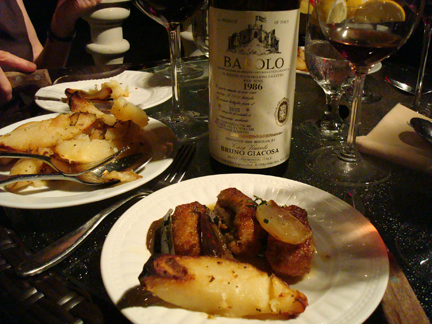
Above: Back in September 2007, Alice, Lawrence, and I shared a wine bottled by Giacosa in a vintage not considered one of the best.

It’s no secret that since Bruno suffered his stroke, his daughter Bruna has been looking for a buyer for the estate. It’s also no secret that last year, Bruna forced Bruno’s long-time protégé Dante Scaglione out of his position. Could it be that internal issues played a role here?

It was irrepsonsible for Ramsdale to make it sound as if Giacosa was patently dismissing the 2006 Langa vintage. When viewed in context, the not-so-breaking news reveals other forces at play.

Ramontalcinos say no to Merlot

Above: They say “no” to Merlot. Federico Marconi (left) handles marketing and Gianni Fabbri is the winemaker at the Fabbri family’s winery, Le Presi, one of my favorite Brunello producers. I tasted with them and snapped these photos at the Italian wine trade fair, Vinitaly, earlier this month.

Don’t get me wrong. I have nothing against Merlot per se. I’ve tasted great Merlot from all over the world — Bordeaux, Trentino, Friuli, Tuscany, California. I can’t say that I’m a fan of most it but that doesn’t mean there’s anything wrong with it.

The problem, as Alice pointed out in her post today, is that Merlot is a grape Zelig: “Why does everyone has to grow merlot? Because it’s a grape Zelig? Merlot, like mint, takes to most places.”

Merlot has been grown in Tuscany for centuries, but it was during the 1980s and 90s that it became increasingly popular there, as the Super Tuscan craze began to emerge and Italy began to sell more wine in the Merlotophile American market. Behind his back (and with an acute dose of disdain), many Italian winemakers call Tuscany’s leading wine wizard “Mr. Merlot” — a distinction bestowed upon him because of the ubiquitous Merlot in his award-winning Chiantis and his alleged use of Merlot in Brunello di Montalcino, where appellation regulations require the wine be made with 100% Sangiovese grapes.

Yesterday, when I wrote “just say no to Merlot,” I was addressing and appealing to producers of Vino Nobile di Montepulciano, who are considering an increase in the amount of international grape varieties allowed in their appellation.

My friend, artist, poet, musician, and marketing director for old school Brunello producer Le Presi, Federico “Ramontalcino” Marconi, had this to say:

    The Fred Man too says No to Merlot! Let’s defend a precious little thing called “heritage”… Why are they so short-sighted and unable to recall the nasty backlash of last year’s “Brunello-gate”? I don’t get it: what does these people have against a Good Ol’ Sangiovese!? And let me tell ya: I am a Sangiovese “fan to the bone”. Gabba Gabba Hey!

Above: Federico created this “Old School” t-shirt to reflect Le Presi’s traditional approach to winemaking. Even though the winemaker and his team are young, the wines are as old school as it gets — natural fermentation and aging in botti, large old, neutral oak barrels. Wolfgang was the first to post on this great marketing idea.

When I met Federico and we became friends, we decided we would start a band called the Ramontalcinos (we owe the name to Josh Loving of Vino Vino fame, an accomplished classical guitar player, who will also be part of the act).

I wish more Italian winemakers could be like Federico and Gianni: they marry a punk rock sensibility with a respect and passion for their heritage. They are wise to see that they can better market their wines not by changing their nature but rather by infusing their image and perception of their brand with youthful energy and verve.

Gabba gabba hey.

Ringo says no to Merlot, too. Check out this clip of Ringo singing the “No No Song” with the Smothers Brothers. The best part is the gag at the end (with Ben Einstein)!

A guilty pleasure: Quintarelli 1998 Valpolicella

There was one day during my stay in Verona for Vinitaly when I managed to escape the prison walls of the fairgrounds and enjoy a stroll down the main street of a small Italian town, eat a sandwich, have something refreshing at a the counter of a bar, and chat with the owner of a fantastic charcuterie and wine shop, Francesco Bonomo (above).

The town was San Martino Buon Albergo (on the old road that leads from Verona to Vicenza). Alfonso Cevola (above) and I stopped there for a brief but much-needed hour of humanity on an otherwise inhumane week of too much travel and too many wines. That’s Alfonso munching on a panino stuffed with Prosciutto di Praga, baked and smoked ham (that we bought at the first food shop we visited).

One of the more interesting bottles displayed on Francesco’s shelves was this bottle of 1973 Barolo by Damilano. Now just a collector’s bottle, its shoulder was pretty low and Francesco agreed that the wine is surely sherryized. Francesco let me photograph the bottle using my phone (I didn’t have my camera with me) but he was careful not to disturb the bottle’s patina of dust, of which he was particularly proud.

I wish I could have taken a better photo of this wines-by-the-glass list at the little bar on the main square of San Martino: Cartizze, Verduzzo (sparkling), Soave, Fragolino, Bardolino, and Valpolicella by the glass? All under 2 Euros? The answer is YES!

Francesco presides over a modest but impressively local collection of fine wine, including an allocation of 1998 Valpolicella by Giuseppe Quintarelli, the gem of his collection. I rarely bring wine back from Italy these days but the price on this wine was too good to pass by.

However coveted and mystified in the U.S., Quintarelli is one of the most misunderstood Italian wines on this side of the Atlantic, in part because its importer is one of the most reviled purveyors in the country (his infamously elitist, classist, snobbish, monopolistic, extortionist attitude are sufficient ideological grounds for not consuming the wine here).

I’ve interviewed Giuseppe Quintarelli on a number of occasions by phone and his daughter Silvana is always so nice when I call (and, btw, they happily receive visitors for tasting and purchase of their wines). I love the wines and was thrilled to get to taste this 10-year-old Valpolicella with Tracie B on Saturday night: she made wonderful stewed pork with tomatoes and porcini mushrooms for pairing (with a side of mashed potatoes). The wine’s initial raisined notes blew off quickly, giving way to a powerful, rich expression of Valpolicella. I tasted the wine repeatedly in 2004-2005 and I was impressed by how its flavors and aromas has become even more intense.

Francesco was so proud of his Quintarelli. He told me that he sells it at just a few Euros over cost because he just wants to have it in the store and wants to be able to share it with his customers. It was great to bring back a little Valpolicella to Austin and my Tracie B, direct from the source and sourced from someone who understands it for what it really is.

Post script

Alfonso gave me this nifty “wine skin” to transport the bottle back stateside. It seals tidily, so even if the bottle breaks in your suitcase, you don’t risk leakage. Happily the bottle made it back intact.

In the olden days, you used to be able to take bottles on the plane and you even used to be able to bring your own wine for drinking. Alice developed this system for smuggling natural wine on to the plane (happily, no Cavit Merlot for her!).

Bite your tongue, Dorothy

tongueMy Google Reader overflows with feeds these days. It’s hard to keep up with them all and I regret that it took me a few days to catch up to Alice’s post on Dorothy J. Gaiter and John Brecher’s article “A Waning Affair with Barolo”. In their piece, the wife-and-husband team priggishly express their disappointment with the 2004 vintage of Barolo. (I read The New York Times daily. It’s my tie to the Big Apple. And I dogmatically avoid The Wall Street Journal — required reading for the rich, a manifesto and manual for capitalist subjugation of the proletariat. As a result, I was unaware of the piece.)

They say they set out to find 50 bottles under $70 so it’s not clear how many they actually tasted. But their unwarranted, superfluous, and supercilious take on the 2004 vintage is decidedly negative. The wines, they write, “really just weren’t that impressive. You can’t imagine our shock and disappointment. Flight after flight left us cold. They weren’t bad. They were pleasant enough. But with wine after wine, we used a word that should never be used to describe Barolo: simple.” Pleasant enough? Simple?

In another one of her excellent posts wherein she continues her struggle (la lotta continua) to defend the world from Parkerization (and here I take her concept of Parkerization as it relates to the arrogant, chauvinist attitude that his followers — more so than he — exude), Alice rightly laments: “I have a hard time when writers smack down vintage. In this case, especially as they really don’t seem to be experienced when interpreting young vintages, it seems irresponsible.”

It is more than irresponsible. In fact, it’s reprehensible.

When you taste a great wine (like Barolo) in its youth from a great vintage (and it certainly will prove to be an excellent vintage, if not a great one), you don’t look for greatness in the wine. You look for the potential for greatness in the wine. Beyond its tannic structure (dominant in this phase of the wine’s evolution), you look for the presence of defects. In their absence, you can begin to assess the wine’s potential for development. You also ask growers and winemakers what they think of the vintage (they know better than any) and you do your homework by reading your colleagues’s assessment of a given wine.

I looked up Franco’s post on a tasting of 57 bottlings of 2004 Barolo in September 2007 with Roy Richards, Nicolas Belfrage, David Berry Green, and Stuart George. (Dorothy and John, if you don’t know who these guys are, please add them to your reading list. They seem to know something about Italian wine.) According to Franco, Barolo 2004 was “classic vintage.” He noted that “2004 seems to be a great vintage and there are many wines worth buying and cellaring — with all likelihood, wines that will get greater over the years… [In 2004], Nebbiolo triumphed with its elegance and its singularity… One thing is certain, 2004 Barolo is a great wine and it deserves our attention, our trust, and the consensus of all lovers of great wine. In English, you would call these wines fine wines: they are elegant, refined, complex, and nothing less.”

Arrogance, hubris, chauvinism, superciliousness, ignorance, disinformation: these are words come to mind as I ponder Dorothy and John’s irresponsible and reprehensible journalism. Once again, the haughty American attitude shows its ugly head. Once again, American wine writers haven’t considered the most important elements in any wine: the people who made it and the place where they live and work. Bite your tongues, Dorothy and John.

Memories of Baldo Cappellano

Above: Teobaldo Cappellano in his cellar (photo courtesy of Polaner).

I met Teobaldo Cappellano on a number of occasions and enjoyed his wines immensely. He was a staunch, vocal defender of traditional winemaking and his Barolo was aged in large, old-oak casks. He fought tirelessly against the homogenization and over-commercialization of wine and was a steadfast opponent of the use of international grape varieties in Italian wine. His uncle, a pharmacist, was the creator Barolo Chinato, and Cappellano’s chinato was widely considered the best. It was a treat to get to taste with him over the last few years at Vini Veri and I felt honored to report on his contribution to the Brunello Debate in October 2008. If you speak Italian (and even if you don’t), I encourage you to watch the archived stream of the debate at Franco’s blog (just visit the blog and you’ll find it embedded to the right). His cadenced authority is matched only by his emboldened passion.

In his post today at Vocativo, Luigi Metropoli reminded us of Baldo’s motto: io evolvo all’indietro, “I evolve backwards.”

The world of wine has lost one of its great rabbis — if not the greatest.

Today, the blogosphere is flooded with tributes and memories of Baldo, as he was known. I’ve collected and translated some passages below.

The world of wine — and not just Piedmontese wine and not just the Barolo and Langa community (which he represented with authority) — is in mourning today for the sudden and cruel passing of Teobaldo Cappellano. He was a tireless activist and an advocate of lost causes — causes even more worthy for the very fact they were lost — because when you know that you have no chance to prevail, defending your beliefs is even more righteous.
—Franco Ziliani, Vino al Vino

Langa and the entire world of Italian wine are orphans today. Everything will be more complicated now that destiny has shown us high noon.
—Marco Arturi, Porthos

One of those gentle giants, long and weedy, he is winemaker, jokester, philosopher.
—Alice Feiring

The last of the Mohicans.
—Gigi Padovani

Barolo has died.
—Consumazione obbligatoria

Someone like Baldo Cappellano cannot die.
—Divino Scrivere

He was a winemaker philosopher.
—acquablog

One night in Paris with Alice

Above: Alice F and Tracie B, two of my favorite ladies, and I went natural-winebar-hopping the other night in Paris.

If you ever get a chance to go natural-winebar-hopping in Paris — where many believe the winebar concept and the natural winebar were born — with the leading lady of natural wine writing, Alice Feiring, go for it. In perhaps the only city on earth where the maître d’s are ruder than the hosts at Babbo or Sparks Steakhouse, Alice your-table-is-waiting-right-this-way Feiring, Tracie B, and I ended up at Racines in the picturesque Passage des Panoramas at the end of the night a few weeks ago while we were in town for gigs with NN+.

Above: The first wine we drank at Racines was this entirely stinky, cloudy, dirty, oxidized Chenin Blanc by winemaker Eric Callcut, who calls it “The Picrate,” which I imagine is a reference to the picric acid. I imagine that picrate tastes like saltpeter since it is used in explosives but I didn’t get a gunpowdery note on this wine. Thoughts?

Between her popular blog Appellation Feiring and her wine-memoir/manifesto The Battle for Wine and Love or How I Saved the World from Parkerization, there is no denying that Alice is one of the wine writing world’s boldface names — whether you agree with her radical positions or you find yourself diametrically opposed to them (there’s really no middle ground with her, which is something we all love about her). But in Paris, she is considered a primissima donna and Tracie B and I were thrilled to be her companions: the toast of the Parisian natural wine circuit seemed to bow before her as if in audience with the queen.

Above: The charismatic owner, Pierre, already enjoyed quite a following even before Food & Wine called Racines “Paris’s hottest winebar.”

As it turns out, owner Pierre Jancou’s family is from Modena, where I taught for a summer many, many moons ago for U.C.L.A. When we discovered our Emilian connection, he insisted that we taste Donato Camilli Lambrusco, which was fantastic — bright with acidity but light in the mouth. Even though we savored the minerality in every last drop of the Chenin Blanc (The Picrate, above), we agreed that the Lambrusco was the wine of the night. (Franco, I know… I know… I’m the only dude who drinks Lambrusco in Paris. That’s HOW much I love Italian wine!)

Pierre is not the only one at his restaurant that speaks Italian with an Emilian accent. His charcuterie speaks Emilian dialect, too, and the lardo melted sumptuously in the mouth, with the natural fruit of the Lambrusco slicing through its liquid fat like a serrated ravioli cutter on a Sunday morning. I ate blood pudding (below) and beets as my main course (just to keep things light). Tracie B and Alice split the sole, which was also excellent if pricey.

Above: The artisanal and natural qualities of Pierre’s food really stood out in the blood pudding and beets. His radically natural ingredients brought a balance and lightness to a dish you would otherwise expect to be gut-splittingly heavy. I ate every last morsel.

For someone who once performed “One Night in Paris” at the Paris Paris nightclub in Paris (yes, it’s true), this was one night in Paris that I will never forget.

Natural Lambrusco in Paris (and late for sound check)

lambrusco

We’re on our way to sound check (and I’m running late, as usual) and I can’t wait to post about recent enogastronomic adventures. Last night, Tracie B, Alice, and I did drink this fantastic natural Lambrusco by Camillo Donati with Pierre at Racine.

Ok… gotta run… more later… stay tuned!