
So good to be home with my beautiful girls… they’re so sweet to me…

So good to be home with my beautiful girls… they’re so sweet to me…
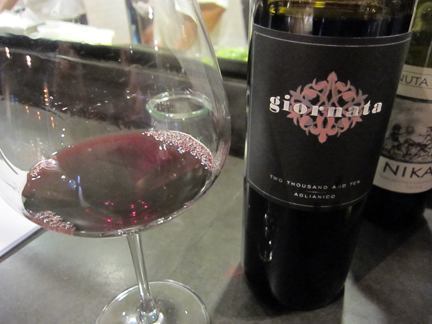
In 2008, when I attended the Unified Wine & Grape Symposium to hear my friend (and a man who has greatly inspired and informed my career) Darrell Corti deliver the keynote address at the meeting of the California Association of Winegrape Growers, he suggested that Aglianico could be an alternative to California’s ubiquitous Cabernet Sauvignon, noting that the Italian grape variety was better suited to California’s climate. (Here are my notes from his talk; I’ve written a lot about Darrell Corti here but this is my favorite post devoted to him.)
Darrell’s talk came to mind yesterday when sales rep and true wine connoisseur Tom Hunter of Revel Wines opened a bottle of Aglianico by the Giornata winery in Paso Robles.
In my view, the legacy of Cabernet Sauvignon and Chardonnay in California is the result of an epochal misunderstanding — a ripple of an “anxiety of influence,” to borrow a phrase from Bloom. A generation ago, when rich white men planted these grapes in Napa, they did so inspired by the wines that rich white men on the other side of the Atlantic drank and not with a mind to propagate varieties suited for the Napa Valley climate, topography, and subsoils.
Cabernet Sauvignon shows well in the cool climate of Bordeaux. Chardonnay is its most expressive in the cool climate of the Côte de Beaune.
Anyone who’s every visited Burgundy or Bordeaux will find little in common with the terroir of the Napa Valley floor, where these French grapes have been grown and vinified so famously for the last forty years.
In more recent memory, Central Coast growers have been inspired by the renaissance of Italian wines. I’ve tasted Nebbiolo, Barbera, Sangiovese, and even Teroldego grown there. And while the wines are sometimes good (and the intentions of the winemakers genuine), their efforts — in my view — are as misguided as those rich white men who came a generation before them.
I can’t conceal that I was skeptical when Tom pulled the Paso Robles Aglianico from his bag but my colleague Rory (with whom I co-curate the wine program at Sotto) and I were blown away by how good the wine was. And unlike the myriad bottlings of Barbera and Nebbiolo that seem to lose their varietal character in the California soil and sunshine, Giornata’s Aglianico tasted like Aglianico, delivering those dark fruit and earthy notes that I love in wines from Vulture, Taurasi, Taburno, and Cilento.
I loved the wine and I’m thrilled that we’re going to be pouring it by the glass at Sotto.
Posting from the plane on my way back to the Groover’s Paradise. Can’t wait to wrap these arms around those girls of mine! :)
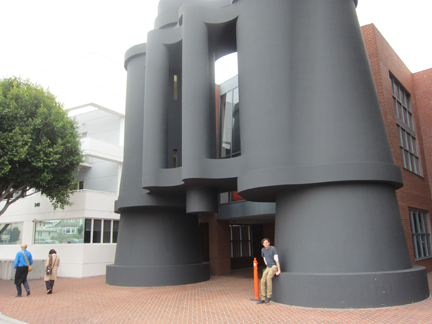
The new Google HQ in Venice. Funny thing is that those binoculars where already there… been there as long as I can remember from my UCLA days…
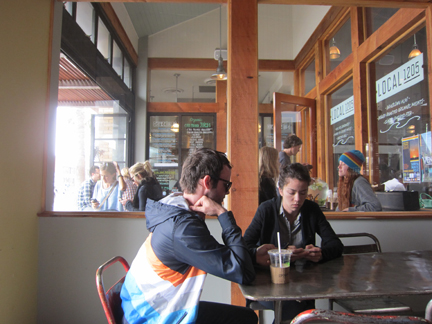
Met one of my oldest and best friends from La Jolla days Irwin at the Local 1205 on Abbot Kinney, fellow La Jollan Craig’s new market and eatery.
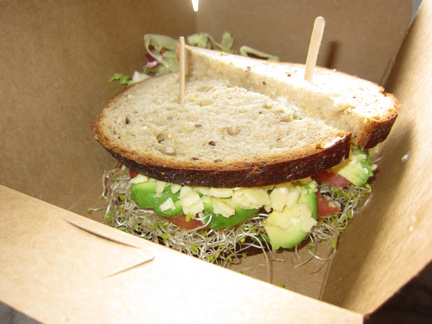
We had “La Jollans,” inspired by a little health food grocery from way back in the day on the corner of Nautilus and La Jolla Blvd. None of us can remember the name of the shop but we remember the avocados and the sprouts on the whole grain.
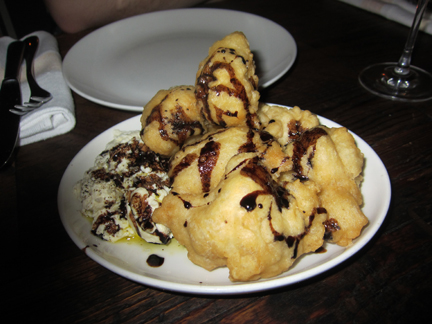
Had to start with the pittule (Pugliese fritters with vincotto and ricotta), paired with Donkey & Goat Sluicebox (pronounced PEE-too-leh, btw).
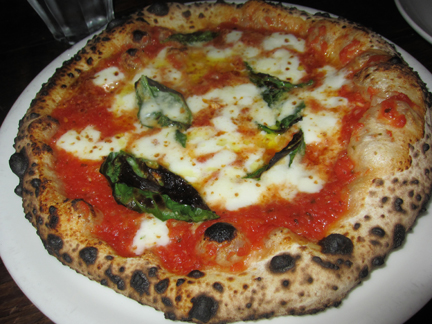
All things considered, I still think that pizzaiolo and chef Zach makes one of the best — if not the best — authentic Margherita in the U.S.
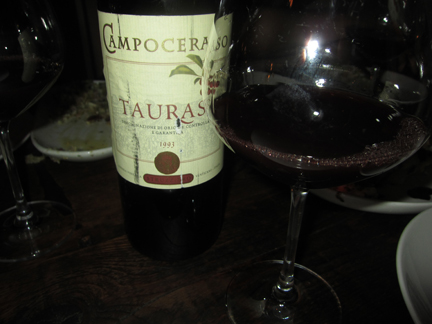
To celebrate the birthday of my good friend (and agent who just scored us the NN+ HBO Girls license) Michael, we opened a bottle of 1993 Struzziero Taurasi Campoceraso — unbelievable.
93 was a classic, balanced (as opposed to americana) vintage in Taurasi and is considered one of the greatest of the decade.
I was blown away by the bright acidity and brilliant fruit in this wine, tempered by the characteristic minerality and earthiness of botte-aged Aglianico. (The most hilarious tweet today, btw, by @JohnQBoxler: “I like big botti and i cannot lie.”)
Pizza and old Taurasi? Blasphemous!
Charles Sciolone would approve, no doubt.
From the department of “dreams do come true”…
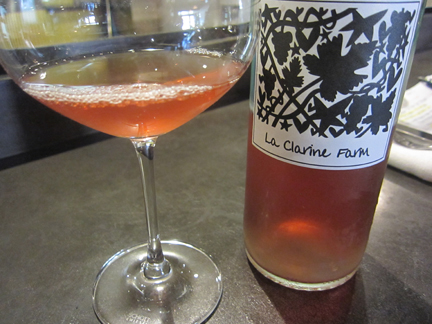
Thanks to the coolest lady on the Los Angeles wine scene, Amy Atwood, of the 90 or so cases produced, we were able to score enough of Hank Beckmeyer’s off-the-charts good La Clarine Farm rosè for a by-the-glass campaign at Sotto (to be launched shortly).
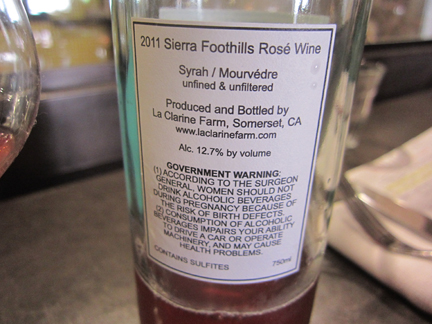
Think: a judicious schmear of qunce jam and lightly salted crème fraîche on gently toasted crusty bread. I cannot wait for Tracie P to taste this wine. It’s salty and crunchy and utterly satisfying.
Domaine LA is the best retail outlet for Hank’s wines in the Southland and I was able to secure some for Do Bianchi Wine Selections (my wine club) for later this spring.
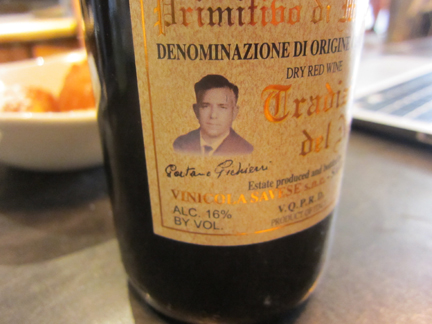
Primitivo di Manduria Tradizione del Nonno by Pichierri, such a classic. Not for everyone but one of my favs at Sotto where I’m working the floor tonight and tomorrow night.
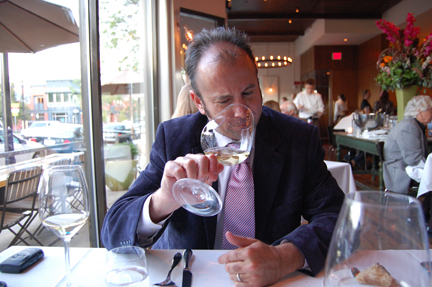
On an early flight to Los Angeleeeees… carrying a couple of wine keys…
See you tonight and tomorrow night at Sotto…

Unfortunately, I’ve got to leave Austin again tomorrow for a few days. But it sure has been nice to be in one place for a while.
Most early evenings, I tune out around 5 p.m. and play guitar and sing for Georgia P until she’s ready for her bath. All she has to do is look at me and another love song just seems to flow from my finger tips. She’s such an inspiration and such a joy for us…
It was great to see the response yesterday to a new entry in the Italian Grape Name & Appellation Project. Thanks to everyone for all the retweets!
Since I’ll be heading to Los Angeles later this week to work the floor at Sotto (where I curate the wine list) on Thursday and Friday nights, I also wanted to post this entry (above) on Taurasi by one of my favorite producers, Struzziero.
Struzziero is old-school Taurasi all the way and we’ve featured a vertical of the wines — 92, 97, 01 — on our list since we first were able to secure an allocation last year.
I love the wines…
And I couldn’t resist making this “outtake” video of my “shoot” with Mario Struzziero at Vinitaly.
With true campano style, he added a short gloss using a word that has a particular meaning in Italian: peripezia or peripeteia (“In classical tragedy [and hence in other forms of drama, fiction, etc.]: a point in the plot at which a sudden reversal occurs. In extended use: a sudden or dramatic change; a crisis,” Oxford English Dictionary). It’s an ancient Greek word that is still used regularly in Italian today, especially in Rome and southward. In workaday language, it means simply mishaps or vicissitudes. But in this case, his usage has layered meanings… It’s one of the things I love about Italy and Italian language…
And I love his family’s wines…
From the department of “ubi major minor cessat”…

Eric the Red writes today on the virtues of pairing pizza and, ahem, Champagne…
Bolly is one of his top picks.
Umm, where have I heard that before?

Our good friend Charles Scicolone (above) – with whom we have shared many a pizza and great wine — also gets a nice shout out in Eric’s piece…

