
“le sexe et la politique”, the new Nous Non Plus album is almost here…
Stay tuned… it will be available soon…

“le sexe et la politique”, the new Nous Non Plus album is almost here…
Stay tuned… it will be available soon…

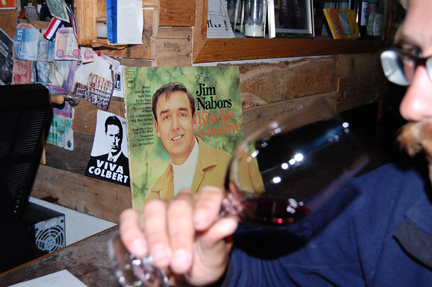
Tracie P and I will never forget the first time we visited Terroir Natural Wine Bar and Merchant on Folsom in San Francisco in May 2009. We watched on as then co-owner Guilhaume Gerard, wielding an aluminum baseball bat (conveniently stowed above the bar for ready access) chased a homeless man out the door and down the street after the man attempted to steal a bottle of wine. Unflustered, Guilhaume soon returned and put the bottle back into a display case and picked up our conversation where we left off.
Terroir has seen its ups and downs since its heyday in 2009 but it’s still there and I thank goodness for it: it’s the one place that I make sure to visit every time I’m in San Francisco (since I travel there more often than not to play with Nous Non Plus, it’s tough to make time for a proper dinner but I can always find a moment for a glass of something natty).
Saturday evening, the last I spent in SF, I went to Terroir accompanied by good friend Billy and Zanotto for a celebratory lap (following our well received Col Fondo tour).
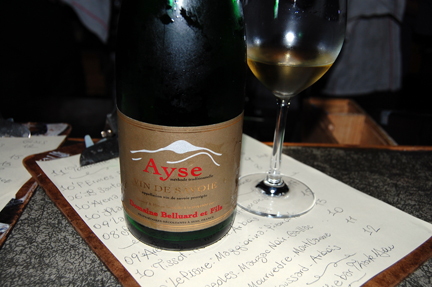
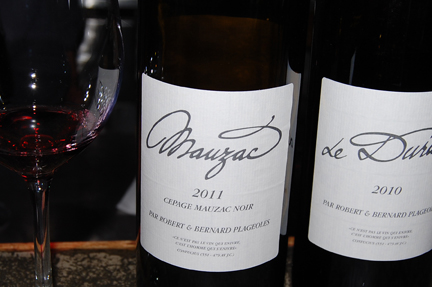
Owner Luc Ertoran poured us some great wines, including the sparkling Vin de Savoie, above, and the Mauzac and Duras by Plageoles from Gaillac.
The wines, conversation, and company were awesome and I really dig the free spirit of Terroir, where you never know whom you’re going to meet and what you’re going to taste at midnight on Saturday on the gritty side of SF.

But the thing I love the most about Terroir is how Luc — or whoever is manning the bar — always has something by the glass that will surprise and thrill me.
This gig may not be for everyone but it sure does it for me…
In other news…
A lot of folks have been quoting Matt Kramer’s recent post on “the big lie of wine democracy.” Ha! If you, like me, are laughing heartily at the thought of a byline by Wine Spectator’s Kramer with such an outrageously self-referential title, please come sit at my table and I’ll pour you some Pampanuto Bianco!
With all due respect to the many writers who are quoting him and drawing inspiration from his muzak, I think it’s worth pointing out that Kramer works for the very same military industrial complex that propagates that very same semiosis…
Wine for thought for this last weekend before Tracie P, Georgia P, and I head to Italy for our 2012 harvest trip…
Thanks for reading and buon weekend yall!
A shot of Pinot Grigio and harvest notes, just in from our good friend Giampaolo Venica. (The click through to his Twitter is worth it, btw, just for the profile pic.)

Ciao Jeremy,
This is the first image from our 2012 harvest.
Very challenging vintage in Friuli Venezia Giulia: what they call the Sahara high-pressure hump kept us without water from months. Only old vineyards could handle this dryness while most of the younger vines suffered deeply. We managed to provide a minimum water supply but of course it is not possible everywhere is not possible and in some places the creeks have also stopped flowing.
Driving through Colli and Collio Orientali, where hills make emergency irrigation difficult, you can see yellow leaves on vines that recall autumn despite the 35°.
Indeed here we are with a good quality of grapes, balanced sugar and acid levels and a minus 20% of crop.
All of us are waiting for the Sunday announced storm that hopefully will bring relief to the region.
Un abbraccio
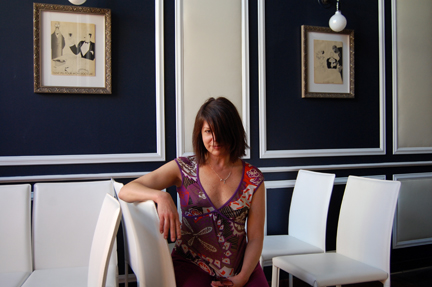
Thank goodness for the amazing Ceri Smith (above), owner of one of my favorite wine shops in the world, Biondivino in San Francisco, and soon-to-be proprietor of Et Al., a “wine salon” around the corner from her (literally) wonderful store.
Goodness because her wines are so thoughtfully chosen and reflect an aesthetic that so many of us embrace and aspire to; goodness because her store and her soon-to-be-opened wine salon are friendly havens and refuge for those fleeing the Babylon of America’s consumerist hegemony; and goodness because she is one of only a handful of American wineshop owners who have remained true to their mission of sharing unadulterated passion for wine (while others are trying to be “as big as U.S. steel” and “are opening soon in Vegas and Hong Kong”).
In this series of posts devoted to my trip to the Bay Area (Eric Lecours in Redwood City; Shelley Lindgren at A16 SF; and David Lynch at St. Vincent SF), I’ve tried to feature the superb and impeccable professionalism of the restaurateurs and wine professionals who populate our nation’s leading food and wine community (stay tuned for the last post tomorrow, btw, on the food and wine punk rock scene in SF).
Ceri is the embodiment of that unwavering commitment to excellence, that unflagging collegiality, and that unflinching spirit.
As we sat and chatted in the space that is to become her new “wine salon” dubbed Et Al. (above), we talked about her Annie Liebovitz-inspired campaign to combat the Italian government’s campaign to censor the expression “natural wine” (she plans to ask Alice Feiring and Lou Amdur to pose nude with a sign reading, “I drink wines naturally”); we traded notes on our favorite bottlings of Aglianico; and she told me she will be serving Georgian wines by the glass in traditional earthenware cups in her new wine salon.
Beyond the work ethic and the sensibility, the thing that unites all of professionals I’ve profiled in recent days is their unbridled curiosity. And I can’t think of any wineshop in the U.S. where boundless inquisitiveness and commercial success align so seamlessly. The thing that impresses me so much about Ceri and her shop and her new restaurant is how she has managed to expand her business in a time of financial challenges and restraint, all the while staying true to her mission, her passion, and her personal interests. Thank goodness for that.
Ceri will ship nearly anywhere in the U.S. When the weather cools down (and allows for wine shipping), give her a budget to work with and let her know what you like/need to drink. Every year, Tracie P and I get a mixed case from her and we’re always thrilled and informed by her selections. You won’t be disappointed.
one… moment in her presence and you can forget the rest…


Above: I grabbed this recently snapped photo of ripe Pinot Grigio — a red, not white, grape — from my friend Ale’s blog.
When my editor at the Houston Press forwarded me a press release announcing the release of Drew Barrymore’s Pinot Grigio, it was time to act…
Here’s my post on our Pinot Grigio Nation.
I’ll see you at the Olive Garden where I’ll be dining on “the never ending pasta bowl,” topped with Ragù pasta sauce and a slice of Kraft “parmesan,” paired with my favorite brand of mayonnaise soda (I will buy a glass of wine for anyone who can tell me what Lou Reed song I’m referring to here).
Thanks for reading. I’m as hung over as hell and I’m not going to take it anymore!
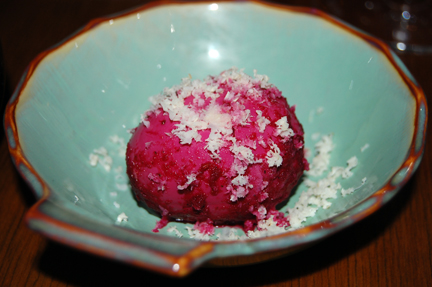
Our meal at the amazing St. Vincent in San Francisco — conceived and directed by Daedalian sommelier and wine writer David Lynch — began with two eggs: one bathed in beet and horseradish, the other in curry and turmeric. If only for their Technicolor, I knew that I wouldn’t be disappointed by the food and wine that would follow.

Had I the means, I would gather all the young wine and restaurant professionals in the U.S. and take them to San Francisco to see how it is superbly done by David Lynch, one of the leading sommeliers in the nation right now (as always), veteran of some of the most storied venues in the contemporary history of American restaurateurship.
Granted, David knows me and my palate, and so when I asked him to pick out a wine for us, I wasn’t surprised when he swiftly delivered the Clos du Papillon Savennières above, “not as extreme” as our beloved Joly, he noted, but no less nuanced or thrilling (and perhaps more graceful and focused).
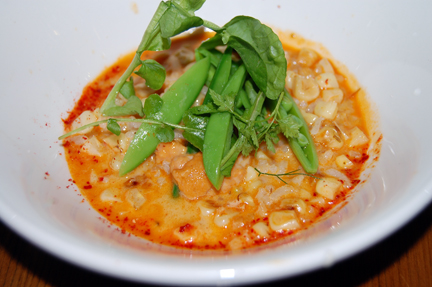
I was equally impressed by the deft hand of chef Bill Niles, to whom David graciously attributed sole authorship of the menu. The “She Crab” (actually lobster in the current season) was adorned with a dollop of sea urchin liver, Carolina rice, and corn chowder. I ate every last drop.
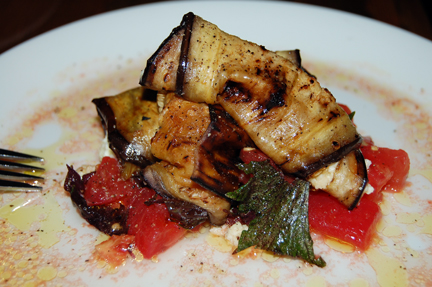
The eggplant roulades, alone, would be worth a return trip. I loved that chef Niles peels his tomatoes for this dish and I’d be remiss in not noting that this was possibly the best tomato I’ve tasted all year.
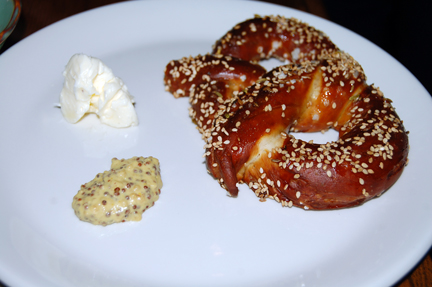
Chef Niles may draw from a Technicolor palette of culinary experiences and techniques but he also seems to love some of life’s simplest “street-food” pleasures, like this classic pretzel. I dug the juxtaposition of the elegance of his eggplant and the sheer pedestrian delight of the pretzel.

David named his new restaurant (opened just a few months ago) after St. Vincent of Saragossa, one of the patron saints of grape-growers, often invoked by wine- and vinegar-makers.
(Of course, I couldn’t help myself from reading up on why St. Vincent is considered patron of wine and vinegar.)
He is often depicted (St. Vincent, not David) with vines or grape bunches. Although there’s no element in hagiography that would associate him with grapes or grape-growing, his feast day, January 22, is celebrated in wine-growing France as the beginning of the vegetative cycle.
There are a number of French sayings uttered on that day, like quand Saint Vincent est beau, abondance pour le tonneau (when [the weather on] Saint Vincent is fair, there will be [an] abundance [of wine] for the casks).
Like so many examples of pseudo-Catholic folklore, his association with wine is purely arbitrary and can be attributed to the date of his commemoration (in the Greek Orthodox Church, he is remembered on November 11).
There’s nothing arbitrary about the way David runs his new restaurant and it was fantastic to watch him in his habitat (as the Italians say), greeting a guest, explaining a menu item, and serving a Savennières to a very happy wine blogger…
Image via La Chouette.
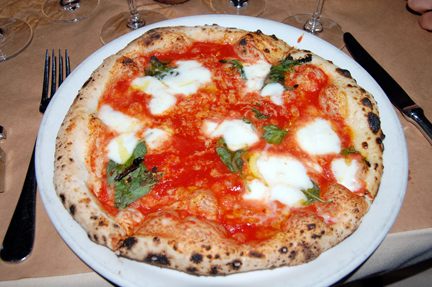
Above: A16 was opened in 2004 and continues to stand apart even after eight years on the cutting edge. On Saturday night, with the restaurant packed to the gills, the margherita pizza — a litmus test for any Italian restaurant — was exceptional.
One of the things that impressed me the most about my trip to San Francisco last week was the complete and utter across the board professionalism of the food and wine professionals I met with.
Even though you’ll find some of the greatest expressions of American and pseudo-European gastronomy in New York and Los Angeles, there is no U.S. city — in my view — that can rival the confluence of world-class service and informed, intelligent, and thrilling wine and food that you find in San Francisco.
When I visited A16 on Saturday night, I was greeted at the door by wine director and owner Shelley Lindgren, who was holding a tray with three spritzers on it.
In the bustle of this high-profile restaurant at 8 p.m. on a Saturday night, a guest proceeded to brush by her, knocking the tray to the floor and the cherry-red spritzers all over Shelley’s white pants. Without missing a beat, Shelley looked up and smiled at the guest, who was mortified. She told her, “o please don’t worry about it! It’s no problem at all! Please enjoy your dinner.”
There are many reasons why A16 continues to pack them in every night. And this is just one of them.
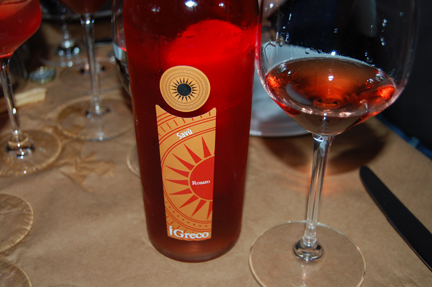
Above: I was so geeked to taste this rosé from Gaglioppo, a wine that I’d been reading about all summer on Shelley’s Facebook. Friggin’ delicious… and a perfect pairing with my pizza.
I owe so much to Shelley. When she opened A16 back in 2004, she was the first wine director in the U.S. to offer her guests an exclusively southern Italian wine list. At that time, no one thought it could be done. Naysayers would ask: what are you going to do about white wine? what about sparkling wine? where are you going to source all the wine you need? and what about wines for your reserve list?
A lot has changed since then. There is a lot more southern Italian wine available in the U.S. today and more and more producers of fine wines from regions like Campania and Basilicata and Calabria are finding their way to the U.S. market.
But there’s no doubt in my mind that Shelley’s work has had a lot to do with this new wave of southern Italian wine in Italy. And there’s no doubt in my mind that her legacy made it possible for me to create my dream list at Sotto in Los Angeles.
“You know,” I said to her jokingly when she visited our table, “one of the reasons why I’m here is so that I can poach wines from your list.”
“That’s what it’s here for,” she told me, “that’s what it’s all about.”
Chapeau bas, Shelley. In my book, you are a model of food and wine professionalism.
Stay tuned: David Lynch’s new St. Vincent is on deck for tomorrow…
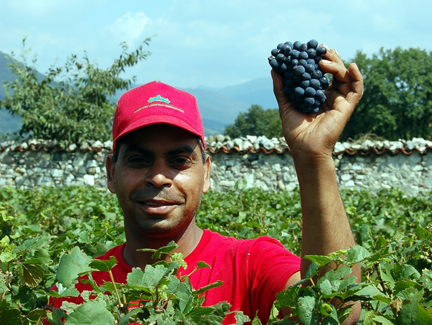
As Tracie P and I prepare for our fall trip to Italy, we’re watching harvest reports carefully.
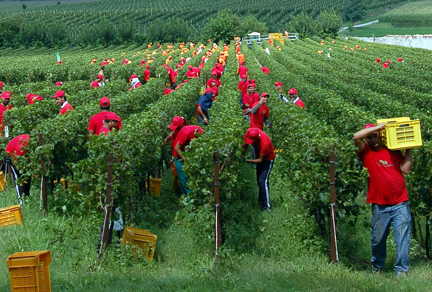
Today, my friends at Berlucchi sent me these photos, snapped on August 8, the day they began picking.
It’s been a summer of prolonged high temperatures and rainfall has been scarce. In appellations where emergency irrigation is not allowed, growers will be facing some tough decisions in coming weeks.
I’m eager to talk to winemakers and to hear their thoughts.
We don’t leave for another few weeks and in the meantime, I’m just glad to be getting back to Austin for some family time after a week of working the California market with Zanotto. :)
So much to tell about my trip to San Francisco, all the cool folks I hung with, and the meals we shared… stay tuned!

