Nüsserhof Blatterle was such a wonderful surprise at Il Buco Alimentari e Vineria

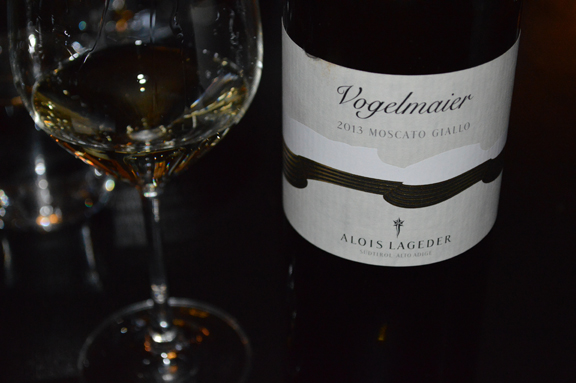
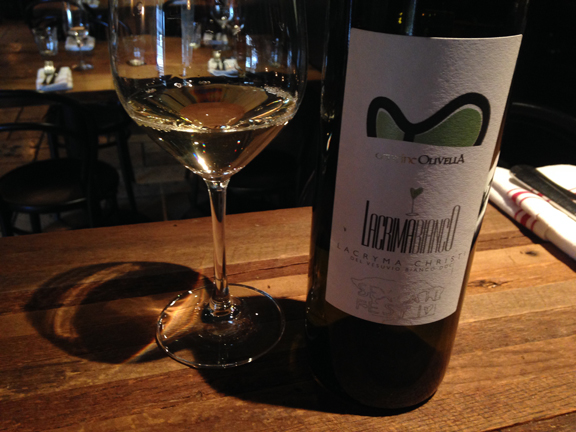
nusserhof BlatterleWhen we sat down for dinner last night at Il Buco Alimentari e Vineria in lower Manhattan, there was no debate over which white wine to start off with: the Nüsserhof B[latterle], made from the rare Blatterle grape in German-speaking South Tyrol.

Honestly, I’d never heard of the variety before and was entirely geeked to try it. I loved its low alcohol (at around 12 percent), freshness, and its easy-going spearmint note on the nose. It was a fantastic wine to go with the charcuterie, pickled beets, and lettuces that came out first from the kitchen.

Italian wine is a never-ending mosaic of grape varieties, styles, tastes, peoples, and places. And this wine was just the umpteenth reason that it never gets boring.

1985 rinaldi tasting notesFor our second bottle, my friend Jamie Wolff, founder and owner of Chambers St. Wines, the current “best wine shop in the world” (vis-à-vis JancisRobinson.com), generously treated us to a stunning 1985 Barolo by Giuseppe Rinaldi (corkage).

Man, this bottle sang in the glass! It had an ethereal balance of savory earth and fruit flavors and although it was still muscular and deliciously chewy in body, its ineffable litheness — a hallmark of the greatest expression of Barolo imho — prevailed in the mouth.

Jamie had double-decanted the wine earlier in the day and its vibrancy left everyone at the table speechless and very happy.

It was so wonderful to see my good friend, Il Buco’s resident wizard, Roberto Paris, who mentored and encouraged me so early on in my career. He is such a lovely man and we couldn’t help but re-stoke the memories of the late nineties and very early aughts before tragedy silenced irony in Manhattan for a time.

All in all, it was a great way to become re-acclimated to my old stomping grounds.

Please stay tuned… More enogastronomic adventures await me in my near future here in NYC…

Sangiovese research breakthrough

best sangiovese tuscany montalcinoAt Bush on my way to NYC today.

But wanted to share a small breakthrough I made in my ongoing Sangiovese research last week.

It’s well known that Baron Bettino Ricasoli grubbed up his vineyards and replanted his Brolio estate (mostly) to Sangiovese in the second half of the nineteenth century.

His decision to embrace and champion Sangiovese as Tuscany’s primary grape variety became a blueprint for the generations of growers and winemakers who followed.

But I’ve been challenged to find ampelographers who describe Tuscan viticulture and the grapes planted there in the decades that followed his move.

Last week, searching and scrolling through Google books, I stumbled across a wonderful survey of Tuscan farming published in 1882 in Florence (Paggi), Tuscan Agriculture: on the state of farming and farmers by Carlo Massimiliano Mazzini.

“It would take too long to list all the grape varieties cultivated in Tuscany,” writes Mazzini. “Their extremely high number represents the principal defect of local viticulture because it prevents [winemakers] from standardizing the types of wine produced there.”

“But in recent years, notable progress has taken shape. In all of the new plantings, the following prized and dependable varieties have come to prevail: Sangioveto, Canaiolo, Mammolo, Trebbiano, and Malvasia. The first three are red, the other two white.”

I posted my notes, along with my original translation of Baron Ricasoli’s famous letter to Cesare Studiati, over at my client La Porta di Vertine’s blog last week.

I hope you find my small discovery as exciting as I did.

Like I said, I’m heading to NYC today for a week of meetings, eating, and drinking. See you on the other side…

Prosecco DOCG just $6.99! Unfair pricing practices undermine small Prosecco growers (& my op-ed for @WineSearcher)

best price value prosecco costcoOn Monday, a colleague and friend in California sent me this image above and the one below.

He snapped it at one of the myriad “big box” stores that dot the landscape of my childhood Southern California.

To some, $6.99 for a bottle of Prosecco DOCG may seem like a great bargain for a high-quality wine.

But to Italian wine trade observers, the notion of an under-$7 Prosecco DOCG reeks of unfair pricing practices.

According to WineSearcher.com, the average retail price of a bottle of Prosecco DOCG from an established bottler in California is around $17. And I can tell you anecdotally that you should be able to find a great bottle of the DOCG there for somewhere between $13-16 — twice the big box price.

costco wine pricesWhen I asked a Prosecco grower and bottler how such a low price could be possible, he told me that the grower and bottler of the big box wine were probably making just cents on the dollar for the wine.

Why would growers and bottlers sell their fruit and their wine at such abominably low prices?

Prosecco DOCG has to be made using hillside-grown fruit from the townships of Valdobbiadene, Conegliano, and Asolo.

Prosecco DOC is made from fruit grown on the valley floors of Treviso province or the entire region of Friuli-Venezia Giulia.

Vineyard management costs for hillside growing areas are higher than those for the valley floors. And that’s one of the reasons, although not the only one, that Prosecco DOCG costs more than DOC.

But because consumers seem to make no distinction between the higher-quality DOCG and the DOC, sales of Prosecco DOCG are being eclipsed by the cheaper and lower-quality DOC. As a result, many smaller and mid-tier DOCG growers are sometimes forced to sell off their fruit at bargain-basement pricing.

It’s a problem that plagues other DOCGs as well, including Franciacorta, Brunello di Montalcino, and even Barolo.

But in Proseccoland, where the Prosecco boom shows no sign of slowing, its impact is acutely felt by smaller growers who see their livelihoods being undercut by big business and big box Prosecco.

And the unsustainability of this tenuous situation (read Marxist notion of boom and bust), is exactly what I wrote about yesterday in my op-ed for WineSearcher.

Thanks for reading…

A man who helped make Prosecco an international phenomenon and the challenges he faces

primo francoAbove: in late 2014, legacy Prosecco producer Primo Franco celebrated thirty years since he took over at his family’s winery, Nino Franco.

“The Italians are a victim of their own success,” said British Prosecco bottler Daniel Spinath in an interview published today by Harpers. “And they have created this problem for themselves. Prosecco has become the generic word to talk about sparkling wine which is not a bad thing for the producers or for the industry.”

He was referring to the fact that many of his customers in England sell his keg-packaged wine as “Prosecco” even though EU law forbids them from doing so.

According to the Prosecco DOCG, which was created in 2009, only wines sold in glass bottles can be marketed as “Prosecco.”

And while Spinath doesn’t label the wine as “Prosecco,” he contends that he cannot stop pub and restaurant owners from presenting it as such. Currently, oustide Italy, Prosecco growers and bottlers have no recourse when it comes to “on premise” marketing as it is called in the trade. They can sue bottlers and packagers of Prosecco but they do not have a means to stop restaurateurs from marketing the wines as Prosecco.

prosecco vintage tastingAbove: some of the Veneto’s leading winemakers and a number of marquee-name wine writers came out to pay tribute to Primo and taste a vertical of his wines stretching back thirty years.

The bottom line: Prosecco has become bigger than Prosecco. Like Xerox for photocopies or Kleenex for tissue paper, it has become an antonomasia for sparkling wine throughout the world.

Fifteen years ago, were you to hand a layperson a glass of Prosecco at a cocktail party, she/he would often respond by saying, “Champagne! How great!”

Today, when you hand someone a glass of Champagne, it’s not uncommon to hear them say, “Prosecco! I love Prosecco!”

Harpers isn’t the only media outlet talking about the mislabeling of keg-packaged Prosecco.

See yesterday’s post by Alfonso. It was prompted by a BBC interview he did on Sunday morning. The subject was the “illegal” sale of on-tap sparkling Glera that has been labeled as Prosecco.

By his estimation, Prosecco sales were up by 50 percent in 2014 in the U.S. with respect to the previous year.

I’ve read reports that claim Prosecco sales are up by as much as 70 percent in Britain.

best prosecco tastingAbove: it was impressive to see how Primo’s wines have aged over the last three decades. They were surprisingly fresh and only showed slight signs of oxidation.

Reading Alfonso’s post yesterday and the article today in Harpers, I couldn’t help but think of a wonderful evening I spent on a chilly night in Valdobbiadene in October of last year with Primo Franco and his family, owners of the Nino Franco winery.

Primo is a friend and I had the great fortune to be invited to his fabu party celebrating his thirty years making wine for his family’s label.

Leading Italian winemakers where there (Anselmi and Maculan among them). Top English-language wine writers were there (Steven Spurrier from Britain, wow!, and Alan Tardy, an American who lives in Italy).

They were all their to pay homage for “brand” he created. As more than one wine luminary noted, Prosecco was one of the appellations that helped to reshape English-speakers’ perception of Italian wines in the 80s and 90s.

Thirty years ago, Primo wasn’t alone in his quest to make Prosecco a popular wine in English-speaking countries. But he was one of a small group of bottlers who packed their bags and headed across the ocean to teach Anglophones about Prosecco’s wonderful freshness, food-friendliness, and versatility at the dinner table.

As one young, über hip Prosecco grower once said to me, “every Prosecco producer should give Primo ten cents for every bottle sold.”

But when it comes to Daniel Spinath’s claim that Italians are victims of their own success, I call bull-shit.

The Prosecchisti are victims of the unbridled greed of unscrupulous bottlers, packagers, and marketers like Spinath, who prefer to shrug their shoulders when it comes to sourcing, pricing, and marketing their products.

And honest Prosecco growers and négociants are penalized by the fact that the Prosecco DOCG Consortium has done virtually nothing to protect their brand by promoting education for trade and consumer awareness.

Primo is one of the most respected people in the Italian wine trade and he is truly one of the loveliest as well. A soul of great learning and humanity and one of the men who turned the world on to the delightful wine that they grow in the hills of Valdobbiadene, Conegliano, and Asolo.

I am proud to call myself his friend and I am his unabashed fan. But I know that he faces an uphill battle in defending his family’s legacy and the Prosecco that he and I both love so much.

Charlie Hebdo wine labels: goûtez la différence!

charlie hebdo wine labelsHonestly, I’m still reeling from the news of last week’s tragedy in Paris, a city to which I feel a strong connection because of my many visits there, the times I’ve performed there with my French-language band Nous Non Plus, and my many friends who live there.

The attacks affect all of us, no matter where we stand. They cut to the core of our ethos — whether eastern or western — and they surely represent a turning point in how the west will view and deal with the growing threat of terror.

As a Jew, I’m also deeply troubled by the anti-semitic nature of the super market massacre and by the fact that the French government has been obliged to mobilize its armed forces to protect Jewish sites. Yes, sadly and tragically, it’s come to this.

But this morning I was struck by a delightful however bittersweet note of levity as I scrolled the morning feed and discovered a wonderful post devoted to wine labels drawn by Charlie Hebdo contributors on Intravino, the popular Italian wine blog.

Intravino editor Antonio Tomacelli has put together a digital collection of hilarious and often bawdy labels, many culled from Professeur Choron’s journal Hara-Kiri.

All five of the vignettists who perished last week, he notes, had also drawn wine labels.

Here’s the link to Antonio’s fabulous post.

Tomorrow, I’ll pick it up here on Do Bianchi once again.

À bientôt

Solidarity with our sisters and brothers in France: vive la France! et vive l’ironie!

paris in winterYesterday’s vicious attack at the offices of Charlie Hebdo resonates and reverberates far beyond Paris, where the very notions of free speech and freedom for all people were enshrined during the great Age of Enlightenment.

As we have read the coverage from Europe, including reports of Italy’s heightened sense of vulnerability, I can’t help but thinks about one of the journalistic trends that emerged during the months that followed the Tragedy of the Twin Towers in New York in 2001.

“Is irony dead?” asked many writers and critical theorists at the time.

In the wake of what happened yesterday in Paris, it’s more important than ever for us to embrace irony.

The despicable men who committed this atrocity are so convinced of their misguided, evil beliefs that they — quite literally — held no quarter for irony and the satirical medium employed by the editors of Charlie Hebdo. And where and when irony were to be eliminated, there would be only totalitarianism.

Without irony and without negation (as the critical theorists would call it), there can be no truth because truth cannot exist in the hermetically sealed world of totalitarianism. And that’s what the attackers want more than anything.

I can’t think of more urgent moment than now to shout at the top of my lungs, vive l’ironie! and vive la France!

To our French sisters and brothers, know that we stand with you!

The photo above was taken in February 2009 when Tracie P and I visited the City of Lights for a tour with my band Nous Non Plus.

Faced with civil disobedience threat, Italian agriculture ministry issues new labeling guidelines

fivi federation italian grape growers independentAbove: the Italian Federation of Independent Grape Growers technical advisory board, including president Matilde Poggi (top row, third from left). Their t-shirts feature a quote from the song “Absolutely Sweet Marie” by Bob Dylan, “to live outside the law, you must be honest.”

On December 31, 2014, the Italian agriculture ministry issued new guidelines for the use of geographic mentions in wine industry labeling and marketing materials. The so-called “clarification” came in response to a threat of civil disobedience by the Italian Federation of Independent Grape Growers (FIVI). The group had called for its members to employ illegal labeling and marketing practices if the ministry did not act to address their grievance with restrictive EU norms.

“It is now possible,” according to a FIVI press release, “to use the name of a province or a region in labeling and marketing materials even when the name is registered as a DOCG, DOC, or IGT.”

In 2014, an Italian winemaker had been fined by government officials for using a geographical mention in marketing materials. The winery, a producer of Barolo, had used the place name “Langhe” in promotional media.

According to the Italian ministry’s interpretation of EU norms, even though the winery is located in Langhe (the Langhe hills of Piedmont), he was not entitled to use the geographic mention because it is the homonym of an appellation name (Langhe as in “Langhe Nebbiolo,” for example).

Many were bewildered by the seemingly absurdist application of EU law.

See this post for background on the controversy.

A number of prominent Italian wine trade members and observers had spoken out about the issue. And in November, FIVI called on its members to engage in civil disobedience if the ministry did not act by the end of the year.

In the FIVI statement, the group’s president Matilde Poggi expressed her satisfaction with the ministry’s new guidelines, calling it “an important step toward simplification and common sense.”

(My) 10 Tips for New Year’s Eve Fizz

barone pizzini rosato franciacorta bestHoly Crap… New Year’s 2015 marks four years that I’ve been posting about wine on Eating Our Words, the Houston Press food and restaurant blog.

The Houston Press is the Bayou City’s weekly rag, akin to the Village Voice and the LA Weekly (it’s owned by the Voice media group).

The blog has had its ups and downs since I moved to Texas. But I’ve really cherished the freedom to post about workaday wine matters that matter to me.

My blog, Do Bianchi, is mostly about our lives and the role that Italian wine and food play in it. So it’s been great to write about the world of wine beyond Italy on Eating Our Words.

And it’s been rewarding to focus on the challenges and thrills of drinking well in a still underserved market where a growing band of ambitious and courageous wine professionals are trying to reshape the Texas wine scene.

People seem to enjoy it and I’ve enjoyed the writing.

As I sat down to rehash the perennial rules-of-thumb for sparkling wine, I realized that the best advice that I could ever give is that the wine is only as good as the persons with whom you share it. I’ve tasted so many incredible wines this year but as I look back on 2014, I remember that the best ones where always with the people whom I care about most.

Please click here to check out my 10 Tips for New Year’s Eve Bubbles.

Thank you to everyone who’s been there and here in 2014. It’s been a year full of light and darkness, high highs and low lows. But there’s always been something interesting to share, an undiscovered wine newly arrived, or an previously unknown grape newly delivered. I really appreciate your being here. It truly means the world to me.

Happy New Year to all! I hope you taste something great tomorrow night and I wish you all good things for a healthy and happy 2015!