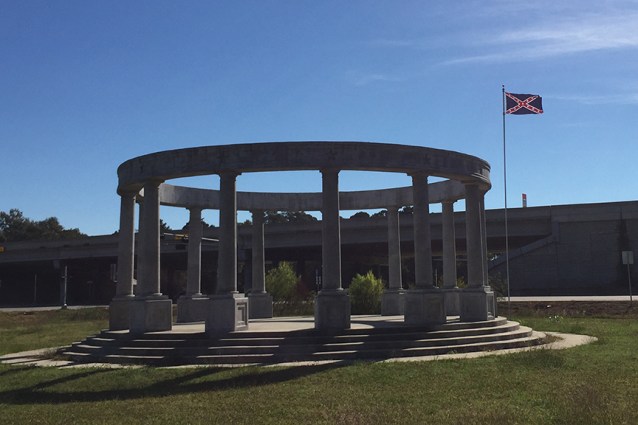
 Last night, someone texted me asking about the Los Angeles Times article “As monuments to the Confederacy are removed from public squares, new ones are quietly being erected,” which was published yesterday in the paper and appears today on the homepage of its website.
As the title reveals, the piece examines communities in the U.S. where new Confederate monuments are currently being erected, even as the controversy over the removal of memorials — mostly from the 1910s and 1920s — continues to rivet the nation.
The centerpiece of the story is the Confederate Memorial of the Wind in Orange Texas, where my wife Tracie grew up and where most of her family still resides. Over the nearly nine years that I’ve lived in Texas, I’ve visited Orange countless times. I took the above photo of the memorial in November of last year, not long after the presidential election.
Anecdotally, I can tell you that most Orange residents (at least among those I interact with) just shrug about it when asked. When I’ve brought it up, nearly everyone concedes that it’s an unfortunate eyesore. But everyone I’ve talked to points out that there’s nothing that can be done about it because it sits on private land. I’ve never met anyone in Orange who has spoken out against it publicly or done anything to have it removed.
The men behind the memorial claim that it’s a homage to their heritage as descendants of Confederate soldiers. I don’t know any of them personally but they have spoken with a number of media outlets (including, and even before, the Times coverage).
Their narrative may be partly genuine. But after nine years in Texas and nearly 10 months into the Trump presidency, I can tell you that these men know exactly what they are doing. They know full well the fear that their memorial instills in the blacks, Mexicans, Asians, Jews (like me), and Middle Easterners that live or pass through Orange. As the author of the article points out, the memorial is “visible from the interstate and loom[s] over Martin Luther King Jr. Drive.” What she doesn’t note is the fact that a church stands just down the road from it.
The overwhelming majority of people who live in Orange are self-defined Christian conservatives. Regardless of denomination, churches in the South have had a far-reaching legacy of complacency when it comes to the intimidation of minorities through the display of symbols, icons, language, and gestures. The Confederate flag is the most recognizable of these but there are many others. I used to ascribe it to ignorance. But with the advent of Trump, I’ve come to realize that it’s not stupidity. In fact, the people who live there are not stupid at all. The majority of residents in Orange have embraced Trump despite his lack of Christian values — from his assaults on women to his abusive attitude toward people who aren’t white.
With his claims that there plenty of “nice people” among the champions of Confederate memorials, Trump has laid to bare not just their complacence but their willful acceptance of a segregationist ideology whose advocates use hateful symbols to intimidate and stoke fear. The residents of Orange can ruefully shrug and say there’s nothing they can do about it. But in Trump America, it’s now painfully and tragically obvious that their interests align with the authors of the memorial.
Today, too many conversations there start with “I’m not a racist but…” or “I have no problem with the Jews but…” It simply doesn’t matter to them that blacks may have a problem with the memorial or that Jews may have a problem with the memorial. Why should it? That’s not what’s important — at least to them — in Trump America. But then again, Christ and His teachings were swiftly tossed aside by those who support Trump. The common good (as espoused by Christ’s disciples, at least in the Book I’ve read) is trumped by the good that the president is doing for our country (at least for the white people in our country). Trump supporters can’t claim ignorance anymore. They know exactly what they are doing.
The deep-seated racism that thrives there is on the rise again, just like the flags being flown over Interstate 10. And evidently, the Christians who live there are okay with that.
In fairness to the residents of Orange, I have to point out that the author of the Times piece was wrong to mock, however subtly, the city’s motto — “Small town charm, world class culture.” As hard as some may find it believe, there is world-class culture there. The Stark family campus of museum collections and botanical gardens are wonderful cultural resources. When I worked as a bibliographer at the Getty Museum (nearly two decades before I met Tracie), I catalogued scores and scores of photographs of painted Medieval and Renaissance painted books that are conserved in the museum there.
I wonder if I might bump into the authors of the Confederate Memorial of the Wind the next time I visit. Wouldn’t that be something?

 “The tortelloni, stuffed with the traditional mixture of ricotta and chard,” wrote LA Times food critic in his review of Rossoblu, “could illustrate the concept of Italian dumplings in a textbook.” I took the above photo last week when I was at the restaurant to lead a vertical tasting of Nebbiolo stretching back to 1996.
 Burgundy may be my mistress.
 Last night I led a tasting of seven of my favorite expressions of Nebbiolo for 24 guests at
  My top wine of the night was the 98 (classic) Barbaresco, which we paired with the first white truffles of the season to arrive in LA (they were literally flown in the day before). What a flight of wines, what a dinner, and what at night!
 It was fascinating to sit down and chat yesterday with Oscar Arrivabene (above) in Los Angeles where he was pouring Domenico Clerico wines with the estate’s new California importer.
 Image via
  Please join me and my band The Go Aways for a set of Americana rock and country on Sunday, October 29 at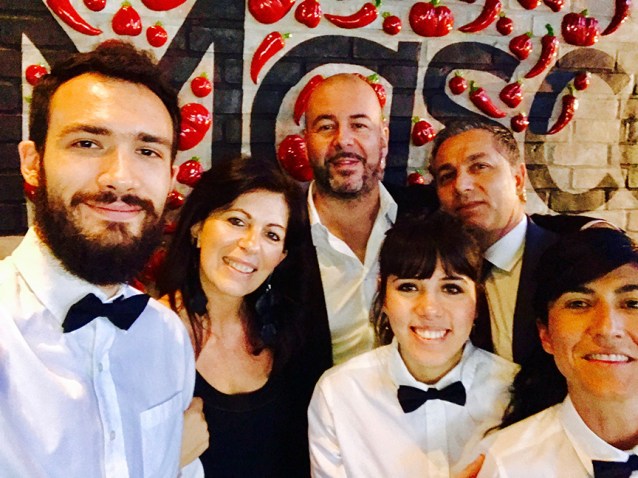
 Images via
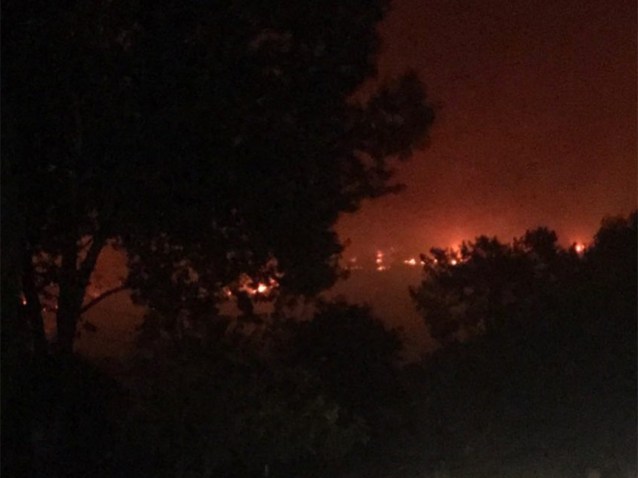 The image above comes from the
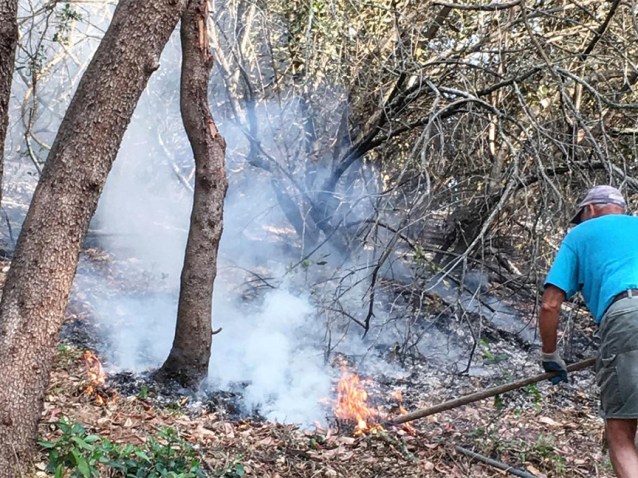
 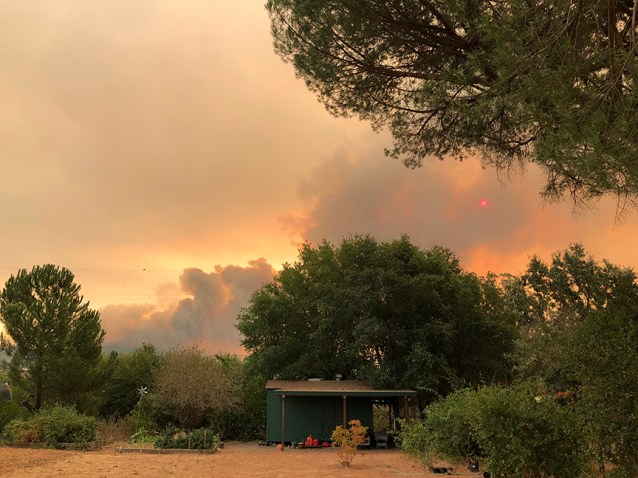 The North Coast of California was hit last night by a rash of wildfires. Most of the fires were sparked by gusting winds taking down trees hitting above-ground power lines. Fires spread quickly with one of the largest, the Tubbs Fire in Santa Rosa, spreading to over 25,000 acres in a matter of hours. The Tubbs Fire has burned portions of the northern part of the city of Santa Rosa and forced the evacuation of two area hospitals and thousands of people…
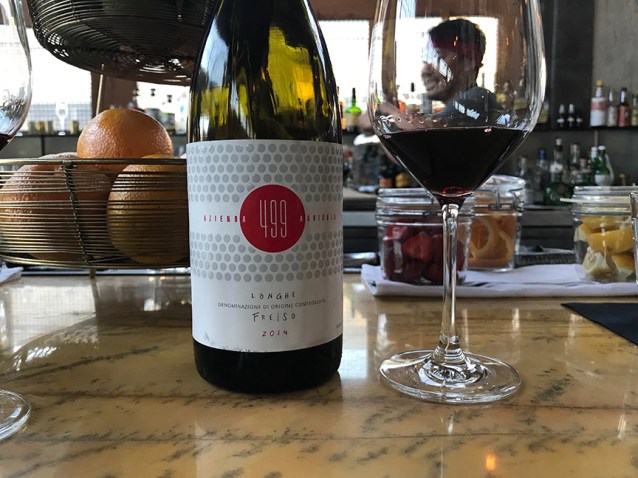 Scrolling through
