Rock out with me, Tracie, and the girls this Sunday, December 29 at 13 Celsius wine bar

That’s one of my favorite photos from back in the day. Tracie and I had just met for the first time the month before (following a six-month e-mance). But I was in East Germany playing a gig with my band Nous Non Plus at a European Green Party retreat (no shit).

Dany Le Rouge (yes, Dany himself!) was dancing with a beautiful girl dressed in red in the audience at that show.

The year was 2008 and things were finally looking up after an annus horribilis in New York the previous year (well, honestly, looking back on it all, it wasn’t so bad, except for the financial crisis).

We had just sold a song to the TV show Girls on HBO and one of the producers featured us on his playlist (that was huge!).

And this beautiful woman from Austin, Texas had just come into my life — changing it forever and for better.

Today, nearly 12 years later, I’m a dude in his 50s who plays 70s and 80s covers at funky downtown natural wine bars. Who would have thunk it?

This Sunday, our band BioDyanmic (I know, right?) will be playing two sets at one of my favorite wine hangs, 13 Celsius (which is actually in midtown, equally funky).

AND… the amazing Thomas Cokinos will be sharing lead vox duties with me. He is not only a super talented player but a super frontman frontperson. Really great.

Click here for the details but all you really need to know is that we will take the stage around 1 p.m. and that me, Tra, and the girls (yes, it’s kid-friendly) will be hanging out afterwards to see the other bands and to enjoy some great wine (at discounted prices; they do this crazy “Sunday Situation” discount program there). The small plates are also excellent (the girls love the charcuterie).

I hope you can join us to end 2019 in bellezza as they say in Italian.

U.S. 100% tariffs will decimate the Italian wine industry (including people you love)

Above: empty picking crates waiting to be filled with grapes at harvest.

No two people could be more diametrically opposed in their sentiments and approaches to Italian wine than Ceri Smith, one of our nation’s leading wine retailers and tastemakers, and James Suckling, one of our nation’s leading wine critics and tastemakers.

But this week, the unlikely pair sent messages to their supporters in which their views seamlessly aligned: in urgent tones, both are asking their followers to register their dismay at the thought of 100 percent tariffs on Italian wines and other European agro products currently being considered by the Trump administration.

Read Ceri’s here (on Facebook) and James’ here.

“Proposed higher tariffs on expanded list of European wines could devastate business, say importers and retailers,” according to a piece published earlier this week by the popular wine trade-focused blog SevenFifty.

Michael Skurnik, a leading importer of Italian wines in the U.S., was quoted in the article: “If enacted, these tariffs could have the effect of essentially crippling the importation and sale of European wine in the U.S. This would mean a devastating loss of revenues, jobs, and taxes to many sectors of the U.S. economy.”

Trade wars like this are nothing new to the U.S. nor the global economy. Few in the wine industry are old enough to remember the Banana Wars of the 1990s. During that decade, the U.S. “imposed a retaliatory range of 100 per cent import duties on European products, encompassing everything from Scottish cashmere to French cheese” (the Guardian).

At the time, the U.S. was retaliating for an EU quota on bananas grown in Latin America but sold by north American companies. Today, the U.S. is retaliating for Airbus subsidies illegally doled out to European interests and for a proposed European “digital service tax.”

What do bananas have to do with cashmere and cheese? What do wine and cheese have to do with airplanes and online advertising? That’s how trade wars work.

Earlier this week, I spoke to one of the top sales agents in California for the largest distributor of fine wines and spirits in the U.S. Even his Trump-supporter colleagues share his fear that said tariffs would decimate their business, not to mention many of their suppliers’ and clients’ businesses. He told me that even his boss, an avid “Trumper,” recognized that many of his employees would have to be dismissed if the tariffs were implemented.

Think of your average Italian restaurant in the U.S., he said, where the wine programs are designed around Italian wines that land at “by the glass” prices. The industry rule of thumb calls for wines by-the-glass to be sold at the same price as the wholesale cost of the of the bottle. An $8-9 by-the-glass wine would now cost $16-18.

Would you pay $18 for a glass of Sangiovese that cost $9 the previous day?

The reasoning is oversimplified here for sake of argument but you get the picture.

According to some estimates, 70 percent of the wine grown in Italy is shipped to the U.S. In many cases, Italian wineries sell nearly 100 percent of their products to the U.S. If the Trump administration implements the tariffs, the entire industry would be disrupted — from top to bottom. The people in the middle would devastated as well (including me and my marketing consulting business).

Ceri and James included the following links where Americans can send messages to their representatives in congress and the U.S. Trade Representative to stop these tariffs from taking effect.

To your senators (via the National Association of Wine Retailers):
https://account.votility.com/enterprise/NAWR/ec/697

To your congressperson (via the National Association of Wine Retailers):
https://account.votility.com/enterprise/NAWR/ec/698

To the United States Trade Representative:
https://www.regulations.gov/comment?D=USTR-2019-0003-2518


If you love Italian wine and the people who grow, make, and sell it, I encourage you to join Ceri, James, and me in taking action.

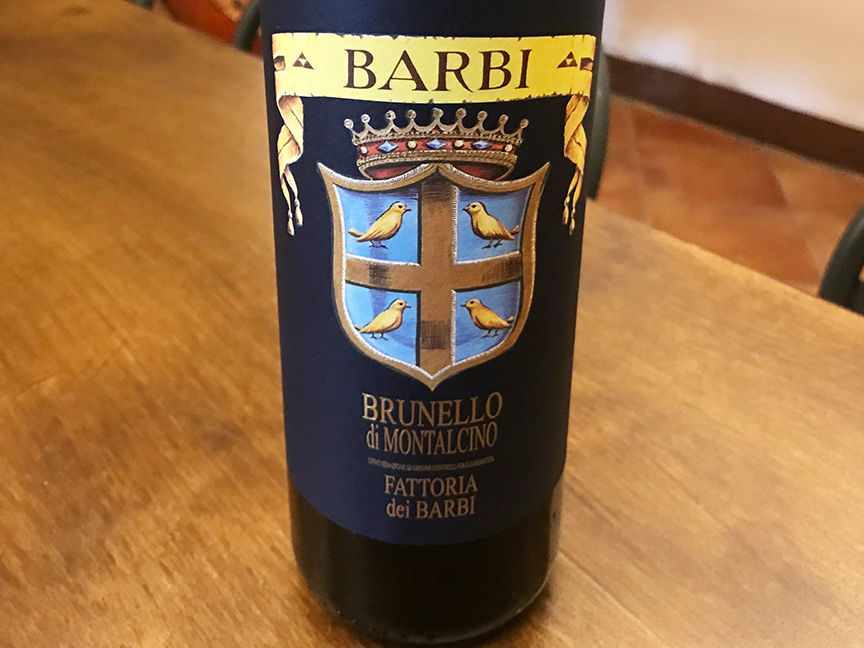
Please stop calling my Brunello “normale”!

Above: the classic “blue label” Brunello di Montalcino from Fattoria dei Barbi. There’s nothing “normale” about it (full disclosure: I consult with Fattoria dei Barbi on media and marketing strategy).

    normal, adj. and n. Constituting or conforming to a type or standard; regular, usual, typical; ordinary, conventional. (The usual sense.)
    Etymology: < classical Latin normālis right-angled, in post-classical Latin also conforming to or governed by a rule (4th–5th cent.) < norma norma n. + -ālis -al suffix.
    Oxford English Dictionary

Let’s just get this straight for once and for all: there’s nothing normale about Brunello di Montalcino.

Nor is there anything normale about Barolo or Barbaresco.

Ever since Italian wine began “trending” in the U.S. in the late 1990s, wine professionals have been faced with a linguistic conundrum: if the “single-vineyard” or “reserve” bottling of a given wine is considered to be superior in both quality and value, what do you call the “blended” or non-designate wine?

Unfortunately, many American tradespeople adopted the practice of calling the latter categories “normal” or — or even more regrettably, using an erroneous and misguided cultural (mis)appropriation from the Italian — “normale.”

There are two major issues with this convention.

Above: the single-vineyard designate Brunello di Montalcino “Vigna del Fiore” from Fattoria dei Barbi.

The first is that normal means, quite literally, conventional or ordinary, as in doesn’t stand out in a crowd.

Brunello, like its northern counterparts Barolo and Barbaresco, are not “conventional” or “ordinary” wines. In fact, they are illustrious, exceptional wines, even when not accompanied by a cru or aging designation.

The second issue is that historically, the Italians who make them consider the blended wines to be the more expressive and reflective of the appellation where they are produced.

The same holds for the “riserva” or “reserve” designation. It’s not that it’s a better wine from better fruit. A riserva wine is a wine that was conceived, through vineyard selection and vinification techniques, for longer-term aging.

Many Americans will be surprised to learn that the cru-designate trend in Italian wine is relatively recent. And in many cases, the single-vineyard designation was added to appeal to American consumers who assume that the single-vineyard expression is superior de facto. The same could be said of vintage-designate wines in Champagne where the non-vintage, vintage-blended wines are considered (by the people who grow them) the more indicative of the domaine’s style and tradition.

Calling a classic Brunello (or Barolo or Barbaresco) “normale” is demeaning not only to the wine but also the winemaker and the people who live, work, and grow grapes in the appellation of origin. And it also creates confusion for the consumer.

And that’s why I encourage my wine trade fellows to call wines blended from more than one vineyard “classic.”

Whether classic, cru-designate, or reserve, these categories are simply different expressions of the appellation and the winery’s style. When it comes to the top wines for which we use them, there’s nothing normale about them.

On a mission from G-d: when a winery isn’t just a winery but a vital cultural institution and resource

Full disclosure: I consult with Antica Casa Scarpa on media and marketing strategy.

Last month, I spent the better part of a week “working the market,” as we say in the wine trade, with my friend and colleague Riikka Sukula, director of operations for Antica Casa Scarpa — or Scarpa as it’s known — in Monferrato.

Market work entails visiting current or prospective clients (known as “accounts”) accompanied by a locally based distributor and/or agent for the winery’s importer. It’s sometimes called a “ride-with” or “work-with.” And it can be as fun and exhilarating as it can be disappointing and monotonous.

As Riikka (above) and I made our way from wine shop to wine shop, restaurant to restaurant, to taste and chat with wine buyers, wine directors, and sommeliers, I had a light-bulb moment as I listened to her deliver her spiel about the winery and the wines.

Yes, Scarpa is a winery, a commercial enterprise, and the purpose and objective of our ride-with was to convince people to buy the wine.

But Scarpa is so much more than just a winery that merely grows, vinifies, and sells wines: as one of Italy’s oldest continuously running estates, it’s a genuine cultural institution and resource, a part of what the Italians like to call their “cultural patrimony” or heritage. Riikka and her colleagues, some of whom were my students at the Slow Food University of Gastronomic Sciences, aren’t just making and selling an agricultural product. They are protecting and giving new life to a cultural icon and benchmark that would otherwise be tragic to lose.
Continue reading

Apply for sponsored trip to Vinitaly. 30+ spots available. Food professionals encouraged to apply.

For more than four years, I’ve worked as a consultant with the Italy-America Chamber of Commerce Texas, located here in Houston. Currently, the Italian government ranks the Texas chamber as the number one chamber in the U.S. and the number five chamber in the world. I’m really proud of the work we do together and I am glad to share the following info here. See you in Verona in 2020!

Held in Verona, Vinitaly is the Italian wine industry’s trade show. It’s the largest and most important gathering of Italian-focused wine professionals each year.

More than 4,400 companies are expected to participate this year. And the organizers expect to present more than 400 events, including tastings and seminars with top producers.

And in recent years, the fair has also included an expansive food component featuring leading producers of cheeses, salumi, olive oils, vinegars, etc.

Click here to learn more about the fair, including travel and accommodation information.

As in years past, the Italy-America Chamber of Commerce Texas has 30+ sponsored spots available for wine and food buyers and professionals, importers, and distributors.

You must be a trade member to apply. Food professionals are also encouraged to submit an application. Anyone based in the U.S. is eligible to apply. 

Click here to receive an application form.

Specogna 2013 Picolit, a truly extraordinary wine we drank at Thanksgiving

One of the things that I’ve loved about living in Texas for the last decade has been how good the food is here.

I’m not talking about the vibrant, überhip food scenes here in Houston and in Austin (the latter, the city where we lived for the first six years of my time here). The food in Houston and Austin is nothing less than amazing and it’s been fantastic to be part of these emerging and now firmly established capitals of U.S. fine dining, food trucks, and gastronomy.

No, what I’m talking about is classic Texas and Louisiana cookery. In Texas in general, and especially here in southeast Texas where Tracie grew up and where we have lived for nearly six years now, people are into food. And they are particularly proud of local and familial food traditions, making for some damn-good eating during the holidays.

So I always set aside some special bottles for our family holiday get-togethers.

This year, it was this truly extraordinary bottle of Specogna 2013 Picolit from the Colli Orientali del Friuli appellation in northeasternmost Italy.

Picolit is a white grape that is used almost exclusively to make a highly coveted dessert wine. Part of the reason why it’s almost always made into a dried-grape wine is that the finicky Picolit vine “aborts” some of its clusters during the vegetative cycle. It literally abandons certain bunches, which never fully form on the plant, and concentrates its vigor into berries that will be markedly rich in aroma and flavor.

Specogna, one of my favorite Friulian growers and winemakers, goes for extreme balance and restraint in their Picolit. This gorgeous wine — beautiful to look at and to taste — clocked in at a lithe 13 percent alcohol. Its vibrant acidity was present and popping on the palate but perfectly balanced. And its layers and layers of flavors were as nuanced as they were persistent in the finish. In many ways the rich finish was the highlight (as you followed it with a bite of pie).

My roommate from my junior year in college in Italy (my first year studying abroad) brought this wine to our home as gift when he came to visit earlier this year. I feel truly fortunate to have such a great friend, bearing such an extraordinary wine! Thanks again, Steve: it was the perfect wine to open at our Thanksgiving meal. What a wine!

Here’s some of what we ate as part of our southeast Texas Thanksgiving this year.

Boudin balls. Crumbled boudin, a rice and pork sausage, breaded and fried (very heavy but man, this is an amazing dish).

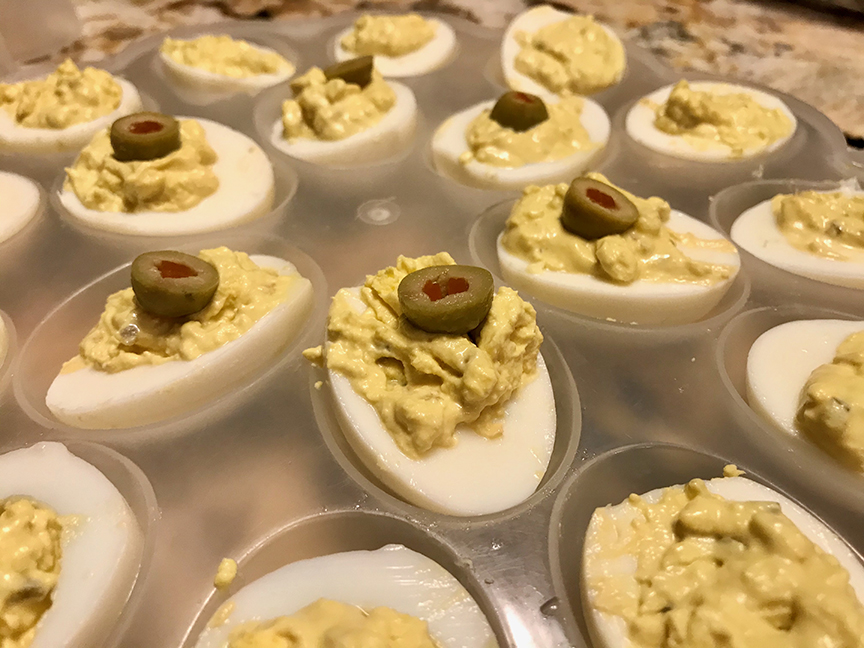
Memaw’s deviled eggs are one of my favorites (memaw means grandma in southeast Texan; Tra’s memaw, Violet Branch, is 98 years old!).
Continue reading

EU officially recognizes Vermouth di Torino designation

According to a report published the Italian national daily La Repubblica, the European Union has recognized “Vermouth di Torino” as an official EU designation.

The announcement of the new designation came last week as the recently formed Consorzio del Vermouth di Torino (the consortium of Vermouth di Torino producers) was holding a festival in Turin (Torino) celebrating the legacy of aromatized wines there.

While the designation had already been approved by the Italian ministry of agriculture in 2017, it has taken two years for the Italian government’s counterparts in Brussels to take this historic and important step.

With the newly approved EU designation, Vermouth di Torino now joins a growing list of countries that have received or requested protected status for aromatized wines. According to the European Commission, these include Nürnberger Glühwein, Thüringer Glühwein, Samoborski bermet, and Vino Naranja del Condado de Huelva.

Click here to continue reading my post today for the Antica Casa Scarpa blog.

If you can’t be with the Pinot Grigio you love, love the Pinot Grigio you’re with (Thanksgiving recommendations 2019)

It’s remarkable to think about how and how much Americans’ perceptions of wine have changed in the last 20 years or so. A generation ago, wine at the Thanksgiving table was mostly an afterthought, if that, even for the privileged among us.

Today we live in an America where “wine is the new golf.” Knowing, appreciating, and consuming fine wine has become part of our social fabric. Professionals (you know, the lawyers and doctors and such) are expected to possess an ever elusive “wine knowledge,” a loosely defined and always liquid (excuse the pun) canon of winespeak and consumption. And even for those who don’t belong to the managerial class, wine has become more accessible and enjoyable (for all the discussion of natural wine and its epistemological implications, we often overlook the fact that it has made wine palatable to a new generation of ready enthusiasts).

That’s not a bad thing. The wine renaissance that has taken shape over the last two decades has manifested itself with many positive ramifications — in production, representation, and consumption.

The new wave of technically superior wines, paired with the heightened interest in wine writing and wine education, has created a truly golden age for wine lovers. And the moneymakers have taken note and followed suit: from the crusty old big shippers to a newly minted army of small importers and distributors, more good wine is making its way coast-to-coast and across the American south and heartland.

The downside of all of this is that our self-imposed enological expectations and pressures often blind us to wine’s true purpose and role in human experience. After all, wine (at least in my view) serves to enhance nutrition, pleasure, and spiritual enlightenment.

(Spiritual enlightenment, you ask? Anyone familiar with wine’s diegetic — not digestive — role in Judeo-Christian tradition is surely aware of its divine association. And those who know the works of American philosopher William James should also recognize how wine — and thoughtful inebriation — can open the mind, so to speak, to a greater state of consciousness.)

And that brings us to the question at hand: even with open minds, the best and the brightest among us seem to be nonplussed by that Holy Grail of wine pairings, the Thanksgiving Feast.

The diversity of the foods and flavors, the congregation of the wine friendly and the wine adverse, the burden of supplying wine to a large and unwieldy group of people who all have wildly different expectations and desires… All of these elements come together to form a puzzle that has no solution, a riddle of the Sphinx for which not even the smartest and most knowing women and men have an answer.

Sadly, the overwhelming pressures and ideals of the new wine culture have prompted us to overthink the perfect pairing.

Perfect pairings are almost never fully predictable. Yes, you can use tradition and experience as a guide. But they only come together thanks to an unforeseeable combination of factors. Opening a bottle of wine and matching it with food always represents a gamble, a wager, a rolling of the enological dice. A glass of Carricante paired with a chilled seafood salad only makes for a prefect pairing when all the elements are right: the wine, the food, and the mood of the people at the table.

And so this year, I would like to propose the following Thanksgiving Feast wine pairing: if you can’t be with the Pinot Grigio you love, love the Pinot Grigio you’re with.

Don’t fret or fluster over the optimal pairing. Don’t spend too much but make sure there’s plenty to drink. Open your favorites but make sure that they’s something for everyone (include a “Chard,” a “Cab,” and a sparkling Moscato for sure). And most important of all, eat and drink and be merry this holiday season.

That’s the secret to enjoying a great Thanksgiving with family, friends, and all the ones you love.

There’s a rose in a fisted glove
And the eagle flies with the dove.

Happy holidays, yall.