Help us raise an MLK billboard overlooking the newly erected Confederate memorial in Orange, Texas where Tracie grew up.

Join our next protest of the newly erected Confederate Memorial of the Wind on MLK Dr. and Interstate 10 in Orange, Texas on MLK Day 2020 (Monday, January 20). Click here for details.

Click here to donate to our billboard campaign. With $400 surplus from our previous campaign and $100 already donated, we need just $500 to make this happen. Please donate now!

Tracie and I are raising money to buy one (1) month of advertising on a billboard that stands across the road from the newly erected Confederate Memorial of the Wind (above), a monument built by the Sons of Confederate Veterans on Martin Luther King, Jr. Dr. in Orange, Texas along Interstate 10.

In observance of Martin Luther King Day (January 20, 2020) and African American History Month (February) , the billboard will look down on the memorial, which (as of this posting) includes the Robert E. Lee battle flag, otherwise known as “the Confederate Flag.”

Artwork for the billboard is being created pro bono by an anonymous designer.

It’s the second year of our billboard campaign. You can see last year’s billboard here.

The City of Orange, the local business community, and even a group of local pastors have asked the Sons member who organized the monument’s construction, Granvel Block, to consider repurposing the site. But he refuses to engage in dialog.

Given the demographics of Orange and the legacy of Jim Crow there, it’s clear that the conspicuous display of the Confederate Flag doesn’t reflect or align with community values. The monument’s prominent location (along a major road that leads into town, just a few freeway stops west of the Louisiana border), makes it highly visible to drivers as they arrive in the state heading west. See the photo below, taken this week by an Orange resident.

(Read a February 2018 Houstonia magazine article on the monument here.)

The content of the billboard will include an appeal to local residents and drivers to ask the Sons to repurpose the site. It will also include a link to a blog I’ve created to document our efforts, RepurposeMemorial.com .

My hope is to have the ad up by the end of next week. And I have already contacted the outdoor advertising company that owns the billboard to get the artwork and ad approved.

Tracie and I have been protesting the memorial since December 2017 and we have no intention of giving up on our cause: to remind the residents of Orange (where Tracie grew up and where her family lives) that it’s socially unacceptable to display images like the Confederate Flag in such a conspicuous location and fashion, with no regard for the values and feelings of the greater community.

We cannot thank you enough for your support. We’ve had so many residents thank us publicly and privately for our protests. We are wholly convinced that we need to speak out on this issue.

Between surplus funds from last year’s campaign and the $100 already donated, we just need $500 to make this happen. Thank you for your support. Please click here to donate.

Please visit and share RepurposeMemorial.com
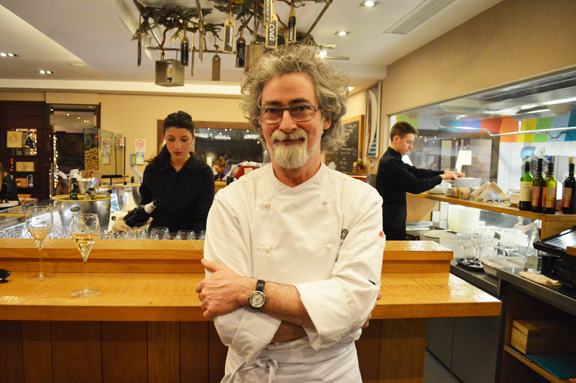
Vittorio Fusari, humanist gastronome and beloved Franciacorta chef, has died at 66

Vittorio Fusari in 2015 at Dispensa Pani e Vini (Bread and Wine Dispensary), his Franciacorta casual and fine dining restaurant and gourmet food and wine shop.

One of Italy’s most beloved chefs, Vittorio Fusari, pioneering gastronome and champion of traditional Italian foodways, has died in Chiari in Brescia Province (Lombardy) not far from Iseo where he was born. According to mainstream media reports, the cause was complications from a heart attack. He was 66 years old.

Fusari began his career in Iseo in 1981 when he opened Il Volto, his first restaurant in Franciacorta, an area known for its sparkling wine production, fresh water fish dishes, and prized beef. Renowned for his deft hand in the kitchen and his imaginative interpretations of classic Lombard recipes, he cooked in some of Lombardy’s most noted restaurants before opening his celebrated Dispensa Pani e Vini (Bread and Wine Dispensary) in 2007, a sort of culinary “campus” where he ran a gourmet food and wine shop, a casual dining bistro, and a fine dining restaurant in Torbiato (Brescia province, also not far from Iseo).

Following the success of his critically acclaimed and wildly popular Dispensa, he shifted his focus to Milan where he became the executive chef at the Michelin-starred Pont de Ferr in the city’s fashionable Navigli (canals) district in 2015.

In one online obituary published yesterday, he is quoted as saying (translation mine): “My work extends beyond the kitchen. My life is devoted to sharing Italy’s ancient gastronomic traditions [with future generations]. Eating well brings people together. It helps them find their shared values. It helps them to be happy.”

In a social media post, composed before his passing, he told his followers: “I haven’t left you. I leave you my recipes and they tell the stories behind my ideas. Copy them and bring them to life as you build a better world through food.”

He is survived by his wife and son.

I had the great fortune to meet Vittorio and dine in his restaurants on numerous occasions. I enjoyed his cooking immensely, as did my wife Tracie and our oldest daughter Georgia who ate at the Dispensa when she was just a toddler. He always insisted that the secret to his cooking was the materia prima, the raw ingredients he selected for his work. And whether it was dried pasta from Puglia, mozzarella from Campania, Prosciutto di Parma from Emilia, or Franciacorta’s famous air-dried “sardines” (actually a fresh water fish, Alosa agone), the foods you found in his shop and restaurants where as wholesome, pure, and authentic as they were delicious.

Vittorio was a humanist gastronome, always bubbling with culinary joy (like his cherished Franciacorta wines), meticulously informed, and contagiously energetic in his work and passion for great cooking. He was tickled by the fact that I brought my pregnant wife to eat in his restaurants and shop at the food counter (she was carrying our youngest). He saw wholesome cooking and eating (as evidenced in the quote above) as a key element in a healthy, happy, and productive life.

Sit tibi terra levis Victor. The sun may come up without you, but the world will never be the same.

“It’s doomsday for everyone.” American wine professionals react to prospect of 100 percent tariffs on EU wines

Above: leading American wine professional Ceri Smith has mounted a campaign urging Americans to write their representatives in Congress and the U.S. Trade Representative asking them not to implement 100 percent tariffs on European wines. See links below.

“Imagine, you are a small importer of French/Italian wines,” writes wine retailer Ceri Smith, owner of the taste-making Biondivino wine shops in the Bay Area.

“You scour the regions to find the wine you want to work with. You develop the relationships with the winemakers. You place the order, pay up front, coordinate the shipment, the back labels, the FDA and all the other government rigmarole, pay all the taxes and duties, load the wine on the container and wait. 30 days while it is in transit. While you wait — the first round of 25% tariffs goes into affect — after your ship left. After you’ve pre-paid close to $200,000 for your container of wine. It lands and gets transferred to warehouse and then, you are told, you have to pay $50k on top of what you already have paid before your wine will be released. How [messed] up is that. Now imagine, if it were 100% tariffs.”

The U.S. Trade Representative (USTR) is currently considering whether or not to impose 100 percent tariffs on European wines — including French, Italian, Spanish, etc.

The deadline for citizens to share their concerns regarding the proposed duties with the USTR is Monday, January 13, 2020.

In its request for comment, it asks U.S. citizens to weigh in as to “whether maintaining or imposing additional duties on specific products of one or more specific EU member states would cause disproportionate economic harm to U.S. interests, including small or medium-size businesses and consumers.”

You can read the USTR “annex II” here, including the request for comment.

Before the New Year’s holiday, I asked a number of U.S. wine professionals to share their (well-founded) fears about the fallout from said tariffs should they be put into place. Here are just some of their responses, including passages culled from their comments submitted to the USTR.

Please join me, Ceri, and all our colleagues below in writing to your representatives in congress and to the USTR (links at the end of this post).

Thank you.

*****

This is so disastrous that the consequences are hard to wrap my head around, but it looks life-threatening. David Lillie and I have spent 18 years building our business, and it could get wiped out in one blow; for better or worse we’ve tied our love of European wine to the life of our shop. We have 25 employees, many with families; we pay their health insurance; we pay a boatload of taxes. Chambers Street Wines is a micro business, but there are many thousands of employees and owners around the country who will be similarly affected — to say nothing of how this will impact our wine loving customers.

Jamie Wolff
Chambers Street Wines (New York)

The proposed tariffs on all European wines will adversely impact not only our little enterprise here in the San Francisco Bay Area, but that of the hundred-plus importers and distributors with whom we work. The various local, American-owned importer companies will be decimated by doubling the price of the wines they offer. Now consider the impact on the people who work for those companies… if sales diminish to near ZERO, sales reps will have to find another means of employment. Now let’s consider the ramifications on the little independent, “Mom & Pop” (Daughter & Son) wineries who rely on a significant percentage of their sales to the U.S. market and you’ll have put thousands (perhaps millions) of people in dire economic straits. Now factor in the myriad of other goods apart from wine on which such tariffs are being considered. Can the world economy sustain such a financial disaster?

Gerald Weisel
Weimax Wine & Spirits (Burlingame)

My 73-year-old business is not being helped by these tariffs, but [they] will cause the slow-down of business which is entwined with imported products. That may cause me to lay off employees due to business decline. It seems that Mr. Trump wants to hand out with one hand and snatch away with the other.

A senior wine trade member (California)

Field Blend Selections employs five people (two partners, one full-time salesperson, and two part-time salespeople). We lease office space in New York City and warehouse space in New Jersey. We utilize various American logistics companies to transport wine across the country and overseas. We contract warehouse services, truck drivers, and delivery people through our warehouse to deliver our products. Those products are then sold in over 275 restaurants and retail shops in New York and New Jersey, which rely upon our company and these items to sell to their guests and customers. Our industry is built on hundreds of other similar companies that support jobs across the economic spectrum — warehouse worker to wine salesperson, retail associate to delivery driver. And together, these companies provide a choice to consumers that ensures quality and value.

Jake Halper
Field Blend Selections (New York)

I’ve been talking to my controller about [the possibility that] these tariffs will be doubled. It’s doomsday for everyone! If this [mess] takes effect, I will be out of business [as will] every company like mine.

Dino Tantawi
Vignaioli Selections (New York)

Please join me and each of the wine professionals quoted here in writing to your representatives in the U.S. government, including the U.S. Trade Representative. Thank you.

To your senators (via the National Association of Wine Retailers):
https://account.votility.com/enterprise/NAWR/ec/697

To your congressperson (via the National Association of Wine Retailers):
https://account.votility.com/enterprise/NAWR/ec/698

To the United States Trade Representative:
https://www.regulations.gov/comment?D=USTR-2019-0003-2518

Happy new year from the Parzen family!

Wishing you a happy and healthy 2020 filled with joy and light.

Happy new year!

Family portrait by Lila Jane, from left, Georgia, Lila Jane, Daddy, and Mommy…

Rock out with me, Tracie, and the girls this Sunday, December 29 at 13 Celsius wine bar

That’s one of my favorite photos from back in the day. Tracie and I had just met for the first time the month before (following a six-month e-mance). But I was in East Germany playing a gig with my band Nous Non Plus at a European Green Party retreat (no shit).

Dany Le Rouge (yes, Dany himself!) was dancing with a beautiful girl dressed in red in the audience at that show.

The year was 2008 and things were finally looking up after an annus horribilis in New York the previous year (well, honestly, looking back on it all, it wasn’t so bad, except for the financial crisis).

We had just sold a song to the TV show Girls on HBO and one of the producers featured us on his playlist (that was huge!).

And this beautiful woman from Austin, Texas had just come into my life — changing it forever and for better.

Today, nearly 12 years later, I’m a dude in his 50s who plays 70s and 80s covers at funky downtown natural wine bars. Who would have thunk it?

This Sunday, our band BioDyanmic (I know, right?) will be playing two sets at one of my favorite wine hangs, 13 Celsius (which is actually in midtown, equally funky).

AND… the amazing Thomas Cokinos will be sharing lead vox duties with me. He is not only a super talented player but a super frontman frontperson. Really great.

Click here for the details but all you really need to know is that we will take the stage around 1 p.m. and that me, Tra, and the girls (yes, it’s kid-friendly) will be hanging out afterwards to see the other bands and to enjoy some great wine (at discounted prices; they do this crazy “Sunday Situation” discount program there). The small plates are also excellent (the girls love the charcuterie).

I hope you can join us to end 2019 in bellezza as they say in Italian.

U.S. 100% tariffs will decimate the Italian wine industry (including people you love)

Above: empty picking crates waiting to be filled with grapes at harvest.

No two people could be more diametrically opposed in their sentiments and approaches to Italian wine than Ceri Smith, one of our nation’s leading wine retailers and tastemakers, and James Suckling, one of our nation’s leading wine critics and tastemakers.

But this week, the unlikely pair sent messages to their supporters in which their views seamlessly aligned: in urgent tones, both are asking their followers to register their dismay at the thought of 100 percent tariffs on Italian wines and other European agro products currently being considered by the Trump administration.

Read Ceri’s here (on Facebook) and James’ here.

“Proposed higher tariffs on expanded list of European wines could devastate business, say importers and retailers,” according to a piece published earlier this week by the popular wine trade-focused blog SevenFifty.

Michael Skurnik, a leading importer of Italian wines in the U.S., was quoted in the article: “If enacted, these tariffs could have the effect of essentially crippling the importation and sale of European wine in the U.S. This would mean a devastating loss of revenues, jobs, and taxes to many sectors of the U.S. economy.”

Trade wars like this are nothing new to the U.S. nor the global economy. Few in the wine industry are old enough to remember the Banana Wars of the 1990s. During that decade, the U.S. “imposed a retaliatory range of 100 per cent import duties on European products, encompassing everything from Scottish cashmere to French cheese” (the Guardian).

At the time, the U.S. was retaliating for an EU quota on bananas grown in Latin America but sold by north American companies. Today, the U.S. is retaliating for Airbus subsidies illegally doled out to European interests and for a proposed European “digital service tax.”

What do bananas have to do with cashmere and cheese? What do wine and cheese have to do with airplanes and online advertising? That’s how trade wars work.

Earlier this week, I spoke to one of the top sales agents in California for the largest distributor of fine wines and spirits in the U.S. Even his Trump-supporter colleagues share his fear that said tariffs would decimate their business, not to mention many of their suppliers’ and clients’ businesses. He told me that even his boss, an avid “Trumper,” recognized that many of his employees would have to be dismissed if the tariffs were implemented.

Think of your average Italian restaurant in the U.S., he said, where the wine programs are designed around Italian wines that land at “by the glass” prices. The industry rule of thumb calls for wines by-the-glass to be sold at the same price as the wholesale cost of the of the bottle. An $8-9 by-the-glass wine would now cost $16-18.

Would you pay $18 for a glass of Sangiovese that cost $9 the previous day?

The reasoning is oversimplified here for sake of argument but you get the picture.

According to some estimates, 70 percent of the wine grown in Italy is shipped to the U.S. In many cases, Italian wineries sell nearly 100 percent of their products to the U.S. If the Trump administration implements the tariffs, the entire industry would be disrupted — from top to bottom. The people in the middle would devastated as well (including me and my marketing consulting business).

Ceri and James included the following links where Americans can send messages to their representatives in congress and the U.S. Trade Representative to stop these tariffs from taking effect.

To your senators (via the National Association of Wine Retailers):
https://account.votility.com/enterprise/NAWR/ec/697

To your congressperson (via the National Association of Wine Retailers):
https://account.votility.com/enterprise/NAWR/ec/698

To the United States Trade Representative:
https://www.regulations.gov/comment?D=USTR-2019-0003-2518

If you love Italian wine and the people who grow, make, and sell it, I encourage you to join Ceri, James, and me in taking action.

Please stop calling my Brunello “normale”!

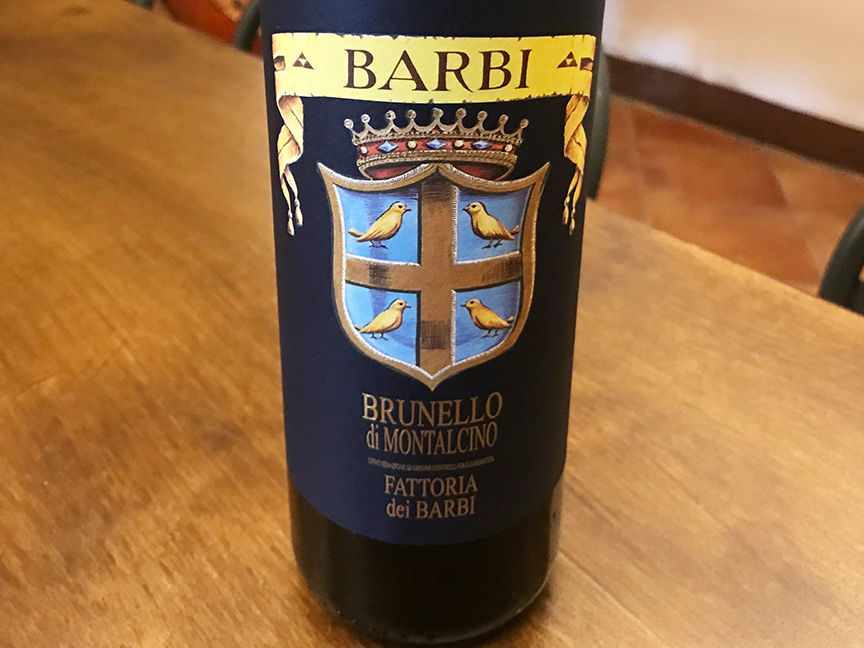
Above: the classic “blue label” Brunello di Montalcino from Fattoria dei Barbi. There’s nothing “normale” about it (full disclosure: I consult with Fattoria dei Barbi on media and marketing strategy).

    normal, adj. and n. Constituting or conforming to a type or standard; regular, usual, typical; ordinary, conventional. (The usual sense.)
    Etymology: < classical Latin normālis right-angled, in post-classical Latin also conforming to or governed by a rule (4th–5th cent.) < norma norma n. + -ālis -al suffix.
    Oxford English Dictionary

Let’s just get this straight for once and for all: there’s nothing normale about Brunello di Montalcino.

Nor is there anything normale about Barolo or Barbaresco.

Ever since Italian wine began “trending” in the U.S. in the late 1990s, wine professionals have been faced with a linguistic conundrum: if the “single-vineyard” or “reserve” bottling of a given wine is considered to be superior in both quality and value, what do you call the “blended” or non-designate wine?

Unfortunately, many American tradespeople adopted the practice of calling the latter categories “normal” or — or even more regrettably, using an erroneous and misguided cultural (mis)appropriation from the Italian — “normale.”

There are two major issues with this convention.

Above: the single-vineyard designate Brunello di Montalcino “Vigna del Fiore” from Fattoria dei Barbi.

The first is that normal means, quite literally, conventional or ordinary, as in doesn’t stand out in a crowd.

Brunello, like its northern counterparts Barolo and Barbaresco, are not “conventional” or “ordinary” wines. In fact, they are illustrious, exceptional wines, even when not accompanied by a cru or aging designation.

The second issue is that historically, the Italians who make them consider the blended wines to be the more expressive and reflective of the appellation where they are produced.

The same holds for the “riserva” or “reserve” designation. It’s not that it’s a better wine from better fruit. A riserva wine is a wine that was conceived, through vineyard selection and vinification techniques, for longer-term aging.

Many Americans will be surprised to learn that the cru-designate trend in Italian wine is relatively recent. And in many cases, the single-vineyard designation was added to appeal to American consumers who assume that the single-vineyard expression is superior de facto. The same could be said of vintage-designate wines in Champagne where the non-vintage, vintage-blended wines are considered (by the people who grow them) the more indicative of the domaine’s style and tradition.

Calling a classic Brunello (or Barolo or Barbaresco) “normale” is demeaning not only to the wine but also the winemaker and the people who live, work, and grow grapes in the appellation of origin. And it also creates confusion for the consumer.

And that’s why I encourage my wine trade fellows to call wines blended from more than one vineyard “classic.”

Whether classic, cru-designate, or reserve, these categories are simply different expressions of the appellation and the winery’s style. When it comes to the top wines for which we use them, there’s nothing normale about them.

On a mission from G-d: when a winery isn’t just a winery but a vital cultural institution and resource

Full disclosure: I consult with Antica Casa Scarpa on media and marketing strategy.

Last month, I spent the better part of a week “working the market,” as we say in the wine trade, with my friend and colleague Riikka Sukula, director of operations for Antica Casa Scarpa — or Scarpa as it’s known — in Monferrato.

Market work entails visiting current or prospective clients (known as “accounts”) accompanied by a locally based distributor and/or agent for the winery’s importer. It’s sometimes called a “ride-with” or “work-with.” And it can be as fun and exhilarating as it can be disappointing and monotonous.

As Riikka (above) and I made our way from wine shop to wine shop, restaurant to restaurant, to taste and chat with wine buyers, wine directors, and sommeliers, I had a light-bulb moment as I listened to her deliver her spiel about the winery and the wines.

Yes, Scarpa is a winery, a commercial enterprise, and the purpose and objective of our ride-with was to convince people to buy the wine.

But Scarpa is so much more than just a winery that merely grows, vinifies, and sells wines: as one of Italy’s oldest continuously running estates, it’s a genuine cultural institution and resource, a part of what the Italians like to call their “cultural patrimony” or heritage. Riikka and her colleagues, some of whom were my students at the Slow Food University of Gastronomic Sciences, aren’t just making and selling an agricultural product. They are protecting and giving new life to a cultural icon and benchmark that would otherwise be tragic to lose.
Continue reading

Apply for sponsored trip to Vinitaly. 30+ spots available. Food professionals encouraged to apply.

For more than four years, I’ve worked as a consultant with the Italy-America Chamber of Commerce Texas, located here in Houston. Currently, the Italian government ranks the Texas chamber as the number one chamber in the U.S. and the number five chamber in the world. I’m really proud of the work we do together and I am glad to share the following info here. See you in Verona in 2020!

Held in Verona, Vinitaly is the Italian wine industry’s trade show. It’s the largest and most important gathering of Italian-focused wine professionals each year.

More than 4,400 companies are expected to participate this year. And the organizers expect to present more than 400 events, including tastings and seminars with top producers.

And in recent years, the fair has also included an expansive food component featuring leading producers of cheeses, salumi, olive oils, vinegars, etc.

Click here to learn more about the fair, including travel and accommodation information.

As in years past, the Italy-America Chamber of Commerce Texas has 30+ sponsored spots available for wine and food buyers and professionals, importers, and distributors.

You must be a trade member to apply. Food professionals are also encouraged to submit an application. Anyone based in the U.S. is eligible to apply. 

Click here to receive an application form.

Specogna 2013 Picolit, a truly extraordinary wine we drank at Thanksgiving

One of the things that I’ve loved about living in Texas for the last decade has been how good the food is here.

I’m not talking about the vibrant, überhip food scenes here in Houston and in Austin (the latter, the city where we lived for the first six years of my time here). The food in Houston and Austin is nothing less than amazing and it’s been fantastic to be part of these emerging and now firmly established capitals of U.S. fine dining, food trucks, and gastronomy.

No, what I’m talking about is classic Texas and Louisiana cookery. In Texas in general, and especially here in southeast Texas where Tracie grew up and where we have lived for nearly six years now, people are into food. And they are particularly proud of local and familial food traditions, making for some damn-good eating during the holidays.

So I always set aside some special bottles for our family holiday get-togethers.

This year, it was this truly extraordinary bottle of Specogna 2013 Picolit from the Colli Orientali del Friuli appellation in northeasternmost Italy.

Picolit is a white grape that is used almost exclusively to make a highly coveted dessert wine. Part of the reason why it’s almost always made into a dried-grape wine is that the finicky Picolit vine “aborts” some of its clusters during the vegetative cycle. It literally abandons certain bunches, which never fully form on the plant, and concentrates its vigor into berries that will be markedly rich in aroma and flavor.

Specogna, one of my favorite Friulian growers and winemakers, goes for extreme balance and restraint in their Picolit. This gorgeous wine — beautiful to look at and to taste — clocked in at a lithe 13 percent alcohol. Its vibrant acidity was present and popping on the palate but perfectly balanced. And its layers and layers of flavors were as nuanced as they were persistent in the finish. In many ways the rich finish was the highlight (as you followed it with a bite of pie).

My roommate from my junior year in college in Italy (my first year studying abroad) brought this wine to our home as gift when he came to visit earlier this year. I feel truly fortunate to have such a great friend, bearing such an extraordinary wine! Thanks again, Steve: it was the perfect wine to open at our Thanksgiving meal. What a wine!

Here’s some of what we ate as part of our southeast Texas Thanksgiving this year.

Boudin balls. Crumbled boudin, a rice and pork sausage, breaded and fried (very heavy but man, this is an amazing dish).

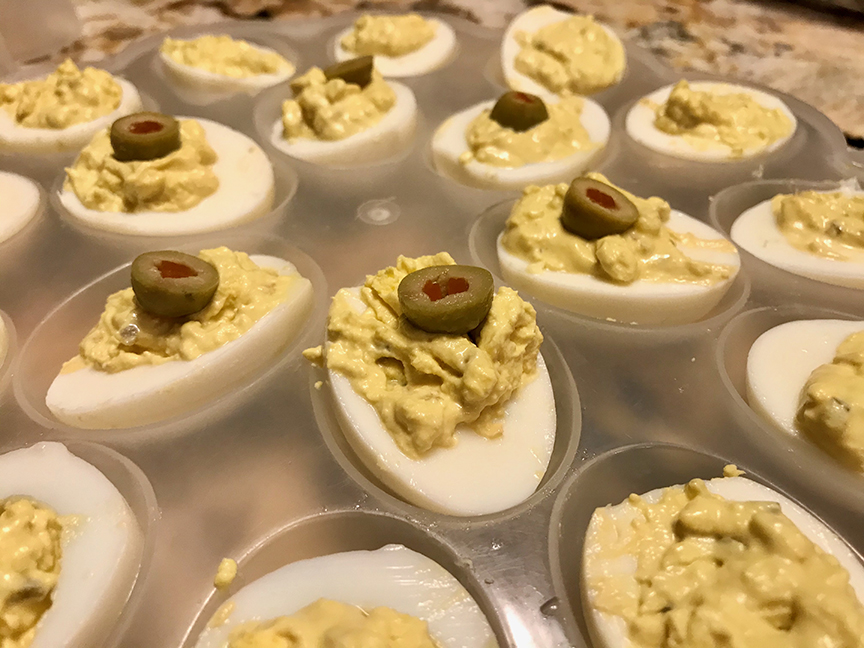
Memaw’s deviled eggs are one of my favorites (memaw means grandma in southeast Texan; Tra’s memaw, Violet Branch, is 98 years old!).
Continue reading